“backstage w/us are the zz top guys – pretty happening for me cuz I saw them in the early-middle 70s and really dug their third and fourth albums big time, really fucking BIG time – I loved them and they were my kind of power trio in those days, my favorite. you know, when I do interviews about bass I’m thinking now I don’t give enough credit to dusty roads cuz I learned tons from him. I’m gonna make that right. I get to talk some w/frank beard, the drummerman – what a very nice guy. so is mr dusty, man, he is something. his fingers are kind of small, like thumbs but man, he can work a bass like no one’s business. he is very kind to me too. what nice cats….
“….I go watch most of their gig – their basshelperman, pulls up a case me to sit on and even gives me a dusty roads pick though I only see him use fingers the whole gig. he’s a great singer too though mr billy does must of it, they do a lot together also. mr billy’s an incredible guitarist and mr frank is really grooving – them all playing together is really something else. wow. I played a telecaster bass in the later minutemen days cuz I finally found one and I could play like mr dusty. now I got to see him work it up close – crimony! they get done and I tell him “much respect” even start foaming some but work hard to hold it back. he is very gracious. I talk to mr frank and he’s also very gracious – I saw him watch our whole gig – he says he dug the stooges show said “it was mach twenty the whole way!” mr billy goes talk to him and I thank him, also he’s big time gracious – they’re all so nice to me. I told mr frank about seeing them in my teen years – I tell him and mr billy I’m an old punk but they put HUGE influence in me and d. boon – why we wanted to be a powertrio, more than cream – be more like them w/their mic stands up there real close together.”
The Ganzfeld Technique or the Poor Man’s Sensory Deprivation Tank
Tools required : 2 ping pong balls sharp scissors or knife headphones an am/fm radio or a suitable recording of white noise a drawing pad and pencil
As a child I could spend many content hours studying the whorls and curlicues in the wood grain of my bedroom door. The arabesque patterns needed only the smallest prompting from my imagination to take on a fecund life of their own and blossom into a fantastic bestiary of mercurial faces and creatures, dragons, imps and gnomic animal heads, each knot of wood providing one eye. How easy it was to slip into the realm of pure imagination then; I practiced the art of daydreaming continuously in the classroom, grades k-8! Some might say this ability, to see forms amidst randomness, is only easily accessed with the imagination of childhood, but I propose this skill is still available to one and all—as adults we simply must approach the realm of the fantastic with a bit more intent. We must make the effort to clear away the clutter of the everyday mundane.
The Ganzfeld effect is one of easiest, quickest, and simplest methods for scrying that I have ever come across. Although it was originally developed for use in Gestalt psychology in the 1930s, and then used mainly in ESP research in the 1970s, its simplicity makes it perfect for our purposes of using it as a pattern generator for practicing Pareidolia.
[Pareidolia: the art of seeing something where there is “nothing.” Animals in the clouds, a man in the moon, Jesus on a tortilla, etc.—widely recognized as a sign of psychosis, and indeed many of the topics we shall discuss here are precisely that—a carefully modulated means of producing lucid madness. (In other words, depending upon the fragility/rigidity of yr own super-ego, proceed w/ these experiments at your own risk!).]
The images available to us with this technique are invaluable—Leonardo Da Vinci himself was a fan of the method.
You should look at certain walls stained with damp or at stones of uneven colour. If you have to invent some setting you will be able to see in these the likeness of divine landscapes, adorned with mountains, ruins, rocks, woods, great plains, hills and valleys in great variety; and then again you will see there battles and strange figures in violent action, expressions of faces and clothes and an infinity of things which you will be able to reduce to their complete and proper forms. In such walls the same thing happens as in the sound of bells, in whose strokes you may find every named word which you can imagine.
Recipe: Take two ping pong balls and cut them in half; you will need two since they tend to have a small logo on one side, and you just want the blank half of the ping pong ball. Begin by cutting the ball in half. You can use a razor or penknife. They cut easily along the seam. The only other requirements are some headphones and white noise. You can use a radio tuned to a dead station, but be careful to avoid picking up bits of interference from stations, as well as EVP. I have come to rely on a free iPhone app called White Noise lite, but you could use pretty much any white noise source—a fan in the background, a passing rainstorm, etc. The idea is simply to block out the usual sonic distractions. You could also fashion a way to hold the ping pong balls in place, tape for example, although I have found that leaning back in a comfortable recliner or a field of grass works fine. Once you have the “goggles” & white noise ready to go, then congratulations, you have constructed a fully portable and efficient miniature sensory deprivation kit!
Now try them on, kick back, and let your subconscious get rolling. Be patient, because nothing usually happens for the first 15 minutes or so. Soon a flowing series of imagery will coalesce out of the static. Your brain is expecting to hear and see stuff because you are still taking in noise and the visual stimuli of a light source. Eventually it will begin creating images to make up for the lack of stimula. Note that in the original experiments red light was used. I have not found this necessary, but a rear bike light makes for a great ad hoc red light source if you want to try that.
I believe this to be one of the most elementary/introductory means for scrying. Later on we will address more advanced methods—such as reading tea leaves, or my personal favorite, Ornithomancy—but for now take some time to familiarize yourself with the feeling of turning off the ego and seeing what the rest of your brain is up to. Be receptive to the images that float to the surface, mold them gently; they are like downy feathers on the surface of a pond and the slightest disturbance will send them reeling. I recommend that for this exercise you don’t worry about trying to verbalize anything, but DO keep a pencil and sketch pad handy to capture any interesting imagery you experience.
I have appropriated this technique from its original usage in parapsychology. The Ganzfeld technique comes to us from Gestalt psychologist Wolfgang Metzger’s studies in the 1920’s on the perception of a homogenous visual field. Ganzfeld being from the German for “entire field”. The most well-known Ganzfeld experiments were conducted at the Maimonides Medical Center in the 70s by Charles Honorton as a means of investigating ESP. In these experiments the person on the receiving end of the telepathy experiment would enter into the mild sensory deprivation of the Ganzfeld technique for about half an hour at a time, while the sender would focus on a randomly chosen target image. No doubt this means was also chosen as a way to combat cheating. Hornorton reported a statistically significant success rate (achieving 32% rather than the chance probability hit of 25%). For our purposes here, the effectiveness of the Ganzfeld as a means of telepathy is beside the point. If anything we intend to use this technique in a manner more aligned with its Gestalt origins, a holistic mode of psychology with roots in the ideas of Goethe, a truly original and holistic thinker, in many regards the first modern or last classic great Magus.
In case I still haven’t convinced you to give this a serious whirl, here is a teaser; the myriad riches available by staring at our own brains, as it were, are reminiscent of the epiphany Flaubert ascribes to his hero in The Temptation of St. Anthony where, at the end of the book, the saint peering into an ocean tide pool, experiences a rush of Pareidola stimulated by the brack and flotsam of the cradle of life itself:
A phosphorescence gleams around the whiskers of seals and the scales of fish. Urchins revolve like wheels, horns of Ammon uncoil like cables, oysters set their hinges creaking . . . Vegetable and animal can now no longer be distinguished. Polyparies looking like sycamores have arms on their boughs. Antony thinks he sees a caterpillar between two leaves; but a butterfly takes off. He is about to step on a pebble; a grey grasshopper leaps up. Insects resembling rose-petals adorn a bush; the remains of may-flies form a snowy layer on the ground. And then the plants become confused with the rocks. Stones are similar to brains, stalactites to nipples, iron flower to tapestries ornate with figures. In fragments of ice he perceives efflorescences, imprints of shrubs and shells – so that he hardly knows whether these are the imprints of the things, or the things themselves. Diamonds gleam like eyes, minerals pulsate. And he no longer feels any fear! He lies flat on his stomach, leaning on both elbows; and holding his breath, he watches.
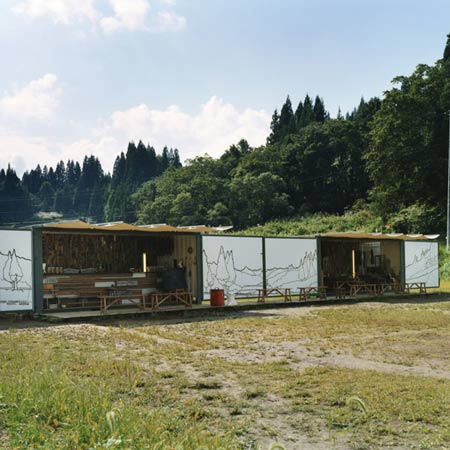
Japanese landscape design studio EARTHSCAPE have created a giant travelling human-shaped herb garden.
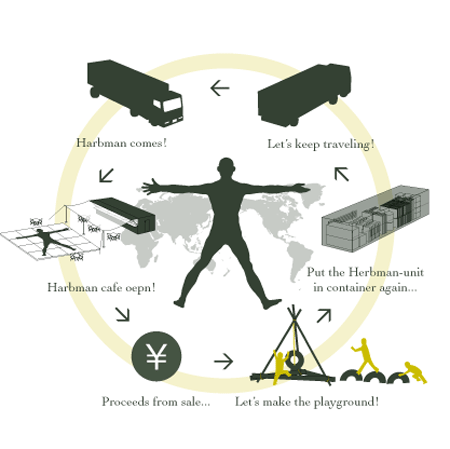
Called Medical Herbman Café Project (MHCP), the garden arrives in shipping containers which convert into a shop and cafe at each location. Herbs are planted according to the parts of the body they can benefit.
Here’s some text from Kobayashi:
“Herbman carries his trunk (the container) as he travels, bringing good health and giving dreams to children wherever he goes. This is the vision of our project. Herbman is a person-shaped herb garden. Various herbs are planted in this garden. Herbs are planted on Herbman’s body according to their effects: for example, herbs that aid digestion are planted in the stomach area, and herbs that work to relieve shoulder stiffness are planted in the shoulder area. In this way, Herbman acts as a kind of herb dictionary. Just by looking at Herbman, people can learn which herbs work for their trouble spots. We also plant herbs that grow naturally in the locale, so that our herbs are constantly changing, and a site-specific Herbman is born in each locale.”
E*Rock just dropped off Audio Dregs’ latest release, ROTFLOL, a LP of music and DVD of animations and videos from Paper Rad’s Jacob Ciocci. I’d seen the videos projected at various shows in the past but I must say I had a great time rediscovering all the hyper details and sounds watching the DVD at home. — Jason Leivian
Ciocci’s music and art, along with Paper Rad’s monumental output, have been (to say the least) highly influential on a younger generation of artists and musicians. ROTFLOL is a “best of” collection of Jacob’s solo music from the past decade, soundtracks from videos and animations, as well as a selected discography of self released cassettes, hand made CDRs, 7 inch vinyl, and live recordings. The music is often composed in ACII, blasted through a series of vintage Casio keyboards and budget electronics, recorded in real time and captured onto rainbow-colored floppy discs before being mixed down to digibeta, for that perfect sound. This collection is an attempt to collect this musical output as its own musical statement on vinyl LP, along with a full DVD of selected video works (some classics, such as the Peace Tape, and some yet unseen face melters) as well as a digital download including over an hours worth of “bonus tracks”.
A long cut of primo California psych damage from California’s International Hello, featuring former members of the legendary Monoshock. Available on their new self-titled debut LP, out now from Holy Mountain of Portland, Oregon. Yes!





 Arthur Magazine
