

Author Archives for Jay Babcock
THEY WERE AFRIRAMPO, by Oliver Hall (Arthur, 2005)
Originally published with photography and design by W.T. Nelson in Arthur No. 18 (Sept. 2005)
They Are Afrirampo
Oliver Hall encounters Osaka’s number one freedom paradise rock duo.
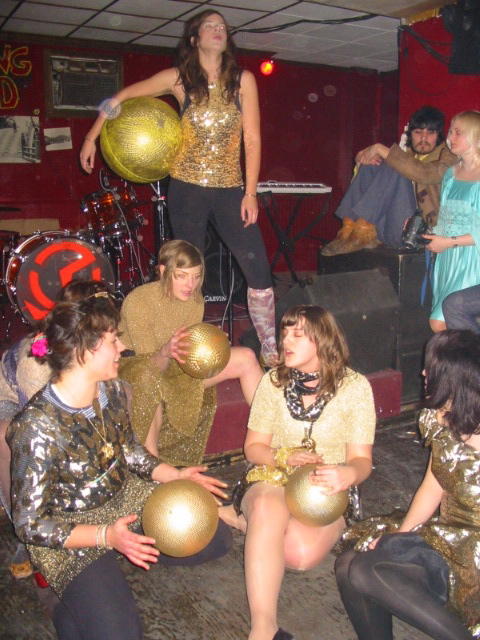
When Oni and Pikachu arrived at the Smell in downtown Los Angeles there was nothing about them that suggested the powers they would soon deploy on stage. Certain performers have a way of carrying themselves in venues that tells you not to approach them unless you have something important to say about the sound system or how many drink tickets they get, and Afrirampo, despite looking road-weary, and dressed down in floral prints with naked faces, held themselves with that kind of authority. Not that it stopped (male) fans from approaching the two, or the band from receiving them graciously. But they did not look like the creatures you’d expect to see after reading any of their press: sex demons, noise futurists, musical athletes, punk sibyls who, when asked for their favorite three albums of all time responded, “1. AFRIRAMPO 2.AFRIRAMPO 3. AFRIRAMPO”. . .
Here is the description of Afrirampo on the band’s website:
young Japanese girls rock duo from Osaka JAPAN!
Naked rock!!!!! Naked soul!!! Red red strong red dress!! Freeeeeeeeedam
paradice rock! Jump! With improvisation.
Sooo fantastic & wild performance!
Afrirampo’s recording career began with A (not to be confused with A’, presumably to be read “A-prime,” a collection of early recordings), a shrieking garage-thrash record with guitar, drums and two girl voices; if the music on this record has any antecedents, it’s the startling moments of weirdness and the playful, conspiratorial spirit of the ealry ‘80s Swiss female punk band Kleenex/LiLiPUT, who, like Afrirampo, enjoyed letting music wreak havoc with familiar vowels. Afrirampo’s latest release, Kore Ga Mayaku Da on John Zorn’s Tzadik Records, is similarly playful but more elaborate and scary, like classical theater. I interviewed them around the corner from the Smell, before they were in costume and makeup; a little over an hour later, their set came to a close with the crowd bearing Pikachu from the stage to the front door as Oni took over the drums and sang Sayonara! Sayonara!
My intention was to interview Afrirampo at the bar behind the Smell on Main, but as we turned from Harlem Alley onto Third Street, Oni exclaimed, “Japanese food!” They had identified something that would relieve their homesickness: a plain burger restaurant with a marquee-style menu behind the counter, sparsely decorated with objects whose strangeness I wouldn’t have noticed if Oni had not been so taken with them.
“I like frogs,” she said, pointing to the giant ceramic vase in the shape of two frogs on the counter. There were plastic pieces of fruit spread out like a rebus on the shelves in one wall and a painting of two ballerinas in a dance studio hung opposite.
“Looks like Japanese,” said Pikachu.
“European,” said Oni. They seem to contradict each other often in conversation in this breezy way, just as one of them will suddenly, frighteningly take over a song in the middle of a performance. When I asked them how music in Japan, especially in their hometown Osaka, is different from music in America, Pikachu frowned, “It’s the same!” “Very different,” said Oni. “Especially in Osaka, like underground scene? Noise? Strong, and also more deep, especially in Osaka, for now. Interesting, more than America.”
Oni seems to love the words “strong” and “deep,” referring, for example, to Keiji Haino, Acid Mothers Temple and the older generation of out Japanese musicians they’ve played with as “deep, deep, crazy old guys.” Despite these connections, Afrirampo does not see itself as a noise band. When I tried to argue that American noise aesthetics have more in common with Japanese noise’s love of pure sound than the conceptual abstractions of European, industrial noise, they seemed to think I am calling them a noise band.
“Not only noise music,” said Oni.
“Actually, not noise music,” said Pikachu.
“Strange music,” said Ono.
“I want to know more about strange music of America,” said Pikachu.
Continue readingWHEN GOOD PRANKSTERS GO CHRISTIAN: Christopher Noxon on the L.A. Cacophony Society (Arthur, 2003)
Originally published in Arthur No. 6 (Sept. 2003)
When Good Pranksters Go Christian
For years, the L.A. Cacophony Society was a haven for creative misfits with a sense of humor. Then tragedy struck, and everything changed.
By Christopher Noxon
Photography by Jack Gould
A new product appears on the shelves of a Los Angeles toy store. It’s a stuffed white teddy bear, sweet and fluffy and unremarkable but for one thing: It’s filled with concrete. The bear’s name, the label announces, is “Cement Cuddler.” A warning is attached: “Unfortunate child, do not mistake me for a living thing, nor seek in me the warmth denied you by your parents. For beneath my plush surface lies a hardness as impervious and unforgiving as this world’s own indifference to your mortal struggle.” Baffled clerks quickly remove the item.
A bus traveling through the Mission District of San Francisco pulls to a stop and picks up a man in a purple wig, pancake makeup and a polka dot jumpsuit. He takes a seat and flips open a newspaper. At the next stop, a woman wearing a rubber nose and carrying a toy poodle pays her fare and plops down with a sigh. Another clown climbs aboard at the next stop, and the one after that, the bus gradually filling up with men and women in full clown costumes, each apparently unaware of the others.
A knot of spectators gathers at the 22-mile mark of the Los Angeles Marathon. Others along the route flash thumbs-up signs and offer hoots of encouragement, but this group has other things in mind. As the weary athletes pass, they offer malt liquor, lap dances, donuts, pork rinds, and lit cigarettes, which they call “sport smokes.” One holds a sign: just give up.
Such are the works of the Cacophony Society, a loose group of art pranksters and satirists based in San Francisco and active in Los Angeles, Brooklyn and 20 other cities in the U.S. and Canada. Members don’t join for God or profit or art or politics. They join for what they call “the pursuit of experiences beyond the mainstream,” which translates as elaborate pranks and public spectacles that, just for a moment, tear the fabric of everyday life.
The Los Angeles chapter is among the most active of Cacophony’s “lodges,” organizing more than 500 public stunts and nonsensical spectacles since 1991. You might have spotted them outside the Academy Awards, picketing for more onscreen male nudity. A week later, the same group hosted a “yard sale from hell” in which customers pawed through bottles of expired prescription drugs and mud sculptures. A few years ago the Cacophonists filled four charter buses with 200 drunken revelers dressed in Santa costumes and made a stop at a holiday display sponsored by the Church of Scientology. After heckling the costumed elves, juggling the prop presents and yanking Scientologist Santa’s beard, the red-suited mob retreated to the bus and peeled away.
In certain counter-culture circles, Cacophonists are modern day Masons, mixing social activism with acts of goofy public exhibitionism. Los Angeles membership hovers around 200, with a core “strike force” of 40 including a Jet Propulsion Laboratory engineer, a guy who removes dead animals from under houses, and a number of semi-employed artists, punks, eBay merchants, and dot-com casualties. Among these assorted malcontents, Cacophony has fostered something approaching contentment. “When I was growing up, I was always called immature or crazy or strange,” says Michael Perrick, a Web site designer who performs as a party clown called Fucko. “I was told I’d never have a normal life. Then I met these people who, when I said, ‘I want to run down the street naked and covered in mud,’ they wouldn’t bat an eye. Someone would grab a camera and say ‘Let’s go.'”
The group also attracts weekend eccentrics who use Cacophony as a way to safely dip their toes in the underground while remaining on solid footing in their everyday lives. What’s unusual is that no one appears to dwell on–or even make–distinctions between the full-time freaks and the recreational ones, says TV writer Michael Perry, who has fallen in and out of Cacophony between stints on Law & Order, NYPD Blue and The Practice. “I have no idea what most people in Cacophony do for jobs, and they know nothing of what I do for a job, and that’s kind of great,” Perry says. “L.A. can be so craven and horrible, and here there’s none of the corporate cultural element that blinds you to the actual possibilities of life.” (Perry helped organize a “JFK assassins reunion,” in which participants came costumed as their favorite suspect – for one night a dingy downtown bar was overrun by mob bosses, CIA agents, Cuban revolutionaries, and a communist bear. The evening ended with the messy detonation of a papier-mache JFK head.)
* * *
I first encountered Cacophony six years ago when I took some out-of-town friends to a Halloween haunted house in the flats of East Hollywood. Our friends were visiting from Sonoma, where they collect vintage wine and grow organic vegetables. Stepping inside, we were greeted by a man wrapped in cellophane fondling a length of sausage between his legs. Nearby was a fellow in a blood-drenched butcher’s smock and a plastic baby mask. On the walls were pages torn from fat-fetish porn magazines. Exiting the room required passing through a curtain of beef tongues. By the time it was over, we’d been flashed by a woman in a Mother Teresa costume, offered pieces of Spam sushi, and witnessed a guy in surgical blues remove with a vacuum cleaner the viscera of a man lying on a gurney.
Back on the sidewalk, my friend the earth mother looked up from her blood-splattered blouse and smiled brightly. “That sure was more interesting than the Getty Center.”
Over the next few years I stopped by several more Cacophony events, including a screening of hygiene movies and the bonfire of a member’s personal belongings on a beach below the runway of Los Angeles International Airport. Some of the events seemed anti-consumerist, others purely obnoxious. Cacophonists walked the finest of lines, of constantly being in on the joke but playing as if they weren’t. When I first started talking to Cacophonists I found I didn’t know when they were being serious. A few months later, I realized that most of the time, they don’t know when they’re being serious.
Then about two years ago, the simmer of insincerity boiled over. Over the course of a few weeks, the group was consumed by an escalating series of in-jokes, put-ons, half-truths, and one shocking tragedy. Members who had become so adept at mocking the mainstream found their attention turned on themselves, as they traded threats of lawsuits, rumors of resurrections, and then, suddenly, grief over the mysterious and utterly unfunny death of one of their own.
What had seemed funny for so long was suddenly very sad.
* * *
Arthur Radio Transmission #21 w/ Thomas (Ted) Rees
Excerpt from “filth-scape,” a manuscript of poetry by Thomas (Ted) Rees:
The Fence Dream
Goes like this: God is a burglar rob you straight out of the womb. Yes, God is a burglar rob you straight out of the womb. Oh, God is a burglar rob you out too soon and drops you on a wide boulevard. Air is full of money, collapsing coarseness. The new agora strokes your nipples and laces its fingers through your belt loops. Resulting constancy of blue balls drives the pursuit of plasticity, solace. You walk, electricity caresses every step, blink, a new sensation of blankness. As touch screens don’t touch back. Visibility is created by wallet thickness and frequency of use, so no one can see your body as you meander. Burgled of corporeality, you sense a smile on your unseeable visage. Beyond the city, another, never-wavering polis of compulsory paper-shuffling, turning in on itself. Praise the world’s pollyanna for gifting you, unseen. See.

STREAM IT: [audio:http://www.arthurmag.com/magpie/wp-content/uploads/2010/06/Arthur-Radio-Transmission-21-6-13-2010.mp3%5D
DOWNLOAD: Arthur Radio Transmission #21 w/ Thomas (Ted) Rees 6-13-2010
This week’s playlist…
Continue reading
C & D review records with Buzz Osborne (Melvins), from Arthur No. 30 (July 2008)
From Arthur Magazine No. 30 (July 2008)
Two dudes, who remain pseudonymous for their own protection, reason together about new records. They are joined this issue by Melvins’ BUZZ OSBORNE, pictured below at Arthur HQ with his pick o’ this issue’s litter…

ENDLESS BOOGIE
Focus Level
(No Quarter)
D: [listening to opening bomber] He’s inviting us over to smoke “figs” in his yard. Is that a misprint?
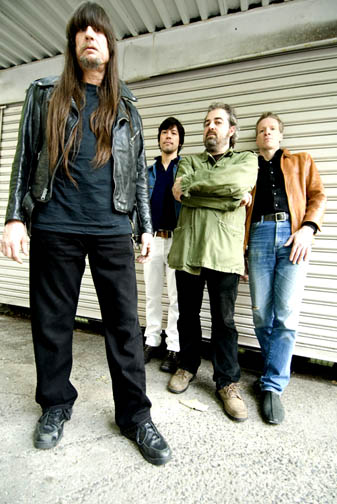
C: [pointing at band photograph] They’re in the backyard because these guys are too old too be smokin’ in the boys’ room. Another in a great history of smoking location songs.
D: That could be a Bob Dylan Theme Time Radio Hour!
C: And invitation songs. Remember that Paul Wine Jones song? “Me and the boys/gonna have a good time tonight/Gonna play some poker/Pork chops.” I miss Paul Jones. That guy rocked and had velvet hats to burn. Not that you should ever burn a velvet hat.
D: [musing over band photo, especially the longhair] What does that guy do all day?
C: When not masquerading as a hick savant guarding mama’s moonshine still? Apparently he’s one of the deepest psych record collectors on the East Coast.
D: [looking at band picture again] I would say he’s one of the top hair growers on the East Coast!
C: Endless hair never ends. Seriously though, a band like this only needs one True Believer. And this guy definitely qualifies, let me tell you!
D: [listening to singer squeal, squawk, mutter and grunt on “The Manly Vibe”] Brings back fond memories of Hasil Adkins talking about hot dogs and doing the hunch.
C: Yeah, if Hasil dug the Nuge instead of the King. This album is for everyone who’s ever thought George Thorogood didn’t finish the job.
D: [abruptly] Or that the Kings of Leon aren’t old enough!
C: … Anyways, I saw these guys play last week.
D: Well of the course the question is, Can they boogie endlessly?
C: Yes, they are quite capable, these Endless Boogiemen. And after the first song, which lasted about two and a half hours, the singer asked “Do I seem taller? I got some new shoes!” Where’d you get ‘em? somebody yelled. “He took a few seconds, and then answered: “I bought ’em at a store!” They’ve got cool t-shirts: just an infinity sign on black.
D: Can you understand what he’s singing?
C: He’s singing in tongues. This song is called “Steak Rock.” Which is about right. I bet the song is timed so that you can cook a steak in the amount of time it takes to listen to it. So where’s the barbecue at?
D: Not in my backyard, sadly.
C: This record should come with an order of peach cobbler.
D: [helpfully] And napkins!
C: …
D: [doorbell rings] We have a guest.
[Enter Melvins vocalist/guitarist Buzz “King Buzzo” Osborne]
Buzz: Gentlemen.
Continue readingThurs June 24, Joshua Tree, CA: Arthur presents LEXIE MOUNTAIN BOYS at Starlite Courtyard (free, outdoors, all-ages)

Arthur Magazine and Mt. Fuji General Store present
LEXIE MOUNTAIN BOYS
Thursday June 24
8:30pm
at the Starlite Courtyard
outside Mt. Fuji General Store
61740C 29 Palms Hwy
Joshua Tree, California
760-333-9174
Free * All ages welcome
Hot off a tour as handpicked openers for Matmos, Baltimore’s experimental all-female a capella performance mob Lexie Mountain Boys make their High Desert debut TONIGHT outdoors in the Starlite Courtyard in downtown Joshua Tree, California in a FREE FREE FREE, pass-the-hat event. All ages are welcome. No two Lexie Mountain Boys performances are alike so please arrive on-time and be appropriately prepared to witness one of the most notorious acts to come out of Baltimore’s internationally renowned underground arts scene.
The Lexies have performed as St Augustine’s Tower (London), The New Museum (NY), The Rohsska Museet (Gothenberg SE), The Baltimore Museum of Art, and more. Their full-length CD “Sacred Vacation” was recorded in a Baltimore church by Wye Oak’s Andy Stack, and released on Carpark Records, also home to Dan Deacon & Animal Collective.
Lexie herself is also a member of the Crazy Dreams Band.
More Lexie Mountain Boys:
myspace
Facebook
New rock n roll: ENDLESS BOOGIE "Pack Your Bags"
Stream:[audio:http://www.arthurmag.com/magpie/wp-content/uploads/2010/06/06-Pack-Your-Bags.mp3%5D
Download: “Pack Your Bags” — Endless Boogie (mp3)
It is our pleasure to present this eight-minute deep cut off Arthur office faves ENDLESS BOOGIE’s forthcoming second album, Full House Head (ahem), out July 20 on vinyl and digital formats from No Quarter Records of New York City. Pre-order by sending money directly to them here.

Byron Coley and Thurston Moore's "Bull Tongue" column from Arthur No. 31 (Oct 08)
BULL TONGUE
by Byron Coley and Thurston Moore
from Arthur No. 31 (Oct 2008) [available from Arthur Store]
Best thing of this issue, perhaps of this year, this decade, this whatever, is Where Demented Wented: The Art and Comics of Rory Hayes by Dan Nadel and Glenn Bray (Fantagraphics). The late Rory Hayes has long been known amongst certain heads as the most insanely primitive and thoroughly unfettered of the ’60s underground cartoonists. His own titles included the Bogeyman series, Cunt Comics and various anthologies. Long obscure, a good bit of his work was collected into a bootleg in the late ’80s called Come Here, Bear (or something similar), but this is the first authorized anthology of his work and it includes some wild unpublished material, a solid historical essay by the Savage Pencil, a lovely piece by Rory’s brother, Geoffrey, and an interview with Rory himself. This stuff’s not for everyone, but if your brain bends far enough, you’ll be able to let Hayes’ art all the way in.

Word is out on The Hospitals’ new self-released LP Hairdryer Peace. It sounds nothing or everything plus so much more than anything they’ve ever committed to wax. Truth of the matter is it lives up to the hype of being the most goddamn killer brain-snaggling rock n roll noise fucked LP we’ve had in a long time. Essential garage-fuzz meets cassette-fi noise huzz meets harry 1/2 jap velvets pussy skum love. Wipe off yr dick and scam this sput now. Seriously boss.
Three out of absolutely nowhere cassette releases that are as sexy as a tanqueray & tonic-buzzed fuckbuddy. #1 is Angels In America with their Cunt Tree Grammar tape which oozes primordial no wave guitar and bored/stoned femme vox glug. Someone turn this into an LP—hey, maybe we will! #2 is The Death Convention Singers with their Corrido cassette (sick sick sick)—we thinks they come from this kind of new nutzo neue-New Mexican scene heralded by the Sick Sick Sick label. It has been written they were some kinda demented a capella scum chorale but this tape is most notably not THAT—what it is is 0-fi guitar junk drone and it plays in a raw and involving deliciousness. #3 is Nebulosis, the first release on the Celebrity Sex Tapes label by a new Ohio (most likely Columbus) long tone drone animal called Fairy of Eagle Nebula who is an exciting addition to the wild contempo legacy Ohio has been so effortlessly displaying the last few years. Unlike most of that zone’s more synth classicist exercises this is guitar/amp huzz and howl in a desperate grey-screen scree. Three sweet teets to be snuggled, me mates.
ALECHEMY

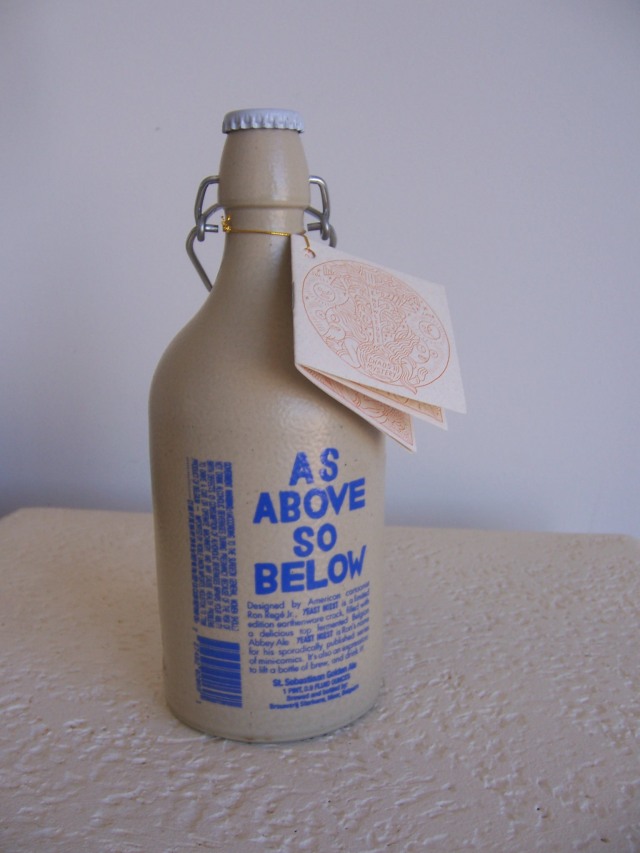
Fat Rabbit Bajada Lodge visitors Sam, cartoonist Ron Regé, Jr. and Tim Leanse display their house gift: the 15th edition of Ron’s “Yeast Hoist” comics series, “Kept in Balance by Equal Weights,” an eight-page alchemy zine that hangs from the neck of a reusable earthenware bottle filled with 16.9 ounces of a Belgian Abbey Ale! Sam and Tim roped the whole thing together. Right now the only place you can get one is from Whole Foods’ flagship store in Austin, Texas, but that should change soon. More info…
LIKE THEY DO IN ALASKA
from : http://spectregroup.wordpress.com/2010/06/17/like-they-do-in-alaska/

How to Calculate Your Resource Wealth
http://apfc.org/home/Content/dividend/dividend.cfm
http://pfd.alaska.gov/faqs/index.aspx
http://iraqdividend.com/alaska_dividend/
“The Alaska dividend, which Hammond helped create while governor, is “an existing basic income guarantee in the world today. Without a permanent fund dividend program,” Hammond said. “Alaska will face the same fate as Nigeria.” There, the World Bank estimates that $296 billion flowed in and out of the government’s treasury during its oil boom, “leaving them worse off than they were before,” Hammond said. The pattern has been repeated around the globe where countries have come into an oil windfall, he said. “Iraq is but the latest example. What better way to induce a capitalistic, democratic mindset among Iraqis? Far better than a few privileged kleptocrats living in opulent splendor while others grovel in squalor,” Hammond said. In Iraq, the economist Smith recommended following Alaska’s precedent but avoiding Alaska’s mistakes, Hammond noted. Those mistakes were two-fold: Not putting all public resource wealth into the fund, and not reserving the income solely for dividends unless approved by a vote of the people. “Public resources should belong directly to the public through mechanisms such as Alaska’s permanent fund … It is a model governments all over the world would be well-advised to copy.”

or Brazil
http://widerquist.com/karl/Suplicy-Interview.htm
http://adn.com/2008/08/09/488420/pfd-rebate-pack-a-punch.html
“The Brazilian National Congress approved Law 10.835 that institutes an unconditional Citizen’s Basic Income, sanctioned by President Luiz Inácio Lula da Silva in January 8, 2004. The law says that it will be established step-by-step, starting with those most in need, until the day when everyone in Brazil will have that right. Everyone in Brazil, including the foreigners living here for more than five years, regardless his/her social or economic condition, will receive R$ 40 per month. In a family with six members, the total will be R$ 240. With the progress of the country, this amount will be raised, we shall say to R$ 100, someday to R$ 500, R$ 1,000 and so on. It will not be denied to anybody. It will be unconditional.”

Step One : Locate Resources
http://afghanistan.cr.usgs.gov/airborne.php
http://independent.co.uk/news/world/asia/afghanistans-resources-could-make-it-the-richest-mining-region-on-earth-2000507.html
“The sheer size of the deposits – including copper, gold, iron and cobalt as well as vast amounts of lithium, a key component in batteries of Western lifestyle staples such as laptops and BlackBerrys – holds out the possibility that Afghanistan, ravaged by decades of conflict, might become one of the most important and lucrative centres of mining in the world. According to a Pentagon memo, Afghanistan could become the “Saudi Arabia of lithium”, with one location in Ghazni province showing the potential to compete with Bolivia, which, until now, held half the known world reserves.”

Determine True Costs
http://seattlepi.com/specials/mining/26875_mine11.shtml
“Gold, silver, platinum and other precious metals for free. Land for $5 an acre or less. It’s pretty much the same deal miners have had for 129 years, ever since Congress approved the General Mining Law in 1872. Modern mining methods have left the West pockmarked by huge craters, some so large that they are visible from space. Under terms of the antiquated law, miners cart away everything from gold to kitty litter from public lands — minerals worth about $11 billion in the last eight years alone. Not only does the U.S. Treasury get nothing, Congress has granted miners a tax break worth an estimated $823 million in the coming decade. Over the years, public lands the size of Connecticut have been made private under terms of the 1872 law, all for $2.50 to $5 an acre, though not all of it has been used for mining. Like the better-known Homestead Act, which offered free land to anyone willing to farm it, the mining law was intended as an incentive to those willing to push West and settle the frontier. That frontier was closed long ago, but the mining law remains on the books and very much in use. Not all critics of the 1872 law call for reform because of environmental damage. Some are galled by the fact that the law, breaking with tradition, allows miners to dig a fortune from public land without giving a share to the American citizens who own it. In 1920, Congress removed oil, natural gas and other minerals that could be used for fuel from the 1872 Mining Law. Instead, the government would lease the rights. And in 1977, Congress decreed that miners of coal on federal land would have to pay a royalty of 8 to 12.5 percent, and clean up after themselves. The government in the past decade has collected $11.08 billion from companies taking coal, oil, and natural gas, plus $35.8 billion in rents, bonuses, royalties and escrow payments for offshore oil and gas reserves. Still, hard-rock miners pay nothing for the gold, silver, platinum, copper and other minerals they get. Walish, the manager of Cambior’s Top of the World project, joins many in the mining industry in warning, “If massive royalties are put on federal land, you’re going to see a lot less mining.”

Distribute Equally
http://nytimes.com/2003/09/10/world/struggle-for-iraq-iraq-s-wealth-popular-idea-give-oil-money-people-rather-than.html
“The notion of diverting oil wealth directly to citizens, perhaps through annual payments like Alaska’s, has become that political rarity: a wonky idea with mass appeal, from the laborers in Tayeran Square to Iraq’s leaders. American officials have projected that a properly functioning oil industry in Iraq will generate $15 billion to $20 billion a year, enough to give every Iraqi adult roughly $1,000, which is half the annual salary of a middle-class worker. ”A fund like Alaska’s is the best way to prevent one kleptocracy from succeeding another in Iraq,” Mr. Clemons said. ”It would go a long way to curbing the cynical belief that Americans want Iraqi oil for themselves, and it would give more Iraqis a stake in the success of their new country. It would be the equivalent of redistributing land to Japanese farmers after World War II, which was the single most important democratizing reform during the American occupation.” Thomas I. Palley, an economist at the Open Society Institute, proposed dividing a quarter of the oil revenue each year among all adults in Iraq. Oil companies would not be directly affected by an oil fund, since they would be paying the same taxes and fees no matter what the government did with the money. But they could benefit indirectly if citizens eager for higher payments pressed the government to increase production and open the books to outside auditors. ”The oil industry likes working in countries with dedicated oil funds and transparent accounting, because there’s less loose money to corrupt the government. Corruption is bad for business,” Mr. West said, ”because it creates instability. In places like Alaska and Norway, people support the oil industry because they see the benefits. In places like Nigeria, they see all this wealth that doesn’t benefit them, and they start seizing oil terminals.”

Namibia Pilot Program
http://usbig.net/links.html
http://globalpolicy.org/home/211-development/48036-a-basic-income-program-in-otjivero.html
“Haarmann is talking about Namibia the way a doctor discusses a patient’s symptoms. “Here,” he says, scrolling through his statistics, “more than two-thirds of the population live on less than $1 a day. The basic income scheme,” says Haarmann, “doesn’t work like charity, but like a constitutional right.” Under the plan, every citizen, rich or poor, would be entitled to it starting at birth. There would be no poverty test, no conditions and, therefore no social bureaucracy. And no one would be told what he or she is permitted to do with the money. The concept is being discussed in many countries of the world. In Germany, it has gained the support of politicians across the political spectrum, including Dieter Althaus, the conservative governor of the eastern state of Thuringia, and businessmen like drugstore chain owner Götz Werner. More than 50,000 German citizens have signed a petition to the German parliament. The pilot project is taking place in Otjivero, a settlement of 1,000 inhabitants in a hot and dusty region 100 kilometers (62 miles) east of Windhoek. A few weeks ago, Dirk Haarmann published his annual report: economic activity in the village has grown by 10 percent, more people are paying tuition and doctors’ fees, health is improving and the crime rate is down. Only 3 percent of the gross domestic product, or €115 million, would be enough to provide a basic income for all Namibians.”
 Arthur Magazine