BLACK FLAG: A 12-Step Program in Self-Reliance, by Jay Babcock (LAWeekly, 2001)

A 12-Step Program in Self-Reliance
How L.A.’s hardcore pioneers BLACK FLAG made it through their early years

by Jay Babcock

Originally published in the June 28, 2001 LAWeekly

By midsummer 1981, when the then-unknown, now-notorious Henry Rollins joined Black Flag as its fourth singer, the South Bay–based punk band had already tasted some extremely hard-earned success. Despite a set of severe hurdles — from an initial difficulty in getting local club gigs and a record deal to sensational “punk violence!” coverage by the news media and constant harassment of both the band and its fans by police — Black Flag had managed to self-release three EPs, tour North America several times, and grow from playing to a couple of dozen people at a San Fernando Valley coffeehouse to headlining shows at the Santa Monica Civic and Olympic Auditorium.

Black Flag accomplished this by developing a do-it-yourself work and business ethic which, although common in jazz, rhythm & blues and folk circles for decades, was almost unique for American rock bands at the time. It was an ethic that was hugely effective, and one that would prove hugely influential over the next two decades.

But what’s ironic about the band’s current historical status as one of American punk rock’s original DIY pioneers — “They may well be the band that made the biggest difference,” says no less an authority than Fugazi’s Ian MacKaye — is that Black Flag’s original aspirations had nothing to do with building an alternate model to the existing music industry.

“The beginning and end of it was always working on the music,” says Black Flag founder, guitarist and chief songwriter Greg Ginn today. “The other stuff was very much at the periphery.”

As they tell it now, Ginn & Co. would have been quite content to let someone else handle the mundane trivialities of being recording artists and performers: the nuts and bolts of producing and releasing records, doing publicity and marketing, booking tours, handling legal matters, lugging equipment, etc. Black Flag would play while others would work. But the music industry, broadly speaking, wasn’t interested in Black Flag—so Black Flag had to figure out, almost on their own, how to get their music heard. This is how they did it, in their own words:

Continue reading

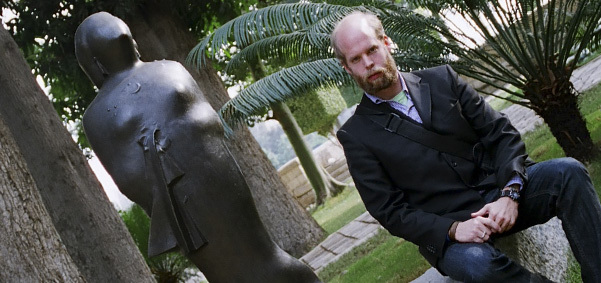
ALL-AGES DIALOGUES, Part V: Will Oldham—”I think the best thing we can probably do would be to make fake IDs more available” (Arthur, 2006)

photo by Valgeir Sigurðsson

The ALL-AGES Dialogues: A conversation with Will Oldham
by Jay Babcock

This interview was conducted by phone in late summer 2006, as part of a series of conversations I was doing with various folks regarding the history of all-ages, philosophy/ethic of all-ages, the state of play of all-ages, yadda yadda. Shoulda been published long ago but stuff kept going awry and we didn’t get it in the mag. Still, almost four years later, it’s a good, pertinent read. Thanks to Will for his time and patience, and special thanks to a certain friend of Arthur who transcribed this conversation a long time ago.

Will Oldham, as Bonnie “Prince” Billy, is traveling and playing shows right now with the Cairo Gang. More info: dragcity.com

Previously in this series:
Interview with John Sinclair (MC5 manager, activist, poet-historian)
Interview with Chuck Dukowski (Black Flag, Chuck Dukowski Sextet)
Interview with Calvin Johnson (K Records, Beat Happening, Dub Narcotic Sound System)
Interview with Greg Saunier (Deerhoof)


Arthur: Do you prefer to play all-ages shows? Is it a priority for you, or does it even matter?

Will Oldham: It matters and it makes a difference, but it isn’t a ‘priority.’ Does that make sense? Every show is contextualized for what it is—in that way, it’s important. But I guess my skewed stance is that I’ve always approached this work of making music in terms of… I think my main drive is to write and record music, so playing live is always just a weird experiment. So to me, every aspect of playing live is part of that weird experiment, whereas a lot of bands and musicians seem to make records of the music that they make. [For me] it’s the reverse. I think that every time that you play live, it’s like, ‘Whoa! What was that all about?’ It’s great whoever the audience is. You try to find the most fun audience, I guess.

Arthur: I noticed that when you are touring shortly, you’re playing a bunch of record stores…

Yeah, an all record-store tour.

Arthur: One of the weird things, from what I can tell about the performance environment in America, is that one of the few places where people of all ages can see quality music in a live setting now is the record store.

Yeah. “Quality music.” One thing that I had started to think about before we started on this topic was… like, how old are you?

Arthur: 35.

I’m 36, and my sense is that, if you won’t take offense, is that we are out of touch. There are quality shows going on six out of seven nights a week that are all-ages shows, in people’s houses, in public places, and we just don’t know those bands. Because I’ve seen some this year—I’ve seen some every year. And it’s like, Whoa, where’d these kids come from? And these kids came from the same places we came from, and they’re making great music that we don’t have access to, because… It’s the same way that bands that I went to see play 20 years ago, people who were 22, to 36, to 50, they would be saying ‘There’s just no music going on these days. There’s no shows like I remember.’ And meanwhile, I was having the fucking time of my life!

Continue reading

COSMIC FARCE, FEB. 18, 2010: DICK CHENEY WADDLES ONSTAGE AT CPAC TO THE TUNE OF…HOWLIN RAIN'S "DANCERS AT THE END OF TIME"?!?

1971-76…

Dancers_at_the_end_of_time

“Bishop Beesley, endlessly corrupt gluttonous villain series. Thirsts for power, money, pleasure.” (wikipedia entry on the villain from the Moorcock books)

2008…

February 18, 2010…

2006…

a24cover

Michael Moorcock (with Arthur editor) at Arthur event at Church of Casper the Friendly Ghost—SXSW, 2005…

MoorcockBabcock

The soul of Rick Veitch

From the blog of genius Vermont cartoonist/dreamworker Rick Veitch

“Over the last couple weeks I’ve found myself in a number on conversations with different people about the nature of the soul. The soul is one of those subjects that everyone has an opinion of but nobody really knows what the darn thing is or even if it really exists. Interestingly, I had a dream the other night in which I saw my soul! It was basically a globe with lots of geometric shapes attached that was constantly changing at a rapid rate. I’ve made a quick little black and white animation that kind of gets it across. In the dream there was an ever-changing riot of pattern and color on each of the geometric shapes. Maybe at some point I’ll do a color version of this to make it complete….”

veitchsoul

More Veitch on Arthur:

A conversation with dreamworker/cartoonist RICK VEITCH, with an introduction by Alan Moore

JODOROWSKY: "I am old. I have so many things to do, so every day I get quicker, in order to do them! I don’t want to die without doing everything I wanted to do."

JodoTarot

One from the archives: an interview conducted in person with Jodorowsky in Burbank back in summer 2003. Jodo’s then-forthcoming book on the Tarot has since been published, and is now available in English as The Way of Tarot: The Spiritual Teacher in the Cards (Destiny/Inner Traditions). Click on the cover above for purchase info at amazon. Here’s a 4.2mb PDF excerpt from the book, courtesy of the publisher. Also: Jodorowsky and Allen Klein reconciled prior to Klein’s death last year, and as a result, all of Jodo’s ABKCO films are now available on dvd.

In the Heart of the Universe
Jay Babcock talks with visionary comics author Alexandro Jodorowsky

Originally published in LAWeekly on January 01, 2004

In 1970, Alexandro Jodorowsky was launched into the counterculture consciousness via an utterly outre film called El Topo, which screened for seven straight months at a theater in New York City. Violent, mystical and more outrageous than Bunuel or Fellini’s surrealist dreamaramas, El Topo was the first midnight movie, a Western that divided critics even as it gained a rabid cult following of turned-on heads including John Lennon, Yoko Ono and Dennis Hopper. Without the benefit of advertising, the film showed seven nights a week to packed audiences. “Within two months,” said the theater’s visionary manager, Ben Barenholtz, who booked the film, “the limos lined up every night. It became a must-see item.”

Allen Klein, infamous manager of the Beatles and Rolling Stones, signed Jodorowsky to a film deal. An El Topo book was published by Lenny Bruce/Miles Davis/Jimi Hendrix/Last Poets producer Alan Douglas—its first half was the film’s nominal screenplay; the second half was a lengthy, startling interview with the auteur.

Born in 1929 and raised in a Chilean seaside town by Jewish-Russian immigrants, Jodorowsky had early ambitions as a poet. Dropping out of university, he formed a puppet company that toured Chile. He left for France in 1953 to find the Surrealists. With Artaud’s The Theater and Its Double as his bible, Jodorowsky worked in film, theater and with mime Marcel Marceau—for whom Jodorowsky wrote various ingenious scenarios. He spent the ’60s bouncing back and forth between France and Mexico — in France, he co-founded the post-Surrealist Panic Movement with Spanish playwright Fernando Arrabal, and in Mexico he drew a weekly comic strip, wrote books, staged plays and finally directed his first real feature-length film, a Dali-esque version of Arrabal’s play Fando y Lis. The Fando y Lis was scandalous and barely screened, but it allowed Jodorowsky to raise the money to make El Topo, the film that would bring him into the English-language world.

By summer 1972, anticipation for Jodorowsky’s next film was high enough for Rolling Stone to send a correspondent to Mexico for a visit to the set of his new film, The Holy Mountain. The resulting article, which was second-billed on the magazine’s cover to a piece on Van Morrison, described scenes, props and conversations that bordered between sensational and plain mad. Participants in the film seemed to be in awe of what they were doing: One P.A. said, “You know, I think this is the most important thing going on in the world today. At the very least, it’s the most far-out.” The finished film may be just that — if you can find it. At some point around the film’s release, Jodorowsky and Klein had a serious falling out that continues to this day, which means The Holy Mountain has never received a legitimate release on videotape or DVD (bootlegs are, of course, available).

In the following years, Jodorowsky attempted to adapt Frank Herbert’s Dune to film. The project ultimately failed, but it drew Jodorowsky into contact with French comics artist Moebius, who, along with Swiss artist H.R. Giger, had contributed design and storyboarding work to the film. Jodorowsky began to collaborate with Moebius on comics, and a new career was born.

Indeed, when I sat down with Jodorowsky this past summer for an hourlong conversation, the extent of that career was obvious: He was hard at work on scripts for six different comics projects. Collaborating with a host of the world’s finest talents during the last 25 years, Jodorowsky has found in comics an art form that can accommodate his seemingly boundless imagination. And what comics they are: the Philip K. Dick-gone-cosmic series The Incal, the Homeric space opera The Metabarons, the revenge/ redemption series Son of the Gun, the strange Western Bouncer. With the opening of Humanoids Publishing’s North American branch in 1999, most of Jodorowsky’s comic work is finally available in English.

In conversation, the almost 75-year-old Jodorowsky remains dazzling. Speaking in broken English (which has been slightly cleaned up in the following excerpts from our conversation), his tone is generous, self-deprecating, inquisitive and almost childlike in its sense of wonder. He has made only three films since 1972’s The Holy Mountain — the lost-children’s fable Tusk (1980), the gonzo Grand Guignol Santa Sangre (1989), and the make-work The Rainbow Thief (1990) — and although he has often spoken of an imminent return to the form, one guesses that in the business climate of 2003 this has got to be a long shot. He has, however, recently finished a number of substantial projects: a book-length commentary on the Bible, a lengthy restoration of what he considers to be the original Tarot deck, a collection of short stories and a book of poems. And in February, his decades-in-the-making, 400-page guide to the tarot will be published in Europe.

Q: You are at work on an alarming number of projects for someone of any age. Where is all the energy coming from?

ALEXANDRO JODOROWSKY: Energy is coming because I will die very soon. I am old. I have so many things to do, so every day I get quicker, in order to do them! I don’t want to die without doing everything I wanted to do.

Continue reading

“Forty-Six Strings and Some Truths”: Harp-playing folksinger JOANNA NEWSOM talks history, theory and inspiration with Jay Babcock (Arthur, 2004)

Forty-Six Strings and Some Truths
Harp-playing folksinger JOANNA NEWSOM talks history, theory and inspiration with Jay Babcock

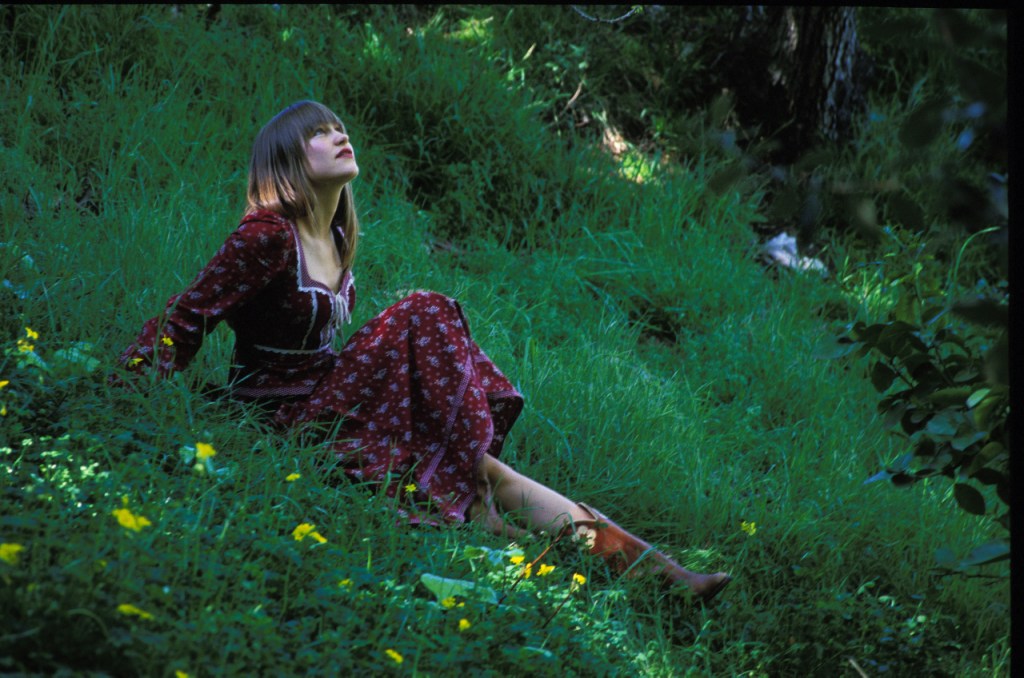
Originally published in Arthur No. 10 (May 2004), with photography by Melanie Pullen.

Photo by Melanie Pullen.

The Lyon & Healy pedal harp is not a regular presence in rock clubs. It’s expensive, it’s big, it’s complicated. It has 46 strings, which cannot be re-tuned between songs during a performance. It’s difficult to master—basic competence requires years of training and practice. Outside of Bjork’s last album and recent tours, it’s an instrument almost without history in pop music.

So, when the 22-year-old Joanna Newsom appears onstage, alone, playing this exotic device, attention is inevitably paid, not just cuz you never see it done, but because, as Joanna says, the harp is usually associated by contemporary listeners with a single cheesy sound: the glissandi, a simple, artless running of the fingers across a broad span of strings, used as a decorative cue in sitcoms, films and commercials. Which means the simple act of witnessing a harp really being played—of runs of notes plucked with one hand while the other plays a fixed pattern—is gonna be novel. It’s as if your only experience of the electric guitar was the sound of a single power chord, and then suddenly you witnessed the playing of whole riffs, whole rhythms, whole melodic lines, whole songs…

Songs. It’s Joanna Newsom’s songs, it’s her lyrics, it’s her singular voice—accurately described by Currituck Co.’s Kevin Barker as “eight and eighty, dawn and dusk”—that makes the gawkers stick around, after the initial curiosity of seeing a harp played by a pixie from a California Gold Rush town wears off. Cuz what Joanna is doing is neither experimental, avant garde stuff, nor the pretentious bloat generally associated with the use of classical instruments on the rock stage. It’s instead firmly rooted in the folk tradition: verse-chorus songs with careful attention paid to lyrics and vocal performance. When Joanna sings “This is an old song, these are old blues/This is not my tune, but it’s mine to use,” she’s stating fact and ambition. She’s making a claim. It’s one that she’s earned the right to make.

With support and advocacy over the last couple of years from friends and admirers like Will Oldham, Devendra Banhart and Cat Power, she began to record her music and perform live. After making two home-recorded CD-R EPs, she released her full-length debut on Drag City this spring with the stunning The Milk-Eyed Mender, and will be touring with Banhart in the early summer.

Two weeks after seeing her wow drunk hipsters in a Seattle rock club, and after tagging along on the photo shoot for this piece, I interviewed Joanna for an hour by mobile phone. I was struck once again by her essential singularity—it extends even into her conversation, which is learned, humble, passionate and articulate. Here is some of what we talked about.

Continue reading

A conversation with Ralf Hutter of KRAFTWERK (May, 2005)

Above: Folk musicians touring the European countryside by bicycle. Photograph Roger-Viollet /Rex Features

The following was originally published in the LAWeekly on June 2, 2005…

Man-Machines of Loving Grace
by Jay Babcock

I like to think (and
the sooner the better!)
of a cybernetic meadow
where mammals and computers
live together in mutually
programming harmony
like pure water
touching clear sky.

—from “All Watched Over by Machines of Loving Grace” by Richard Brautigan

Next Tuesday, German electronic-music pioneers Kraftwerk will perform in Los Angeles for the first time since their now-legendary show at the Hollywood Palladium in 1996. That concert drew an appreciative, astoundingly diverse cross-genre audience: indie-rock nerds and art-school casualties, computer-programming geeks and hip-hop heads, synth freaks and industrial goths, every laptop musician west of the Colorado and — oh yes! — breakdancers. Machines, it seems, had succeeded in uniting humans.

It’s impossible to overstate Kraftwerk’s influence on pop music and culture over the last 30 years, from new wave to hip-hop, electronica to (yawn) Coldplay (who use the riff from “Computer Love” on their new song, “Talk”). We all know Kraftwerk songs — odes to transportation like “Autobahn” and “Trans-Europe Express,” future/now manifestoes like “Man/Machine” and “The Robots” — but it’s in the live context, where the songs are joined to specially designed graphics, that Kraftwerk achieves a purity of all-encompassing vision that secular music rarely touches. It’s all about rapture, and an interaction with — or longing for — a relationship with something other than human.

On the telephone, Ralf Hutter — co-founder of Kraftwerk with Florian Schneider, and now approaching 60 years of age — is helpful and deliberate, like a professor pleased to have a visitor who’s interested in his research on an obscure subject.

Q: There’s a bumper sticker that says “Drum machines have no soul.” Do you think that is true?

Continue reading

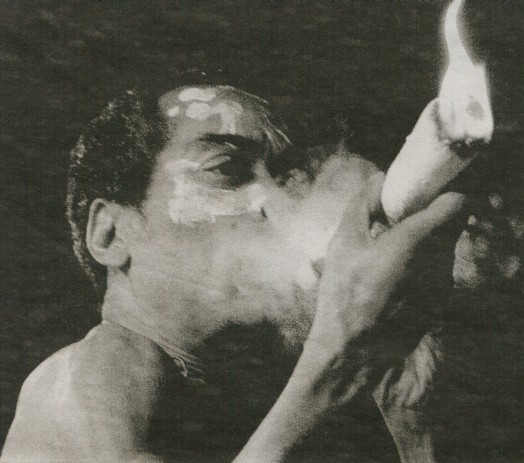
FELA: KING OF THE INVISIBLE ART by Jay Babcock (1999)

This article was originally published in Mean Magazine (October 1999), which I was editing at the time, with art direction by Camille Rose Garcia. The piece was accompanied by a set of sidebar interviews and an overview of Fela’s catalog by Michael Veal [who was finishing his work on the manuscript that would be published as Fela: The Life And Times Of An African Musical Icon]. The main article text, and sidebars, were later reprinted in full in the Da Capo Best Music Writing 2000 book (thank you Douglas Wolk and Peter Guralnick).

FELA: King of the Invisible Art
by Jay Babcock

Fela Anikulapo Kuti: 77 albums, 27 wives, over 200 court appearances. Harassed, beaten, tortured, jailed. Twice-born father of Afrobeat. Spiritualist. Pan-Africanist. Commune king. Composer, saxophonist, keyboardist, dancer. Would-be candidate for the Nigerian presidency. There will never be another like him. This is the sensational story of Fela, the greatest pop musician of the 20th century, featuring the words of Fela’s friends, fans and the Ebami Eda himself.

“What can I say? I wasn’t Hildegart!”
Fela always knew the power of a name.

If you are African—and especially if you work with music, which shares a link of common invisibility with the spirit world—you must have a spiritually meaningful, beneficial name. Without the correct name, Fela explained, “a child can’t really enter the world of the living.”

He didn’t like the name he was given when he was first born, in 1935: his Nigerian parents had followed a local German missionary’s suggestion. So Fela died and was born a second time, on October 15, 1938; this time his parents called him Fela.

“Bear the name of conquerors?” he asked Carlos Moore, author of Fela: This Bitch of a Life, in 1981. “Or reject this first arrival in the world? The orishas [spirits] they heard me. And they spared me. What can I say? I wasn’t Hildegart! It wasn’t for white man to give me name. So it’s because of a name that I’ve already known death.”

In 1975, at the height of his popularity and power, Fela changed his middle name. “I got rid of ‘Ransome.’ Why was my name ‘Ransome’ in the first place? Me, do I look like Englishman?” Fela’s full name was now Fela Anikulapo-Kuti, which meant in whole, ‘He who emanates greatness, who has control over death and who cannot be killed by man.’

That same year Fela also started to cheekily call himself Black President, eventually releasing an album bearing the same title in the midst of a thwarted campaign. And sometime in 1986, following his release from Nigerian prison after serving 20 months on trumped-up charges, Fela began to call himself the Ebami Eda, which translates roughly as “the weird one,” or more delicately, as “the one touched by divine hand.”

Fela was touched, alright. But he was not only a visionary musician who created a whole new style of music—Afrobeat—and left behind an incomparable body of recorded music. No. Fela also simultaneously spoke truth to power, and then recorded it as a 12-minute dance-funk song, with a title like “Government Chicken Boy” or “Coffin for Head of State.” He endured brutal physical punishment and constant imprisonment. In the end, he died from complications associated with the AIDS virus. His heart was broken: he had sung so much, fought so hard, amassed such popularity, and still, hardly anything changed for the better in his beloved, heart-shaped continent of Africa. So: following is the story of that big generous, humorous, creative, divine heart that Fela had: from its early heartbeats, to Afrobeat, to the beatings it took, to its final, slow heartbreak.

Continue reading

MUSIC IS NEVER WRONG: A visit with Josh Homme & John Paul Jones of Them Crooked Vultures (Arthur, 2009)

MUSIC IS NEVER WRONG
A visit with Them Crooked Vultures’ Josh Homme and John Paul Jones

Interview by Jay Babcock
Posted: October 15, 2009

Them Crooked Vultures is a new band comprised of guitarist-vocalist Joshua Homme (Queens of the Stone Age, Kyuss), bassist John Paul Jones (Led Zeppelin), drummer Dave Grohl (Foo Fighters, Nirvana) and guitarist Alain Johannes (Eleven), with Jones and Johannes also playing other instruments. These guys really don’t need an introduction so you won’t be getting one here. What’s interesting is what they’re doing: Vultures have spent much of this year together, writing and recording music in a Los Angeles studio, and are now touring without having officially released a note of the music they’ve recorded. No album, no single, no YouTube video, no leak, no official photos, no nothing: the only way to hear Them Crooked Vultures, really, is to see them live.

In some ways, it’s an echo of the Eric Clapton-Steve Winwood-Ginger Baker supergroup Blind Faith, who did a similar thing in 1969, touring ahead of their album’s release, selling out tours on the strength of their collective pedigree. But unlike Blind Faith, who hedged their bets by including renditions of songs from their old bands, Vultures are performing 80 or so minutes of new Vultures music every night: no Zeppelin covers, no Queens jams, no standards. As Homme says onstage on the night I first see them play, it’s a “social experiment” as much as a musical one, and to the audience’s credit, there was not a single shouted request that I could hear for something other than what the band was playing: Vultures’ blind faith is being rewarded.

Perhaps this is down to a collective solidarity with the idea of the independent musician, or a real interest in simply unfamiliar music by trusted faves—or maybe it’s because most of the songs presented on Monday night were strong on first listen, and if listener’s fatigue inevitably set in at some point due to the continued ear-pummeling, then you could just stand there and behold the wonder of 63-year-old John Paul Jones, shoulders bobbing, at the helm of his instrument, smiling with pleasure at Dave Grohl as yet another propulsive, post-“Immigrant’ Song” (or “Achilles’ Last Stand,” or…) bassline locked in with Grohl’s powerhouse thumping and a distinctively Homme guitar riff. Interestingly, Grohl’s drumkit was not on the riser usually associated with big-time rock bands, which I’m sure disappointed some Foo Fighters fans, but it had the crucial benefit of placing the musicians nearer each other, allowing them to create a more cohesive sound in the midst of so much volume; as John Paul Jones said after the show, “I can feel Dave’s kick-drum that way,” and from his smile, you know that’s as much for his benefit as the audience’s.

Smiles. The amount of smiling between the Vultures onstage, as well as the sheer caliber of playing, reminded me of Shakti, the Indian-Western supergroup led by English master guitarist John McLaughlin and Indian tabla genius Zakir Hussain that fuses classical Indian music with Western jazz. I’m not talking about laughs between songs, or witty stage banter, although with Josh Homme at the microphone you’re always going to get that, but the smiles that occur in the midst of the music: the joy that emerges spontaneously in the midst of collective creativity, usually marking some new discovery or progress, or a new threshold being crossed, or something just feeling fundamentally good. In the last two decades of loud guitar music, this kind of uncontrived on-stage joy has been far too rare—outside of Ween shows, of course, and gee wasn’t that the Deaner himself backstage with the champagne on Monday night? Anyways. Josh, who I’ve interviewed before, and who headlined the second night of ArthurBall in 2006 as half of The 5:15ers (a duo he has with longtime collaborator Chris Goss), invited me to talk with him and John Paul Jones in the band’s dressing room just prior to their set at Philadelphia’s Electric Factory on October 12, 2009. Here’s how the conversation went…

Continue reading

Mitch Altman's revolutionary Trip Glasses ("a sound and light brain machine")

I was lucky enough to get a 14-minute test ride with this device a couple days ago, courtesy Mitch himself (and Scott Beibin), and can personally attest to its efficacy. Mitch says they should be available commercially soon, retailing for $40. Something like this is long overdue, especially given that Brion Gysin’s dream machine, which works on a similar principle, was developed decades ago. Experienced meditators and psychonauts will recognize the spaces in consciousness that your brain travels to with the aid of this device; others are in for a pleasant, overwhelming shock. It’s like a trailer for an actual psilocybin or LSD trip, or for what you may experience in deeper meditation. Wonderful, much needed—and totally subversive. Well done, Mitch!

Here’s some video with some other folks trying out the Trip Glasses..

soundandlightbrainmachine

Click here for Trip Glasses site

More info: Make magazine