THIS ONE TOOK A WHILE TO BAKE

a35cvrstore

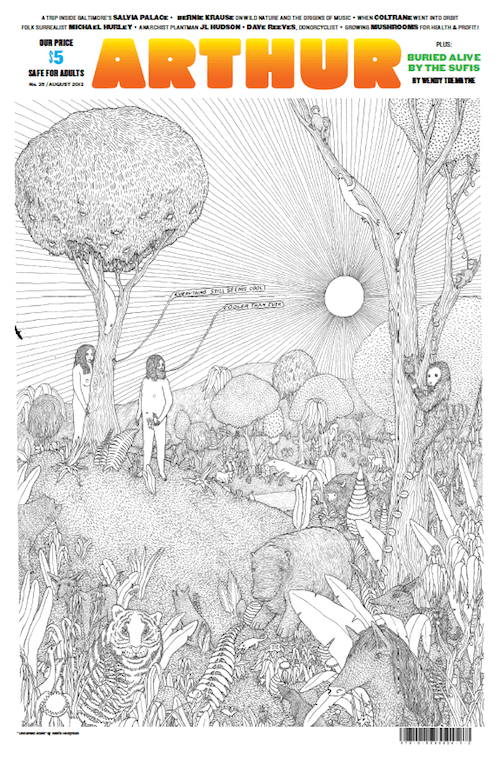
ARTHUR NO. 35 / AUGUST 2013

Click here to order this issue now at the Arthur Store

Streets: Aug. 19, 2013

Cover by Kevin Hooyman

Contents:

ON THE TRAIL OF THE LONESOME SNOCK
Wily folkplayer MICHAEL HURLEY (aka Elwood Snock) has charmed hip audiences for over fifty years now with his timeless surrealist tunes and sweetly weird comics, all the while maintaining a certain ornery, outsider mystique. Longtime Snockhead/Arthur Senior Writer BYRON COLEY investigates this Wild American treasure in an enormous 11,000-word, 8-PAGE feature replete with rare photos, artwork, comics… and a giant color portrait by Liz Devine. Snock attack!

CHEW THE LEAVES, GET IN THE TANK
Inside Baltimore’s T HILL, new kinds of experiments with salvia divinorum are going on. Journalist/photographer Rjyan Kidwell visits Twig Harper, Carly Ptak…and the Wild Shepherdess.

BURIED ALIVE BY THE SUFIS
Swap-O-Rama Rama founder and author WENDY TREMAYNE (The Good Life Lab: Radical Experiments in Hands-On Living) wanted to understand what motivated her life-long anti-consumerism. She found the answer underground. Illustration by Kira Mardikes

GASH, CRASH, ASH
Nobody rides for free. DAVE REEVES on the price motorcyclists pay for being better than you. Illustration by Lale Westvind.

THE BIOPHONIC MAN
Guitarist, composer and analog synthesizer pioneer BERNIE KRAUSE left the recording studio to find that really wild sound. What he discovered was far more profound. Interview by Jay Babcock. Illustrations by Kevin Hooyman.

GIANT STEPS FOR MANKIND
Stewart Voegtlin on JOHN COLTRANE’s startling 1960s ascension from space bebop to universe symphonies. Dual astral/material plane illustration by Beaver.

FLOWERS, LEAVES, ANARCHISM
Matthew Erickson on the J.L. Hudson Ethnobotanical Catalog of Seeds

Plus…

* Arthur’s new regular column “Come On In My Garden” debuts. This issue, Camilla Padgitt-Coles visits Enumclaw’s Norm Fetter at his family’s Pennsylvania mushroom farm. They’re medicinal!

* The Center for Tactical Magic on demons and drones…

* New full-page full-color comics: “Forgiveness” by Julia Gfrörer and Part 2 of Will Sweeney’s “Inspector Homunculus” serial.

* And, of course, the “Bull Tongue” exhaustive survey of underground cultural output by your intrepid guides Byron Coley and Thurston Moore…

The last two issues of Arthur are sold out from us. Don’t blow it, bucko. Click here to order this issue now at the Arthur Store!


WOODS KOVERING A GREAT UNDERHEARD ETERNAL KINKS KLASSIC

This is the beautiful Ray Davies-written b-side to the new Woods 7″ out next week. The Kinks originally released it in 1971 as part of the soundtrack for Percy, a very odd (and little-seen) film…

And here’s the a-side, a re-recording with new Woods drummer Aaron Neveu of a song off their 2011 album, Sun and Shade

Woods say: “The recording of these songs serves as a farewell to Rear House, Woods’ home, recording studio, creative refuge and beloved shithole for ten long years.”

More on the 7-inch: woodsist.com

Woods are touring the East Coast, then Europe, then the West Coast in the coming months.
Info: woodsist.com

IT WAS A LIVING PIECE OF GOD

Screen Shot 2013-07-01 at 5.26.01 PM

From a review by Peter Brown in the New York Review of Books of “The Nativist Prophets of Early Islamic Iran: Rural Revolt and Local Zoroastrianism” by Patricia Crone (Cambridge University Press):

…As [Crone] presents it, Zoroastrianism as practiced preserved one basic principle: the world was good. It was good because it was suffused with an energy of light that was a direct continuation of the energy of God himself. As Crone puts it with memorable crispness: to Zoroastrians, the light of the sun and of the holy fires that they worshiped was not a symbol—it was a sample. It was a living piece of God. A world permeated with so precious a substance had to be kept pure. The safety of a divine order, fully present in the here and now, was at stake in every aspect of nature and of human society.

This amounted to a call to action. A Zoroastrian was a militant for the right order of things. Given the ravages of a constant, opposing force of evil, the order of things had to be defended and restored by means of constant efforts of reform. The world demanded not flight but perpetual vigilance, even social engineering. Only in this way would creation recover its original, undamaged radiance. It would shine again like gold, “excellent, without decay.”

And the Zoroastrians of the villages had no doubt as to how this radiance would be restored—by community of property combined with equal access to women. To outside observers, Christian or Muslim, this seemed either hilarious or obscene: “abstemious wife-sharing is always reported as if it were a merry free-for-all.” But this was not how the villagers saw it. What mattered for them was how to keep together the precious deposit of family land. For family land to break up; for each portion to follow a separate household; worse than that, for these portions to be irrevocably lost to outsiders, through the violence of the powerful and the pressure of agrarian debt: this was the sure way to impoverishment and the death of the village. Polyandrous marriage was the solution. For the Zoroastrians of the village, only a community of women could maintain the divine integrity of the land.

In reflecting on these topics, many Zoroastrians proved themselves to be far from boneheads. They examined the origins of private property with considerable moral rigor. They claimed that private property had been caused by the cold, life-denying impulse of “desire”—by an antisocial lust for land. They also denounced the swaggering “resource polygyny” of the nobility—the corralling of women as wives and concubines at the expense of potential non-noble spouses. Both desires caused “envy.” And envy lay at the root of the conflicts that destroyed the harmony of God’s creation. This was what a shadowy intellectual, Zardūsht son of Khrōsak, had thought already in the mid-third century. These ideas were taken up by Mazdak in the 530s. As a result of the preaching of Mazdak, a protracted jacquerie rocked the Iranian plateau. The villagers emptied the granaries and the harems of the nobility, until the Mazdakites were suppressed with exemplary (and much-praised) savagery by the great shah Khosrau I (531–579).