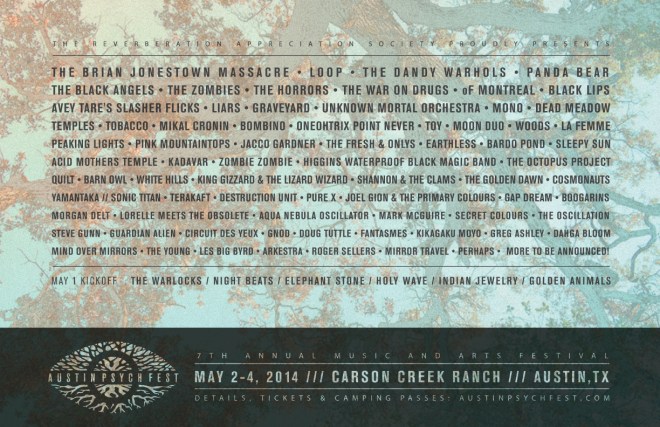
The 7th annual Austin Psych Fest is coming up in May and the lineup for this three-day celebration is praiseworthy as always. A festival featuring BOMBINO, TEMPLES, GRAVEYARD, WHITE HILLS, WOODS, MOON DUO, PANDA BEAR, ACID MOTHERS TEMPLE, LIARS, DEAD MEADOW, GAP DREAM, STEVE GUNN, GREG ASHLEY, MARK MCGUIRE, THE ZOMBIES (!!!), EARTHLESS, BARDO POND, DESTRUCTION UNIT…? Get out! You and those dearest to you have no choice but to attend. Buy as many tickets as possible NOW NOW NOW via austinpsychfest.com
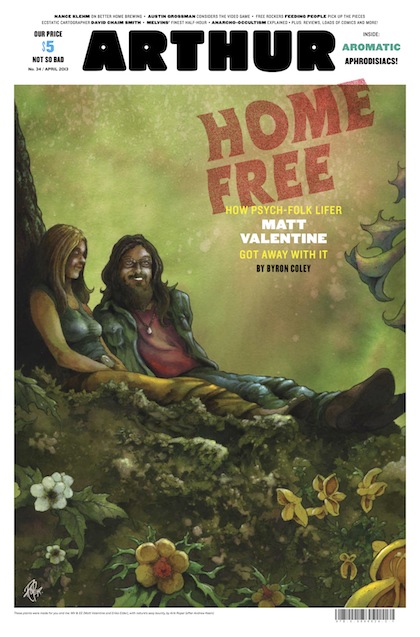
For over two decades, musician/head MATT VALENTINE has navigated strange, inspiring trips across myriad underground psychedelic terrains, joined by a revolving cast of fellow free travelers. Byron Coley crosses the bridge to get MV’s side of the story.
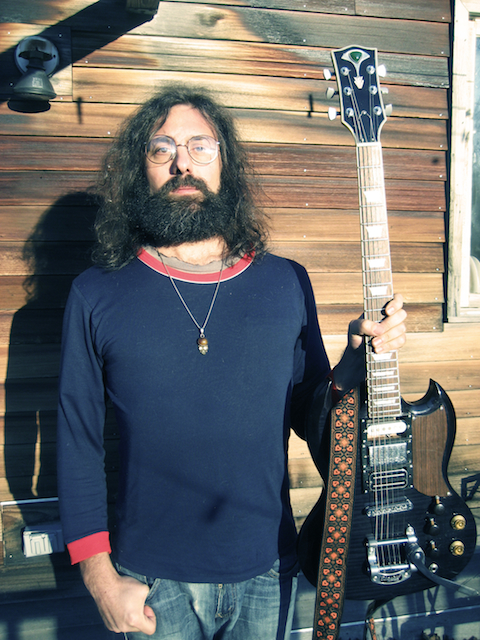
Matt Valentine aka Matthew Dell aka LunarMV, etc., is one of the more righteous freaks of our age. As a writer, guitarist, vocalist, label head, whiskey fan, and whatever else he might happen to be, Matt is one of those rare guys who is always ready to go “all in.” He is neither shy about his many accomplishments, nor unwilling to speak about them, but he is so flat-out committed to his own sci-fi-damaged version of personal history the way he’d like it to be known that he can be a tough person to interview. He loves the elliptical, the mysterious, the vaguely legendary secrets that underpin all true history, and he seems more than happy to offer wild and theoretical answers to most dull and specific questions that come his way. For this reason, among others, there are few places you can turn for objective facts about the musical/historical trajectory of Matt Valentine.
And the man clearly deserves a thorough overview.
This isn’t exactly it, but it’s a first step. Matt and I have been friends for a couple of decades. We’ve done various projects together over the years—tapes, shows, albums, tours, books, etc.—and he well knows in what high esteem I hold all of his work. To my mind, much of the popularity of the acid-folk revival was instigated by Matt and his cohort—hardcore record collectors and fans who were capable of hearing things no one else had noticed, and were eager to translate their discoveries into post-punk tongues. Few people have been as tireless in their work expanding and documenting the boundaries of underground culture over the past years, and Matt has created a vast web of friends, recordings and memories documenting his aesthetic peregrinations as well as those of his fellow travelers.
Matt, among other things, has been a tireless documentarian of his passage through space and time. The number of recordings he has released is not easily discerned, but let’s just say they are legion. What continues to mystify listeners is the fact that Matt’s sonic trajectory is constantly evolving. Unlike the many artists who bogusly claim “my latest release is by far my favorite,” Matt’s new records generally incorporate a new form-innovation/renovation/reconsideration. The guy is acutely aware of where he has been and seems dedicated to Heraclitus’s dictum about not stepping in the same river twice. Because of this, Matt’s albums (the major ones, anyway) often represent a true progression in terms of technique, interpretation and vision. That said, the new LP, Fuzzweed (Three Lobed) is a monster of sweetly-stoned tongue-form. It boils many elements of the essential, ineffable MVEE whatsis into a kind of floating vocal/way-post-Dead instrumental-puddle that will absolutely sear your brain. The first batch of copies also come with a CD that culls the best moments of the new 7-CD Zebulon residency set COM just issued. It’s weird. There are only a handful of people whose recordings I choose to follow with something like fervor. Matt is one of them. Hopefully this talk will help you to understand why.
I had hoped that Erika Elder, Matt’s partner in all things, would attend the interview as well. But she played possum at work, leaving us to blab untended from the light of afternoon into the dark of night. Hopefully, this interview will give you some idea of the depth and width of Matt Valentine’s work. It’s a vast weird place. Hello.
B: Let’s start with some basics. Where did you grow up?
M: The Hudson Valley region. I was born in Mount Kisco, NY. Lived in several towns around there, including Yonkers for a bit when I was super young.
B: Did you play music when you were a kid?
M: Yeah, but I wasn’t really in a lot of bands or anything. I started a bit when I was in high school. I was kicked out of the school band. I played alto sax. But I got booted out pretty early because I think, without really knowing anything about it yet, that I wanted to play like Ayler. I would take the melody of “When the Saints Come Marching In” and transmogrify it.
B: Was it a marching band?
M: At first, yeah. Then it became more of a concert recital band, and you had to choose whether you wanted to be in the jazz band or one of the other standard school things. The school I went to was pretty interesting because it was fairly liberal. Like, there weren’t any walls in the school. So when you didn’t have a class there was a big open space called The Commons. It was grades 9-12, and the cafeteria and the smoking section and all that stuff was in the middle. When you didn’t have a class it was a regular thing to hang out in The Common with an acoustic guitar and just play and meet people. So that’s where I first started to get hip to the idea of social communication through music. I did weird recordings at home, then the first serious band I was in was a relatively professional band.
B: Who was that?
M: That was a band I played with right out of high school called the Werefrogs. I played with two guys who were older than me, from the same school. They had graduated the year before me and had played in bands for a while. One was a drummer, the other a guitarist. They were both from the same scene at the school and they wanted a bass player. So I said, “Oh, I’ll play bass.” I think they wanted me in the band because I could hang out and I was into kinda cool music.
B: What era was this?
M: Around late ’88. We did a couple of singles.
B: What kinda stuff was it?
M: Psychedelic rock.
B: What were your models?
M: We were probably most like dudes who wanted to play like Joni Mitchell or something. It was kinda weird chords like that, but these two guys were more advanced musically and into jazz voicings and things like that. It was a trio, so of course there were obvious things like Hendrix. I was listening to WNYU a lot then. They had a program called The New Afternoon Show. I would get off this mail room job I had, and the show was on from 4:00 to 7:30 in the afternoons in the tri-state area. I would listen to that driving home, and they’d play stuff like the Road Pizza 12” and all these crazy bands who made one single and then disappeared. It was the most crazoid music I’d ever heard. It made some of the college radio stuff of that era seem incredibly straight. I really dug the stuff I heard, so I’m sure some of that stuff was in the mix as well. This was around the time when Nirvana played on that tour with the Cows at the Pyramid. I’d be going into NY to see gigs like that. And Galaxie 500 was playing at CB’s Canteen a lot, so that was in there. Of course Sonic Youth, and to some degree things like Bern Nix. I’d go see him a lot when he’d play at Roulette and the old Knitting Factory. I was starting to get into that stuff when I was in high school. Then there were some weird record stores popping up, so I’d spend time in those and pick up stuff. So the influences were classic rock, along with a few underground things.
We did a few singles and then we got signed, really quickly by this English label. I think they thought we were gonna be a grunge group or something. But they were cool. They were an independent label and had some good bands like Levitation. It was called Ultimate Records, a weird label in Camden Town. We did three EPs with them and one LP. We did a couple of Peel Sessions. So I was kinda cutting my teeth early. We did big tours early on. We did gigs with Yo La Tengo and with Radiohead in the States. It seemed like it was a big noise pretty quickly, and I never turned back from that really. I met a lot of people through that, and then I started playing a lot more seriously after that band dissolved.
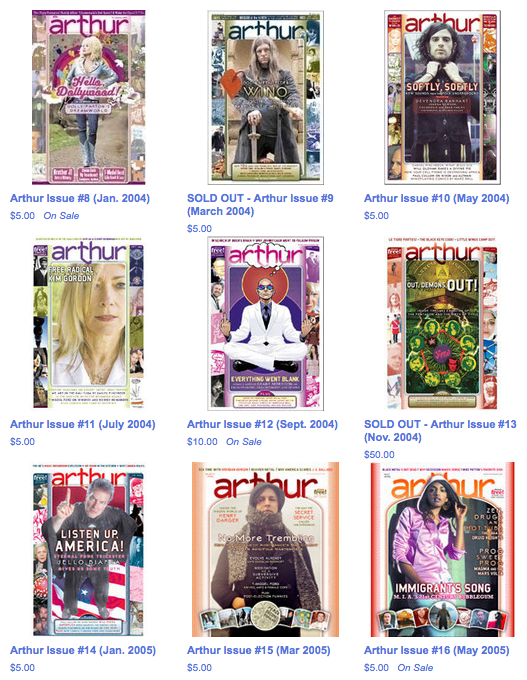
Because so many people have been asking for some clarification as to Arthur’s future:
There are no further issues of Arthur planned at this time. We’re happy we got to do the three issues we did in 2013, while being able to pay our contributors for the first time ever and fulfill all those old outstanding subscriptions.
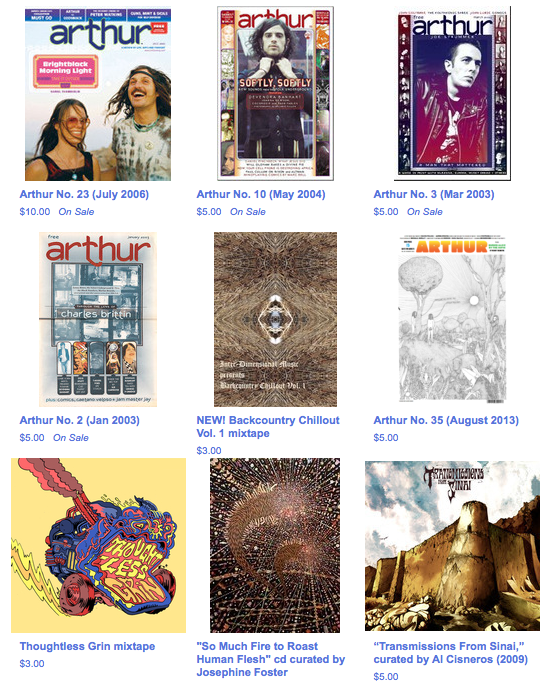
The online mail-order Arthur Store will be open until March 2, 2014. At that point, all unsold backstock will be chucked on the compost heap or into the recycle bin. Everything has been discounted. A number of items are now sold out and have been removed from the Store. Go here to grab stuff for cheep: arthur.bigcartel.com
This website, as well as the Arthur Facebook, Twitter and Tumblr pages/feeds, will stop being updated on March 3, 2014.
For many reasons, it’s now time for Arthur to go dormant. Perhaps the mag will sprout again in the future, perhaps not. In any event, we hope we’ve been of some use, and thank everyone who’s been so kind to us.
Thank you so kindly,
The Arthur Gang
Joshua Tree, CA * Portland, Ore. * Austin, TX * Northampton, MA * wherever you can hear your footsteps
“Freeman House is a former commercial salmon fisher who has been involved with a community-based watershed restoration effort in northern California for more than 25 years. He is a co-founder of the Mattole Salmon Group and the Mattole Restoration Council. His book, Totem Salmon: Life Lessons From Another Species received the best nonfiction award from the San Francisco Bay Area Book Reviewers Association and the American Academy of Arts and Letters’ Harold D. Vursell Memorial Award for quality of prose. He lives with his family in northern California.”
That’s the biographical note for Freeman House on the Lannan Foundation website. We would add that earlier in his life, Freeman edited Innerspace, a mid-1960s independent press magazine for the nascent psychedelic community; presided over the marriage of Abbie and Anita Hoffman at Central Park on June 10, 1967; and was a member of both New York City’s Group Image and the San Francisco Diggers.
This is the eleventh (and final) lecture in this series. This series ran previously on this site in 2010-11.
Watershed Work in a Changing World: Lessons Not Yet Learned
by Freeman House
Plenary presentation for the California Salmon Restoration Federation’s 25th Annual Conference, Santa Rosa, CA, 9 March 2007
Watershed restorationists tend to develop a peculiar set of mind. Community-based watershed groups, the heart of anything we might call a popular movement toward restoring the Earth, are particularly prone to these psychological symptoms. The accepted protocols encourage us to envision something called “reference ecosystems,” some ideal state of dynamic equilibrium that we are then encouraged to imagine existed once and toward which we should be devoting our efforts. We develop strong attachments to certain elements of the living places in which we work, different elements for different practitioners. Some people love fish and some love trees. Many of us love the whole mysterious web of interrelationships. In all, we act as if the distribution of species and communities and weather patterns—either in the present or in our idealized reference ecosystem — is the once and always way that nature has manifested itself.
Sooner or later, we discover the weaknesses in such an idea. If only by paying attention long enough, we discover that nature over the long term is as fluid and fickle as running water. Recently, researching the prehistory of my region, I discovered something that changed the way I thought of the systems in which I’d been working for more than 20 years. I found that only five to six thousand years ago, the entire bioregion had been a few degrees warmer than it has been since and those few degrees determined a very different distribution of species than those we have been striving to maintain for so long. Most relevant for me was the discovery that in that warmer time that followed the last period of glaciation, there had been few if any salmon using the waters of California. (I found this discovery to be slightly embarrassing, having made public statements which confused the history of salmon speciation with the time that salmon had been using my home river. I would tell people salmon had been using my river for 60,000 years rather than the more accurate 6,000.)
More fascinating, though, is the archaeological evidence of Karuk and Tsnungwe ancestral peoples in the mountains above the Trinity River more than eight thousand years ago. Peoples living today in the Klamath River systems are direct descendants of people who lived through climate changes similar in magnitude to the ones we anticipate now. While those ancient peoples had centuries to adapt to a more gradual change than we anticipate, the degree to which that culture changed its life ways remains instructive. In simple terms, the Karuk people changed the way they lived. They changed from scattered groups of hunter-gatherers living in the mountains and following the food to substantial village cultures with an elaborate ceremonial life organized around newly available acorn and salmon resources. The point here is that a people completely changed their way of life in response to changes in the environment and they did it successfully and sustainably. The scope of change we face is quite different; it’s getting warmer rather than cooler and the rate of change is likely to be much quicker. We may be able to draw no more instruction from the Karuk model than that we adopt similar goals—to change our ways of life in the direction of sustainability and survival. Even James Lovelock, that most gloomy of prognosticators, ends a recent interview that predicts the human species pushed back into the Artic zones with the cheery observation that we are all survivors of humans who have endured half a dozen climate changes of equal magnitude within human time.
Now, you might ask, what does all this philosophizing have to do with how community-based watershed restorationists carry on their work? Climate change models currently available are projected on a global scale with an infinitude of possible local variations. Watershed restoration is by definition a local effort. How can community-based watershed groups include the unknown variables that face us as we make our strategic plans?
“Freeman House is a former commercial salmon fisher who has been involved with a community-based watershed restoration effort in northern California for more than 25 years. He is a co-founder of the Mattole Salmon Group and the Mattole Restoration Council. His book, Totem Salmon: Life Lessons from Another Species received the best nonfiction award from the San Francisco Bay Area Book Reviewers Association and the American Academy of Arts and Letters’ Harold D. Vursell Memorial Award for quality of prose. He lives with his family in northern California.”
That’s the biographical note for Freeman House on the Lannan Foundation website. We would add that earlier in his life, Freeman edited Innerspace, a mid-1960s independent press magazine for the nascent psychedelic community; presided over the marriage of Abbie and Anita Hoffman at Central Park on June 10, 1967; and was a member of both New York City’s Group Image and the San Francisco Diggers.
This is the tenth lecture in this series. This series ran previously on this site in 2010-11, and is being rerun now because it’s the right thing to do.
Citizens and Denizens
by Freeman House
Keynote talk for the first Carmel Watershed festival, 2004
I’ve been asked to talk on the subject of watershed citizenship. That made me want to know more about that word citizen, so I dug around a little. It’s been a useful exercise. The word originated as “denizen,” meaning ‘of a place.’ As urban life became more dominant, denizen evolved into “citizen” meaning city person. As nations rose, the word came to define who belonged inside the boundaries and who didn’t. The ancient Greeks reserved the rights and privileges of citizenship to wealthy men, and for most of Roman times, they were dispensed at the pleasure of the emperor. It wasn’t until the American and French revolutions that the notion of popular and participatory decision-making came to be associated with the word. So we can trace the concept from ancient tribal and ethnic definitions of who does and who doesn’t belong to “our” society, forward in time as it evolves toward more inclusiveness. But always there is the notion of boundaries….. In the natural world, boundaries are rarely so clear as humans have been able to make them. (What grizzly or salamander would have invented the rectangular grid? The boundaries of, say, Idaho represent the range of what?)
As the word is used today, “citizen” is the creature of the invented world, rather than a participant in unfolding creation, which is what a denizen might be.
When I chop wood
I get the axe blade good and oiled up with baby oil and then look at my reflection awhile on the shiny axe head.
When I chop wood
I think in cords. Like that truck is about 4 cords. That cloud up there is probably 9. My leg is like 1/8th.
When I chop wood
The blisters on my hands pop, finally, and whiskey comes out and I suck on ‘em.
When I chop wood
My beard grows faster. When I’m done I shave off my 2 foot beard with an oily axe blade while looking in a puddle.
When I chop wood
Forest animals come out and sing a song in perfect rhythm to my chops. They sing a song called, “Man a Choppin’, Man a Choppin’”
When I chop wood
I build great stacks of chopped wood. Art scenes I guess. The scent overcomes the neighborhood and they open their windows to get some chopped wood inside.
When I chop wood
Blood comes out of the tree stump and floods over the grass and onto my boots and I stand hacking in blood up to my laces.
When I chop wood
They close down the farmer’s market and the singer / song writer of the week comes to listen to my song.
When I chop wood
I’m doing a godamn service to mankind so don’t go chattering to me about whats for dinner or whatever.
When I chop wood
I sometimes start chopping other things too. I chopped some floors and some ladders once. If it’s made of wood then I’ll chop it. All I see is wood. And chopping.
When I chop wood
I feel like people in the 1800′s did when they were working. I don’t need clean water or a car. I just need this godamn wood chopped.
When I chop wood
The neighborhood kids gather ’round and say, “I’m gonna chop me some wood one day.” I look up say, “Not like this you won’t.”
When I chop wood
I go over to a boulder when my axe blade gets dull and I rub it on the boulder and get it so sharp that it could cut another couple dozen cords. 7 cords.
When I chop wood
I don’t even bother getting up unless there’s about 10 cords needed. That’s about 10 long beds full. You’re truck will probably break down before I’m done cuttin’. Then I’ll cut your godamn truck up with an axe and get back to my wood choppin’.
When I chop wood
I get real mad and pretend the wood is my old day job. I pretend I’m cutting up my old jobs and then I just start hacking and soon there’s nothing but kindlin’ and just wood dust flying up in the sun rays and on my face.
When I chop wood
It’s like going to church or taking a shower or maybe driving. All the good ideas come when I get to choppin’ and then I know I should be rich because I was the one who thought of the steak sandwich anyhow.
When I chop wood
I think about writing down all the things that happen in my life every day, like when I got in a fist fight inside the Bank of America, but more like a reflection or a memoir or a story on cable starring Sam Elliot when he too, has to chop wood.
When I chop wood
There’s no one better. There’s just no one out there who can chop more wood than me. I mean no one and I welcome all challengers.
“Freeman House is a former commercial salmon fisher who has been involved with a community-based watershed restoration effort in northern California for more than 25 years. He is a co-founder of the Mattole Salmon Group and the Mattole Restoration Council. His book, Totem Salmon: Life Lessons from Another Species received the best nonfiction award from the San Francisco Bay Area Book Reviewers Association and the American Academy of Arts and Letters’ Harold D. Vursell Memorial Award for quality of prose. He lives with his family in northern California.”
That’s the biographical note for Freeman House on the Lannan Foundation website. We would add that earlier in his life, Freeman edited Innerspace, a mid-1960s independent press magazine for the nascent psychedelic community; presided over the marriage of Abbie and Anita Hoffman at Central Park on June 10, 1967; and was a member of both New York City’s Group Image and the San Francisco Diggers.
This is the ninth lecture in this series. This series ran previously on this site in 2010-11, and is being rerun now because it’s the right thing to do.
The Case For The Watershed As An Organizing Principle
by Freeman House
[I’ve rarely given a talk in circumstances more alien to my life experience. This talk was presented a roomful of county and state bureaucrats charged with implementing a five-county wetlands protection and restoration effort. The five counties were the southwestern-most part of California, stretching from Santa Barbara to San Diego, a part of the state that makes me feel like I’m in a foreign country. As if to accentuate the weirdness, the luncheon was held at Sea World, a theme park in San Diego.]
I’ve had quite a bit of time to puzzle about what qualifies me to be here. I feel a little like a visiting diplomat or more accurately, an anthropologist dropping into a whole other culture. Up in the backwoods of northern California, where I come from, we tend to think of ourselves as living in Alta California. Los Angeles and San Diego seem like another place, although they shouldn’t, considering that the voters around here determine a lot of what goes on in the state of California. Which is where I live regardless of the fact that it’s much easier for me and my comrades to think of ourselves as part of the Klamath Province.
I have worked at watershed restoration for 20 years, but in a drainage where there are no dams, and where there are still three species of a wild salmon population holding on. An eighth of the land base is managed benignly by the federal government as the King Range National Conservation Area, another eighth not so benignly by corporate timber interests, and the rest is held either in ranches or private smallholdings. It has a human population density of less than ten folks per square mile. Not too many similarities. And most of the people in this room probably know more about wetlands biology than I do.
Since it was a book I wrote that inspired the organizers to invite me and the book, Totem Salmon, is mainly about attempts to invoke a new (or rather very old) kind of community identity that lives within the constraints and opportunities of the place it finds itself, that’s what I’ll go ahead and talk about.
It could be my best credentials for being here today is the fact that I was born in Orange County. The earliest memories are of my first five years spent at my grandparents’ home in Anaheim, pre-Disneyland. Set in the middle of town, I had two acres to run in haphazardly planted to oranges and lemons and avocados, and for a long time that Edenic space was my model for paradise. Each weekend, we’d drive in my grandfather’s 1935 Buick sedan for maybe ten minutes to a local farm to buy our week’s supply of eggs and milk and vegetables. When we extended our drive to visit Aunt Florence in Pomona, we drove through 60 unbroken miles of commercial orange groves, another image of paradise. I’m revealing my age when I tell you that the air was wonderful, the light incredible.
Since then, I’ve learned something about the settlement of contemporary Anaheim. The existence of Anaheim is entirely dependent on 19th-century amateur efforts in social and physical engineering. Hard as it may be to believe when trying to find the freeway exits to Anaheim today, it was largely settled in the 1860s by polyglot groups of urban utopians who had few of the skills required for the kinds of agriculturally-based communitarian paradigms they were pursuing.
One thing was clear to all of them, however, and that was that their dreams were dependent on importing water to the arid lands they hoped would support them. Continue reading →




 Arthur Magazine