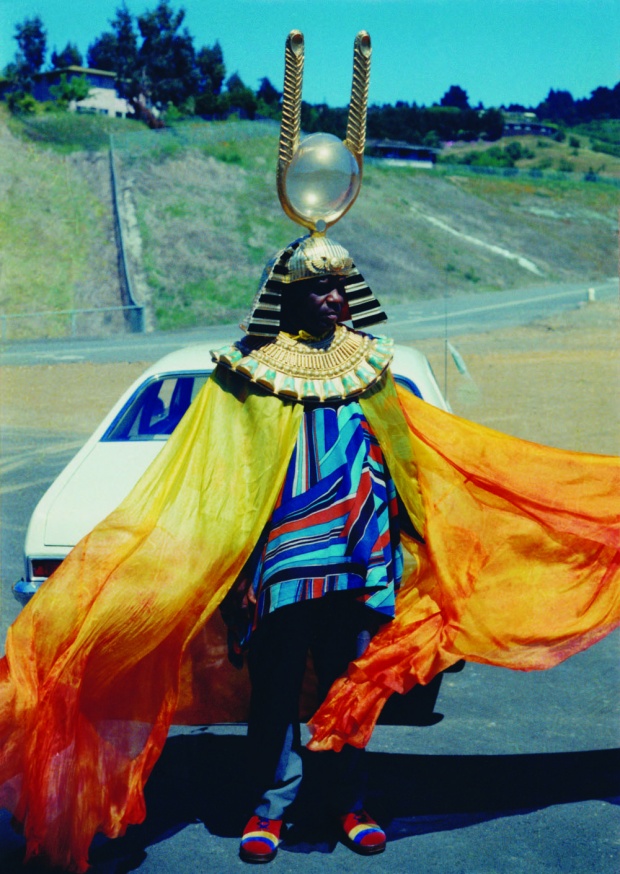
THE WIRE magazine has a gallery of wonderful vintage Sun Ra photos and related artworks up on their website, excerpted from the recently published Sun Ra + Ayé Aton: Space, Interiors and Exteriors, 1972 by John Corbett (paperback, PictureBox).

THE WIRE magazine has a gallery of wonderful vintage Sun Ra photos and related artworks up on their website, excerpted from the recently published Sun Ra + Ayé Aton: Space, Interiors and Exteriors, 1972 by John Corbett (paperback, PictureBox).
Great interview by Tim Teeman with the ever brilliant John Waters in The Guardian ahead of his recent one-man show at this year’s Homotopia in Liverpool. Why won’t The Powers That Be give this national treasure his own nightly television talk show already?
Originally published in Arthur No. 33 (Jan 2013)…
BULL TONGUE
by Byron Coley & Thurston Moore
– Exploring the voids of all known undergrounds since 2002 –
1 CLAUDE PELIEU It has been ten years since the French-born artist, writer, and translator Claude Pelieu died at his home in upstate New York. His memory has been well served this past year, by the publication of at least three books that should be of extreme interest to anyone with a true hankering for the avant garde. The first is Kali Yug Express (Bottle of Smoke Press, bospress.net), a fantastic cut-up novel originally published in France in 1974. Translated by Pelieu’s late widow and long-time partner-in-crime, Mary Beach, it’s great to finally have a chance to read this book in a language we completely understand. As with some of his other work, Pelieu’s cut-ups do not always flow with the same dream-logic that guides Burroughs’ hand when he’s navigating similar waters, but it reads quite well. And Bill Roberts’ production standards are as high as ever. Second up is Un Amour de Beatnik (Non Lieu, editionsnonlieu.fr), a collection of letters and poems sent to Pelieu’s first wife (Lula Nash) in 1963-64, along with examples of his visual work from the early ‘60s. Although it’s all in French, the book is written in a relatively straightforward way, so you can parse it out even if yr French is as rusty as ours. Fully annotated, with period photos, a good chronology and whatnot, it’s a very solid read (and Claude’s early Leger-influenced paintings are quite a revelation). Third is Pelieu Mix/Etat des Lieux (la Notonecte, 15 bis rue Noel du Fail, Rennes, 35000, France), assembled by Benoit Delaune. Pelieu Mix is mostly a facsimile edition of some of Pelieu’s notebooks from the late ‘90s, filled with various texts, collages. It’s a great, beautiful jumble of stuff, presented spiral-bound, and now that we’re examining it more closely we realize it may have come out a while ago. But we just got it, so fuck you. More info on Pelieu and his art (as well as Mary Beach’s) can be had at beachpelieuart.com. Worth whatever eye strain it takes.
2 SPECTRE FOLK Spectre Folk is Pete Nolan’s long-running non-Magik Markers combo. And their new album, The Ancient Storm (Vampire Blues, vampireblues.net), is a quartet scene, with Pete joined by Aaron Mullan, Steve Shelley and Peter Meehan. Dreamier, poppier and ghostlier than previous efforts, it is tempting to call this the best record with a world class foodie (Meehan) since Robert Sietsema’s last recording with Blinding Headache. The longer tracks have a splendid psych droopiness and the whole thing just flows like butter. Meanwhile, Nolan’s label, Arbitrary Signs (arbitrarysigns.blogspot.com, has continued to flower slowly. Most recent drop was Your First Ever River by United Waters. UW is the new solo (or solo-esque) project by Brian Sullivan from Mouthus. The guy’s a brutal arm-wrestler (take our word!), but he also shows an incredible deftness with deeply murky pop constructions on River. Even more than with Brian’s other project, Eskimo King, the sounds here are bizarre but assembled with a precision recalling some of the best efforts of the long-gone Bobby J label. It’s a record that rewards heavy, smoked listening. Don’t think we ever mentioned the last record on Arbitrary Signs either, which was Four Corners Bounce by Devin, Gary & Ross. The surnames invovled are Flynn, Panter & Goldstein, so you can be assured this project is also a riot of screwed-up ‘60s pop readymades, interspersed with doper madness and actual songs that will twist yr mind like taffy. Don’t not check it out.
Haven’t seen this one before. All of his works are precious treasures. Total genius.
Sergei Parajanov: wikipedia
Originally published in Arthur No. 35 (August 2013)…

Column: Applied Magic(k)
Author: The Center for Tactical Magic
Title: “The Deception of Robot Demons”
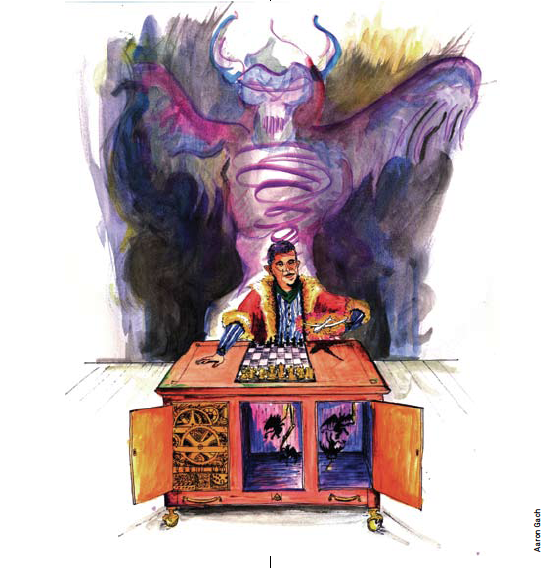
Illustration: Aaron Gach
Seldom used in stage magic today, automata (self-operating mechanical figures) featured prominently among conjuror’s acts before the 1900’s. Skillful craftsmen offered public demonstrations of elaborate clockwork characters that could perform entertaining miracles. Perhaps the most famous automaton of all time was the chess-playing spectacle known as The Turk. From the late 1700’s through the mid-1800’s, the turban-topped, robe-wearing, moustachioed machine amazed audiences in Europe and the Americas as he defeated the majority of his opponents, including Ben Franklin and Napoleon Bonaparte.
Despite an intense amount of public speculation and scrutiny, the mystery of its inner workings remained a closely guarded secret for many years. Although some correctly suspected that The Turk was in fact a mechanical illusion that concealed a human chess master, these theories were particularly difficult to prove since The Turk was opened up at the beginning of performances to provide the audience with a view of its interior.
In crafting illusions, it is essential for magicians to deflect suspicion by guiding audience perception. This may occur through misdirection, camouflage, patter—or, in the case of The Turk—a combination of all three presented through a carefully orchestrated sequence of events that gives a false appearance of reality. The final effect in this case was an amusing battle of wits apparently between man and machine that was way ahead of its time. Resonating with some of the earliest fears and hopes of the posthuman condition, it predated Mary Shelley’s techno-angst classic, Frankenstein, by nearly 50 years, and IBM’s Deep Thought chess computer (which lost to chess champion Garry Kasparov in 1989) by more than 200 years.
Somewhere between the horror of Frankenstein and the hubris of Deep Thought a melange of other mechanistic mayhem has emerged with far less entertaining implications. Although Nikola Tesla first conjured the notion of a squadron of remotely piloted warplanes in 1915, it has only been in the past decade that drone warfare has moved from from the shadows into the spotlight. In this “theater of conflict,” we find ourselves once again presented with the illusion of intelligent machinations. As with The Turk, we are often presented with a well-choreographed display intended to subvert our logic through partial truths and deceptive patter.
Drone strikes (particularly when they run afoul) are frequently discussed by government spokespersons as if the machines were making their own decisions, with zero accountability for their human operators, strike teams, or the officers and officials who authorize and oversee these missions from an air farce base outside of Las Vegas. When US missiles kill people in countries that we’re not even at war with, should it even matter if the aircraft had a human being sitting in the cockpit?
Continue readingApparently this was Lou’s final appearance onstage. The last few minutes are like some beautiful farewell…
Lou Reed & Antony, “Candy Says,” Salle Pleyel, Paris 6 March 2013
LOU REED, 71
the easiest heroes are consistent
but the ones who really shape us
are random maniacs
whose work we stumble across
at times in our lives
we desperately need misdirection
and so it was i met the music of lou reed
through a guy named buzz
who’d bought the first velvets album
but didn’t like it
just the way he hadn’t liked the first mothers album
a month earlier
which meant i got each for a buck
there is literally no way to describe
the way that record hit me
i was a ten year old seventh grader
and the first time i played the album
i was transformed into someone else
someone who knew more than my contemporaries
even if i couldn’t quite shake it all out
lou and john and sterling and moe
gave me much more info
than i could understand
but they did it in a way
i loved so intuitively
with music exploding in such amazing directions
it made sense on a molecular level
and through the years i followed lou
good scenes, bad scenes, he put us through it all
but we kinda paid attention
because, after all
this motherfucker
this lou reed
this electroshocked cocksucking bastard
who put out many more lousy records than good
was the father of everyone i’ve ever known
and i never thought he’d die
and i really miss him
more than i ever thought i would
— Byron Coley
The definitive MC5 documentary feature film — two hours — made a few years ago — never released.
The following article on the making of this documentary was originally published in Arthur Magazine No. 9 (March 2004) (available from The Arthur Store) when the commercial/theatrical release of this wonderful, heartbreaking film seemed imminent…
HIGH FIVE
Detroit’s visionary MC5 receive a film tribute that aims to rewrite rock history
By Steffie Nelson
On New Year’s Eve, 1972, the MC5 took the stage at Detroit’s Grande Ballroom, a vast psychedelic venue where they’d held court as the “house band” between 1966 and 1969. Their live shows had been so incendiary, the five band members so arrogant, that even a huge star like Janis Joplin, no slouch in the live department, once refused to go on after them. This gig, their swan song as it were, was sloppy and dispassionate; the ghosts of past glories even more unforgiving than the sparse, cynical crowd. Guitarist Wayne Kramer took off mid-performance to go cop dope, and the MC5 never played again. Kramer and guitarist Fred “Sonic” Smith were 22; singer Rob Tyner and drummer Dennis Thompson were 24; bassist Michael Davis was 26. In the end they’d effectively been “pulled apart by the killer forces of capitalism and competition,” which their manager John Sinclair had railed against, perhaps presciently, in the liner notes to their now-legendary debut album Kick Out The Jams.
The MC5 hold a curious place in rock history. Their ascendance represented a moment in America when art and commerce converged, when all that was vital and visceral was also the pinnacle of hip. As the flamboyant and badass musical mouthpiece of the White Panther Party, the MC5 did embody the soul of the late ‘60s counterculture: one foot in the optimistic past and the other in the disillusioned, deadly future; one hand holding a guitar, the other a shotgun. It’s an irresistible image, one which was unappetizingly co-opted by Levis last spring for a series of T-shirts. A promotional performance in London by the three surviving Five (Rob Tyner suffered a fatal heart attack in 1991; Fred Smith died of heart failure in 1994) was seen by detractors as a final, sad sellout.
The question of whether or not the MC5 failed at the end of the day is much debated in the riveting feature-length documentary MC5: A True Testimonial, directed by David Thomas and produced by Laurel Legler. All parties agree, however, that for a fleeting, incandescent moment the MC5 were “at the center of the yin-yang,” as Michael Davis philosophizes in the film, “and it was our job to keep it going in a positive direction.”
But the proverbial yin-yang was already spinning into darkness, and it took the MC5 with it. Like fireworks on the fourth of July, they rose with a bright, beautiful bang and, as far as mainstream America was concerned, disappeared with a puff of smoke into the night. They were, ultimately, sacrificial – the artistic entity that was the MC5 didn’t survive more than seven years—but their legacy has continually inspired legions of punks, rockers, artists and freaks, who got turned on to their music through word-of-mouth, or more than likely though the persistent echo of a call to arms that rings with timeless resonance: “kick out the jams, motherfucker.”
As David Thomas says, “The people who know, know. The other people don’t get it.” The Chicago-based Thomas and his wife Laurel Legler began working on MC5: A True Testimonial in 1995, spurred on through financial troubles and licensing hassles by sheer love and respect and the determination to do justice to these American legends. As Legler points out, few bands have received this sort of filmic treatment, and if they have their way MC5: A True Testimonial will revise rock history. On the eve of a limited theatrical release and the worldwide release of a nearly four-hour DVD edition of the film (including deleted scenes, complete live performances, interview outtakes and fan testimonials), David Thomas and Laurel Legler are ready to testify.
Continue reading

From Michael Hurley:
Those who know of the evils and outrages of Monsanto, biotech agriculture, GMOs… what we’re rallying for is to save our food and our bodies from this sickening plague. I’m collecting songs from songwriters to put together for an instructive record album. Then we’ll have a nice concert and a big fish fry, and cook up the last of the non-mutated salmon and good potatoes and beans.
Mail your contribution here:
Michael Hurley
℅ Arthur Magazine
POB 1307
Joshua Tree, CA 92252
=====
Portrait photo of Michael Hurley by Liz Devine, published in Arthur No. 35 (Aug 2013), which features a gigantic, career-defining 11,500-word article on Hurley by Arthur Senior Writer Michael Hurley. You can buy a copy for $5 from a retailer near you, or order it via mail direct from us.