WHERE WILL IT END?: J.G BALLARD, interviewed by V. Vale, introduced by Michael Moorcock (Arthur No. 15/March 2005)

V. Vale, with J.G. Ballard

This feature was originally published in Arthur No. 15 (March, 2005).

Where Will It End?
From his home in an English suburb, controversial novelist J. G. Ballard wonders if there is something fundamentally flawed about the American take on reality. Interview by V. Vale, with an introduction by Michael Moorcock.

Born in 1930, J.G.Ballard spent his formative years in a Shanghai civilian prison camp, experiences which form the basis of his autobiographical novel Empire of the Sun, filmed by Steven Spielberg. In England he abandoned his medicine degree at Cambridge to become a technical journalist. His first stories in New Worlds, Science Fantasy and Science Fictions Adventure from 1956 including “The Voices of Time,” “Vermilion Sands” and “Chronopolis” are in The Complete Short Stories of J.G.Ballard (2002). Three novels, The Drowned World (predicting climate change), The Crystal World and The Drought increasingly reflected his interest in surrealist painting. The Terminal Beach in Science Fantasy (1964) marked a new phase, dispensing altogether with the conventions of science fiction.

Appearing in New Worlds, which by then I was editing, “The Assassination Weapon” (1966) was the first of Ballard’s “condensed novels” where iconographic personalities and events became the basis of narrative. Other stories included “The Atrocity Exhibition Weapon,” “You: Coma: Marilyn Monroe” and “Plan For The Assassination of Jacqueline Kennedy” in New Worlds and, increasingly, in literary magazines such as Ambit and Transatlantic Review. His work encountered considerable hostility in the United States, where its irony went largely undetected. Doubleday, the publisher of The Atrocity Exhibition, ordered all copies pulped after it was printed. It eventually appeared from Grove Press in 1970. Meanwhile, “Why I Want to Fuck Ronald Reagan” became the basis of a UK court case, while his “Assassination of John Fitzgerald Kennedy Considered as a Downhill Motor Race,” “lost” by his U. S. agent, eventually appeared in New Worlds and Evergreen Review.

He remains a seminally controversial writer hugely admired by the likes of Martin Amis, Salman Rushdie, Fay Weldon, Angela Carter, Iain Sinclair and most of the best science fiction writers. Described as pornographic and psychotic when first reviewed, Crash (1973) was filmed by David Cronenberg starring James Spader in 1996. Concrete Island (1974) and High Rise (1975) continued similar themes of our psychological and sexual relationship with contemporary phenomena and iconography. The Unlimited Dream Company (1979) and Hello America (1981) are enjoyable satires; his autobiographical The Kindness of Women (1991) was a sequel to Empire of the Sun. Recent novels like Cocaine Nights (1996), Super-Cannes (2000) and Millennium People (2003) continue to develop techniques describing his unique experience and his notion that contemporary bourgeousie have become the new slave class. Today he lives in the same London suburb where he settled some 45 years ago and, as a widower, raised three children, eschewing electronics and still working at his typewriter. Combining the creative insight and originality of a modern William Blake, Ballard is our greatest living visionary writer. —Michael Moocock


The following is an excerpt from an interview conducted by V. Vale by telephone following the Nov. 2, 2004 United States elections. The interview appeared in J. G. Ballard Interviews, available from http://www.researchpubs.com. J. G. Ballard Quotations is also available from the same excellent publisher.

V. Vale: I wanted to get your “take” on the neo-cons and Bush, and your perspective on what happened with this election in November, 2004.
J. G. Ballard: I’m sure you and your readers have had an absolute Niagara of comment on the subject, so I don’t want to give anything but one European’s perspective on it. But there’s no doubt that most people over here on this side of the Atlantic were hoping for a Kerry victory. There’s something very frightening about Bush and the neo-con group. Donald Rumsfeld is quite a scary figure—putting it mildly.

One feels that Bush and his closest advisers are entirely driven by emotions. They’re no longer driven by a reasoned analysis of where the world is going, and what the U.S. response should be. They’re driven by this visceral need to express their anger—you know, their anger and, really, rage at the world. One feels, listening to people like Rumsfeld, Bush himself, and one or two of the others like Richard Perle, that the world is seen as an extremely hostile place. And moreover, they want it to be a hostile place.
They need enemies who can be challenged and then destroyed. This is a kind of psychology that people in Europe are very familiar with, going back to the psychology of people like Hitler and his henchman, and then to Stalin and the whole paranoid stance that both the Nazi and the Soviet regimes had towards their enemies. If they didn’t have enemies, they would soon invent enemies. Because they’re absolutely hung up—and I suspect Bush and the neo-cons, to a surprising extent, in a great democracy like the U.S., are hung up on this need to hate and this need to destroy. And of course it’s frightening, because where will it end? Today Iraq, tomorrow Iran, and the day after, hmmm… maybe France, you know, because given their mindset, there will be no shortage of enemies.

I think there’s nothing particularly extreme about saying this. I think it’s what people over here perceive of as part of the dangers of this situation. Nobody thinks there is a connection between the 9/11 attack and Saddam Hussein. There’s no connection at all—it’s quite the opposite. Hussein was running a secular regime. Bush and Rumsfeld have created a kind of unstable regime dominated by religious fanatics in Iraq, of the Khadafi kind they thought they were getting rid of!

So it is unnerving. It leads us to question many other areas of the American world view. Is there something fundamentally flawed about the American take on reality? I say that as a lifelong admirer of the U.S., by the way. But it does seem to me that a lot of the formulas that govern American life—in particular its entertainment culture—have leaked out of, say, the Hollywood films and into political reality. That’s frightening.

Continue reading

NOT A KOOK: Trinie Dalton interviews HENRY DARGER doc filmmaker Jessica Yu (Arthur No. 15/March 2005)

Not a Kook
Filmmaker Jessica Yu explores the life and work of mysterious artist Henry Darger in an innovative new documentary.
By Trinie Dalton

Originally published in Arthur No. 15 (March 2005)

In the Realms of the Unreal opens with shots of artist Henry Darger’s dusty homemade books and scrappy art supplies, with actress Dakota Fanning relating how Darger sought solace in art after a childhood as an abused orphan. This bit of biography prepares audiences for Darger’s own summary, narrated by actor Larry Pine, of his life work—a cryptic 15,000-page epic novel detailing a war waged over child slavery—at first illustrated onscreen by stills of Darger’s startling art. But it’s when one of his drawings comes to life—a girl flaps her butterfly wings and flies away—that you realize director Jessica Yu has taken biographical documentary to a new level.

Using animation constructed from Darger’s artwork, Yu opens a door into Darger’s hermetic world of evil, adult Glandelinians and their captive Vivian Girls—cute, Shirley Temple-ish girls who sometimes sport horns, wings, tails and penises. Lightning flashes in stormy skies, soldiers fire guns, and monsters called Blengins circle through the clouds. These nightmarish scenes, it turns out, harken directly back to Darger’s own past: nuns, mean teachers, and childhood enemies from his early life reappear as Confederate army members, often slaughtered on the page as a way to recoup his mental losses. (One especially cruel bully morphs into General John Manley, head of the opposing regime.)

Henry Darger grew up in asylums for feeble-minded children, and spent his adult years as a recluse. A self-taught artist who made a living as a janitor, he lived in a small apartment in the Lincoln Park area of Chicago, secretly recording the war between the Glandelinians and Vivian Girls, down to the last casualties and debts accrued. Incredibly, no one knew of his prodigious artistic talents until his landlords discovered Darger’s work upon his death in 1973 and began to share it with the public. Countless articles and several books have since been published on Darger, but never has his art been actively portrayed as it is here, embellished by a storytelling voice that sounds the way Darger’s voice may have sounded: gentle but curt, impassioned but matter-of-fact. Add in several interviews with neighbors, including one with Kiyoko Lerner, and you get a fascinating—if necessarily speculative—picture of Darger inhabiting his strange fantasies.

Animating someone else’s art is a controversial proposition, doubly so with Darger. His sincere, exacting artistic approach required that he dedicate every second of free time to perfecting his techniques. The boxes of pencil nubs, tall stacks of visual reference and piles of used watercolors that Yu’s camera scans across demonstrate that Darger was his own harshest teacher and critic. Fortunately, Yu’s animators kept the special effects to a minimum, going more for an old-fashioned, paper-doll like style rather than the gaudy Pixar look. The animation is charming and loyal to the work.

Yu’s last two films—the Academy Award-winning Breathing Lessons: The Life and Work of John O’Brien and The Living Museum—also documented artists who overcame physical and mental challenges. She’s friendly and open, making it obvious that she’s doing what she loves. I interviewed her at her home in Los Angeles, as she was preparing to travel to Chicago, Darger’s hometown, for the film’s opening festivities.

In the Realms of the Unreal is screening in select theatres across North America through April.

Arthur: How did this film come to be?
Jessica Yu: I was giving a talk about my last film, The Living Museum, about a group of artists in a psychiatric center in New York. A reporter in the audience knew the Lerners [Darger’s landlords], and he asked me if I’d heard of Darger. The next day he took me to Kiyoko Lerner’s house. Kiyoko showed me some paintings, then she let me go up to his room by myself. Before this, Darger had been an abstraction to me. But I felt such a strong sense of his presence in his room. Everything in there said something about him. I wanted to tie together the feeling of that room with some comprehensible look at the work, so that we might get a sense of who this person was.

There’s so much great footage of his room in the film. Did you shoot that footage on your first visit?
No, I went back to ask Kiyoko about making a documentary. She was open, but cautious. She doesn’t want people to exploit Darger’s work. I wanted the room to substitute for Darger himself. To do this, I tried to get movement in all the shots, and we shot a lot from where he sat at the desk. I imagined how he might have looked at the room. He had his central point, gazing up at the stained glass window of the dove, sitting at the table surrounded by his work. It gives you a sense of how he lived.

Was your fascination rooted in a love for Darger’s artwork or with his tragic story? Or both? Continue reading

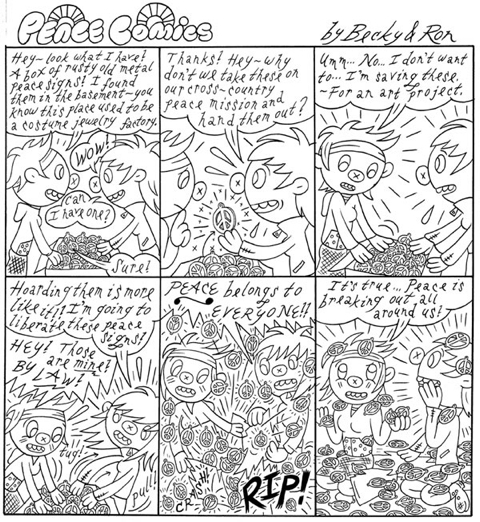
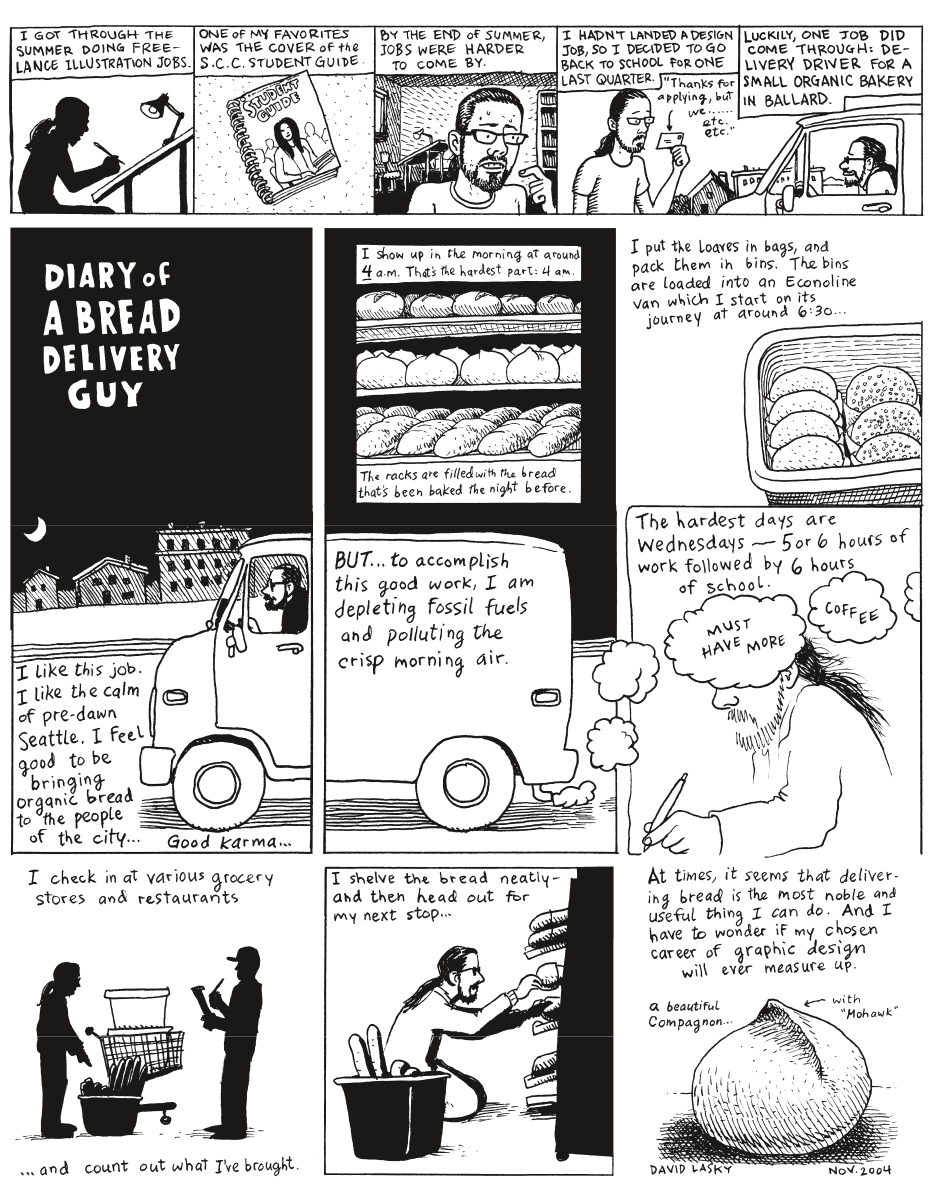
"Post-Election Funnies: How do we make art in this political climate?" edited by Tom Devlin (Arthur No. 15/March 2005)

Post-Election Funnies

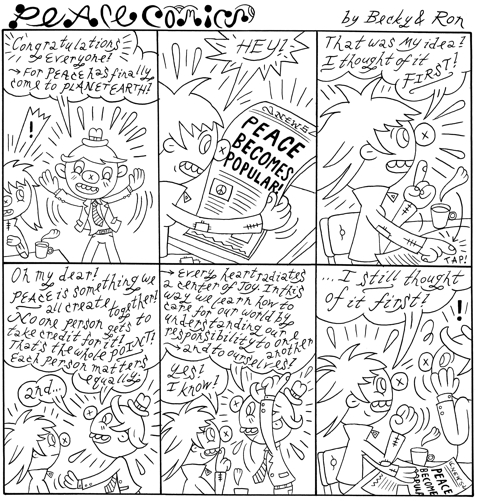
It’s George Bush’s world, they just draw comics in it. A special feature on making art in troubled times, featuring work by Chris Wright, Brian Ralph, Dan Zettwoch, Megan Kelso, Ben Jones, Paul Lyons, David Lasky, Tom Hart, Vanessa Davis, Greg Cook, Marc Bell, Amy Lockhart and John Hankiewicz. Edited by Tom Devlin.

Originally published in Arthur No. 15 (March 2005). Click each image (page) to really enlarge. It’s still not gonna be completely legible—for that, you’ll have to see the actual magazine (available at the Arthur Store for cheep)—but it’s pretty good.

"My Conversation With the Secret Service" by IAN SVENONIUS (Arthur No. 15/March 2005)

Originally published in Arthur No. 15 (March 2005)

A Conversation With the Secret Service
Was I being investigated as a threat to the president—or as a potential hire for a sinister job?

By Ian Svenonius

I have a suspicion that the current president might be assassinated. How do I know? I was interviewed for it.

About a year and a half ago, I took a call from people who identified themselves as the Secret Service. They expressed an urgent desire to see me, which in their highly considered psycho-babble, was made to sound like a choiceless inevitability.

On the demand for an explanation, the agent, a woman, told me that they had intercepted an email which seemed to implicate me in a plot to harm the POTUS: that is, the President Of The United States.

I immediately surmised that her concern was related to a mass mailing I’d written in beat-prose to attract attendees to a night of record playing at a local club, called “Spilt Milk.” Thinking that my audience would enjoy the same amusements as myself, I had perhaps contained some reference to a dispatched leader of the free world.

The Secret Service’s responsibility was to check out every instance of a threat, no matter how far-fetched.

“We need you to come down to the office. It’s extremely important,” the woman insisted.

To get the initial sale, through, they used a female agent, knowing via a psychological assessment based on telephone and computer surveillance, that this would seem less threatening to me. Like a talented telemarketer, she was gentle but firmly coercive. In fact, the two professions are related, as the FBI and CIA’s inquisition techniques are lifted straight from Nelson Rockefeller’s bible for salesmen, How to Win Friends and Influence People, and feature the exact same mind control tricks. Of course, telemarketers don’t have the weight of state security at their disposal.

“I can’t come down, I’m really busy,” I told her, though my inbred instinct was to obey.

“We’ll come to your house, then,” she insisted, another offer I evaded.

After much back and forth, I agreed to meet “them,” the Secret Service agents, at a French bistro not far from my house. It seemed less likely that they’d kill or abduct me in a public setting.
Before I left my home, I alerted a few people as to the nature of my rendezvous and they agreed to witness the interrogation from afar, unannounced.

When I arrived, the officers were sitting in the outside cafe section under a sun umbrella which said “CHIMAY.” One was the woman I had spoken with on the telephone and she was accompanied by a man in a lowslung baseball cap with some rugged facial growth.

They looked drab and angry, respectively.

As the woman agent clasped the evidence and sat businesslike, her partner assumed the “bad cop” persona, searching me like a berserker and then scowling fiercely through the duration of the meeting. The implication was clear; if he were let off his chain, he would make quick work of me for god and country.

The purpose of this choreographed psycho-ballet is of course to draw the detainee into the maternal arms of the good cop so as to escape the paternal bad cop figure’s wrath. This psy-op cliche was immediately transparent, but it still worked; psychological reflex is at least as dependable as the blood-and-guts kind.

Meanwhile, my own spy witnesses had taken their anonymous positions, taking snapshots innocuously in case I were later dangled from a helicopter by these freak thugs.

When the waiter came by, I ordered a latte.

The mama character drew the offending email from a folder dramatically, like it was a bad report card. She read it aloud, slowly and haltingly as if translating from hieroglyphs.

Continue reading

HOROSCOPE by Becky Stark (Arthur No. 15/March 2005)

Horoscope by Becky Stark

Originally published in Arthur No. 15 (March 2005)

Aquarius
(January 21 – February 19)
Many of your judgments have accumulated to create a fortune, a palace and a miracle. You choose again, and you choose the miracle. In your vast explorations of horizons rising and falling, the delight you bring and the fascinations you lead are the priceless seeds of revolution, thought up on a ferris wheel ride!

Pisces
(February 20 – March 20)
In dreams the water comes most. This mystery of you is everlasting, and rest comes from the sands. We take the sand as our character and our part. To feel the whole, we wash these small pieces through our hands. Return to the sand—walk on it, too!

Aries
(March 21-April 21)
Always beginning: the paradox of sublime sorcery. There is none more beautiful than the infant! Beautiful, perfect, divine, child. You are weeping new tears that we can drink. Thank you for the new dance steps, too.

Taurus
(April 21 – May 21)
Dear sweet power of thought: I now devote myself to your relation. The miracle of thinking and how magical this ability is to make reality—these thoughts guide my new world. I accept my leadership within this heaven of earth that is of my mind.

Gemini
(May 22 – June 21)
O my best friend, best friend of all life—the saddest and most funny—in your nature, human life rests its paradoxes. You are greatly loved as the keeper of the key as we enter the theater of utopia. Thank you for having carried this key with you all along!

Cancer
(June 22 – July 22)
You know everything! With this knowledge you also possess everything. The question is: how can you begin to not know things? Your perfect creative mind is manifested when you have the ability to choose what you see, what you hear, what you know, who you are. You already have this ability.

Leo
(July 23 – August 22)
Forgive the sugar. Forgive the salt. Forgive the beginning, forgive the end. Forgive what you’ve taken, forgive what you stole. Forgive when you waken, forgive when you’re old. Love is the beginning, love is the end. Teach me how to waken, teach me how to mend.

Virgo
(August 23 – September 23)
Do you remember when you witnessed the animals coming to drink at the pool below your rock? You sat for hours as they came, some smiling at you. You tell this story to a stranger and the two of you weep with its tenderness. Remember your tenderness: it is the revelation of music.

Libra
(September 24 – October 23)
If a stranger offers you candy, you should take it. If taking it makes you fear for your life then you should take two pieces. Then also you should start giving candy out to strangers, or maybe something more wholesome than candy.

Scorpio
(October 24 – November 22)
Hello children of desire! Be sure your passions are breaking upon the opening chances for life. Remember: choose ecstasy if it is new. When faced with the prison of before, choose the new ecstasy right now. You may experience this as the opposite of your previous or present body. Now prepare for your own power of god.

Sagittarius
(November 23 – December 21)
O sweet love of the perfect aim! I know that your arrows can go anywhere so you don’t like those targets anymore? Go beyond the target and make your arrows return. This is your new practice. Now we all fly on the wings of your arrows! See how we fly! Your cooperative nature is the sexy side effect of such skillful flight.

Capricorn
(December 22 – January 20)
If clowning was like flying, you are a kite! In this way, you catch electricity from the sky! Lightning travels to your paper and pen and we trust your words. This love is so strong around you that soon your comedies will manifest. Keep the comedies in your heart like you keep the money in your chest! If you are wondering, Hmm. Does it matter if my soul lives or dies? The answer is yes—it matters !! P.S. Your soul never dies.

DREAMWEAPON – The Art and Life of Angus MacLise opens May 10, 2011 in New York


Photo of Angus MacLise in Kathmandu by Ira Cohen

Via Boo-Hooray:

DREAMWEAPON / The Art and Life of Angus MacLise is the upcoming exhibit at pop-up / parasite gallery Boo-Hooray presenting the work of the American artist, poet, percussionist, and composer active in New York, San Francisco, Paris, London and Kathmandu in the 1960’s and 1970’s. The exhibition series is open every day May 10th – May 29th and will include an overview of poetry, artwork, and publications in Chelsea, a sound installation featuring the complete MacLise tapes archive in Chinatown, and a night of film at Anthology Film Archives screening never-before seen outtakes from Ira Cohen’s The Invasion of Thunderbolt PagodaDREAMWEAPON is curated
by Johan Kugelberg and Will Cameron.