WINNERS: John Adamian reviews Holy Modal Rounders doc dvd

Winners
Lunatic folk-poet pranksters The Holy Modal Rounders get their own documentary

Bound to Lose…The Holy Modal Rounders dvd
directed by Sam Wainwright Douglas and Paul C. Lovelace
boundtolose.com

Reviewed by John Adamian

originally published in Arthur No. 32 (Dec 2008)

It’s hard to imagine a music scene more in a need of subversive humor, half-crazed irreverence, and a swift attitudinal kick in the ass than New York’s folk scene in the early 1960s. The folkies in the Lower East Side circa 1963 called out desperately for jesters to deflate their over-serious pieties and do-good earnestness. But when Peter Stampfel and Steve Weber, a pair of hard-partying absurdist folk poet-pranksters, gave the scene just what it needed in the form of the first Holy Modal Rounders record, the effort was met with puzzlement or offended condescension by the established order. As music critic Robert Christgau says early on in Bound to Lose—a loving, engaging and sometimes painful documentary about the group —the Holy Modal Rounders were folk geniuses on the order of Bob Dylan, because they had internalized the founding documents of the movement, most notably Harry Smith’s Anthology of American Folk Music, and they’d approached the business of making folk music with the zeal and experimentation of the abstract expressionist painters and beat poets who partied at the same bars.

Continue reading

NANCE KLEHM on cougars, weeds and mugwort…

Invite the Wild Neighbors to Dinner
by Nance Klehm

from her Weedeater column, originally published in Arthur No. 30 (July 2008)

Charismatic mega-fauna are really taking it on the chin these days. They look great on posters and t-shirts, but don’t let them walk untethered through town!

I was quite upset when, in April, a mountain lion showed up in Chicago, and was shot seven times by the police. I too have always felt a bit conspicuous and unwieldy in the city.

This cougar traveled hundreds of miles to get to Chicago. Perhaps it knocked out a few slow squirrels or stray cats when it touched on the interminable sprawl of Chicago, or Milwaukee, or even Rockford, Illinois, but there were no human attacks. Of course, there could have been—but there wasn’t.

Last year, also in Chicago, a coyote showed up in the refrigerated beverage section of a downtown sandwich shop. After 45 minutes, and after several people-customers took pictures of it with their cell phones, animal control showed up. The coyote was given an overnight stay at a suburban wildlife rehabilitation center and released—probably back into the suburbs.

Most people around here are asking why these animals show up in huge metropolises. I think a better question to ask is this: Don’t you ever feel like one of these animals?

Mountain lions are both protectors and nurturers. They are loners and independent types. They stand for something quite formidable. Heck, they’re lions! It doesn’t seem like city folk are ready to live with such animals. Most have fear rather than respect for them. Lots of fear. Some reasonable. Some not so much.

So, if you feel like you’re a big cat in the big city, how do you protect yourself from being shot?
Perhaps it would be better to adapt the strategy of a weed.

Weeds are plants that were once valued and cultivated but now have escaped cultivation. Some have been further domesticated into a more mild form now recognized as food. For instance, our lettuces are domesticated variations of wild lettuce.

Weeds are really good at hiding in the open. Their secrets are kept close in their invisibility. Their numbers are always spreading.

Be a weed:
thrive no matter where you are
make your own food and oxygen
make soils better for the next inhabitants
send out a gazillion seeds
reincarnate frequently in unexpected places

I want to introduce you to mugwort—Ms. Artemesia vulgaris. She is widespread in the United States. Mugwort pops up in both our urban and rural settings. She is downright plentiful and ready for you to use. (Note: if pregnant, please do not use this herb. Read more about it first.)

Artemis, the Queen of the Beasts, was a wild one. She was an extreme hunter and friend of forest beasts. Artemis found mugwort and delivered it to the centaur. Forever after, it has carried her name.

I recommend you look for Artemesia vulgaris. And when you find her, gently trim a piece and dry it, then simply burn it in a saucer and inhale the smoke. This plant is a protector from evil as well as an aide to communication with the plant world.

Native Americans, Asians, and Europeans have used this plant medicinally and as a healthful culinary herb for hundreds of years. In Europe it was used as the main bittering flavor for ales until cultivated hops took over. My friend, Tree, just shared some of his herby mugwort ale with me while we munched on some homemade cheese. Sweet. Mugwort is used in moxibustion. In acupuncture, this is the smoking punk they hover over your acupuncture points. It draws blood to the skin’s surface and unblocks your body’s meridian points of stuck energies.

Fresh or dried mugwort also repels insects, cleanses your blood of toxins, promotes sweating, and reduces tension. Lastly, you should know it has some of the same properties of its mysterious cousin of a different species (any guesses?).

Mugwort is also used for lucid dreaming. Cut a sprig and put it under your pillow or tuck a sprig into your pocket for protection. Burn some before you settle into an evening outside. Smoke some before you go foraging or before you lie down in a meadow for a nap.

Maybe it is time we invite these charismatic mega-fauna and not-so-charismatic weeds to the table. Set a place for them. I am not talking about putting them on the menu at some upscale restaurant so we can create a demand. I am simply proposing we let them walk through town. They can take up shelter under our porches or feed off the extra bunnies.

Speaking of weeds, please do serve them up, drink them, smoke them, learn about them and love them. Find an overarching but examined respect for them. You should, because the mega-fauna and weeds are already here or on their way.

While riding my bicycle by the train line recently, I saw the ghost image of the big cat out of the corner of my eye. It emerged from the alley and then ducked back in. In other words, the cat’s spirit hasn’t left.

Nance Klehm is a radical ecologist, system designer, urban forager, teacher, artist and mad scientist of the living. She has worked in Australia, England, Scandinavia, the Caribbean and various places in the United States and Mexico. She is a promoter of direct participatory experiences.



Ian Nagoski on American labels and blogs who are finding and sharing good music from all over the world (Arthur, 2008)

PEARL DIVING
Notes on a Few Americans Finding Musical Jewels in International Waters

by Ian Nagoski

from Arthur Magazine No. 32 (Dec 2008)

Record players are altars. The listener first goes through a repertoire of ritual gestures, removing the black spiral-inscribed disc from the sleeve, holding it by the edge and label and placing its center through the spindle before lifting the tone arm and placing it at the edge of the spinning disc. The air in the room begins to move, and the memory held by the disc of a performance by some living, breathing person is reiterated, separated from its image and corporeality in an angelically invisible space. Some part of the listener enters into that space and goes into communion with the unseen force of the sound.

It is magical and mysterious stuff, this impulse for sound-play that is universal among human beings through all times and places on earth.

Continue reading

“SLOW DOWN”: Erik Davis’s “The Analog Life” column (Arthur, 2008)

Originally published in Arthur Magazine No. 32 (Dec 2008)

“The Analog Life”
by Erik Davis

Illustration by P.D. Hidalgo


SLOW DOWN


Is it really so horrible to imagine the planet down-shifting for once?

You can hardly blame anyone for feeling the fear and panic that helped drive October’s near financial meltdown. Scanning the headlines or the newsfeeds, our eyes greeted a steady pulse of bummer lingo. “Global Recession.” “Great Depression.” “Financial Collapse.” Serious words for serious times. But there was another phrase I kept stumbling across, less apocalyptic certainly but still delivered with a grim fatalism, that struck me differently. The economy, we were warned, was showing signs of a significant slowdown.

Slowdown? I don’t know about you, but I could use a bit of a slowdown right about now. Take things easy, not run around so much, maybe poke around the garden and restring that guitar. Hold a neighborhood potluck, learn emergency response, can some tomatoes. I haven’t finished rebuilding the office, and haven’t even cracked The Man Without Qualities.

OK, I am being a little facetious. After all, “slowdown” describes the debilitating stuttering of capitalism’s endless Big Bang-like expansion, an enormously powerful wave of transformation that in some manner or another floats almost all of our boats. If this immense flow of nested feedback loops, production networks, and capital flows starts to slow, then things don’t just mellow out. They start to fall apart, like a Chinese acrobat—scratch that, American acrobat—whose spinning plates lose their momentum and inevitably fall to the floor even as the poor fellow keeps his balance. That means families get pushed into poverty, small businesses close, poor folks grow desperate and rich folks even more selfish and mean.

Continue reading

ARTHUR 32 IS ONLINE-ONLY

a32_cover.jpg

Hey gang,

Well, the economic contraction has now officially claimed Arthur No. 32. The best we can do right now is make the entire magazine available online, for free, to everyone, in various formats. Digital is never a substitute for the real thing, but in this case, it’s better than nothing. We hope.

Continue reading

NYTimes on Arthur's "The Invasion of Thunderbolt Pagoda" release on DVD

August 27, 2006 – Sunday New York Times

Long, Strange Trip for a Hypnotic Film

By JAMES GADDY

It took 38 years, but Ira Cohen’s cult film, “The Invasion of Thunderbolt Pagoda,” which was first screened in 1968 at the high point of the psychedelic hippie head rush, is now commercially available. Given the close calls, the long absences and his chaotic archival system, Mr. Cohen, 71, is a little surprised himself.

“It didn’t really involve patience,” he said in his apartment on West 106th Street in Manhattan, surrounded by books stacked waist high. “It was just reality.”

In 1961 Mr. Cohen built a room in his New York loft lined with large panels of Mylar plastic, a sort of bendable mirror that causes images to crackle and swirl in hypnotic, sometimes beautiful patterns. After a few years experimenting with the technique in photographs, he invited his friends from the downtown scene — like Beverly Grant, Vali Myers and Tony Conrad — to make a film.

Continue reading

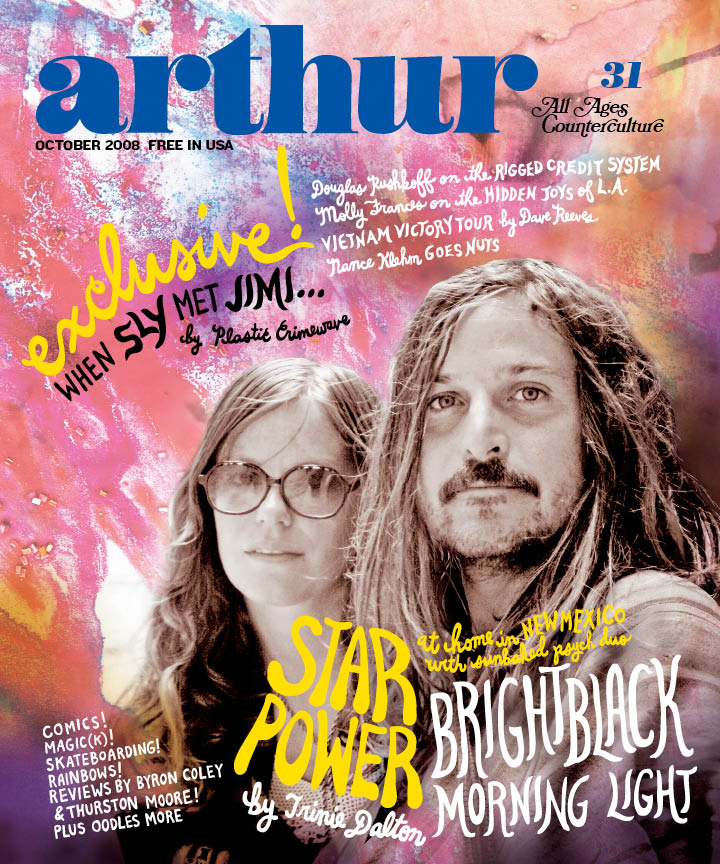
“KEEPING IT LOCAL”: Trinie Dalton visits BRIGHTBLACK MORNING LIGHT (Arthur, 2008)

trinienabob.jpg

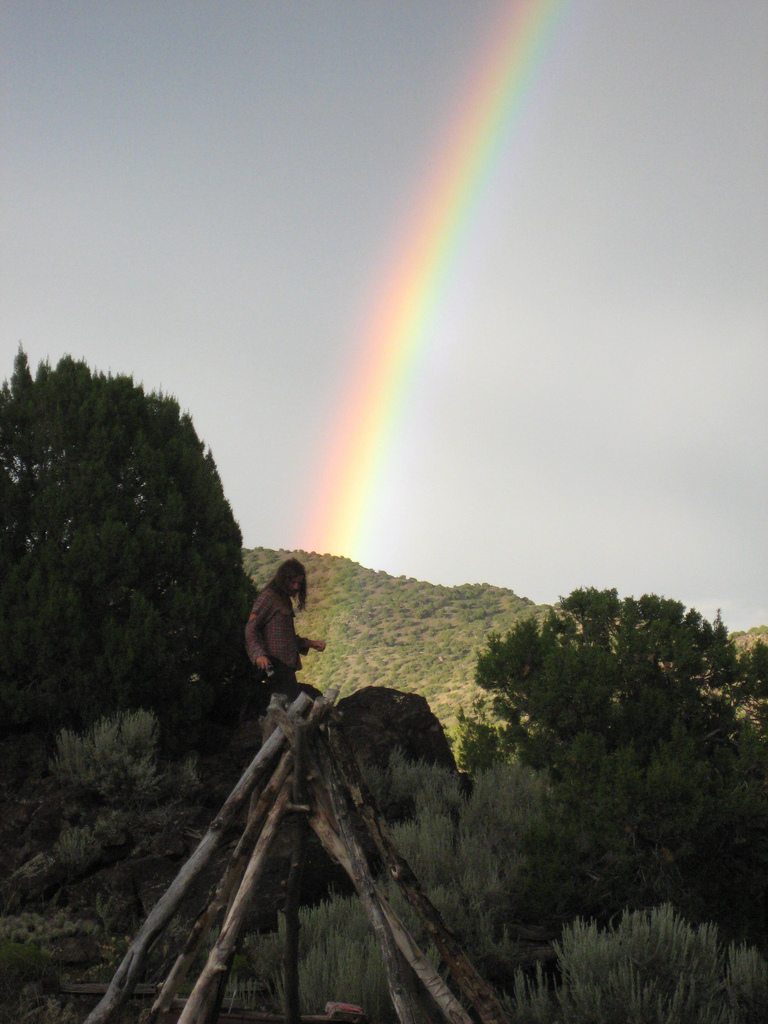
Nabob, photographed by Trinie Dalton

KEEPING IT LOCAL
Two transplants from the Heart of Dixie who went west to the land of mesas, pueblos and geodesic domes, Rachael Hughes and Nathan Shineywater have found a way to thrive beyond society’s mad dash to survive. Trinie Dalton travels to New Mexico to meet BRIGHTBLACK MORNING LIGHT, and hear their stunning new album in the pair’s natural habitat.

originally published in Arthur No. 31 (Oct 2008), with photographs by Lisa Law

Leaving Brightblack Morning Light’s northern New Mexico deep wilderness enclave, I finally get their obsession with the local AM radio. The daily monsoon moves in as I fly down the hill from their town in my red rental car. Mexican cumbia, a variation of the upbeat Colombian pop music, sounds interplanetary crackling through the fuzzy AM distance. I imagine it transmitting from some far off Mexican star, a star I’d like to visit. Crank the cumbia, see what it can do in a storm. Brightblack Morning Light’s Nabob Shineywater says AM is like Sun Ra. Yesterday morning, just after I’d arrived, we were hiking up a wash and Nabob asked, “Who are we to say Sun Ra wasn’t from another planet?”

The sky gets dark as wind kicks up. With the first lightning crackle and boom, the radio shorts and cumbia cuts out—quiet for a moment, then back up, hissing, scratched, and damaged. Have I blown the speakers? Has the radio station’s tower been struck? Each lightning bolt slicing vertically down the flat horizon causes more disruption. Nabob also mentioned that in Los Alamos, scientists recently disproved Einstein’s theory that light travels fastest. Radio waves now win that contest. Two days after the anniversary of the Pueblo Revolt of 1860—a big deal in these parts—thunder means the obliteration of human sounds. Recognizable dance beats are exchanged for something Frankenstein-ish: a live, electric orchestration so weird and marvelous it could only have been invented by Nature, the omnipresent force in this sandy region.

Continue reading

Is the “planetary consciousness” of neotribal psytrance gatherings just window dressing for the same old hedonism?

Art by Hye Jin Lee

Trance Planet
by Erik Davis

originally published in Arthur No. 31 (Oct 2008)

Idanha-a-Nova, Portugal

This August, around 25,000 people hauled their kits and caboodles down a long hot narrow road in the middle of the Portuguese nowhere to camp like migrants along the shores of a lake not far from the Spanish border. They made the trek to attend Boom, a biannual electronic dance music festival that has grown into a large and successful event that eschews corporate sponsorship and keeps its roots in the underground alive. There were all sorts of people at Boom, but the dominant vibe of the weeklong festival was neotribal: a rave-inflected millennial florescence of hippie shit like long hair, fashion exotica, hardcore psychedelia, trance dancing, healing arts, and pagan-ish New Age mysticism with an apocalyptic thrust. There were chai shops and vegan grub vendors and massage centers and drug information booths, plus four music stages that provided everything from cheesy breakbeats to live world fusion to ambient driftworks. But the core genre was psytrance, an intense and sometimes unnervingly trippy form of electronic dance music whose pulverizing, brain-synching and monotonous beats that embody a ferocious psychedelic aspiration that makes dancing at Boom as much a ritual as a party.

Continue reading