“What kind of times are they, when talk about trees is almost a crime because it implies silence about so many horrors?” —Bertolt Brecht (To Those Born Later)
Most people have an appreciation for plants and make an effort to occasionally hike among them, repose in their shade or even co-habitate with them. And while it’s safe to say that we recognize plants’ value and usefulness, it’s also a fair assessment to state that the plant kingdom is frequently taken for granted. When we’re not trampling it, cutting it down, or eating it, we’re usually ignoring it altogether.
Perhaps that’s why the vast majority of modern people who encounter the idea of human/plant communication—or “psychobotany,” as we prefer to call it—find it strange. But it’s equally strange that this viewpoint has become normalized. After all, anthropologists largely agree that people have been attempting communication with the plant kingdom for as long as there have been plants and people. So why is it considered “abnormal” to attempt communication with plants today? And what can we hope to accomplish by entering into such a conversation in the first place?
From engendered grudges and evolutionary angst to theological quibbles and accusations of entrapment, the story of Adam and Eve in the Garden of Eden has certainly been fertile ground for all sorts of controversy. But surely there’s an upside. At the very least the Bible has given us a glimpse of Utopia: proto-hippies living blissfully in a magic garden. In one corner of paradise they receive vitality from the Tree of Life; in another they gain consciousness of self after sampling the forbidden fruit from the Tree of Knowledge.
From ARTHUR MAGAZINE No. 29 (May 2008): Peter Lamborn Wilson’s half-serious proposal for a political movement to uphold and propagate the ideals of Green Hermeticism. Wilson sometimes uses the pen name ‘Hakim Bey.’ He is the author of the Temporary Autonomous Zone concept and manifesto, which, for better or worse, was the original inspiration for the Burning Man festival..
THE ENDARKENMENT MANIFESTO
At least half the year belongs to Endarkenment. Enlightenment is only a special case of Endarkenment—and it has nights of its own.
**
During the day democracy waxes, indiscriminately illuminating all and sundry. But shadowless noon belongs to Pan. And night imposes a “radical aristocracy” in which things shine solely by their own luminescence, or not at all.
**
Obfuscatory, reactionary and superstitious, Endarkenment offers jobs for trolls and sylphs, witches and warlocks. Perhaps only superstition can re-enchant Nature. People who fear and desire nymphs and fauns will think twice before polluting streams or clear-cutting forests.
**
Electricity banished shadows—but shadows are “shades,” souls, the souls of light itself. Even divine light, when it loses its organic and secret darkness, becomes a form of pollution. In prison cells electric lights are never doused; light becomes oppression and source of disease.
**
Superstitions may be untrue but based on deeper truth—that earth is a living being. Science may be true, i.e. effective, while based on a deeper untruth—that matter is dead.
**
The peasants attacking Dr. Frankenstein’s tower with their torches and scythes were the shock troops of Endarkenment, our luddite militia. The original historical Luddites smashed mechanical looms, ancestors of the computer.
**
“Neolithic conservatism” (Paul Goodman’s definition of anarchism) positions itself outside the ponderous inevitability of separation and sameness. Every caveman a Prince Kropotkin, every cavewoman Mrs. Nietzsche. Our Phalanstery would be lit by candles and our Passions avowed via messenger pigeons and hot-air balloons.
**
Imagine what science might be like to day if the State and Kapital had never emerged. Romantic Science proposes an empiricism devoid of disastrous splits between consciousness and Nature; thus it prolongates Neolithic alchemy as if separation and alienation had never occurred: science for life not money, health not war, pleasure not efficiency; Novalis’s “poeticization of science.”
**
Of course technology itself is haunted—a ghost for every machine. The myth of Progress stars its own cast of ghouls and efreets. Consciously or unconsciously (what difference would it make?) we all know we live in techno-dystopia, but we accept it with the deterministic fatalism of beaten serfs, as if it were virtual Natural Law.
**
Technology mimics and thus belittles the miracles of magic. Rationalism has its own Popes and droning litanies, but the spell they cast is one of disenchantment. Or rather: all magic has migrated into money, all power into a technology of titanic totality, a violence against life that stuns and disheartens.
**
Hence the universal fear/desire for the End of the World (or for some world anyway). For the poor Christian Moslem Jewish saps duped by fundamentalist nihilism the Last Day is both horrorshow and Rapture, just as for secular Yuppies global warming is a symbol of terror and meaninglessness and simultaneously a rapturous vision of post-Catastrophe Hobbit-like local-sustainable solar-powered gemutlichkeit. Thus the technopathocracy comes equipped with its own built-in escape-valve fantasy: the Ragnarok of technology itself and the sudden catastrophic restoration of meaning. In fact Capital can capitalize on its own huge unpopularity by commoditizing hope for its End. That’s what the smug shits call a win/win situation.
**
Winter Solstice (Chaos Day in Chinese folklore) is one of Endarkenment’s official holidays, along with Samhain or Halloween, Winter’s first day.
**
Endarkenment stands socially for the Cro-Magnon or “Atlantaean” complex—anarchist because prior to the State—for horticulture and gathering against agriculture and industry—for the right to hunt as against the usurpation of commons by lord or State. Electricity and internal combustion should be turned off along with all States and corporations and their cult of Mammon and Moloch.
**
Despite our ultimate aim we’re willing to step back bit by bit. We might be willing to accept steam power or hydraulics. The last agreeable year for us was 1941, the ideal is about 10,000 BC, but we’re not purists. Endarkenment is a form of impurism, of mixture and shadow.
**
Endarkenment envisages a medicine advanced as it might have been if money and the State had never appeared, medicine for earth, animals and humans, based on Nature, not on promethean technology. Endarkenment is not impressed by medicine that prolongs “life span” by adding several years in a hospital bed hooked up to tubes and glued to daytime TV, all at the expense of every penny ever saved by the patient (lit. “sufferer”) plus huge debts for children and heirs. We’re not impressed by gene therapy and plastic surgery for obscene superrich post humans. We prefer an empirical extension of “medieval superstitions” of Old Wives and herbalists, a rectified Paracelsan peoples’ medicine as proposed by Ivan Illich in his book on demedicalization of society. (Illich as Catholic anarchist we consider an Endarkenment saint of some sort.) (Endarkenment is somewhat like “Tory anarchism,” a phrase I’ve seen used earliest in Max Beehbohm and most lately by John Mitchell.) (Other saints: William Blake, William Morris, A.K. Coomaraswamy, John Cowper Powys, Marie Laveau, King Farouk…)
**
Politically Endarkenment proposes anarcho-monarchism, in effect somewhat like Scandinavian monarcho-socialism but more radical, with highly symbolic but powerless monarchs and lots of good ritual, combined with Proudhonian anarcho-federalism and Mutualism. Georges Sorel (author of Reflections on Violence) had some anarcho-monarchist disciples in the Cercle Proudhon (1910-1914) with whom we feel a certain affinity. Endarkenment favors most separatisms and secessions; many small states are better than a few big ones. We’re especially interested in the break-up of the American Empire.
**
Endarkenment also feels some critical admiration for Col. Qadhaffi’s Green Book, and for the Bonnot Gang (Stirnerite Nietzschean bank robbers). In Islamdom it favors “medieval accretions” like sufism and Ismailism against all crypto-modernist hyperorthodoxy and politics of resentment. We also admire the martyred Iranian Shiite/Sufi socialist Ali Shariati, who was praised by Massignon and Foucault.
**
Culturally Endarkenment aims at extreme neo-Romanticism and will therefore be accused of fascism by its enemies on the Left. The answer to this is that (1) we’re anarchists and federalists adamantly opposed to all authoritarian centralisms whether Left or Right. (2) We favor all races, we love both difference and solidarity, not sameness and separation. (3) We reject the myth of Progress and technology—all cultural Futurism—all plans no matter their ideological origin—all uniformity—all conformity whether to organized religion or secular rationalism with its market democracy and endless war.
**
Endarkenists “believe in magic” and so must wage their guerrilla through magic rather than compete with the State’s monopoly of techno-violence. Giordano Bruno’s Image Magic is our secret weapon. Projective hieroglyphic hermeneutics. Action at a distance through manipulation of symbols carried out dramaturgically via acts of Poetic Terrorism, surrealist sabotage, Bakunin’s “creative destruction”—but also destructive creativity, invention of hermetico-critical objects, heiroglyphic projections of word/image “spells”—by which more is meant (always) than mere “political art”—rather a magical art with actual dire or beneficial results. Our enemies on the Right might call this political pornography and they’d be (as usual) right. Porn has a measurable physiopsychological effect. We’re looking for something like it, definitely, only bigger, and more like Artaud than Brecht—but not to be mistaken for “Absolute Art” or any other platonic purism—rather an empirical strategic “situationist” art, outside all mass media, truly underground, as befits Endarkenment, like a loosely structured “rhizomatic” Tong or freemasonic conspiracy.
**
The Dark has its own lights or “photisms” as Henry Corbin called them, literally as entoptic/hypnagogic phosphene-like phenomena, and figuratively (or imaginally) as Paracelsan Nature spirits, or in Blakean terms, inner lights. Enlightenment has its shadows, Endarkenment has its Illuminati; and there are no ideas but in persons (in theologic terms, angels). According to legend the Byzantines were busy discussing “the sex of angels” while the Ottomans were besieging the walls of Constantinople. Was this the height of Endarkenment? We share that obsession.
Ghosts are unwieldy subjects to contend with. It’s as if their ephemeral nature predisposes them to be barely tangible topics of research. The vast majority of evidence used to support the existence of ghosts is subjective: first-hand reports and eyewitness accounts. Despite the fact that forensic science, cultural geography, physics, and parapsychology all suggest that any given area is inscribed with the residue of that area’s history, the hard data on hauntings remains inconclusive.
To make matters hazier, the definitions of ghosts often swirl together with religious beliefs and philosophical assumptions. For example, if we define ghosts as being the spirits of the departed, we are stating clearly that we believe in life-after-death and some notion that separates body and spirit. Whether this notion is Cartesian dualism, Egyptian ka, Polynesian mana, or the yin-world spirits of Taoism, the assertion is that the individual is not indivisible. At the very least we are forced to accept the idea that the self is multiplicitous.
This shouldn’t be such a leap. At any given moment a person can be characterized by many different activities that s/he engages in: mechanic, musician, anarchist, lover, gardener, cyclist, etc. A person doesn’t think of him/herself as a mechanic when s/he’s in the garden, although s/he also doesn’t stop being a mechanic. We are many things to many people in many spheres of activity – simultaneously. But still we remain ourselves. On the most basic level, we live multiplicitous lives every day.
And when we go to sleep at night, it doesn’t end there. Our dreams continue to embroil us in action-adventures that would surely leave us breathless and exhausted if it weren’t for the simple fact that our bodies barely participate in all of the fun. If there is any sort of universal logic that can be applied as a subjective proof for the insubstantiation of the self, it is the simple fact that we all dream, whether we remember it in the morning or not.
To be clear, dreams don’t prove that ghosts are real. Nor does it prove that ghosts are the spirits of dead people. Rather, the travels we undertake when our eyes are closed simply suggest that a meaningful disembodied existence can occur. Even if we dismiss dreams (and ghosts) as immaterial and inconsequential, anyone who has ever experienced a nightmare won’t deny the fact that these visions can cause acute physical and psychological sensations in our waking lives.
But what are ghosts exactly? The incorporeal dead hanging out amongst the living? Reflected light? Psychosis? Atmospheric anomalies? Holographic messages from the future? Alien lifeforms? Osama’s latest WMD (Weapon of Mental Distortion)? Whatever they are, ghosts, like magic(k), pop up, in one form or another, in nearly every culture on the planet, and have been described in legends, myths, and stories throughout history. A popular Chinese attitude towards ghosts is voiced in the age-old expression, “If you believe it, there will be, but if you don’t, there will not.” According to legend, the saying was penned by a scholar named Zhuxi (Song Dynasty, 960 – 1279). Now Zhuxi was such a strict non-believer that he decided to write an essay about the non-existence of ghosts. But, lo and behold!—a ghost showed up to convince him otherwise. The ghost made such a lucid argument, that Zhuxi was forced to reconsider his thesis. In fact, it’s actually the ghost that is credited with authoring the aforementioned expression, and Zhuxi merely wrote it down.
Whether we believe in ghosts as actual paranormal phenomena, or as manifestations of mass cultural imagination, we can agree on some fundamental characteristics of ghosts. For starters, it’s significant to note that many such manifestations consistently take the form of people, or exhibit seemingly conscious behaviors. This could be similar to looking skyward and seeing faces in the clouds; however, there’s one major exception. When we let our minds drift in the cumulo-nimbus we also tend to see things like bears in bathtubs, and inverted Lay-Z-Boys. And we don’t hear ghastly tales of glowing gaseous forms resembling anything quite so banal, or cute and cartoony. Instead, we are most often presented with accounts of haunting encounters that evoke horror, sorrow, fear, anger, remorse, passion, and purpose. Ghosts emerge from the shadows; from dark corners; from forgotten and abandoned recesses. Regardless of whether or not these phantoms are psychological projections or external paranormal phenomena, it’s clear that our collective response to these apparitions is apprehension, angst, and anxiety.
Generally speaking, there are two dominant types of ghost stories: lost love, and grave injustices. The “lost love” category encompasses all of those apparitions who wait endlessly for lovers to return, or visit their living loved ones for comfort, counsel, and last condolences. In the second category, the vast majority of ghost stories hover around a central theme of grave injustices yet to be rectified. Murder. Torture. Betrayal. The plight of this sort of phantom is one of paradox; it seeks to rest in peace, yet refuses to quit the struggle until things have been set right. While the crimes of the past still linger at the site of a haunting, the ghost’s job is to make sure we, the living, don’t ignore it. Their refusal to let injustices be forgotten manifests in a form of spiritual civil disobedience. From silent vigils to shrieks and moans to outright property destruction, these ghosts are paranormal protestors bearing witness to a world gone woefully awry. In their quest for peace, the phantoms that haunt us defy the laws of the material world in acts of otherworldly anarchism. Offering spiritual resistance to the complicit affairs of everyday life, these insurgent souls have little regard for the rules and boundaries that restrict the world of the living.
They defy even gravity itself. Moving through gates and walls, no barrier restricts their attempts to resolve the inequities that torment them—and consequently us. After all, it is the apathy of the living that drives them to disturb the peace, because they cannot rest until the conflict is, once-and-for-all, addressed and resolved. There is no moving on. Not until unsavory events are properly put to rest.
It’s this kind of dissenting spirit that needs to be channeled today. Even Senator Specter (R-PA), whose position on most policies is rather ghoulish, could not sit idly by when faced with the recent legislation surrounding Guantanamo Bay detainees. Like all hauntings, the degree of uncanniness is quite remarkable. It’s only too fitting that the Chairman of the Senate Judiciary Committee be named Specter. And perhaps even more appropriate that he should take issue with the United States’ recent dissolution of habeas corpus (meaning quite literally “(You should) have the body”). Dating back as far as 1305, and included in Article 1 of the U.S. Constitution, habeas corpus is one of the oldest and most celebrated guarantees of personal liberty. It grants individuals the right to question their detainment and challenge the government on the legality of their imprisonment. By killing habeas corpus, the clock on civil liberties is set back more than seven centuries to a time when judicial courts were simply a king and his dungeons. No wonder Mr. Specter is voicing his disapproval.
The haunting of society by the ghosts of our collective past resonates within a present that continues to manifest grave injustices. Generation after generation, the abuse of power materializes in a reoccurring nightmare, claiming countless victims—collateral damage in a battle to maintain hegemony. Doomed to repeat the tragedies of the ages, these lost souls insinuate their desires and anxieties into the world of the living. Each step of the way, these energies inform our thoughts, our dreams, our actions—indeed, every aspect of our existence. Ghosts are an unsettling reminder that the crimes of the past have not yet been resolved. Refusing to quietly fade from consciousness, they demand that their howls be heeded. The residues of injustice permeate the physical, psychological, and parapsychological landscape, inscribing the present with desperate warnings and demands for reconciliation.
Perhaps it’s time for the living to start paying attention to the stirring in the shadows. These aberrations in space, time, and freedom remain inscribed in mind, spirit, and social body, awaiting their release through the discovery and recovery of our own self-determining forces. Can the righteous spirits of the past truly join forces with the living to achieve peace and justice? If you believe it, there will be, but if you don’t, there will not.
EXERCISES
Through methods of divination, channeling, investigation, experimentation, and active engagement, we can invoke those that seem most experienced in dealing with past inequities—ghosts. Here are a few experiments in magic(k) to get you started. As always, please let us know how it goes by emailing to: goodluck at tacticalmagic dot org
1. Summoning ancestral spirits for guidance and inspiration is an age-old practice re-popularized in the ’70s through Milton Bradley’s mass production of the Ouija board. But you don’t need to jump on eBay to get a piece of the action. Make your own walkie-talkie to the spirit world by covering any smooth surface with the letters of the alphabet, numbers 0-10, and the words, “yes,” “no,” “unclear” and “goodbye.” Use another object that glides easily over the surface as your planchette, or pointer. A shot glass, serving spoon, or cell phone will work okay. A generic board will likely attract a general audience. For the best results, craft your set-up with a righteous spirit in mind using items and symbols that the spirit might find appealing. If, for example, you wanted the counsel of Nathan Hale, draw the board on a copy of the Patriot Act. For Harriet Tubman, try replacing the planchette with a broken handcuff. Grab a few friends, dim the lights, and place your fingertips lightly on the planchette. Then, invite the spirits, and begin your supernatural conspiring.
2. The problem with ghosts is not that they won’t shut up, but rather that it took death to get them to speak up in the first place. Is it fear of death that keeps us from voicing our dissatisfaction with the world of the living? Or fear of life? Fortunately, there’s no need to wait for that last breath to start haunting places. Form your own ghost mob and venture out to haunt sites of known social injustices. Banks, police stations, recruitment centers, and chain stores are but a few potential targets. From large-scale occupations by friends in Halloween gore to quiet insertions of tape recorded whispers and groans, a ghost mob can embody suppressed fears and desires whilst banishing the specters of social control.
3. Encounters with ghosts are said to increase during times of social crises and the post-trauma periods immediately following. Most notably, research suggests that more people see ghosts (or at least report them) in wartime and during post-war transitions. If this assessment is accurate, we should expect a barrage of ghost sightings related to Katrina, Afghanistan and Iraq. We are sincerely interested in studying this trend. If you have had paranormal experiences that you feel are related to social crises, please let us know by emailing us at: socialhauntings at tacticalmagic dot org
ABOUT THE AUTHOR: The Center for Tactical Magic is a moderate international think tank dedicated to the research, development and deployment of all types of magic in the service of positive social transformation. To find out more, check out tacticalmagic.org
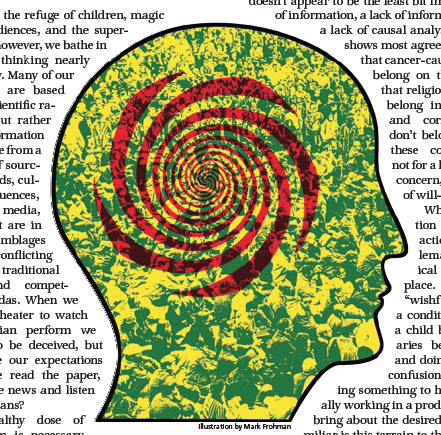
Cognitive scientists use the term “Magical Thinking” to describe a lack of causal reasoning. According to them, the belief in superstitions, lucky charms, and rain dances often falls into this category. But the term can be applied to any situation where one makes judgments based on a cause-and-effect rationale that wouldn’t hold up under scientific scrutiny. Simply put, magical thinking is (from a cogsci perspective) the analytical by-product that occurs when your hopes, fears, desires, prejudices, and beliefs take over your decision-making.
Child psychologists often use the term slightly differently. For a child, magical thinking often refers to conditions in which the cause and the effect are disassociated. For example, the kid sees you grab a remote control from the table and hears the stereo turn on, but doesn’t yet understand that the two actions are related. It is primarily this aspect of magical thinking that stage magicians rely on when performing illusions. In feats of magical reverse engineering, a good magician will think about a desired effect to be produced, and then work backwards to plan the method. The success of the effect is then greatly enhanced by the magician’s ability to conceal the method from the audience. In essence, the magician returns the audience to a state of child-like perception where causes and effects are distant strangers. Some embrace this sense of wonderment while others resent the inflicted feelings of naiveté. Yet, it should be noted that while such magical thinking evokes a child-like sense of the world, it does not limit us to childish behavior.
It would be easy to believe that magical thinking is merely the refuge of children, magic show audiences, and the superstitious; however, we bathe in magical thinking nearly every day. Many of our decisions are based not on scientific rationale but rather on information we receive from a variety of sources – friends, cultural influences, mass media, etc. And many of these sources are in fact assemblages of conflicting truths, traditional bias, and competing agendas. When we enter a theater to watch a magician perform we expect to be deceived. But what are our expectations when we read the paper, watch the news, and listen to politicians?
Cover photograph by Jose Villarrubia. Art direction by W.T. Nelson.
Magic Is Afoot
Celebrated comics author ALAN MOORE gives Jay Babcock a historical-theoretical-autobiographical earful about the connection between the Arts and the Occult
Gen’rals gathered in their masses/Just like witches at black masses/Evil minds that plot destruction/Sorcerer of death’s construction/In the fields the bodies burning/As the war machine keeps turning/Death and hatred to mankind/Poisoning their brainwashed minds” — Black Sabbath, “War Pigs” (1970)
As author Daniel Pinchbeck pointed out in Arthur’s debut issue last fall, magic is afoot in the world. It doesn’t matter whether you think of magic a potent metaphor, as a notion of reality to be taken literally, or a willed self-delusion by goggly losers and New Age housewives. It doesn’t matter. Magic is here, right now, as a cultural force (Harry Potter, Buffy, Sabrina, Lord of the Rings, the Jedi, and of course, Black Sabbath) , as a part of our daily rhetoric, and perhaps, if you’re so inclined, as something truly perceivable, in the same way that love and suffering are real yet unquantifiable–experienced by all yet unaccounted for by the dogma of strict materialism that most of us First Worlders say we “believe“ in. Magic is here.
It’s the season of the witch. And arguably the highest-profile, openly practicing witch–or magus, or magician, or shaman–in the Western world is English comics author Alan Moore. You may know Moore for the mid-’80s comic book Watchmen, a supremely dark, exquisitely structured mystery story he crafted with artist Dave Gibbons that examined, amongst other things, superheroes, Nixon-Reagan America, the “ends justify the means” argument and the nature of time and space. Watchmen was a commercial and critical success, won numerous awards, and made the tall, Rasputin-like Moore a semi-pop star for a couple of years. Watchmen re-introduced the smiley face into the visual lexicon, the clock arrow-shaped blood spatter on its face studiously washed off by the late-’80s/early ‘90s rave scene. Rolling Stone lovingly profiled Moore; he guested on British TV talkshows; he was mobbed at comics conventions; and he got an infamous mention in a Pop Will Eat Itself song.
Recoiling in horror from the celebrity status being foisted on him, Moore withdrew from public appearances. He also withdrew from the mainstream comics industry, bent on pursuing creative projects that had little to do with fantasy-horror and science fiction and adult men with capes. Some of these projects, like the ambitious Big Numbers, fell apart; others were long-aborning sleeper successes that took years to produce, like From Hell (Moore and artist Eddie Campbell’s epic Ripperology), Voice of the Fire (Moore’s stunning first novel) and The League of Extraordinary Gentlemen (a clever Victorian pulp hero romp in comics form, drawn by Kevin O’Neill); and still others were good-faith genre comics efforts to pay the rent and restore certain storytelling standards to a genre (superhero comics) in decline.
In recent years, Moore’s public profile has been rising again, partly due to the embrace of Hollywood. This summer will see the release of the second high-profile film based on an Alan Moore comic series in three years: a $100-million film version of League of Extraordinary Gentlemen, starring Sean Connery. But like the Hughes Brothers’ 2001 radically simplified, arthouse/Hammer adaptation of From Hell starring Johnny Depp and Heather Graham, League will only have some surface similarity to the comics work that inspired it. That’s down as much to typical Hollywood machinations as much as the sheer unadaptability of Moore’s comics–these are works meant to function as comics. Even Terry Gilliam couldn’t see a way to make a film out of Watchmen. Moore’s comics are as tied to the peculiar, wonderful attributes of the comics form as possible.
Comics is itself where the magic comes in. The comics medium is one of the few mainstream entertainment industries open to folks who are openly into what is considered to be very weird, spooky and possibly dangerous stuff. Alejandro Jodorowsky, best known for the heavily occultist films El Topo and Holy Mountain, has been happily doing comics in France for decades. The English-speaking comics industry, meanwhile, has always been open to these sorts of people; indeed, Steve Moore (no relation) and Grant Morrison had been doing magic long before Alan Moore’s late-1993 foray into magical practice. Comics, it seems, attracts–or breeds–magicians, and magical thinking. Perhaps it’s that the form–representational lines on a surface–is directly tied to the first (permanent) visual art: the paintings on cave walls in what were probably shamanistic, or ritualistic settings. In other words: magical settings. Understood this way, comics writers and artists’ interest in magic/shamanism seems almost logical.
For Alan Moore, as the conversation printed below makes clear, this stuff isn’t just the stuff of theory or history or detached anthropological interest. It’s his reality. It informs his daily life. And it informs his artistic output, which in recent years, has been a prodigious outpouring of comics (his ongoing Promethea series, ingeniously drawn by J.H. Williams III, is by far the best), prose essays, “beat seance” spoken-word recordings and collaborative magical performances–one of which, a stunning multimedia tribute to William Blake, I was lucky enough to witness in London at the Queen Elizabeth Hall in February 2000. I did not get to meet Alan Moore at that performance, but I was able to interview him later that year by telephone. We talked for two and a half hours. Rather, Alan talked and I made occasional interjections or proddings. What I found is that Alan doesn’t speak in whole sentences. He doesn’t speak in whole paragraphs. He speaks in whole, fully-formed essays: compelling essays with logical structure, internal payoffs, joking asides, short digressions and strong conclusions. Reducing and condensing these enormously entertaining and enlightening lectures proved not only structurally impossible, but ultimately undesirable. So here are thousands upon thousands of words from Mr. Moore, with few interruptions, assembled from that first marathon in June 2000 and a second in November 2001. Don’t worry–these conversations are not out-of-date. They were ahead of their time. Their time is now.
Because Black Sabbath told us only half the story. There are other, largely forgotten purposes for magic…
Arthur: How did your interest in becoming a magician develop? How has being a magician affected how you approach your work?
Alan Moore: Brian Eno has remarked that a lot of artists, writers, musicians have a kind of almost superstitious fear of understanding how what they do for a living works. It’s like if you were a motorist and you were terrified to look under the bonnet for fear it will go away. I think a lot of people want to have a talent for songwriting or whatever and they think Well I better not examine this too closely or it might be like riding a bicycle–if you stop and think about what you’re doing, you fall off.
Now, I don’t really hold with that at all. I think that yes, the creative process is wonderful and mysterious, but the fact that it’s mysterious doesn’t make it unknowable. All of our existences are fairly precarious, but mine has been made considerably less precarious by actually understanding in some form how the processes that I depend on actually work. Now, alright, my understanding, or the understanding that I’ve gleaned from magic, might be correctly wrongheaded for all I know. But as long as the results are good, as long as the work that I’m turning out either maintains my previous levels of quality or, as I think is the case with a couple of those magical performances, actually exceeds those limits, then I’m not really complaining.
Arthur: You work mostly in comics, which is interesting, as so many magicians–maguses? magi?–have been involved in the visual arts in the last century. Austin Osman Spare, Harry Kenneth Anger, Maya Deren. Aleister Crowley did paintings and drawings.
Crowley lamented that he wasn’t a better visual artist. I went to an exhibition of his and well, some of the pictures work just because they’ve got such a strange color sense, but…it has to be said that the main item of interest was that they were by Crowley. But yes, there’s that whole kind of crowd really: Kenneth Anger, Maya Deren, Stan Brakhage, Harry Smith. And if you start looking beyond the confines of self-declared magicians, then it becomes increasingly difficult to find an artist who wasn’t in some way inspired either by an occult organization or an occult school of thought or by some personal vision.
Most of the Surrealists were very much into the occult. Marcel Duchamp was deeply involved in alchemy. “The Bride Stripped Bare by Her Bachelors”: that relates to alchemical formulae. He was self-confessedly, he referred to it as an alchemical work. Dali was a great many things, including a quasi-fascist and an obvious scatological nutcase, but he also was involved deeply in the occult. He did a Tarot deck. A lot of the Surrealists were taking inspiration from alchemical imagery, or from Tarot imagery, because occult imagery is perhaps a natural precursor of a lot of the things that the Surrealists were involving themselves with.
But you don’t have to look as far as the Surrealists, really. With all of those neat rectangular boxes, you’d think Mondrian would be rational and mathematical and as far away from the Occult as you could get. But Mondrian was a Theosophist. He [borrowed] the teachings of Madame Blavatsky–all of those boxes and those colors were meant to represent theosophical relationships. Annie Besant, the Theosophist around the turn of the last century, published a book where she had come up with the idea, novel at the time, that you could represent some of these abstract energies that Theosophy referred to by means of abstract shapes and colors. There were a lot of people in the art community who were keeping up upon ideas from the occult and theosophy, they immediately read this and thought, Gosh you could, couldn’t you? And thus modern abstract art was born.
One of the prime occult ideas from the beginning of the last century, which is also interesting because it was a scientific idea, and this was the sudden notion of the fourth dimension. This became very big in science around the end of the 19th century, beginning of the 20th, because of people like these eccentric Victorian mathematicians like Edwin Abbot Abbot–so good they named him twice–who did the book Flatland, and there was also C. Howard Hinton, who was the son of the close friend of William Gull, he gets a kind of walk-on in From Hell, who published his book, What is the Fourth Dimension?
And so ‘the fourth dimension’ was quite a buzzword around the turn of the last century and you got this strange meeting of scientists and spiritualists because the scientists and the spiritualists both realized that a lot of the key phenomena in spiritualism could be completely explained if you were to simply invoke the fourth dimension. Two woods of different materials, two rings of wood, different sorts of wood, but at seances could become interlocked. Presumably. This was some sort of so-called stage magic. The idea of the fourth dimension could explain that — how could you see inside a locked box? Or a sealed envelope? Well in terms of fourth dimension, you could. Just as sort of three-dimensional creatures can see the inside of a two-dimension square. They’re looking down on it through the top, from a dimension that two-dimensional individuals would not have.
So you got this surreal meeting of science and spiritualism back then, and also an incredible effect upon art. Picasso spent his youth pretty well immersed in hashish and occultism. Picasso’s imagery where you’ve got people with both eyes on one side of their face is actually an attempt to, it’s almost like trying to create, to approximate, a fourth dimensional view of a person. If you were looking at somebody from a fourth dimensional perspective, you’d be able to see the side and the front view at once. The same goes with Duchamp’s “Nude Descending A Staircase” where you’ve got this sort of multiple image as if the form was being projected through time, as it descends the staircase.
The further back you go, the more steeped in the occult the artists become. I’ll admit to you, this is looked at from an increasingly mad perspective on my part, but sometimes it looks to me like there’s not a lot that didn’t come from magic. Look at all of the musicians. Gustav Holst, who did The Planets? He was working according to kabbalistic principles, and was quite obsessed with Kabbalah. Alexander Scriabin: another one obsessed with Kabbalah. Edward Elgar: He had his own personal vision guiding him, much like Blake had got. Beethoven, Mozart, these were both alleged, particularly Mozart, were alleged to belong to Masonic occult organizations. Opera was entirely an invention of alchemy. The alchemists decided that they wanted to design a new art form that would be the ultimate artform. It would include all the other artforms: it would include song, music, costume, art, acting, dance. It would be the ultimate artform, and it would be used to express alchemical ideas. Monteverdi was an alchemist. You’ve only got to look at the early operas, and see just how many of them are about alchemical themes. The Ring. The Magic Flute. All of this stuff, there’s often overt or covert alchemical things running through it all.
And there’s Dr. Dee, himself. One of the first things he did, he used to do special effects for performances. He got a reputation for being a diabolist just through doing…I suppose it was a kind of 14th-century Industrial Light and Magic, really. He came up with some classical play, which required a giant flying beetle. He actually came up with a giant flying beetle! [laughs] I think that did more to get him branded as a diabolist than any of his later experiments in angels. No one could understand all this stuff that he was doing with the Enochian tables–they weren’t really bothered by that. But he’d made a man shoot up into the air! [laughter] So he must be the devil or something…
Given the sheer number of people from all fields that would seem to have a magical agenda, it’s even more strange that magic is generally held in such contempt by any serious thinkers. I think that most people that would think of themselves as serious thinkers would tend to assume that anybody in Magic must be some kind of wooly headed New Age mystical type that believes every horoscope that they read in the newspaper. That would be completely dismissive of giving the idea of Magic any intellectual credibility. It’s strange–it seems like you’ve got a world where most of our culture is very heavily informed by Magic but where we almost have to keep up the pretext that there isn’t any such thing as magic, and that you’d have to be mad to be involved in it. It’s something for children or Californians or other New Age lunatics. That seems to be the perception and yet once you only scratch the surface in a few areas, you find that magic is everywhere.
Originally published in Arthur Magazine No. 12/Sept. 2004
“One Nervous System’s Passage Through Time”: Magic works, says genius comic book scribe GRANT MORRISON, and he would know—he’s been exploring it for 25 years. He talks with Jay Babcock about what he’s experienced and What It (Maybe) All Means.
Cover illustration by Cameron Stewart.
Although he has claimed to be an heir to an immortal space dynasty who stays cheerful by imagining that aliens “will probably be turning up to rescue him any day now,” Grant Morrison was in fact born in 1960 to a pair of liberal activist Earthlings. Growing up in the slums of Glasgow, Scotland, where he was brought up by his mother while being “barely educated” in public schools, Morrison developed an early enthusiasm for all things pop and fantastic: rock n roll music, science fiction and fantasy literature, mythology and the occult, punks, mods, beatniks and, of course, foxes and cats.
But the early love that would bear the most fruit was for comic books, which he began writing and drawing as an adolescent. Foregoing higher education and living on his own in a Glasgow ghetto from age 19, Morrison gradually built a career as a comics writer of prodigious imagination, armed with a sense of humor: the title of his first published story was “Time Is a Four-Lettered Word.”
After years of toil writing in the British sci-fi comics world while making psychedelic mod-pop with his Glaswegian band The Makers, Morrison landed work at American publisher DC Comics, where his deeply unsettling Batman graphic novel Arkham Asylum, illustrated by Sandman cover artist Dave McKean, was published in 1989. It remains Morrison’s bestselling work but in the wake of his work since then—his two-year run on Animal Man, in which the lead character, refashioned as a superpowered animal-rights activist, gradually becomes aware that he is a character in a comic book; four years of Doom Patrol, a deeply Surrealist four-color romp starring a superhero team of mental patients; shorter works like the multi-meta-superhero comic Flex Mentallo and the controversial-for-obvious-reasons Kill Your Boyfriend; The Invisibles, an epic for would-be technoccult anarchists; and The Filth, a seriously dark and bizarre 13-issue series, discussed at length in this interview—it seems relatively minor.
“You don’t get much time on Earth to do stuff, so I like to keep busy,” Morrison told one interviewer last year, and so he has: in addition to the aforementioned work, Morrison recently completed a 40-issue run on New X-Men and Seaguy, a picaresque three-issue series drawn by this Arthur’s cover artist Cameron Stewart; an original screenplay for Dreamworks; and scripts for two more three-issue series debuting in the next few months, We3 and Vimanarama.
Recently returned from a wedding honeymoon that included a week’s stay in Dubai (where “they’re building the 21st century out of sand,” he says), Morrison spoke at length by phone from his Glasgow home about the whys and wherefores of his work, his life and the Present Situation in Our World.
Arthur: Did you see the news about the super-strong German toddler? I was reminded where you were saying your run on X-Men was a set of fables for the coming mutant, which you thought might already exist or be on their way.
Grant Morrison: I figured even within 50 years we’ll probably have quite a few superhumans on the planet. There’s something about the superman idea that’s pushing itself closer and closer to reality, to the real-life material workaday world that we can touch. The supercharacters began in the pulps and then worked their way through comics, and they keep moving to more and more extensive mass media. Now it’s everywhere, and it’s become the common currency of culture. I said, way back, almost joking, that I thought the super-people were really trying very hard to make their way off the skin of the second dimension to get in here. They want to be in here with us. They’re colonizing people’s minds, and they’re now colonizing movies, so the next stage is to clamber off the screen into the street. I think what you’re starting to see, with things like this weird kid, and also the experiments that are going on with animals, the cyborg experiments and genetic manipulation that is now possible, is that pretty soon there’s gonna be super-people. You’ll be able to select for superpeople: “I want my kid to have electric powers.” That kind of thing.
And when supermen do come along, what are they gonna want to find? A role model. Like everyone else on the planet. We all want to find people who’ve trod our path before, who can suggest some ways to help us feel significant. So the idea behind a lot of what I was doing in X-Men and really all of my comics is to give these future supermen a template, to say “Okay you’re a superhuman, and maybe it feels a little like this. I’ve tried really hard as one of the last of the human beings to think what it might be like in your world.” Rather than bring them to us, which is what a lot of superhero fiction in the past has tried to do, I’ve tried to go into their world and to understand what’s going on in the space of the comics, and to try and find a way to make that into a morality, almost, or a creed, or an aesthetic, that might make sense to someone who has yet to be born with powers beyond those of mortal man. I think we have to give them images of rescue and ambition and cosmic potency, rather than images of control and fascist perfection.
Arthur: Can a cartoon code of ethics really deal with real-world subtleties?
In a sense it is a cartoon code of ethics, but these will be cartoon people, having to live in a real world. And I think the cartoon code of ethics stands up as well as anything Jesus came up with. Don’t kill. Don’t let bullies have their way. Use your powers in the service of good. I think we should be focusing towards that, rather than providing images of destruction or of despair.
Purely on a conceptual level, the Justice League were created to solve every possible problem, right? [chuckles] That’s what they’re there for. They never fail. These are things that the human imagination has created and put on paper and they exist – they have a more than 40 years’ lifespan. Still existing, still clinging to life, these images. So I think if we’ve created something in our heads that’s so beautiful and so strong and so moral that it can solve all our problems with justice, intelligence and discrimination, then why don’t we use it? Tap into it a little more and understand what these images mean and what they can do for us beyond the obvious. Why was Superman created? That’s the really important thing. What kind of imaginative need was being served by that? And to access that again, to make it vital again, to empower the fiction again, I think, would help our culture deal with some of the implications of its own future.
We have to hang onto the immense power of that imaginative world. Every creed, every weapon, every invention or symphony began as an idea in someone’s head. We’re very good at making insubstantial ideas into physical artifacts or systems of conduct—which is magic, of course, humanity’s greatest skill.
Yeah, you can imagine that the first Aryan superman will probably crawl out of his test tube and want to subjugate us all with the hammers of his fists, but by using the power of imagination right now maybe we can provide his mighty brain with something better than conquest to think about.
Ghosts are unwieldy subjects to contend with. It’s as if their ephemeral nature predisposes them to be barely tangible topics of research. The vast majority of evidence used to support the existence of ghosts is subjective: first-hand reports and eyewitness accounts. Despite the fact that forensic science, cultural geography, physics, and parapsychology all suggest that any given area is inscribed with the residue of that area’s history, the hard data on hauntings remains inconclusive.
To make matters hazier, the definitions of ghosts often swirl together with religious beliefs and philosophical assumptions. For example, if we define ghosts as being the spirits of the departed, we are stating clearly that we believe in life-after-death and some notion that separates body and spirit. Whether this notion is Cartesian dualism, Egyptian ka, Polynesian mana, or the yin-world spirits of Taoism, the assertion is that the individual is not indivisible. At the very least we are forced to accept the idea that the self is multiplicitous.
This shouldn’t be such a leap. At any given moment a person can be characterized by many different activities that s/he engages in: mechanic, musician, anarchist, lover, gardener, cyclist, etc. A person doesn’t think of him/herself as a mechanic when s/he’s in the garden, although s/he also doesn’t stop being a mechanic. We are many things to many people in many spheres of activity – simultaneously. But still we remain ourselves. On the most basic level, we live multiplicitous lives every day.
And when we go to sleep at night, it doesn’t end there. Our dreams continue to embroil us in action-adventures that would surely leave us breathless and exhausted if it weren’t for the simple fact that our bodies barely participate in all of the fun. If there is any sort of universal logic that can be applied as a subjective proof for the insubstantiation of the self, it is the simple fact that we all dream, whether we remember it in the morning or not.
To be clear, dreams don’t prove that ghosts are real. Nor does it prove that ghosts are the spirits of dead people. Rather, the travels we undertake when our eyes are closed simply suggest that a meaningful disembodied existence can occur. Even if we dismiss dreams (and ghosts) as immaterial and inconsequential, anyone who has ever experienced a nightmare won’t deny the fact that these visions can cause acute physical and psychological sensations in our waking lives.
But what are ghosts exactly? The incorporeal dead hanging out amongst the living? Reflected light? Psychosis? Atmospheric anomalies? Holographic messages from the future? Alien lifeforms? Osama’s latest WMD (Weapon of Mental Distortion)? Whatever they are, ghosts, like magic(k), pop up, in one form or another, in nearly every culture on the planet, and have been described in legends, myths, and stories throughout history. A popular Chinese attitude towards ghosts is voiced in the age-old expression, “If you believe it, there will be, but if you don’t, there will not.” According to legend, the saying was penned by a scholar named Zhuxi (Song Dynasty, 960 – 1279). Now Zhuxi was such a strict non-believer that he decided to write an essay about the non-existence of ghosts. But, lo and behold!—a ghost showed up to convince him otherwise. The ghost made such a lucid argument, that Zhuxi was forced to reconsider his thesis. In fact, it’s actually the ghost that is credited with authoring the aforementioned expression, and Zhuxi merely wrote it down.
Whether we believe in ghosts as actual paranormal phenomena, or as manifestations of mass cultural imagination, we can agree on some fundamental characteristics of ghosts. For starters, it’s significant to note that many such manifestations consistently take the form of people, or exhibit seemingly conscious behaviors. This could be similar to looking skyward and seeing faces in the clouds; however, there’s one major exception. When we let our minds drift in the cumulo-nimbus we also tend to see things like bears in bathtubs, and inverted Lay-Z-Boys. And we don’t hear ghastly tales of glowing gaseous forms resembling anything quite so banal, or cute and cartoony. Instead, we are most often presented with accounts of haunting encounters that evoke horror, sorrow, fear, anger, remorse, passion, and purpose. Ghosts emerge from the shadows; from dark corners; from forgotten and abandoned recesses. Regardless of whether or not these phantoms are psychological projections or external paranormal phenomena, it’s clear that our collective response to these apparitions is apprehension, angst, and anxiety.
Generally speaking, there are two dominant types of ghost stories: lost love, and grave injustices. The “lost love” category encompasses all of those apparitions who wait endlessly for lovers to return, or visit their living loved ones for comfort, counsel, and last condolences. In the second category, the vast majority of ghost stories hover around a central theme of grave injustices yet to be rectified. Murder. Torture. Betrayal. The plight of this sort of phantom is one of paradox; it seeks to rest in peace, yet refuses to quit the struggle until things have been set right. While the crimes of the past still linger at the site of a haunting, the ghost’s job is to make sure we, the living, don’t ignore it. Their refusal to let injustices be forgotten manifests in a form of spiritual civil disobedience. From silent vigils to shrieks and moans to outright property destruction, these ghosts are paranormal protestors bearing witness to a world gone woefully awry. In their quest for peace, the phantoms that haunt us defy the laws of the material world in acts of otherworldly anarchism. Offering spiritual resistance to the complicit affairs of everyday life, these insurgent souls have little regard for the rules and boundaries that restrict the world of the living.
They defy even gravity itself. Moving through gates and walls, no barrier restricts their attempts to resolve the inequities that torment them—and consequently us. After all, it is the apathy of the living that drives them to disturb the peace, because they cannot rest until the conflict is, once-and-for-all, addressed and resolved. There is no moving on. Not until unsavory events are properly put to rest.
It’s this kind of dissenting spirit that needs to be channeled today. Even Senator Specter (R-PA), whose position on most policies is rather ghoulish, could not sit idly by when faced with the recent legislation surrounding Guantanamo Bay detainees. Like all hauntings, the degree of uncanniness is quite remarkable. It’s only too fitting that the Chairman of the Senate Judiciary Committee be named Specter. And perhaps even more appropriate that he should take issue with the United States’ recent dissolution of habeas corpus (meaning quite literally “(You should) have the body”). Dating back as far as 1305, and included in Article 1 of the U.S. Constitution, habeas corpus is one of the oldest and most celebrated guarantees of personal liberty. It grants individuals the right to question their detainment and challenge the government on the legality of their imprisonment. By killing habeas corpus, the clock on civil liberties is set back more than seven centuries to a time when judicial courts were simply a king and his dungeons. No wonder Mr. Specter is voicing his disapproval.
The haunting of society by the ghosts of our collective past resonates within a present that continues to manifest grave injustices. Generation after generation, the abuse of power materializes in a reoccurring nightmare, claiming countless victims—collateral damage in a battle to maintain hegemony. Doomed to repeat the tragedies of the ages, these lost souls insinuate their desires and anxieties into the world of the living. Each step of the way, these energies inform our thoughts, our dreams, our actions—indeed, every aspect of our existence. Ghosts are an unsettling reminder that the crimes of the past have not yet been resolved. Refusing to quietly fade from consciousness, they demand that their howls be heeded. The residues of injustice permeate the physical, psychological, and parapsychological landscape, inscribing the present with desperate warnings and demands for reconciliation.
Perhaps it’s time for the living to start paying attention to the stirring in the shadows. These aberrations in space, time, and freedom remain inscribed in mind, spirit, and social body, awaiting their release through the discovery and recovery of our own self-determining forces. Can the righteous spirits of the past truly join forces with the living to achieve peace and justice? If you believe it, there will be, but if you don’t, there will not.
EXERCISES Through methods of divination, channeling, investigation, experimentation, and active engagement, we can invoke those that seem most experienced in dealing with past inequities—ghosts. Here are a few experiments in magic(k) to get you started. As always, please let us know how it goes by emailing to: goodluck at tacticalmagic dot org
1. Summoning ancestral spirits for guidance and inspiration is an age-old practice re-popularized in the ’70s through Milton Bradley’s mass production of the Ouija board. But you don’t need to jump on eBay to get a piece of the action. Make your own walkie-talkie to the spirit world by covering any smooth surface with the letters of the alphabet, numbers 0-10, and the words, “yes,” “no,” “unclear” and “goodbye.” Use another object that glides easily over the surface as your planchette, or pointer. A shot glass, serving spoon, or cell phone will work okay. A generic board will likely attract a general audience. For the best results, craft your set-up with a righteous spirit in mind using items and symbols that the spirit might find appealing. If, for example, you wanted the counsel of Nathan Hale, draw the board on a copy of the Patriot Act. For Harriet Tubman, try replacing the planchette with a broken handcuff. Grab a few friends, dim the lights, and place your fingertips lightly on the planchette. Then, invite the spirits, and begin your supernatural conspiring.
2. The problem with ghosts is not that they won’t shut up, but rather that it took death to get them to speak up in the first place. Is it fear of death that keeps us from voicing our dissatisfaction with the world of the living? Or fear of life? Fortunately, there’s no need to wait for that last breath to start haunting places. Form your own ghost mob and venture out to haunt sites of known social injustices. Banks, police stations, recruitment centers, and chain stores are but a few potential targets. From large-scale occupations by friends in Halloween gore to quiet insertions of tape recorded whispers and groans, a ghost mob can embody suppressed fears and desires whilst banishing the specters of social control.
3. Encounters with ghosts are said to increase during times of social crises and the post-trauma periods immediately following. Most notably, research suggests that more people see ghosts (or at least report them) in wartime and during post-war transitions. If this assessment is accurate, we should expect a barrage of ghost sightings related to Katrina, Afghanistan and Iraq. We are sincerely interested in studying this trend. If you have had paranormal experiences that you feel are related to social crises, please let us know by emailing us at: socialhauntings at tacticalmagic dot org
ABOUT THE AUTHOR: The Center for Tactical Magic is a moderate international think tank dedicated to the research, development and deployment of all types of magic in the service of positive social transformation. To find out more, check out tacticalmagic.org


 Arthur Magazine