
Nance Klehm on swine flu hysteria, Four Thieves Vinegar, organic anti-virals and flu foes

sloppykiss

MAY DAY! : “LEANING IN” TO OURSELVES, OUR WASTE AND OUR OTHERS
by Nance Klehm

Last week, in response to the swine flu outbreak, Mexico City managed to close its shop doors and empty its streets of 20 million folks. That’s darkly impressive, but consider this: Mexico City, which once was an island, and whose main environmental pressure has been flooding, has also advised its residents to do frequent hand washing—a simple task made difficult because one of the main fresh water pipelines shut down before the outbreak, affecting a quarter of the city’s population. This is not the first drastic water rationing for this populace, nor will it be the last.

With a high level of street culture where informal interactions are inexhaustible and richly layered—in my deepest belly, I xoxox Mexico City even though I usually come out bruised after a prolonged stay—I can’t help but ask how are we “lean in” when social distancing becomes policy, however temporary.

zabaleen

In Egypt, pigs are not only a food source for the non-Muslim population, they are the “clean up crew,” an integral part of the solid waste disposal system in major cities. In Cairo, pigs are mostly handled by the Zabaleen (Arabic for “garbage people”). The Zabaleen (pictured above) are landless farmers and pig breeders, Coptic Christians who migrated to the city 50 years ago from northern Egypt and became the unpaid grassroots garbage collectors of the city. The 60,000 or so Zabaleen make their living absorbing and sorting Cairo’s waste. Raw materials such as steel, glass, plastic, etc. are resold and other materials are repaired, reused or burned as fuel. Their low-tech, metabolic system means that 80-90% of what they collect is reused, recycled or otherwise returned to the economy.

The Zabaleen keep pigs in apartment courtyards, where they are fed food and other waste. The pigs’ waste is used for fertilizer. Pigs also are used for food.

At the start of this year, Egypt hired foreign multinational contractors to manage Cairo’s waste stream, replacing the Zabaleen and existing systems. The result has been higher disposal fees and a much lower recovery/recycling rate of materials.

Why would a country hire a transnational at a high cost when they have for decades had a highly effective grassroots labor of an indigeonous group do it voluntarily?

To make matters even worse for the Zabaleen, Egyptian goverment officials have responded to swine flu hysteria by ordering the slaughter of the nation’s 300,000 pigs…

* * * * *

In light of all this panic around a possible “pandemic,” my seed-saving pal Damon recently reminded me of an herbal anti-viral elixir, the historic anti-plague remedy called “Four Thieves Vinegar.” The story of this remedy, distilled from many versions, goes like this: In France, during the bubonic plague of the early 1600s, poor mountain folk were hired as gravediggers to dig mass burial pits. Thieves made busy looting homes of dead families. It was a few individuals from both of these groups who had the herbal knowledge of anti-virals, putting them to use in warding off the deadly virus. It is said that a few surviving thieves who were captured for their crimes were released when they shared the elixir’s recipie with the authorities.

HOW TO MAKE “FOUR THIEVES VINEGAR”

Using a quart jar or larger vessel, gather equal parts of dried or fresh thyme, peppermint, rosemary, sage, and lavender, a teeny bit of clove if you’ve got it, and, if you’re a believer in the stinking rose, add some garlic. Pour enough of your homemade fruit scrap or cider vinegar to just cover the herbal material. Put a lid on tight and keep the vinegar some place you pass every day, like near your coffee maker or bed, so you can shake or stir it once or more a day. Do this for as many days as you can. Six weeks is the optimal tincturing time. Strain liquid from the plant material and drink a teaspoon several times daily; wipe down skin and surfaces with it for disinfection; or do both as you feel necessary.

DEALING WITH VIRUSES

Viruses do not contain the enzymes that are needed to live, so they need to have host cells. Those could be in a plant, or an animal or even a bacteria. Without a host, viruses die.

Many of the plants in this remedy are anti-virals – others are also anti-bacterial and/or anti-fungal – I’ve included a full list of easily forageable and cultivatable anti-viral and flu foe plants below.

I’ve taught you how to make fruit scrap vinegar (“Breaking it Down” Weedeater column in Arthur No. 32) and Molly Frances has talked about the uses of apple cider vinegar in Arthur. If you have some of that around then use this as a base. If not , make some so you always have some on hand. Vinegar is so healthy and antiseptic, not to mention delicious, it behooves you to always have some around.

As per my conviction, I only include plants that are easily forageable, cultivated or available in any neighborhood store, urban or rural. This is a decent list but not an inclusive list. I encourage you to do more research around anti-virals and the listed plants.

ANTI-VIRALS

Aloe Vera—Wound healer extraordinaire that is also anti-bacterial, anti-inflammatory and when the juice is drunk, helps repair digestive track and soothes ulcers. Always have this plant or a leaf on hand.

Eucalyptus—You lucky Californians! The oil from this common weedy tree is also anti-bacterial and anti-fungal. It breaks up and expels mucous, relieves congestion and cools fevers.

Garlic—The ubiquitous garlic is antiseptic, anti-bacterial, anti-parasitic, anti-fungal, immune-stimulating and anti-protozoan. Growing garlic is easy… try it!

Ginger —Yummy and fairly easy to find, ginger is anti-bacterial, anti-fungal, diaphoretic, anti-spasmodic, circulatory stimulant, anti-arthritic, anti-inflammatory and more. Can also be used in baths to warm the body and promote sweating.

Hen of the Woods – Forageable mushrooms -Yummy!

Lemon—Again this is a ‘forageable’ for the Californians… Lemon helps fight infections and stimulates immune system

Shiitakes – Easy to grow indoors. Investigate this!

Thyme—Chases mucus from the body. Thyme is antiseptic, antibiotic and anti-microbial.

Wildflower Honey – In its original undiluted state, there is no shelf lfve for honey. If you don’t keep bees, or know someone who does, work on either of these relationships this season. Honey is anti-biotic and anti-inflammatory; it’s an immune stimulant; it’s anti-carcinogenic, a laxative, a cell regenerator, and it’s anti-fungal… etc.!

FLU FOES

Clove— Anti-bacterial, anti-septic, anti-microbial, bactericidal. Useful for infectious diseases and respiratory infections. This is something you pick up off a grocery shelf. Invaluable painkiller. I have used this on tooth and gun aches with huge relief.

Common Sage—wonderful for throat and upper respiratory infections.

Hyssop—This is most delicious as a tea. It relieves congestion, cough, sore throats and the constant beautiful blooms makes bees deliriously happy.

Juniper—Anti-bacterial, anti-fungal, antiseptic. Useful for upper respiratory infections, urinary tract infections, candida, salmonella, e. coli… Good to burn tby our dry toilets… Forageable.

Oregano—This common culinary herb is an anti-infectious agent and an immune stimulant. Who knew? Easy to grow too.

Peppermint—Fights infections, relieves congestion, clears sinuses – yum-yum and so easy to grow.

Rosemary—Anti-fungal, anti-bacterial, anti-parasitic. Also for respiratory infections. I love to bathe with this plant. The steaming of this plant also helps relieve migraines. Forageable for you west coasters.

Walnut –A bitter as heck blood cleanser, anti-inflammatory an anti-parasitic. Forageable.

Western Red Cedar – Binds wounds, helps on clearing lungs, diarrhea and an antifungal. Forageable.

Wormwood—Here is my friend Artemesia again, though not the common weedy one. It’s her cultivated cousin of yore…. Wormwood is anti-malarial, anti-bacterial, anti-fungal and anti-inflammatory. In public gardens and therefore forageable with discretion.
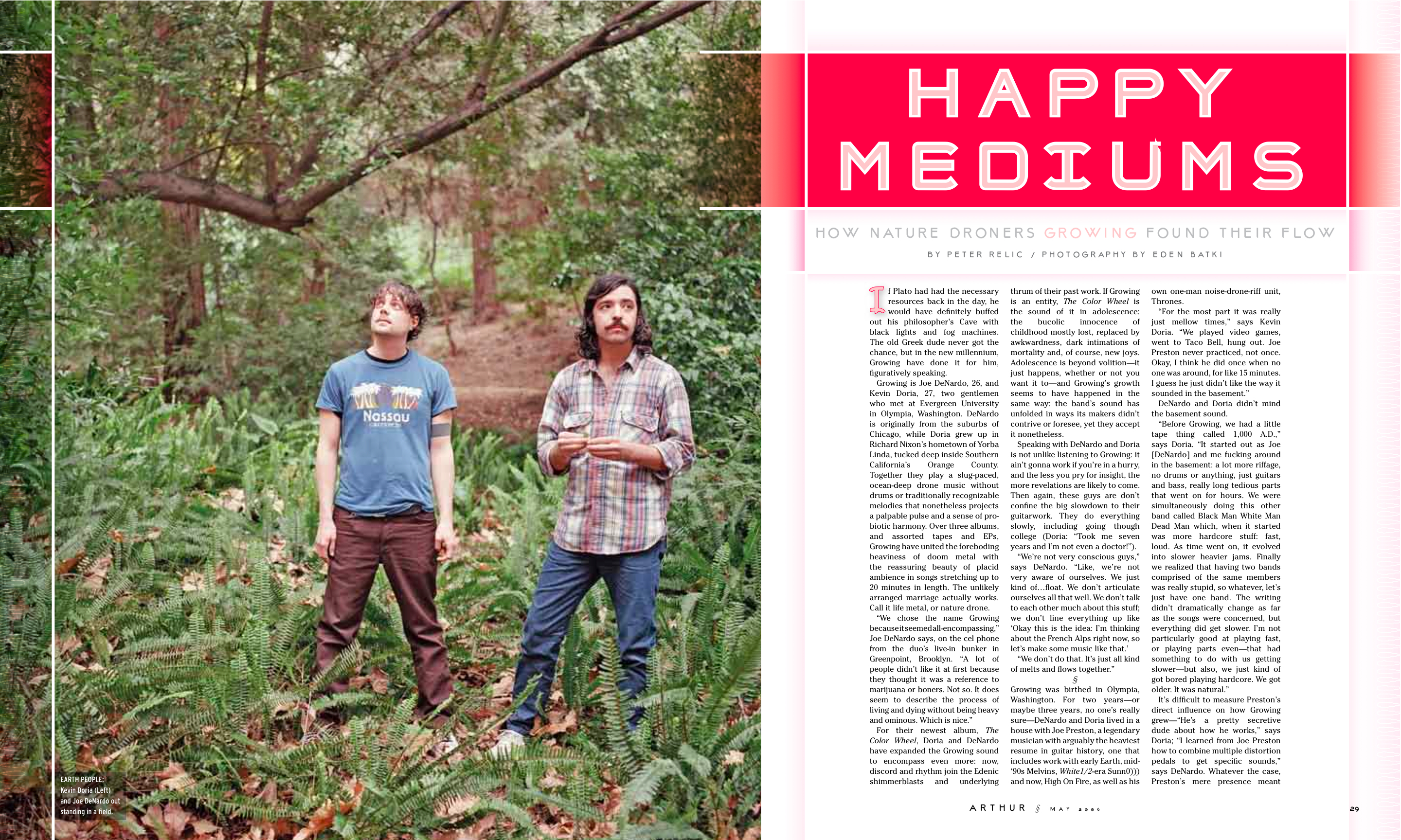
North American droners GROWING, profiled by Peter Relic (Arthur, 2006)

Happy Mediums
How nature droners Growing found their flow

Text by Peter Relic
Photography by Eden Batki
Layout by W.T. Nelson

originally published in Arthur No. 22 (May 2006)

If Plato had had the necessary resources back in the day, he would have definitely buffed out his philosopher’s cave with black lights and fog machines. The old Greek dude never got the chance, but in the new millennium, Growing have done it for him, figuratively speaking.

Growing is Joe DeNardo, 26, and Kevin Doria, 27, two gentlemen who met at Evergreen University in Olympia, Washington. DeNardo is originally from the suburbs of Chicago, while Doria grew up in Richard Nixon’s hometown of Yorba Linda, tucked deep inside Southern California’s Orange County. Together they play a slug-paced, ocean-deep drone music without drums or traditionally recognizable melodies that nonetheless projects a palpable pulse and a sense of pro-biotic harmony. Over three albums, and assorted tapes and EPs, Growing have united the foreboding heaviness of doom metal with the reassuring beauty of placid ambience in songs stretching up to 20 minutes in length. The unlikely arranged marriage actually works. Call it life metal, or nature drone.

“We chose the name Growing because it seemed all-encompassing,” Joe DeNardo says, on the cel phone from the duo’s live-in bunker in Greenpoint, Brooklyn. “A lot of people didn’t like it at first because they thought it was a reference to marijuana or boners. Not so. It does seem to describe the process of living and dying without being heavy and ominous. Which is nice.”

For their newest album, The Color Wheel, Doria and DeNardo have expanded the Growing sound to encompass even more: now, discord and rhythm join the Edenic shimmerblasts and underlying thrum of their past work. If Growing is an entity, The Color Wheel is the sound of it in adolescence: the bucolic innocence of childhood mostly lost, replaced by awkwardness, dark intimations of mortality and, of course, new joys. Adolescence is beyond volition—it just happens, whether or not you want it to—and Growing’s growth seems to have happened in the same way: the band’s sound has unfolded in ways its makers didn’t contrive or foresee, yet nonetheless accept.

Speaking with DeNardo and Doria is not unlike listening to Growing: it ain’t gonna work if you’re in a hurry, and the less you pry for insight, the more revelations are likely to come. Then again, these guys are don’t confine the big slowdown to their guitarwork. They do everything slowly, including going though college (Doria: “Took me seven years and I’m not even a doctor!”).

“We’re not very conscious guys,” says DeNardo. “Like, we’re not very aware of ourselves. We just kind of…float. We don’t articulate ourselves all that well. We don’t talk to each other much about this stuff; we don’t line everything up like ‘Okay this is the idea: I’m thinking about the French Alps right now, I spent time in the caves, we can make some music like…’

“We don’t do that. It’s just all kind of melts and flows together.”

* * * * *

Growing was birthed in Olympia, Washington. For two years—or maybe three years, no one’s really sure—DeNardo and Doria lived in a house with Joe Preston, a legendary musician with arguably the heaviest resume in guitar history, one that includes work with early Earth, mid-‘90s Melvins, White1/2-era Sunn0))) and now, High On Fire (which features an ex-member of Sleep), as well as his own one-man noise-drone-riff unit, Thrones.

“For the most part it was really just mellow times,” says Kevin Doria. “We played video games, went to Taco Bell…just hung out for the most part. He never practiced, not once. Okay, I think he did once when no one was around, for like 15 minutes. I guess he just didn’t like the way it sounded in the basement.”
DeNardo and Doria didn’t mind the basement sound.

“Before Growing, we had a little tape thing called 1,000 A.D.,” says Doria. “It started out as Joe [DeNardo] and me fucking around in the basement: a lot more riffage, no drums or anything, just guitars and bass, really long tedious parts that went on for hours. We were simultaneously doing this other band called Black Man White Man Dead Man which, when it started was more hardcore stuff: fast, loud. As time went on, it evolved into slower heavier jams. Finally we realized that having two bands comprised of the same members was really stupid, so whatever, let’s just have one band. The writing didn’t dramatically change as far as the songs were concerned, but everything did get slower. I’m not particularly good at playing fast, or playing parts even—that had something to do with us getting slower—but also, we just kind of got bored playing hardcore. We got older. It was natural.”

Continue reading

Theusaisamonster Is Done Fighting

Your contributing editor learned a long time ago to be suspicious of most white dreads but theusaisamonster guys get a lifetime pass because they make unstoppable songs like “Cocaine Wedding” and create things like the above eight-minute-long forest-prog fantasy animation video. Witness “Fight No More Forever (remix)” and understand why people are bummed that they’ll be playing their last-ever show, this Saturday, May 9, 2009. Go click around on their mySpace page for more about that show.

A bit more info: The film is directed by Peter Glantz and incorporates 150 fresh new drawings by the great Kevin Hooyman, who was recently featured on this site. The song originally featured on THEUSAISAMONSTER’s “Tasheyana Compost” album.

UPDATE: Director Peter Glantz wrote to let us know that you can download yer very own HD copy of the above video — suitable for iPod screenings, etc — for $1.50. Wotta deal! Just click below …

Today's Autonomedia Jubilee Saint — Henry David Thoreau!


May 6 — Henry David Thoreau
Celebrant of uncomplicated natural life, the future primitive.

MAY 6, 2009 HOLIDAYS AND FESTIVALS
*Feast of the Fiery Flying Roll.

ALSO ON MAY 6 IN HISTORY…
1626 — Dutchman Peter Minuit purchases Manhattan Island from natives.
1812 — Black emancipationist Martin Robinson Delany born, Virginia.
1856 — Psychoanalysis founder Sigmund Freud born, Vienna, Austria.
1861 — Bengali writer, educator, Rabindranath Tagore born, Calcutta, India.
1862 — Back-to-the-land advocate Henry David Thoreau dies, Concord, Mass.
1915 — Filmmaker Orson Welles born, Kenosha, Wisconsin.
1919 — Wizard of Oz creator L. Frank Baum dies, Hollywood, California.
1935 — WPA established in FDR’s New Deal; State as make-work employer.
1937 — Zeppelin Hindenburg explodes over Lakehurst, New Jersey.
1970 — Yuchiro Miura of Japan skis down Mount Everest.
1992 — Film actress, recluse Marlene Dietrich dies, Paris, France.

Excerpted from The 2009 Autonomedia Calendar of Jubilee Saints: Radical Heroes for the New Millennium by James Koehnline and the Autonomedia Collective

May 11, ALI_FIB Gigs Comes to Brooklyn!

peter-walker-color
Parisian curator, critic, and all-around weird music guru Maxime Guitton is the kind of guy that any DIY community would love to have around. Since 2003, his has been gracing the French capital with evening after evening of choice musical and visual phenomena–most of them in some way left of center, and all of them handpicked with love. Ali_Fib Gigs, which he co-runs with Benjamin Tellier and Jérôme Boutinot, has organized some sixty shows and festivals in Europe, in sites ranging from music venues, squats, and churches to crypts, art galleries, and museums. He also curated the music component of the “Psychedelic Explorations in France, 1968” fest at the CAPC museum in Bordeaux last year, which examined the history of psychedelia from a French perspective and the legacy of the late 1960s in the so-called “third psychedelic revolution” of the present.

This Monday, people in the New York area (lucky ducks!) can get the ALI_FIB experience in their very own backyard. Or, more specifically, at Matchless in Brooklyn, with a killer evening of music by raga guitar legend Peter Walker (and one-time musical director under Dr. Timothy Leary), David Daniell, and Carter Thornton. Wow.

Peter Walker + David Daniell +Thornton
Monday May 11th – 9pm – $8
Matchless
557 Manhattan Ave.
Brooklyn, NY 11222
Nassau Ave. (G) / Bedford Ave. (L)

poster by Zeloot

If you can’t make it out the show, check out the Ali_Fib-curated “Err on the Good Side” compilation, recently released on the Swiss-French micro-label, Three:Four. Featuring Amen Dunes, Ben Nash, Duane Pitre, El-g, Sus & Jakob, Hellvete, Illitch, Liberez, Mike Wexler, Sir Richard Bishop, and Steve Gunn.
tfr002-400px

May 10th – Book Launch for Michael Schmelling's "The Plan" at FAMILY in Los Angeles, CA

All over New York City, often hidden in tiny rent-controlled apartments that have survived many waves of gentrification in their surrounding neighborhoods, there are slightly delusional (and perhaps even secretly brilliant) artists, writers, and recluses of all kinds who to this day are continuing to hoard their precious manuscripts, newspapers, records, memorabilia, and artwork that nobody’s ever seen.

Only a privileged few gain access to these dwellings, which are in themselves mini-worlds; each of these apartments is like a museum, devoted exclusively to the compulsive collecting habits of its owner. It’s no shock that there is a New York-based company, Disaster Masters, that finds these compulsive hoarders, counsels them and helps them to clean up their apartments (Sidenote: did you know that in Japan there are similar companies that try to coax teenage boys into leaving their rooms? Read about it here.)

Between 2003 and 2005, photographer Michael Schmelling accompanied Disaster Masters to 12 different apartments, making it his prerogative to document each apartment pre-cleanup, while it was still in its most natural, chaotic state. The result is The Plan, a 576-page book, featuring 490 black and white photographs, with an entire chapter dedicated to each home.

Thanks to Schmelling, these remnants of New York history are now preserved for us all to see. Come take a look at what he’s captured at Family’s book launch for The Plan, where Schmelling will discuss his work, accompanied by a slide show, question-and-answer session, and book signing at the end.

Sunday, May 10th, 7:30pm
FAMILY
436 N. Fairfax Ave. / Los Angeles, CA 90036
Free admission

For more info, visit http://www.familylosangeles.com/

Today's Autonomedia Jubilee Saint — Karl Marx


May 5 — KARL MARX
German communist theorist, capitalist critic, philosopher.

MAY 5, 2009 HOLIDAYS AND FESTIVALS
*Cinco de Mayo.
* Japan: Feast of Banners, fish kites fly.

ALSO ON MAY 5 IN HISTORY…
1818 — Great Communist theorist, philosopher Karl Marx born, Trier, Germany.
1862 — Battle of Puebla, Mexico.
1867 — Nellie Bly, famous for around-the-world race, born, Cochran’s Mills, PA.
1920 — Italian-American anarchists Sacco and Vanzetti arrested, Braintree, Mass.
1925 — John Scopes arrested for teaching evolutionary theory, Tennessee.
1926 — American jazz great Miles Davis born, Alton, Illinois

Excerpted from The 2009 Autonomedia Calendar of Jubilee Saints: Radical Heroes for the New Millennium by James Koehnline and the Autonomedia Collective

"LITTLE FLASHES" by Aidan Koch

Aidan Koch just completed school and she’s looking forward to a productive and creative summer.  Her talent just seems to grow and develop at an exponential rate.  I sense she’s tuned into the source of endless love, the gift that keeps on giving.  She’s working on a follow up to her thesis project (Love Poems) called Night Poems and she also just finished a new comic called YesLittle Flashes is a new work she created just for Arthur, celebrating the ephemeral/eternal beauty of divine existence.

webflash001

Continue reading