
How to Subvert Institutional Authority Through Graffiti and Other Tactics in 13 Steps

Applied Magic(k): Sigils, Logos and Lucky Charms
by the Center for Tactical Magic

Originally published in Arthur No. 23 (June 2006)

One of the first lessons of magic(k) that we learn as children is that words and symbols have power. Abracadabra. Hocus Pocus. A five-pointed star. A four-leaf clover. As we get older, this primary notion quickly degrades and often becomes the source of one of the first dismissive tendencies towards magic(k) that arises amongst adults. Too many hokey movies and failed attempts to levitate with an utterance conspire against us. Soon the lesson is forgotten; magic(k) words and the power of symbols sneak away to party with Santa and the tooth fairy.

But words and symbols continue to work their magic(k) regardless of whether or not we believe in them. Look at the recent outcry against Madonna singing from the cross or riots in response to Mohammed cartoons and we begin to see that the power of symbols is anything but make-believe. For those who insist that religious sensitivities are an easy shot, consider this secular example: For over 150 years the United States had a Department of War. During much of that time U.S. foreign policy consisted of “neutrality” and therefore the DoW did not lend any direct military support in foreign conflicts. World War II put a definitive end on U.S. neutrality once and for all, and in 1947 the DoW was renamed the “National Military Establishment” or NME (pronounced “enemy”). Realizing the error of their acronym, politicians again changed the name in 1949 to what we know today as the “Department of Defense.” More than half a century after “war” became “defense” the DoD sits deep within the Pentagon planning “pre-emptive defensive strikes” while waving a flag with 50 pentagrams on it.

Okay, so spin-doctoring isn’t exactly the same thing as witch-doctoring. Still, most performing magicians (conjurers) won’t deny the power of language. And few will debate the fact that word choice makes a difference when presenting a trick. Many will even insist that the “patter” makes or breaks the illusion. More to the point, the strength and efficacy of a trick is often closely tied to the audience’s ability to relate both specifically and abstractly to the overall illusion. This is precisely why magic with money tends to hold people’s attention more than tricks with handkerchiefs. Money is already a loaded symbol, whereas how many people revere a silk hanky? If you still maintain your doubts, try first performing card tricks over lunch and then later in the middle of a poker game. Any guesses on which audience gets more riled up when you magically produce four aces from up your sleeve?

Admittedly, the ability to make a scrap of green paper covered in Masonic symbols disappear doesn’t quite live up to our childhood expectations of magic(k). Perhaps this is especially true because we become adept at making dollars disappear all the time. As we grow older, we become initiated into the Church of Consumerism. It is here that we become increasingly distrustful of anything “magical” since we quickly find the mystique tarnished by a barrage of commodities gilded in glitz. Yesteryear’s potions, spells, and apparatuses are hawked as today’s energy drinks, pharmaceuticals, and hi-tech gizmos. Finding ourselves surrounded by “magic” cleaning supplies, “power” tools, and Lucky Charms, it’s easy to concede that there’s no such thing as “real” magic(k). Yet, ironically this is where some of the oldest forms of magic(k) still thrive today.

Continue reading
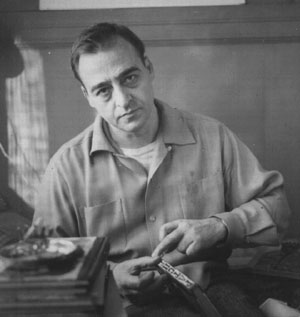
Happy Birthday Kenneth Patchen

It’s the birthday of poet Kenneth Patchen, born in Niles, Ohio (1911). He came from a working-class family — coal mining on his mother’s side, farming on his father’s, and while he was growing up his father was a steel worker in Youngstown. His Scottish grandfather loved to read aloud Robert Burns poems. And Patchen said that in Burns’ poems and his grandpa’s stories, “there was what you would call magic.” He started keeping a diary when he was 12 years old, wrote poems throughout high school, went to a handful of colleges, and traveled around the country working as a migrant laborer.

Then he went to a friend’s Christmas party and met Miriam Oikemus, a college student at Smith and an anti-war activist. The daughter of Finnish socialist immigrants, she had joined the Communist Party at the age of seven. Kenneth and Miriam fell in love and exchanged letters for a while — Patchen wrote her love poems. They got married in 1934. A few years later, when Patchen was just 26 years old, he suffered a terrible spinal injury while he was helping a friend separate two collided cars. He spent the rest of his life in severe pain, and went through three surgeries. The first two surgeries were helpful, and increased his mobility, so he was able to tour the country and give poetry readings. He partnered with Charles Mingus and the Chamber Jazz Sextet, and he set his poetry to jazz music, for performances and recordings.

But during the last surgery, something went wrong and Patchen fell off the operating table and permanently ruined his back. He was bedridden for the rest of his life, but he continued to write and paint in bed. He said: “It happens that very often my writing with pen is interrupted by my writing with brush, but I think of both as writing. In other words, I don’t consider myself a painter. I think of myself as someone who has used the medium of painting in an attempt to extend.”

During his career, Patchen wrote more than 40 books of poetry and prose, much of it illustrated, including The Journal of Albion Moonlight (1941), The Memoirs of a Shy Pornographer (1945), The Love Poems of Kenneth Patchen (1960), and But Even So: Picture Poems (1968). He dedicated every book to Miriam.

In 1945, two journalists published an article called “The Most Mysterious People in the Village,” about the life of Kenneth and Miriam Patchen. Miriam told the journalists that her husband was “absolutely impossible until he’s had a whole pot of coffee in the morning.” They wrote about visiting Kenneth Patchen’s bedroom: “The bed was massive and so was the man. He wore a faded gray sweatshirt with washed-out blue cuffs and pocket. The shirt was tucked into the waistband of black woolen trousers that were frayed at the cuffs. Patchen wore blue, maroon and tan Argyle socks, but no shoes. His body seemed muscular and powerful; his face delicate and sensitive. His skin was white and his eyes were a deep blue-gray.”

Years later, Miriam described their daily routine: “I’d be up earliest, go for the paper, read it. He’d awaken later, having finally gotten to sleep, have breakfast and look at the news, then get to work. ‘Get to work’ meant writing in bed, lying down. The upright sitting position was painful for him, then. I’d read, wash clothes, house clean, take coffee to him frequently. When we had almost no money life was the same as when we had a little. At 12th Street we always had the rent and money for utilities. With an advance from Mr. Padell we bought a couple windsor-style chairs, one easy chair and a table. What elegance those pieces gave to the doll house.”

Kenneth Patchen died in 1972, at the age of 60. Miriam Patchen remained a champion of leftist causes as well as her late husband’s poetry, and collaborated on his biography Kenneth Patchen: Rebel Poet in America (2000), by Larry R. Smith. Miriam Patchen died in 2000 at the age of 85, sitting up in a chair, reading.

Kenneth Patchen said, “It’s always because we love that we are rebellious; it takes a great deal of love to give a damn one way or another what happens from now on: I still do.”

[SUNDAY LECTURE] "Wild Humanity: People and the Places That Make Them People" by Freeman House

Freeman House is a former commercial salmon fisher who has been involved with a community-based watershed restoration effort in northern California for more than 25 years. He is a co-founder of the Mattole Salmon Group and the Mattole Restoration Council. His book, Totem Salmon: Life Lessons from Another Species received the best nonfiction award from the San Francisco Bay Area Book Reviewers Association and the American Academy of Arts and Letters’ Harold D. Vursell Memorial Award for quality of prose. He lives with his family in northern California.”

That’s the biographical note for Freeman House on the Lannan Foundation website. We would add that earlier in his life, Freeman edited Innerspace, a mid-1960s independent press magazine for the nascent psychedelic community; presided over the marriage of Abbie and Anita Hoffman at Central Park on June 10, 1967; and was a member of both New York City’s Group Image and the San Francisco Diggers.

This is the first lecture in this series. Other lectures are available here: http://www.arthurmag.com/contributors/sunday-lecture/.


WILD HUMANITY: People and the Places That Make Them People
by Freeman House

Revised in November 2001 from a University of Montana Wilderness Lecture delivered in April 2001

1.
Richard Manning writes in Inside Passage: A Journey Beyond Borders, “…people should cease drawing borders around nature and instead start placing boundaries on human behavior…we should begin behaving as if all places matter to us as much as wilderness. Because they do.” We have not only set wilderness apart from our everyday lives; we have also made a distinction between human life and the very concept of wildness. The effect of this questionable distinction is to put a most dangerous limitation on our potential for adaptive human behavior. As Manning continues, both our parks and our culture set “a line between utility and beauty, sacred and profane. This line is destroying us, as it is destroying the planet.”

A few months ago I heard Florence Krall summarize her late husband Paul Shepard’s life work in a single sentence: There is an indigenous person waiting to be released in each of us. Our genome is “the sum of an individual’s genetic material, a product of millions of years of evolution” (Shepard 1998). The human genome is as wild as the ecological systems out of which it evolved. Basic comfort as a human being requires a conscious interaction with the more-than-human aspects of the textures of life surrounding, just as an infant needs the touch of other humans to thrive. Wild animals can survive for a while in a zoo. Contemporary humans are trained for survival in the zoo of an abstracted, objectified, and commodified world.

The genome demands, writes Shepard, that our cultures constitute a full and rewarding mediation between ourselves and the ecosystems within which we live. By this tenet, our genome, the structure within which our rational processes are embedded, is requiring of us that we recover our niches in particular ecosystems. Strong and mysterious language: the genome demands. It suggests that we are impelled to engage the health of our watersheds and ecosystems as a first step in our search for sanity—for ourselves, for our communities, and for our species.

The title of this series is the poetics of wilderness, but I’d rather be talking about the poetics of the wild. Because it’s among my assumptions that “wilderness” is a social and political construct, while the word “wild” is best used to describe the essential organizational structure of Creation; that Creation is a wild unfolding; and that we humans (as well as all our co-evolved life forms) are both expressions and agents of that unfolding.

Given these premises, it is quite possible that the self-satisfied technological advances of the last 500 to 5000 years of so-called civilization may not represent the pinnacle of evolution we encourage ourselves to believe they are. Continue reading

CLOSE

Photo by Tim Rooke / Rex Features ( 1259561a )

09 Dec 2010
Prince Charles and Camilla Duchess of Cornwall’s Rolls Royce Phantom VI is attacked by student protesters (leaving it with a smashed window and covered in paint) as they travel to the London Palladium for the Royal Variety Performance.

Arthur Radio Transmission #31 w/ ARP

When you close your eyes, music emanating from speakers takes on its full 3D form. Physical vibrations reach your muscles in invisible waves, aiding in relaxation. The laser arc of a new sound being introduced pierces your mind’s eye and opens visions; it is possible to recreate an entire scene, part imaginary, part from memory. An isolated ocean in a desert, palm trees swaying against an open horizon. Circuits producing not only the sound of wind, but the feel of it brushing up against your skin, the filling of a vast expanse of sky…

Above: A teaser from this episode’s live set by special guest ARP (aka Alexis Georgopoulos), who recently released his LP The Soft Wave on Norway’s Smalltown Supersound. Order it in the US here.

STREAMING: [audio:http://www.arthurmag.com/magpie/wp-content/uploads/2010/12/Arthur-Radio-31-w_-ARP1.mp3%5D

DOWNLOAD: Arthur Radio Transmission #31 w/ ARP 9-26-2010

Playlist below…

☾☾☾☾☾☾☾ Hairy Painter + Ivy Meadows DJ set @ 00:00 ☽☽☽☽☽☽

Continue reading

Arthur co-presents Tues Dec. 14 at Cinefamily: HENRY JACOBS SPECTACULAR

We are positively giddy to be co-presenting this evening at Cinefamily that dublab has put together to celebrate the work of Henry Jacobs (pictured above). Arthur readers with fine memories will recall that Henry was lovingly profiled in Arthur No. 26 (August 2007) by Joel Rose (read “One Man Goofing” ) and saluted by filmmaker/artist Mike Mills in the same issue (“Red Goo, Paper Cut-Outs and Conscious Digressions: Henry Jacobs’ handmade absurdism”). Two episodes of Jacobs’ early ’70s PBS show “The Fine Art of Goofing Off” (memorably described as “Sesame Street for adults”) were screened on the main stage between music bands at ArthurFest in September, 2005. But enough about the past. Here are the details for this Tuesday’s event…

TUESDAY, December 14

dublab, Arthur and Cinefamily present

THE FINE ART OF GOOFING OFF AND OTHER WIDE WEIRDNESS OF HENRY JACOBS

All Ages / 8pm / $12

the Cinefamily
611 N Fairfax Avenue
Los Angeles, 90036

www.cinefamily.org

www.dublab.com

From Cinefamily:

What happens late at night when the television fuzz melts together with your subconscious mind? They become one entity and blossom into bright bursts. The TV channels the waves of your id and every unknown notion your cerebrum has hidden away in dusty recesses becomes a glowing explosion of sight and sound. Does this ultimate, brain-tickling television program sound too good to be true? In this day and age of narrow focused broadcast beams it is, but open your eyes wide because in 1972 a few episodes of this magic was made real. Sound artist Henry Jacobs got together with producer Chris Koch and visual artist Bob McClay to create a series of half-hour television programs for San Francisco public television station KQED. This show titled “The Fine Art of Goofing Off” is an ultimate revelation. It is like Sesame Street’s psychedelic, philosophical cousin who lives on the top floor of a tenement on the weird side of the road. It’s a wild, tangential ride through richly layered imagery and hypnotic, non-matching sources. One familiar voice heard on the program is that of Zen philosopher Alan Watts. This is no strange coincidence as Henry Jacobs was as tight with Watts as tight can be. Jacobs is somewhat the voice behind the voice behind the voice behind the voice of Zen. As the co-founder and manager of the Alan Watts archive he has continued spreading his pal’s Eastern Philosophy to the world.

Jacobs is the living, breathing, acting, thinking, laughing, swimming expression of life lived with a mind wide open. This vibe made him fast friends with Alan Ginsberg, Karlheinz Stockhausen, Ken Nordine, Lenny Bruce, Lawrence Ferlinghetti, and many other luminous minds in motion. In the company of stellar collaborators Henry’s creative output has influenced modern music with its inventive twists. He is often considered the originator of modern surround sound due to his “Vortex: Experiments in Sound and Light” which came to life at the San Francisco’s Morrison Planetarium and at the 1958 World Expo in Brussels. He also hosted the very first ethnographic radio show on American radio and released an album “Radio Programme No 1 Audio Collage: Henry Jacobs’ Music and Folklore” on the legendary Folkways Records in 1955. He even provided improvised soundtrack material and background dialogue for George Lucas’ film “THX 1138″ and was nominated for an Academy Award in 1964 for his work on the short film “Breaking the Habit.”

Wow, we could go on and on and on but the point is, you should not miss this screening. We’ll be showing Henry’s favorite moments from “The Fine Art of Goofing Off”, some amazing short films and excerpts from “THX 1138.” We’ll also share audio snippets from Vortex and other moments from “the Wide Weird World of Henry Jacobs.” We’ll even have Henry on the line for a live remote Q&A from his wild outpost on the Northern California Coast. Oh yeah, there will be a live tape loop performance and probably some left-handed ping pong action happening as well.


Henry Jacobs: official website

Henry Jacobs: Important Records

Henry Jacobs: Locust Music

A Poem from Mark Perlberg

Once in a While
by Mark Perlberg

Mother was agitated all morning.
A call had come from her brother Harold,
who was spoken of only in whispers
and despised by those with a talent
for never changing their minds.
But Mother loved him.

Somehow I learned that my uncle
had forged checks and spent time in prison.
And I knew he played the saxophone
in small jazz bands.

In late afternoon the doorbell rang.

My uncle stood in the hall.
A tall man slightly stooped, he shook snow
from his long brown overcoat. He had a high
hooked nose and wavy brown hair
that fell across his forehead,
and he carried packages wrapped in Christmas paper.

My stepfather signaled: disappear.

In early evening Uncle Harold
knocked on my door with a gift for me:
jazz records, the first I’d seen.

Fats Waller beaming from the album cover
is clearer to me now than my uncle’s face.
“I can’t give you anything but love, baby.”

A mourning sax backing Lee Wiley:
“Once in a while, will you give just
one little thought to me…”

At first light my uncle was gone,
His footprints vanishing in a fresh fall of snow.