Our popular “Tuff Wizard” T-shirt by Arik Moonhawk Roper is back in stock for $18.95 US postpaid. Dark (forest) green ink on light (cactus) green (980 Anvil 4.5 oz. Ringspun Cotton Fashion Fit) available in Small, Medium, Large and XL — go to The Arthur Store to order
This week on Arthur Radio we invited the Spectre Event Horizon Group to create an original and undoubtedly mind-expanding segment for the show (you may otherwise know them on the Arthur blog as secret santa, purveyors of obscure and highly relevant technological, biological and environmental information of this day and age). Here’s a description of their first audio documentary contribution, straight from Spectre themselves:
Spectre begins its experiment with radio by getting a tutorial from Albie Tabackman, an inventor + osteopathic physician who – among many other cool projects – has got a customized electric delorean up on blocks in his backyard. He’s also our friend Max Fenton’s dad, who joins us as well: lately Albie’s been working with stirling engines, and today they both kindly help us understand how it is stirling engines work and why we should each have one under our kitchen sink. Or don’t you want your own personal emission-free power plant?
Last week, before the Times Square incident, I was talking with a former U.S. intelligence officer who worked extensively on jihadi cases during several overseas tours. He said that when a singleton of Shahzad’s profile—especially a U.S. citizen—turns up in a place like Peshawar, local jihadi groups are much more likely to assess him as a probable U.S. spy than as a genuine volunteer. At best, the jihadi groups might conclude that a particular U.S.-originated individual’s case is uncertain. They might then encourage the person to go home and carry out an attack—without giving him any training or access to higher-up specialists that might compromise their local operations. They would see such a U.S.-based volunteer as a “freebie,” the former officer said—if he returns home to attack, great, but if he merely goes off to report back to his C.I.A. case officer, no harm done.
Whatever the narrative behind Shahzad’s case turns out to be, we can take solace that we will hear it in a court of law. Amidst the country’s often self-defeating search for a justice system to address terrorism, his is not a particularly hard case—a U.S. citizen arrested on U.S. soil for a crime against Americans carried out in New York. We can nonetheless look forward to “The Daily Show” clips showing cable television anchors railing about the Obama Administration’s failure to recognize him as a warrior. Fortunately, like one of those Eleven O’clock News bank robbers who tries to rob an A.T.M., only to topple it over on himself, Shahzad’s case may help to illuminate a truth larger than himself: Terrorists are criminals, and the great majority of criminals are prosaic.
The Rules of the Game A “Camera Obscura” column by Paul Cullum Originally published in Arthur No. 11
Discussed herein:
The “Kingdom of Credibility” Trilogy: o The Humiliated (De Ydmygede) (1998), directed by Jesper Jargil o The Exhibited (De Udstillede) (2000), directed by Jesper Jargil o The Purified (De Lutrede) (2002), directed by Jesper Jargil
And:
o The Five Obstructions (2004), directed by Jørgen Leth and Lars von Trier o Tranceformer: A Portrait of Lars von Trier (1997), directed by Stig Björkman (available on the Criterion DVD release of von Trier’s The Element of Crime)
“In the rain forest of the Cameroon in West Central Africa lives a floor-dwelling ant known as Megaloponera foetens, or more commonly, the stink ant. On occasion, one of these ants while looking for food is infected by inhaling a microscopic spore from a fungus of the genus Tomentella. After being inhaled, the spore seats in the ant’s tiny brain and begins to grow, causing changes in the ant’s patterns of behavior. The ant appears troubled and confused; for the first time in its life, it leaves the forest floor and begins to climb. Completely spent and having reached a prescribed height, the ant impales the plant with its mandibles. The fungus continues to consume first the nerve cells and finally all the soft tissue that remains of the ant. After approximately two weeks, a spike appears from what had been the head of the ant. This spike is about an inch and a half in length and has a bright orange tip, heavy with spores, which rain down onto the rain forest floor for other unsuspecting ants to inhale.” —The Museum of Jurassic Technology
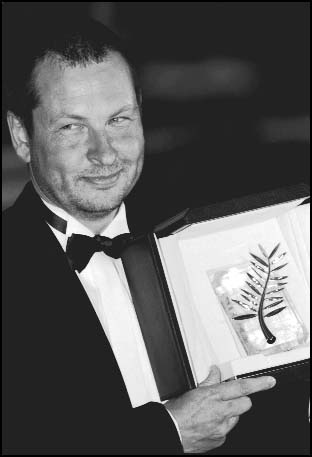
Were he not already so ubiquitous, this might seem like the season of Lars von Trier. Dogville, the first part of his “USA Trilogy” (to be differentiated from his “Europa Trilogy”—The Element of Crime, Epidemic and Europa/Zentropa; and his “Golden Heart Trilogy”—Breaking the Waves, The Idiots and Dancer in the Dark) appeared earlier this year to begin the excoriation of the American character by European cinema, a process just put to decisive referendum by the awarding of Michael Moore’s Fahrenheit 9/11 the Palme d’Or at Cannes. Stephen King’s The Kingdom Hospital, an adaptation of The Kingdom I and II, von Trier’s successive miniseries on Danish television, appeared as a much-touted ABC series and suffered mightily by comparison. And The Five Obstructions, co-directed by von Trier and his mentor Jørgen Leth, equal parts documentary, experiment and intervention, currently scuttles its way around the arthouse circuit.
The latter presents von Trier at his comical best. Resembling Fassbinder refashioned as a Muppet (Fassy Bear?), he is at once imperious and cuddly, using his private empire to force Leth, his former film instructor at the Danish Film Institute, into repeatedly remaking The Perfect Human, the film von Trier rates closest to perfect. “This little gem,” as he calls it, is a 12-minute 1967 black-and-white short that marries an insouciant formal abandon to a faux anthropological take on upscale hipsters, in the manner of Peter Sellers’ The Running Jumping & Standing Still Film (which handed Richard Lester his directing style on a platter) or, more pointedly, title designer Saul Bass’s Why Man Creates. Leth is the one who famously introduced “the rules of the game” into von Trier’s way of thinking, the intense penchant for order which, as we know from Tranceformer, a 1997 documentary by Stig Björkman, implicitly appealed to this son of radical academics who was raised free of restraints of any kind. (Tranceformer also informs us that at age 12, “Lars Trier” was the child star of Clandestine Summer, a winsome Swedish-Danish TV series, and that he added the “von” in film school—as in “Erich von Stroheim,” Teutonic tyrant and classical sadist—in much the same way Francis Ford Coppola appended his signature to exchange the quotidian for the epic.) The Five Obstructions is justified as homage and a form of therapy, von Trier’s magnanimous gesture to force his mentor out of his “provocative perverse perfection.” Yet it ultimately borders on autobiography, as von Trier judges and rejects not only his patriarch, but his own aesthetic foundations, subjecting them to outsize pressures as if to test their structural worthiness—like Steven Soderbergh did in interviewing his mentor, Richard Lester, in Getting Away With It.
This is the Lars von Trier—whimsical ideologue, benevolent autodidact, goofball despot—on display in three documentaries by Jesper Jargil, which he collectively labels “The Kingdom of Credibility Trilogy.” Jargil, who shot von Trier’s The Idiots and has directed over 500 commercials, is a kind of unofficial biographer of the Dogme masters class: The Humiliated (1998) is a behind-the-scenes look at The Idiots, arguably von Trier’s best film; The Exhibited (2000) chronicles his similar assault on the theater; and The Purified (2002) documents a summit meeting of the four Dogme founders, as well as their separate peace with procedural orthodoxy. None are currently commercially available, and all are ripe for international exploitation. Jargil is currently working on a documentary on D-Day, Dogme 95’s simultaneous four-channel improvised docudrama that was broadcast on New Year’s Eve 2000, with the working title 4-D.
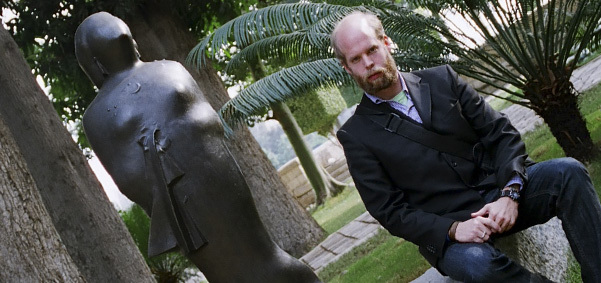
The ALL-AGES Dialogues: A conversation with Will Oldham by Jay Babcock
This interview was conducted by phone in late summer 2006, as part of a series of conversations I was doing with various folks regarding the history of all-ages, philosophy/ethic of all-ages, the state of play of all-ages, yadda yadda. Shoulda been published long ago but stuff kept going awry and we didn’t get it in the mag. Still, almost four years later, it’s a good, pertinent read. Thanks to Will for his time and patience, and special thanks to a certain friend of Arthur who transcribed this conversation a long time ago.
Will Oldham, as Bonnie “Prince” Billy, is traveling and playing shows right now with the Cairo Gang. More info:dragcity.com
Arthur: Do you prefer to play all-ages shows? Is it a priority for you, or does it even matter?
Will Oldham: It matters and it makes a difference, but it isn’t a ‘priority.’ Does that make sense? Every show is contextualized for what it is—in that way, it’s important. But I guess my skewed stance is that I’ve always approached this work of making music in terms of… I think my main drive is to write and record music, so playing live is always just a weird experiment. So to me, every aspect of playing live is part of that weird experiment, whereas a lot of bands and musicians seem to make records of the music that they make. [For me] it’s the reverse. I think that every time that you play live, it’s like, ‘Whoa! What was that all about?’ It’s great whoever the audience is. You try to find the most fun audience, I guess.
Arthur: I noticed that when you are touring shortly, you’re playing a bunch of record stores…
Yeah, an all record-store tour.
Arthur: One of the weird things, from what I can tell about the performance environment in America, is that one of the few places where people of all ages can see quality music in a live setting now is the record store.
Yeah. “Quality music.” One thing that I had started to think about before we started on this topic was… like, how old are you?
Arthur: 35.
I’m 36, and my sense is that, if you won’t take offense, is that we are out of touch. There are quality shows going on six out of seven nights a week that are all-ages shows, in people’s houses, in public places, and we just don’t know those bands. Because I’ve seen some this year—I’ve seen some every year. And it’s like, Whoa, where’d these kids come from? And these kids came from the same places we came from, and they’re making great music that we don’t have access to, because… It’s the same way that bands that I went to see play 20 years ago, people who were 22, to 36, to 50, they would be saying ‘There’s just no music going on these days. There’s no shows like I remember.’ And meanwhile, I was having the fucking time of my life!
Mickey Mantle drinks scotch
Sets his drink on the Mantle
Maybe it leaves a little ring
Babe Ruth drinks scotch
Talks about the time:
Swung his donkey bat
At the left field wall
Bludgeon you with his donkey bat
Piss and cum and wine and vinegar
And mirth and myrrh arch out the tip when real true contact wakes it up
Flows like wine
Mickey:
Yeah, Babe,
But you swung at everything
Homerun King, sure
But also, like, “strike you’re out”
Boom, “strike you’re out”
“Strike, you’re out”
Long Pause
“Strike ONE”
“Strike TWO”
And so on
I’m Babe Goddamn Ruth
Horse Dick Adonis
Flapity-Jack the Conjurer
Manipulator, commanding the common yield to the SPLENDID
Splitting The Crack of Dawn
Splitting it like The Crack of The Goddamn Bat
Spitting huge mouthfuls of vinegar tobacco spit into the ocean, who is my only true competition





 Arthur Magazine