

Came across these via a notice on Mr. Hutchinson’s passing at Rob Young’s Electric Eden blog. Yes, that is Stonehenge in the background. More are available at http://ukrockfestivals.com

Came across these via a notice on Mr. Hutchinson’s passing at Rob Young’s Electric Eden blog. Yes, that is Stonehenge in the background. More are available at http://ukrockfestivals.com
BEEFHEART
pappy with a khaki sweatband
old bowed potbellied barnyard
that only he noticed
the old fart was smart
these words were my calling card
used as defense against squares
throughout northern new jersey
in the early years of the 1970s
incanted while playing pinball
they sometimes piqued the interest
of a teenaged hipster chick
lollygagging ‘round the bowling alley
spoken in the classroom
or the dining hall or locker room
they were more a way of creating
a bubble of madness to protect me
from the goddamn normals
who dogged my every sullen step
trying to impress me with words
& gestures i could not understand
but the poetry of captain beefheart
at first even more than his music
got under my skin and layed eggs
that have continuously erupted
i would never be fool enough
to say i enjoyed all the captain’s bands
or records or tours, but most of them
were fine beyond belief
and provided a glimpse of something
so weird, yet apparently sustainable
that it was a balm to my soul and also
to the souls of the many other losers
who i would come to enjoy and respect
over the next decades of my life
years that would have been far bleaker
perhaps even devoid of splendor
without the model he provided.
so let this stand as a toast
to the ghost most holy-o
imperfectly human, yet umblemished
as a saint to the disaffected youth
who found sense & succor
in his vision of things as they might be
& perhaps even, as they truly were
goodnight, don
goodnight
–byron coley
From Jason Leivian:
Simon Roy is a talented young artist from Victoria, BC. I first noticed his work when Simon was on a book tour with Brandon Graham earlier this year. He’s had some great science fiction comics published in Heavy Metal magazine and I highly recommend his debut graphic novel, Jan’s Atomic Heart.
PUBLISHER’S NOTE: You can download this ‘lecture’ as a convenient PDF for $2.00, payable via PayPal, credit card or debit card. Click here to go to the order form. A link containing the PDF will be emailed to you upon payment.
“FREEMAN HOUSE is a former commercial salmon fisher who has been involved with a community-based watershed restoration effort in northern California for more than twenty-five years. He is a co-founder of the Mattole Salmon Group and the Mattole Restoration Council. His book, Totem Salmon: Life Lessons from Another Species received the best nonfiction award from the San Francisco Bay Area Book Reviewers Association and the American Academy of Arts and Letters’ Harold D. Vursell Memorial Award for quality of prose. He lives with his family in northern California.”
That’s the bio for Freeman off the Lannan Foundation website. We would add that earlier in his life, Freeman edited Inner Space, a mid-’60s independent press magazine about psychedelics; married Abbie and Anita Hoffman at Central Park on June 10, 1967 (see Village Voice); and was a member of both New York City’s Group Image and the San Francisco Diggers. He is a founding director of the Planet Drum Foundation.

photo by Jim Korpi
RESTORING RELATIONS: The Vernacular Approach to Ecological Restoration
by Freeman House
This piece is based on a keynote talk presented to the 3rd annual meeting of the Society for Ecological Restoration, California chapter, in Nevada City CA, May 1994. It was published in Restoration and Management Notes, Summer 1996.
A couple of years ago, I read a very well-written book that tried to convince me that wherever humans touched nature, nature became un-natural, its beauty and wildness spoiled .The book took notice, correctly I think, that human influence on the landscape had become universal. The writer, Bill McKibben, drew the conclusion that because of this, the end of nature was near. The name of the book is, in fact, The End of Nature (McKibben 1989). Like many environmentalists, McKibben is a passionate man, a man who grieves for injuries to nature. But during the time of writing, he seemed also to be a man who had swallowed most of industry’s argument for the inevitability and (indeed!) naturalness of its destructive behavior in regard to natural systems and human communities. If you accept these arguments—some of which are that economies must grow; that the efficiency of mass production legitimizes its brutalization of human life and and the destruction of natural systems; that mere appetite is the ruling element in human behavior—then McKibben’s conclusions must be correct. If humans are such a sport of nature, if their behavior can only be anti-nature, and if humans are everywhere, then nature must surely be on its way out. It is as if we lived somewhere else altogether than in the ecosystems which provide us with all our needs.
But in fact, humans have always been immersed in ecosystems. And for most of the time we’ve been on the planet, with the exception of the the last few hundred years, humans have behaved as if they were immersed in ecosystems. [1] The paleolithic hunter fails to find his game and returns to counsel with his people. How has their behavior strayed from the path of ample provision? The pre-industrial neolithic planter burns brush, saves seed, collects dung. Alongside deep frugality in the home exist the exuberant public indulgence in great monuments that were observatories of planetary movement, and the devotion of large amounts of time and energy to ceremonial observances of non-human processes and presences in the landscape surrounding. Throughout the industrial age, ecosystem behavior has endured even though its practitioners have been pushed back to the most marginal of land bases.
It is important to understand that behavior which rises out of ecosystems—life lived by immersion—has never been passive but diligently active: symbiotic, reciprocal, deliberately manipulative, and creative. Dennis Martinez, the pre-historian of the restoration movement, has shown us that the indigenous peoples of North America—and by extension elsewhere—have always been an interactive element of the landscape, effecting their own long-term survival with management practices so extensive that ecosystem function was affected (Martinez 1993). This is another view altogether of human relationships to nature. Rather than objectifying nature as a resource base functioning only to provide human wealth and comfort, such cultures express themselves as interactive parts of the natural systems around them. In such cultures, individuals are able to perceive themselves as having no greater (or lesser) a function in ecosystem process than algae, or deer.
Most of us have forgotten how to act this way. Over the recent few hundred years we have been encouraged to forget. There is, in fact, a whole educational industry structured for the purpose of convincing us that our primary identity is as consumers. The question is not how to mourn nature, or how to isolate and protect its tattered fragments, but how to re-engage it and thus rediscover our native wit and adaptive genius. And we will find, I believe, that this rediscovery is possible, but only ever in one place at a time. If we are to re-immerse ourselves in our larger lives, if we are to regain our extended identity, it will be through the portals of individual ecosystems and particular places. Continue reading

Love has no body
I love you, you big dummy
No body has love
No body has love
Breathe deep
Breathe high
Breathe life
Don’t breathe ah lie
I love you, you big dummy
Quit askin why
BEEFHEART

“Full Metal Rabbit: Leif Goldberg’s all new 2011 calendar. Fully silkscreened, fully awesome.”
Available now from the good folk at PictureBox
Originally published in Arthur No. 13 (Nov. 2004). Layout by W.T. Nelson.
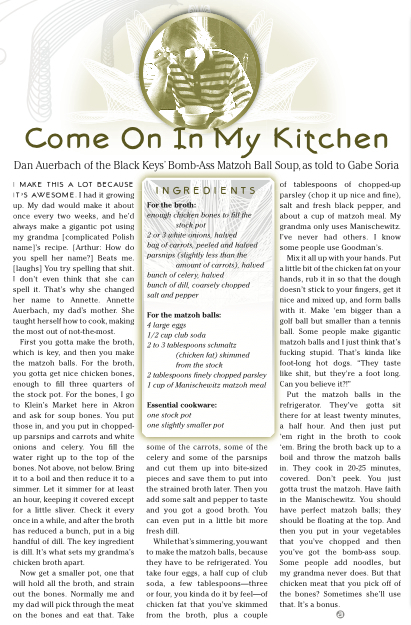
Dan Auerbach of the Black Keys’ Bomb-Ass Matzoh Ball Soup
As told to Gabe Soria
Essential cookware:
one stock pot
one slightly smaller pot
Ingredients:
For the broth:
enough chicken bones to fill the stock pot
2 or 3 white onions, halved
bag of carrots, peeled and halved
parsnips (slightly less than the amount of carrots), halved
bunch of celery, halved
bunch of dill, coarsely chopped
salt and pepper
For the matzoh balls:
4 large eggs
1/2 cup club soda
2 to 3 tablespoons schmaltz (chicken fat) skimmed from the stock
2 tablespoons finely chopped parsley
1 cup of Manischewitz matzoh meal
I make this a lot because it’s awesome. I had it growing up. My dad would make it about once every two weeks, and he’d always make a gigantic pot using my grandma [complicated Polish name]’s recipe. [Arthur: How do you spell her name?] Beats me. [laughs] You try spelling that shit. I don’t even think that she can spell it. That’s why she changed her name to Annette. Annette Auerbach, my dad’s mother. She taught herself how to cook, making the most out of not-the-most.
First you gotta make the broth, which is key, and then you make the matzoh balls. For the broth, you gotta get nice chicken bones, enough to fill three quarters of the stock pot. For the bones, I go to Klein’s Market here in Akron and ask for soup bones. You put those in, and you put in chopped-up parsnips and carrots and white onions and celery. You fill the water right up to the top of the bones. Not above, not below. Bring it to a boil and then reduce it to a simmer. Let it simmer for at least an hour, keeping it covered except for a little sliver. Check it every once in a while, and after the broth has reduced a bunch, put in a big handful of dill. The key ingredient is dill. It’s what sets my grandma’s chicken broth apart.
Now get a smaller pot, one that will hold all the broth, and strain out the bones. Normally me and my dad will pick through the meat on the bones and eat that. Take some of the carrots, some of the celery and some of the parsnips and cut them up into bite-sized pieces and save them to put into the strained broth later. Then you add some salt and pepper to taste and you got a good broth. You can even put in a little bit more fresh dill.
While that’s simmering, you want to make the matzoh balls, because they have to be refrigerated. You take four eggs, a half cup of club soda, a few tablespoons—three or four, you kinda do it by feel—of chicken fat that you’ve skimmed from the broth, plus a couple of tablespoons of chopped up parsley (chop it up nice and fine), salt and fresh black pepper, and about a cup of matzoh meal. My grandma only uses Manischewitz. I’ve never had others. I know some people use Goodman’s.
Mix it all up with your hands. Put a little bit of the chicken fat on your hands, rub it in so that the dough doesn’t stick to your fingers, get it nice and mixed up, and form balls with it. Make ’em bigger than a golf ball but smaller than a tennis ball. Some people make gigantic matzoh balls and I just think that’s fucking stupid. That’s kinda like foot-long hot dogs. “They taste like shit, but they’re a foot long. Can you believe it?!”
Put the matzoh balls in the refrigerator. They’ve gotta sit there for at least twenty minutes, a half hour. And then just put ’em right in the broth to cook ’em. Bring the broth back up to a boil and throw the matzoh balls in. They cook in 20-25 minutes, covered. Don’t peek. You just gotta trust the matzoh. Have faith in the Manischewitz. You should have perfect matzoh balls; they should be floating at the top. And then you put in your vegetables that you’ve chopped and then you’ve got the bomb-ass soup. Some people add noodles, but my grandma never does. But that chicken meat that you pick off of the bones? Sometimes she’ll use that. It’s a bonus.
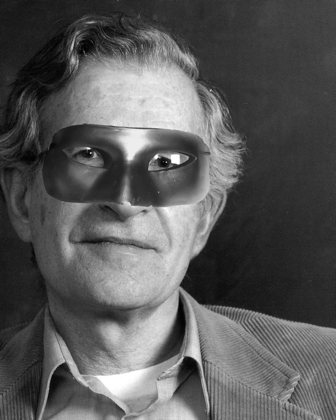
Applied Magic(k): Sigils, Logos and Lucky Charms
by the Center for Tactical Magic
Originally published in Arthur No. 23 (June 2006)
One of the first lessons of magic(k) that we learn as children is that words and symbols have power. Abracadabra. Hocus Pocus. A five-pointed star. A four-leaf clover. As we get older, this primary notion quickly degrades and often becomes the source of one of the first dismissive tendencies towards magic(k) that arises amongst adults. Too many hokey movies and failed attempts to levitate with an utterance conspire against us. Soon the lesson is forgotten; magic(k) words and the power of symbols sneak away to party with Santa and the tooth fairy.
But words and symbols continue to work their magic(k) regardless of whether or not we believe in them. Look at the recent outcry against Madonna singing from the cross or riots in response to Mohammed cartoons and we begin to see that the power of symbols is anything but make-believe. For those who insist that religious sensitivities are an easy shot, consider this secular example: For over 150 years the United States had a Department of War. During much of that time U.S. foreign policy consisted of “neutrality” and therefore the DoW did not lend any direct military support in foreign conflicts. World War II put a definitive end on U.S. neutrality once and for all, and in 1947 the DoW was renamed the “National Military Establishment” or NME (pronounced “enemy”). Realizing the error of their acronym, politicians again changed the name in 1949 to what we know today as the “Department of Defense.” More than half a century after “war” became “defense” the DoD sits deep within the Pentagon planning “pre-emptive defensive strikes” while waving a flag with 50 pentagrams on it.
Okay, so spin-doctoring isn’t exactly the same thing as witch-doctoring. Still, most performing magicians (conjurers) won’t deny the power of language. And few will debate the fact that word choice makes a difference when presenting a trick. Many will even insist that the “patter” makes or breaks the illusion. More to the point, the strength and efficacy of a trick is often closely tied to the audience’s ability to relate both specifically and abstractly to the overall illusion. This is precisely why magic with money tends to hold people’s attention more than tricks with handkerchiefs. Money is already a loaded symbol, whereas how many people revere a silk hanky? If you still maintain your doubts, try first performing card tricks over lunch and then later in the middle of a poker game. Any guesses on which audience gets more riled up when you magically produce four aces from up your sleeve?
Admittedly, the ability to make a scrap of green paper covered in Masonic symbols disappear doesn’t quite live up to our childhood expectations of magic(k). Perhaps this is especially true because we become adept at making dollars disappear all the time. As we grow older, we become initiated into the Church of Consumerism. It is here that we become increasingly distrustful of anything “magical” since we quickly find the mystique tarnished by a barrage of commodities gilded in glitz. Yesteryear’s potions, spells, and apparatuses are hawked as today’s energy drinks, pharmaceuticals, and hi-tech gizmos. Finding ourselves surrounded by “magic” cleaning supplies, “power” tools, and Lucky Charms, it’s easy to concede that there’s no such thing as “real” magic(k). Yet, ironically this is where some of the oldest forms of magic(k) still thrive today.
Continue readingPeter Coyote talks with Rebecca Solnit about her book, A Paradise Built in Hell: The Extraordinary Communities That Arise in Disaster.
 Arthur Magazine