Mushroom Magick: A Visionary Field Guide
by Arik Roper
Hardcover: 144 pages
Abrams
ISBN-10: 0810996316
List Price: $19.95 Amazon Price: $13.57
Here’s some promotion blurbage from the publisher:
For centuries hallucinogenic mushrooms have participated in a sublime relationship with humankind, thanks to their psychoactive chemicals that shift and modify the human mind. Arik Roper’s exquisite painted portraits of magic mushrooms illustrate more than 90 of the known hallucinogenic species from around the world. He captures their powerful auras, adding to a tradition of Mushroom art that stretches back more than 400 years.
Popular culture critics [and sometime Arthur columnists] Erik Davis and Daniel Pinchbeck provide background and testimony in elegant essays, and mushroom expert Gary Lincoff contributes notes. This beautifully designed and profusely illustrated mushroom bible will appeal to nature lovers, mushroom hunters, and enthusiasts of all things psychedelic.
(UPDATE: “Hack Money, Hack Banking” by Douglas Rushkoff, the March 20 follow-up to “Let It Die,” is available here.)
LET IT DIE by Douglas Rushkoff
March 15, 2009
With any luck, the economy will never recover.
In a perfect world, the stock market would decline another 70 or 80 percent along with the shuttering of about that fraction of our nation’s banks. Yes, unemployment would rise as hundreds of thousands of formerly well-paid brokers and bankers lost their jobs; but at least they would no longer be extracting wealth at our expense. They would need to be fed, but that would be a lot cheaper than keeping them in the luxurious conditions they’re enjoying now. Even Bernie Madoff costs us less in jail than he does on Park Avenue.
Alas, I’m not being sarcastic. If you had spent the last decade, as I have, reviewing the way a centralized economic plan ravaged the real world over the past 500 years, you would appreciate the current financial meltdown for what it is: a comeuppance. This is the sound of the other shoe dropping; it’s what happens when the chickens come home to roost; it’s justice, equilibrium reasserting itself, and ultimately a good thing.
I started writing a book three years ago through which I hoped to help people see the artificial and ultimately dehumanizing landscape of corporatism on which we conduct so much of our lives. It’s not just that I saw the downturn coming—it’s that I feared it wouldn’t come quickly or clearly enough to help us wake up from the self-destructive fantasy of an eternally expanding economic frontier. The planet, and its people, were being taxed beyond their capacity to produce. Try arguing that to a banker whose livelihood is based on perpetuating that illusion, or to people whose retirement incomes depend on just one more generation falling for the scam. It’s like arguing to Brooklyn’s latest crop of brownstone buyers that they’ve invested in real estate at the very moment the whole market is about to tank. (I did; it wasn’t pretty.)
Sasha Watson talks to artist Marc-Antoine Mathieu about creating a graphic novel for the most famous museum in the world and “pulling the image out of time” with his comics.
Note to the reader: Click each image for a full-size version.
It had been several years since I’d last spoken with comics artist Marc-Antoine Mathieu but when I got him on the phone, I remembered how thrilling and exhausting it could be to talk to him. Within moments of making the connection between his home in France and mine in Los Angeles, I was mentally dashing after him as he leapt from particle physics to the significance of the first cave paintings to Proust and the nature of time. Mathieu is well-known in France as a graphic novelist who, with every book, expands the boundaries of the form. He does this with a unique combination of intellectual weightiness and the purest sense of play. It’s the same in conversation; he’ll be discussing a mathematical or philosophical concept, about which he’s read widely and consulted several experts, and then suddenly he’s laughing—you’re both laughing—at some comical application of the idea. Trying to keep up with him is thought-provoking and funny and exhilarating, and it’s all those things at the exact same time.
Mathieu’s recent book, The Museum Vaults, just out in an English translation from NBM ComicsLit, perfectly encapsulates his mingling of intellect and lighthearted fun. Published in France in 2006, it was the second book in a series of four put out by the Louvre museum and the French graphic novel house Futuropolis, in which four comics creators were asked to produce a stand-alone book for the series.
In spite of the almost unbelievable prestige attached to such a publication, when the editors first approached Mathieu, he told them he didn’t want to take part.
“Comics represent total freedom for me, and I was a little afraid of being constrained by any specific requirements,” said Mathieu in our recent phone conversation. “Besides,” he added, “the Louvre is an intimidating subject. What hasn’t already been said about the museum, about art, about beauty?”
It was a good question, and one that has its roots in the history of French comics. During the political turmoil of the ’60s, comics rose up on the tide of cultural upheaval. The form could be as rebellious and irreverent as the young intellectuals of the time, and they held it out as a banner of a new and more vital culture.
“See?” they said, picking up their comic books and thumbing their noses at old guard institutions like the Louvre, “This is art to us.”
It’s no wonder then that there should be some head-scratching as to what these two cultural symbols have to say to one another. Fabrice Douar, head of the Louvre’s publishing division, and Sebastien Gnaedig, editorial director of Futuropolis, understood Mathieu’s concerns. “The universe of the Louvre is extremely rich,” says Douar, in what might be considered a wild understatement, “and that can be discouraging.”
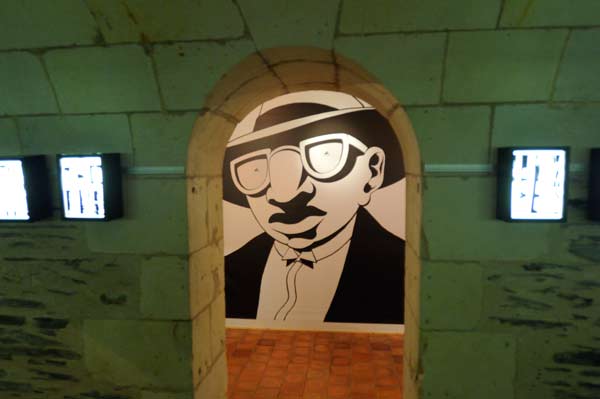
Julius Corentin Acquefaques in a doorway
Douar and Gnaedig assured Mathieu that the only requirement was that there be a link to the Louvre—“an artwork, the building, a gallery, whatever, as long as there was a link,” said Douar—and that no restrictions would be placed on the work itself.
But there was still the question of whether the topic was simply too paralyzing for Mathieu to have any fun. Arguably the most famous museum in the world, the Louvre has been a universally recognized symbol of French cultural hegemony and the very highest of high art since the French Revolution. For Mathieu, there seemed little reason to illustrate “this enormous and almost too visible entity”.
Douar and Gnaedig weren’t looking for an homage to the museum, though. They were looking for artists whose creative vision would flourish, even when faced with the Louvre’s historical and cultural magnitude.
“We hoped to find graphic novelists who had their own very strong personal universes,” Douar says, “and then to encourage the confrontation of their world with that of the Louvre.”
In other words, the editorial team wanted nothing more than for Mathieu to do the book his way. Once this became clear, Mathieu’s ideas began to take shape.
“I started out imagining fantastical spaces that would give me total freedom to talk about a Louvre that was invisible but universal—an infinite space, like the space of art itself,” he says. To find this space, he had to “look sideways, out of the corner of my eye, take a significant step back from the subject right from the beginning.”
Of this method, Douar says, “Marc-Antoine Mathieu created a universe that is like the Louvre, but not exactly. It’s a kind of parallel world in which he examines, not the work, but the discourse around art.”
It is just this refusal to look directly at the subject, and thereby to generate multiple images of it, that characterizes Vaults. Even the name of the museum at the center of the story is a mystery. It is called by turns, (in the English translation) u rude love muse; the museum of the louver; muse, lure, loud, eve; oeuvre due slum; loud muse revue, etc. The main character, Eudeus, informs us in the first chapter that, “all these names are nothing but anagrams of the museum’s real name, which has been forgotten.” The name of le Musée du Louvre is never directly mentioned in the book.
There is humor in this approach. In looking, not at the works of art but at “what’s in the wings, and what surrounds them: the frames, the guards, the archives… the flip side of the painting,” Mathieu finds a lot to laugh at. There are the guards who learn in class the exact tone of the “Tsssk,” that they use when a patron gets too close to a work of art and there are the restorers who accidentally add too large a “schnoz” to a broken classical statue.
But there is also a deeper reflection at the heart of Vaults, in which art itself is seen as infinite. “A work of art is a world,” says Mathieu. “The museum, a world of worlds, a morsel of the infinite.”
To emphasize this point, the book opens with a quote from Henri Bergson, the philosopher whose work inspired Proust’s meditations on time. The epigraph reads, “Time is an invention, or it is nothing at all.” According to Bergson, chronology was a false order imposed on consciousness, in which many experiences and states of being coexist. Mathieu’s museum is an illustration of this concept. In it, all moments of art, from the first anthropomorphized pebble to the Mona Lisa to the sequential pictures of graphic novels, are simultaneously made manifest.
For Mathieu, this concern with time is an inherent fact of his medium. Comics allow the reader to move backwards and forwards, to look up or down. “When you’re watching a movie,” says Mathieu, “you’re a prisoner of time. I think, ultimately, this is why I chose to work in comics and not in film. Proust, Faulkner, and the greatest filmmakers, too, Herzog, Godard, Tarkovsky, all tried to pull the image out of time. I try to do this in comics.”
When I first encountered Mathieu’s work, I’d just graduated from college and I was living in Oxford with a grad student friend, trying to figure out how to be a poet. I was a snob in the way a lot of people are when they want to be artists but haven’t done much about it yet—out of terror. Comics were not on my radar.
But when L’Origine, Mathieu’s first book, arrived in the mail from a French friend, that changed.
“This book contains something I’ve never seen before!” enthused my friend in the letter that still holds the page in my book. “I’m sending you my copy since I couldn’t find it at the store. Hurry up and tell me what you think.”
L’Origine opened my eyes to new worlds of art. Suddenly I knew that great art could exist in many forms, not only those sanctioned by artistic and scholarly institutions.
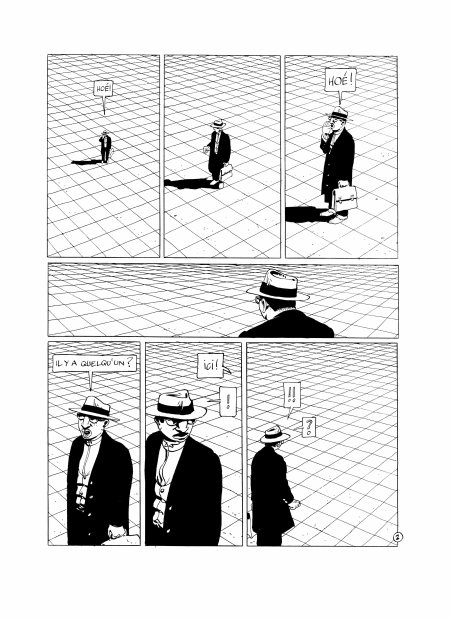
The first surprising thing about L’Origine, and what my friend referred to in his note, was that the book itself had become a character in the story. An impassive hero with a hefty name, Julius Corentin Acquefacques, receives an envelope in the mail. Inside, he finds a page torn out of the very comic we are reading. Through a series of investigations, he comes to realize that he is reading pages from his future, and that he is the hero and savior of his own comic book world. Mathieu had, in a sense, broken through the fourth wall of the comic, allowing the character to become aware of the limits of his world, and of the reader.
But Mathieu’s easy bypassing of the normal boundaries of his art went far beyond this intellectual sleight of hand. In all five books of the Julius series, Mathieu seamlessly combines varied realms of thought and levels of discourse. In Julius’s world, absurdist humor mingles with philosophical reflection, poetic reverie with mathematical speculation.
My surprise at the richness of Mathieu’s work was more than a reflection of my own naïveté regarding comics. His breadth of references really is startling. For one thing, a host of literary greats watch over his universe. Kafka—whose name turned backwards and then spelled out phonetically makes “Acquefacques”—holds dominion, but the Surrealists are here, too, alongside Borges, Perec, and many others. Of these literary presences, Mathieu says, “It’s a very intimate relationship, the way you’re touched by an artist. It’s like family. You do what they did. You redo Borges the way Borges redid things from Cervantes. We all have a compost pile, a nucleus, a trunk, something precious like that.”
The compost pile that feeds Mathieu’s work isn’t restricted to literature. His mathematical explorations in the Julius books were interesting enough to attract the attention of scientists at CERN, the world’s largest particle physics laboratory, located in Geneva.
“They work on questions of entropy and chance,” said Mathieu. “That’s always interested me, and it must show in my work because they invited me to come there several years ago.”
Mathieu compares what he does in comics to what these scientists do. “Every day they invent a world that’s completely inconceivable,” he says. “Math is a language that lets you conceive of things that would be impossible to conceive of without it. Comics are sort of the same thing. You create a language to say something that you couldn’t have said in any other way. I’ve always liked to change position, change the dialectic, change my galaxy.”
As with The Museum Vaults, there’s a philosophical underpinning to the Julius books as well. For all the slapstick humor and clever wordplay that fill Julius’s days, the real question revolves around his place in the universe, and whether he has any control over it. His discovery of pages of his future leads to an extended meditation on free will. On entering a bookstore in which volumes are stacked several stories high, Julius muses, “All these books, all these memories, one on top of the other, give rise to a strange question… Was I, like them, written?”
If the lack of free will acts as an overarching constraint, the highest level of the bureaucracy in which Julius lives, there is also a built-in release valve. The full title of the series is Julius Corentin Acquefacques, prisonnier des rêves—prisoner of dreams. In his dreams, Julius overcomes the limitations imposed on his world. He climbs out of the panel, sees in color, flies away from the pages on which he’s drawn. The absolute freedom that he experiences in his dreams provides a stark contrast to his daily life, to which he is forever being rudely awakened.
Mathieu follows an oulipian code, imposing strict limitations on his work in order to release the imagination. This is why he works almost entirely in black and white. “It’s in a field of black or a completely white space that you as a reader can bring something to the work,” he explains. “Colors say too much; they take away from your imagination. It’s a political choice, too, to say to the reader, ‘Figure it out, it’s up to you to take over here, to imagine what there is in the darkness.’”
On top of all this, Mathieu refuses even the constraints of the book itself. Every volume in the Julius series includes a startling bookmaking flourish—the missing panel of L’Origine, the pop-out spiral of Le Processus, and the pages in 3D, along with 3D glasses, of La 2,333e Dimension.
For me, reading L’Origine for the first time was like being lifted by a twister, twirled in the air and then set down again, magically intact and incredibly exhilarated. My reaction, as it turned out, was right in line with the my-head-is-about-to-explode tone of the reviews. Critics loved the self-referentiality, the meta-gaze, and the way Mathieu used the two-dimensionality of the book to pull off his high wire act.
In 1991, Mathieu won the Alph-art coup de coeur prize at Angoulême, the world-famous French festival of comics. The prize, which is for the best first book by a new comics creator, has been awarded to some of the best current French graphic novelists, including Lewis Trondheim in 1994; Emmanuel Guibert and Joann Sfar in 1998; and, most famously, in 2001, Marjane Satrapi for the first volume of Persepolis.
Since then, Mathieu has published several stand-alone books in addition to the five volumes of the Julius series. One of these, Dead Memory, was published in an English translation by Dark Horse Comics in 2003, but the Julius books, for which he’s best-known in France, remain untranslated.
Prior to meeting Mathieu, six years after first reading L’Origine, I’d been warned by someone who knew someone who’d once worked with him that he was “difficult”. On the hour and a half train-ride from Paris to Angers, where he lived, I braced myself for a haughty intellectual, a disdainful French artist. But when I walked out of the train station in Angers that Saturday morning in July, I saw something very different. Short, brown-haired, in his late 30s, Mathieu was unintimidating. He looked, I thought, not totally unlike Julius, with his rounded shoulders and pronounced, Gallic nose. The difference was that Julius’s eyes are covered by the blank lenses of his glasses, remaining expressionless throughout his wildest adventures, while Mathieu’s were warm and brown, his expression open and kind.
“Why don’t we call each other tu,” he said when I addressed him at first with the formal vous. “It’s easier that way.”
On the way to his studio, Mathieu pointed out the Angers cathedral. The small city, positioned at the westernmost point of the Loire Valley, began life as a Roman fortification, and then became the medieval stronghold of the Angevin Empire. Today, it is known for its flowers, its chateau, and a series of tapestries that show a gory version of the Apocalypse. Asked if he’d ever thought of moving his design business to Paris, Mathieu said no, that he preferred a slower pace. “There’s more space to think here,” he said. “More room to create.”
When we’d set up this interview, Mathieu had told me about his graphic design business, Lucie Lom, and offered to show me the studio. I’d agreed but the truth was, I wasn’t all that interested. Lucie Lom was his day job, I figured, what paid the bills so that he could do the creative work of his graphic novels.
Mathieu pulled up in front of a small building on a tree-lined street, where cars were parked lazily in the dirt outside. As he showed me around the comfortably messy studio, filled with projects left out the evening before, I began to realize that Lucie Lom was not at all what I’d thought.
In 1985, Mathieu and his business partner, Philippe Leduc, were just finishing art school at the Ecole des beaux-arts in Angers.
“I felt very free, very open and ready to start something new,” says Mathieu. “Philippe had the idea to start a design company that focused on installations and poster art. We both wanted to do work that was out of the ordinary and that had an ethical basis, and we both wanted to tell stories. All of our ideas start out as stories.”
Leduc and Mathieu’s first large-scale project was an installation exhibiting post-war Polish poster art, which they showed in the basement of the theater in Angers.
“We tried to recreate the atmosphere of the places where the posters were created,” he explains. “We showed Trepkowski’s early posters in a little room that we decorated to look like the ruins of Warsaw.”
The pair spent six months on the project, spending (and losing) their own money to put it together, but the exhibit was a success. In the wake of that show they were asked to do an installation at the Angoulême festival, and they’ve done many more since.
Mathieu leads me up a creaky staircase to the second floor, where Leduc, laying out a poster in the back room, waves hello. I flip through posters they’d made over the years. One, for a theatrical version of Animal Farm shows a small pig crawling out of the neck of a military uniform; a bleeding crescent moon on a green background advertises protests in support of Algeria in 1999; others advertise plays, concerts, dance performances.
When I ask how he and Leduc choose their projects, Mathieu talks first about the negative side of advertising.
“People are more and more used to consuming images whose only purpose is to sell them something,” he said. From the beginning, Lucie Lom’s purpose was different. “We try to do work that says something, that has meaning. We try to make sure that every image we create is unique. We think about the influence it might have on the people who see it.”
Far from a day job, Lucie Lom is an essential part of Mathieu’s creative output. “I need the balance,” he says, when I ask how he feels about having two careers. “Writing is very solitary and when I draw I go totally into my own thought, my own imagination. With installations, you’re working collectively with a team of people, which is both wonderful and very good for me.”
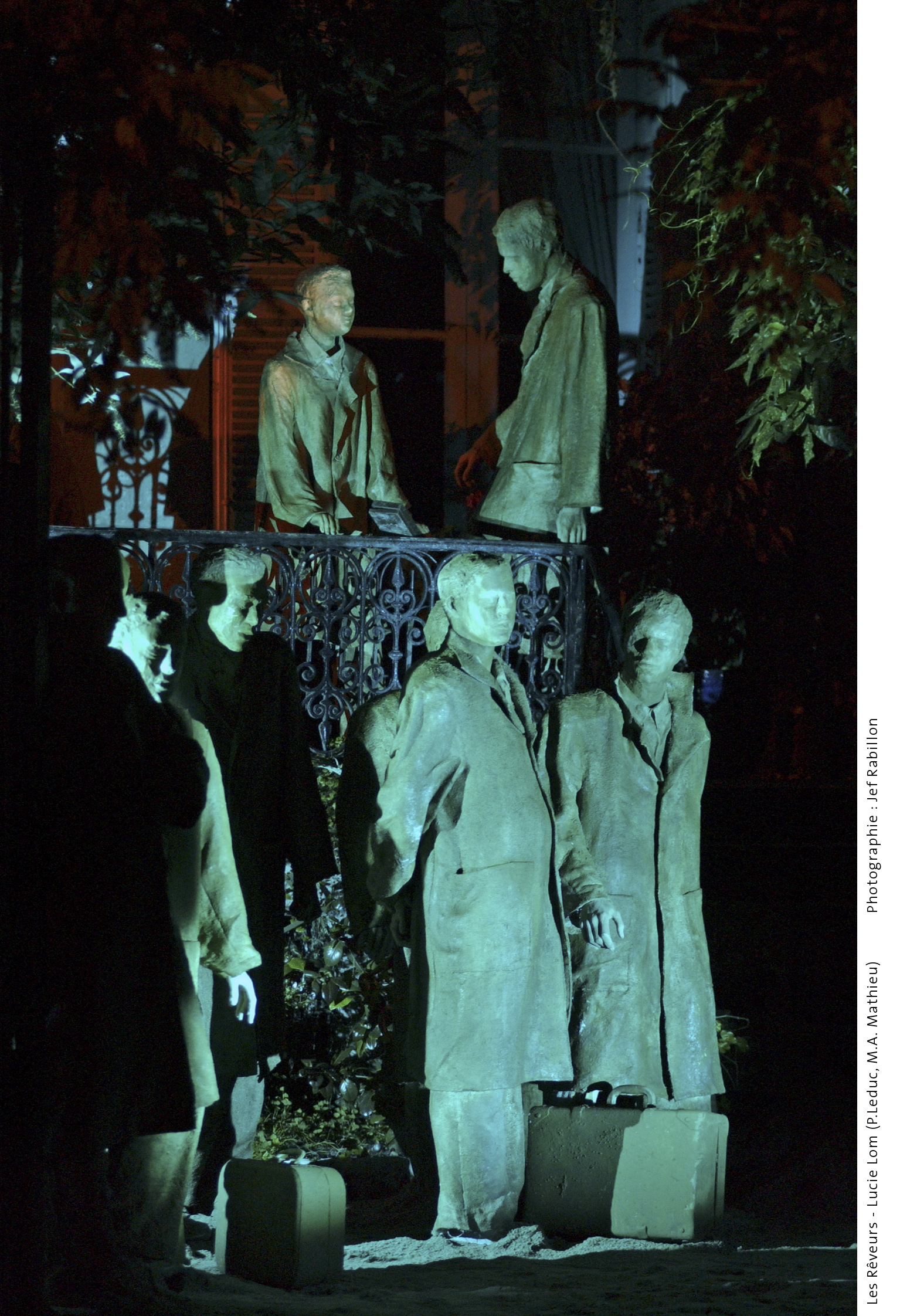
As we left Lucie Lom that day in 2004, we walked through a courtyard past a crowd of white plaster statues that were leaning against the outer walls of the building. These, Mathieu told me, were the Dreamers, plaster men in business attire, buttoned trench coats and wingtips. It was a project that Lucie Lom had done the year before as part of a week-long festival of the arts held annually in Angers. Each evening, the Dreamers appeared in a different spot around the city. One night they stood clustered by a street map, all gazing curiously at the routes they might take. Another night, they were in an alley, looking in puzzlement at the street’s cobblestones, several of which were illuminated. On yet another, they stood in front of a store window, where mannequins lay discarded in various states of undress.
On the final night of the festival, the Dreamers were found by the river Maine, the offshoot of the Loire on whose border the city rises. For the first part of the evening, they stood as they had on previous nights, blank and frozen. But then, at a certain moment, they began to move. As if by magic, the stiff-backed statues stretched and bent. That night dancers painted the color of plaster, stood in place of the statues.
Several weeks after visiting Mathieu in Angers, I traveled to Lille, the northern city that served as that year’s European Capital of the Arts, a year-long festival that changes location annually. Lucie Lom had recently put up an installation called La Forêt suspendue—the suspended forest.
I exited the train and walked toward the central plaza. From a distance, I saw trees hanging upside down over the square, their leaves and branches clustered together, shading the pavement beneath, their trunks rising toward the sky. As I stepped under the canopy’s shade, I heard birdsong coming from the branches and saw lights playing among the leaves.
“People can come to sit or walk beneath it,” Mathieu had said when he described the suspended forest to me. They come play music, talk, whatever they want. It’s like a fairytale setting.”
The forest became one of the flagships of the Lille celebration, the image of leaves and branches hovering over the square and stretching down side streets, symbolizing the beauty and fantasy of the festival. Standing beneath it, I thought back to my conversation with Mathieu in Angers the week before. At a certain point, he’d suddenly changed the subject.
“I don’t believe in free will,” he’d said. “It’s hard to find anyone to talk to about that. Nobody wants to discuss it.”
At the time, I’d thought this was why he was an artist then, so that he had a place to explore the ideas that no one would discuss with him. Now, though, I realized that Mathieu’s art was also a release from those ideas. Maybe there is no free will—the book has an ending, whether you know what it is or not—but there is also the dream that opens up the panel, the dancer that moves in place of the statue, the fairytale forest in the middle of a busy city. It is here that Mathieu’s art resides, in a place outside of time, where the harshest restrictions of intellect open up to the most joyful release of creation.
Sasha Watson‘s first novel for young adults, Vidalia in Paris, came out in October. She is currently living in Marfa, Texas.
Your contributing editor was in the Trader Joe’s one day, grinding his coffee at one of their machines next to some other dude. The spoon that’s usually chained to the coffee grinder — it’s there so you can flip the last of the beans down to be crushed — was gone, so we were both using the plastic lids from our coffee cannisters to this end. Guy says to me something about how isn’t it great we have thumbs, can learn to use simple tools and ha ha ha.
My response: “Fuck thumbs man. Thumbs mean that we developed agriculture, built cities and spread civilization to the point where we gotta have jobs in order to buy food and stay alive.” The dude sorta laughs as I go on. It’s a Silver Lake Trader Joe’s in the middle of the afternoon — i.e. full of self-employed freelancers and other such bohemians and assorted leisure-seekers — so it’s not surprising that he’s somewhat sympathetic to my random, half-serious anti–civilizationspiel.
“Take dolphins, for example. They didn’t evolve thumbs, which means they get all the benefits of intelligence minus the drags of civilization. So they swim around all day having sex and eating sushi,” and dodging tuna nets and plastic bags etc etc, “while you and me have to scrimp and save only to settle for some lame pre-packaged California rolls. Never mind my prospects as a hetero male trying to find a date in a city where the single guys outnumber the single ladies two to one.” He laughs again and we’re both on our way home to enjoy the fruits of civilization such as the aforementioned coffee and deli-fresh sushi.
I was kidding about the sushi line, but as it turns out dolphins use — or at least are starting to use — a sushi-chef like approach to preparing cuttlefish for dining. From Discover:
Australian researchers have observed a female bottlenose dolphin using her snout to prepare a meal of cuttlefish. But instead of just gobbling up the fish, the dolphin carefully extracted its bones before dining—a display of chef-like skills that is extraordinary among marine mammals.
The feast took place in South Australia’s Upper Spencer Gulf, where cuttlefish breed. The researchers had first filmed this amazing culinary-enabled dolphin off the coast of South Australia in 2003, where they saw her preparing four different cuttlefish. They were able to identify her in 2007 by her scars (apparently the circular scars on her head were unique enough to identify her four years later). They recorded her meals with a Sony HD Cam video camera, and later used the footage to analyze her foraging behavior.
Read the original study, “Preparing the Perfect Cuttlefish Meal: Complex Prey Handling by Dolphins” at PLoS ONE.
THEY called it a lesbian paradise, the pioneering women who made their way to St. Augustine, Fla., in the 1970s to live together in cottages on the beach. Finding one another in the fever of the gay rights and women’s liberation movements, they built a matriarchal community, where no men were allowed, where even a male infant brought by visitors was cause for debate.
Emily Greene was one of those pioneers, and at 62 she still chooses to live in a separate lesbian world. She and 19 other women have built homes on 300 rural acres in northeast Alabama, where the founders of the Florida community, the Pagoda, relocated in 1997.
Behind a locked gate whose security code is changed frequently, the women pursue quiet lives in a community they call Alapine, largely unnoticed by their Bible Belt neighbors — a lost tribe from the early ’70s era of communes and radical feminism. “I came here because I wanted to be in nature, and I wanted to have lesbian neighbors,” said Ms. Greene, a retired nurse. She hopes the women, ages 50 to 75, will be able to raise enough money to build assisted-living facilities on the land and set up hospice care.
She walks each day in the woods with her two dogs, Lily, a border collie mix, and Rita Mae, a Jack Russell terrier and beagle mix named for Rita Mae Brown, the feminist activist and author of the lesbian classic “Rubyfruit Jungle.” Ms. Greene trims branches of oak, hickory and sassafras trees and stops by the grave of a deer she buried in the woods after it was hit by a car. She named it Miracle. “I talk to Miracle every day,” Ms. Greene said. “That is one of my joys of living here.” Continue reading →
In the midst of all the New Age therapy-speak in the comments — e.g. “i was the canvas i was doing the painting on, it was a shamanic abstract x-pressionist personal human sculpture” — “sonofman” jumps in to direct the RSers over here to Arthur to check out some of the Center for Tactical Magic’s contributions. Thanks, sonofman. Here’s a quick digest of the Center’s “Applied Magic(k)” columns, for your consideration:
I am done with self-publishing Arthur, which I’ve been doing since July, 2007. It’s too much work for one person to edit, publish and manage a national magazine, month after month, year after year.
I am talking with interested parties regarding their taking over the Publisher role for Arthur Magazine.
Please stay tuned. And, subscribers: your subscriptions will be fulfilled when we resume publication. Thanks for your patience.
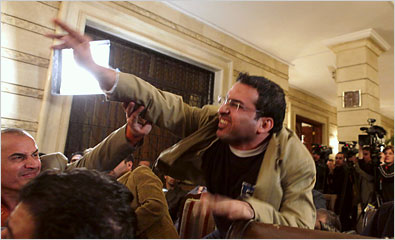
For slinging truth directly to despotic criminal power in a heroic, selfless act of CONTEMPORARY conscience and righteousness, an act that many others could have done but none dared, Iraqi journalist/shoe-thrower Muntader al-Zaidi is the clear choice for Arthur Magazine’s coveted “Man of the Year” award for 2008.
In honor of the occasion, Charles Potts has composed a new poem, “Balls Out,” which we proudly present here:
Balls Out for Muntader al-Zaidi
We’ve found Hitler’s missing testicle
Lodged in George W. Bush’s nose.
Yes ladies and gentlemen
George Bush was snorting Nazi Nuts
When one of them got stuck in the cocaine.
Muntader al-Zaidi attempted a seasonal variation on
Tchaikovsky’s Nutcracker Sweet
With his shoes.
He really wanted to hit the visiting fascist in the face
The lame duck occupational Caesar of the colony of Iraq
To crack the American crackpot empire
With his shoes.
George Bush ducked al-Zaidi’s flying shoes
Just like he ducked
Every single other responsibility of the office he stole.
Duck this George:
Since the nefarious democrats didn’t have balls enough to
Impeach you,
al-Zaidi impeached you with his shoes.
The Muntader al-Zaidi College of Journalism at Yale
Now open for admission.
We owe you a pension al-Zaidi.
We are all in prison
Until you are set free.
The Libertarian Book Club/Anarchist Forum presents…
Tuesday, December 16, at 7:00pm
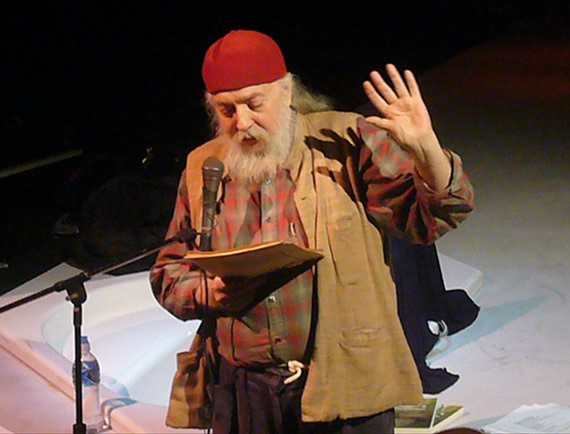
PETER LAMBORN WILSON’s CHAOS DAY of 2008 THE MAGIC OF MONEY AND THE FUTURE OF CAPITALISM
“The History of Money since Sumeria to its Apotheosis as Pure Imagination in the 21st Century”
Peter Lamborn Wilson on finance as a form of gnosticism, a long historical view of the current crisis, and the prospects for resistance and revolution in the 21st century.
The event will take place at The Living Theatre, 21 Clinton Street, Manhattan (just south of Houston St) (212-792-8050). Coming from uptown, take the F or V train to “2nd Avenue” (exit front of train on 1st Ave, walk east along Houston and turn right on Clinton) or coming from downtown, take the F, V, M or Z train to “Delancey – Essex” and walk east on Delancey three blocks and turn left on Clinton for 2 and a half blocks.
Everybody is welcome and invited to come and to have their say.
There is no set fee for the presentation, but a contribution to aid the LBC is suggested.
If you have questions, contact the Libertarian Book Club/Anarchist Forum, 212-475-7180 or e-mail: roberterler (at) erols.com
Peter Lamborn Wilson is an American political writer, essayist, and poet, known for first proposing the concept of the Temporary Autonomous Zone (TAZ), based on a historical review of pirate utopias. He sometimes writes under the name Hakim Bey.
Texts by Peter Lamborn Wilson published in Arthur:
The Endarkenment Manifesto (Arthur No. 29, May 2008) Wilson’s half-serious proposal for a political movement to uphold and propagate the ideals of Green Hermeticism–the “coherent spiritual movement that constitutes the only imaginable alternative to unending degradation of Earth and humanity.”
WEDNESDAY, 12/10
Process Books and Arthur Magazine present
PURE COUNTRY: THE LEON KAGARISE ARCHIVES, 1961-1971
A very special evening with the First Lady of Banjo
RONI STONEMAN
plus
THE TALL PINES
THE JONES STREET BOYS
A celebration for the release of the book Pure Country. The show includes rare color slides of hillbilly stars and their fans from the ’60s music park scene, along with stories by the book’s writer Eddie Dean and a live performance by legendary banjo picker (and Hee Haw star) Roni Stoneman. Both will sign books after the show.
Throughout the ‘50s and ‘60s, country music’s most legendary performers played backwoods stages in outdoor music parks, live and unfiltered. It was a time when Johnny Cash, Patsy Cline and George Jones mingled up close with fans like kin at a mountain family reunion. These dollar-a-carload picnic concerts might have been forgotten if it hadn’t been for Leon Kagarise. An audio engineer by trade, he began recording the live shows on reel-to-reel tape and shot hundreds of candid color slides of the stars and their fans.
Music journalist Eddie Dean spent many hours interviewing Kagarise before his death in early 2008. His introduction and accompanying text tells how an obsession created a view into a lost world that challenges easy assumptions about Country and reveals a secret history of Country music in the ‘60s, when the industry largely turned its back on its rural roots and produced a slick, studio-centric product known as the Nashville Sound.
Forced into commercial exile, traditional country performers scratched out a living in the outdoor-music park circuit, where Kagarise served as their unofficial court photographer. With a meticulous and loving eye, Kagarise captured dozens of classic country and bluegrass artists in their prime, including June Carter, Dolly Parton, Bill Monroe, Hank Snow, The Stanley Brothers, The Stonemans, and many others.
Over a decade, he amassed an archive of over 600 color slides and 4,000 hours of pristine-sounding live performance as well as radio and television recordings, some of the only known surviving documents of the era. Pure Country presents 140 of Kagarise’s stunning color images, most never seen in print, from an archive now considered by historians to be one of the richest discoveries in the history of American music.
Eddie Dean, who wrote the foreword and the text of the book, will be narrating a slide show of images from the book of such country legends as George Jones, Kitty Wells, Johnny Cash, June Carter, Dolly Parton, Roy Acuff, Minnie Pearl amongst others.











 Arthur Magazine