DAILY MAGPIE – Feb. 5 – Mark Ruwedel, Westward the Course of Empire

ruwedel

Opening reception, Thursday Feb 5th, 6:00-8:00pm, free

Mark Ruwedel’s new exhibition Onward the Course of Empire opens Thursday at the Yossi Milo Gallery, 525 W. 25th St in New York City.  Ruwedel photographs abandoned 19th and 20th century railway lines in The United States and Canada.  Ruwedel’s gelatin silver prints bear witness to the grown-over traces of North America’s railway past.

ruwedel2

DAILY MAGPIE – February 4 – Bioflourescence

glow-in-the-dark-cats

The Secret Science Club is hosting neurobiologist and scuba diver, Vincent Pieribone, at the Bell House in Gowanus. He’ll talk about incandescent occurrences in nature and particularly in marine life.  It’s real free and starts at 7, but if you get there before they have delightful Happy Hour deals (2fr1 I do believe).  Bill Nye will probably be there.

Buy American?

Not to get all protectionist-ically jingoistic, but wouldn’t it be great if there were a way that we could produce marijuana without having to deal with directly fund Mexican drug cartels?

Imagine, a pot-farming Shangri-La where most of the gunfire is some penny-ante bullshit between paranoid trigger hippies and trigger-happy meth heads popping off into the open sky, trying to figure out who has the bigger box of bullets. Or hey, maybe forget the guns altogether (except for target practice and varmint deterrence, of course) and see if some New Age-type hippies can find a way to cultivate cannabis for medical use, etc. without torturing and killing thousands of their neighbors?

Perhaps someday we’ll find a way to grow our own. Until then, we’ll have to rely on the dirt weed that psychopathic gangsters and their terrified migrant-labor minions are smuggling in through sewer pipes, raising in environmentally-devastating wilderness grows and ramping over the border in pickup trucks. Wait, what?

From the February 1, 2009 New York Times:

Tougher Border Can’t Stop Mexican Marijuana Cartels
By SOLOMON MOORE

TUCSON — Drug smugglers parked a car transport trailer against the Mexican side of the border one day in December, dropped a ramp over the security fence, and drove two pickup trucks filled with marijuana onto Arizona soil.

As Border Patrol agents gave chase, a third truck appeared on the Mexican side and gunmen sprayed machine-gun fire over the fence at the agents. Smugglers in the first vehicles torched one truck and abandoned the other, with $1 million worth of marijuana still in the truck bed. Then they vaulted back over the barrier into Mexico’s Sonora state.

Despite huge enforcement actions on both sides of the Southwest border, the Mexican marijuana trade is more robust — and brazen — than ever, law enforcement officials say. Mexican drug cartels routinely transported industrial-size loads of marijuana in 2008, excavating new tunnels and adopting tactics like ramp-assisted smuggling to get their cargoes across undetected.

But these are not the only new tactics: the cartels are also increasingly planting marijuana crops inside the United States in a major strategy shift to avoid the border altogether, officials said. Last year, drug enforcement authorities confiscated record amounts of high potency plants from Miami to San Diego, and even from vineyards leased by cartels in Washington State. Mexican drug traffickers have also moved into hydroponic marijuana production — cannabis grown indoors without soil and nourished with sunlamps — challenging Asian networks and smaller, individual growers here.

Keep reading after the jump.

A Justice Department report issued last year concluded that Mexican drug trafficking organizations now operated in 195 cities, up from about 50 cities in 2006.

The four largest cartels with affiliates in United States cities were the Federation, the Tijuana Cartel, the Juarez Cartel and the Gulf Cartel.

“There is evidence that Mexican cartels are also increasing their relationships with prison and street gangs in the United States in order to facilitate drug trafficking,” a Congressional report from February 2008 stated. Intelligence analysts were detecting increased Mexican drug cartel-related activity in Chicago, Detroit, Minneapolis, Seattle and Yakima, Wash. — areas that used to be controlled by other ethnic networks.

Smuggling is still most conspicuous in the Southwest, which has been home to Mexican traffickers for more than two decades. From Nogales, Ariz., recently, a reporter watched as smugglers across the border, in hilltop stations, peered through binoculars at the movements of American Border Patrol agents. The agents gunned their trucks along the barrier looking for illegal crossings.

About noon, border agents saw a 60-pound bale of marijuana drop over the fence.

“That kind of thing happens every day here,” said Agent Michael A. Scioli, a spokesman for Customs and Border Protection.

For the cartels, “marijuana is the king crop,” said Special Agent Rafael Reyes, the chief of the Mexico and Central America Section of the Drug Enforcement Administration. “It consistently sustains its marketability and profitability.”

Marijuana trafficking continues virtually unabated in the United States, even as intelligence reports suggest the declining availability of heroin, cocaine and other hard drugs that require extensive smuggling operations.

By combining smuggling with domestic production, the cartels have sustained the marijuana trade despite the onslaught of enforcement actions on both sides of the border. From 2000 through 2007, Mexican authorities arrested about 90,000 drug traffickers, more than 400 hit men and a dozen cartel leaders, according to a 2008 Congressional report. The United States extradited 95 Mexican nationals last year. Seizures in the first half of 2008 outpaced the average seizure rate from 2002 to 2006.

But the price has been high. Tensions have increased among the cartels, which are warring over lucrative drug routes through Mexican border towns like Juarez, Tijuana and Nogales, Sonora. More than 6,000 people, including hundreds of police officers, were killed by drug-related violence in Mexico in 2008. United States Border Patrol agents are also reporting more violent confrontations with traffickers.

As the Mexican government and American authorities have hardened the border, drug cartels are increasing production just north of it to avoid resorting to smuggling.

Many of the largest marijuana plantations are hidden on federal and state parklands, federal authorities say. Bill Sherman, a Drug Enforcement Administration agent based in San Diego, said the authorities were also finding an increasing number of farms in Imperial and San Diego Counties, an area traffickers traditionally avoided because of the presence of border guards, various police agencies and Camp Pendleton, a Marine base.

“We’re seeing a lot more grows down here now,” Mr. Sherman said. “That is a shift.”

Drug enforcement agents uprooted about 6.6 million cannabis plants grown mostly by cartels in 2007, one-third more than the plants destroyed in 2006. In California, the nation’s largest domestic marijuana producer, the authorities eradicated a record 2.9 million plants by the end of the marijuana harvest in December.

Yet enforcement officials say they see no discernible reduction in the domestic supply. Prices have remained relatively steady even as the potency of marijuana increased to record levels in 2007, according to the National Drug Intelligence Center, a Justice Department analysis agency.

Mr. Reyes also noted that Mexican traffickers in the United States were choosing hydroponic marijuana, which is more potent, profitable and easier to hide because it can be grown year round with sunlamps. (A pound of midgrade marijuana sells for about $750 in Los Angeles, compared with $2,500 to $6,000 for a pound of hydroponic marijuana.) He noted a case last year in Florida in which Cuban growers used several houses in a single Miami tract development to supply hydroponic marijuana to Mexican traffickers.

Kathyrn McCarthy, an assistant United States attorney in Detroit, said Mexican traffickers in Michigan were trading Colombian cocaine for hydroponic marijuana from British Columbia to sell in the United States. In Washington State, now the second biggest domestic producer of marijuana, Mexican cartels are growing improved varieties of outdoor marijuana to compete with BC Bud and other potent indoor plants.

Last year, narcotics officers discovered 200,000 high-quality marijuana plants growing amid leased vineyards in the Yakima Valley. The Northwest has traditionally been the province of Asian hydroponic networks.

Despite increased planting, the cartels still rely on smuggling. Near Nogales, Ariz., Mr. Scioli pointed out several cross-border tunnels, one of which extended from the backyard of a house, under the fence and into Mexico 40 yards away. Another series of cross-border tunnels made use of existing sewer lines or drainage pipes. They were among the nine smuggling tunnels drug enforcement agents have discovered there since 2003.

Despite the fact that the authorities are discovering more marijuana production inside the United States, most of the cartels’ leadership remains in Mexico and, for now, so does most of the violence. Still, recent photographs from Mexico of the decapitated heads of Mexican policemen play in the minds of law enforcement officials on this side of the border, who are vigilant for signs of spillover.

The Mexican police in Sonora “are stuck between two warring cartels,” said Anthony J. Coulson, a federal drug enforcement agent. “The cops are being killed as pawns. They’re being used to show how much power and control the cartels have.”

Mr. Reyes, the special agent, said, “The violence is happening because of the pressure we’ve exacted, but it does not fuel any increase or decrease in marijuana.”

No one sees a quick end of the violence in Nogales, Sonora.

Sheriff Tony Estrada of Santa Cruz County said there was so much violence on the other side of the border that many Mexican police officers and politicians had become virtual refugees in Nogales, Ariz.

“The violence has left a large contingent of police on this side of the border,” Sheriff Estrada said. “The killing will stop when somebody dominates. When somebody takes control.”

DAILY MAGPIE – February 2nd at THE SMELL

The time is NOW! Climb aboard the the glowing ship and launch yourself into THE FUTURE with the combined sonic explorations of GANG GANG DANCE, HAUNTED GRAFFITI, and L.A.’s synth-pop sorceress NITE JEWEL. Once you return to earth, be sure to chronicle the tales of your travels so that others can live vicariously through your experience.

Date & Time: Monday, February 2nd
Venue: THE SMELL (L.A.)
Location: 247 S. Main Street / Los Angeles, CA 90012 (For driving directions, go here)
Price: $7

New Wolves in the Throne Room EP

Malevolent Grain

We’re going to go out on a limb here: Olympia, WA’s Wolves in the Throne Room are easily the pre-eminent American eco-black metal band.

For those not already in the know, there’s been a emergence in the black metal world of a sort of “shoegaze” sound — much celebrated by indie rock nerds around the globe — found on albums from old hands like Enslaved as well as relative newbies of the nascent American black metal scene (see famous Alhambra, CA shut-in Xasthur). WITTR make such dark, My Bloody Valentine-style raging guitar buzz sounds from time to time, as well as switching between cookie-monster style grunt-growling and near-operatic arias of sometimes-singer Jamie Meyers. Plus they apparently live on an off-the-grid farm in the countryside. Arthur columnist Erik Davis talked to them about this for Slate back in 2007. Check out his interview here.

Where most Scandinavian black metallers are obsessed with, say, the outcome of 10th Century battles between Vikings and German Christian colonizers, WITTR are more concerned with pagan/environmental themes, adding a decidely fresh take on subjects usually dealt with in far more pastoral sonic palette. Epic jams like “I Will Lay Down My Bones Among the Rocks and Roots” and “Hate Crystal” are rife with brutal imagery — just imagine the soundtrack to an especially grim Derrick Jensen lecture, perhaps?

Add all these things up and you’ve got a black metal band that you can actually talk to non-black metal people about, without having them suggest you take your conversation over to their younger World of Warcraft obsessed sibling.

Wolves in the Throne Room’s excellent new EP Malevolent Grain was released this weekend on vinyl, with a CD version soon to come. Check it out at the WITTR online store. New album Black Cascade due out later this spring.

More WITTR after the jump …

Continue reading

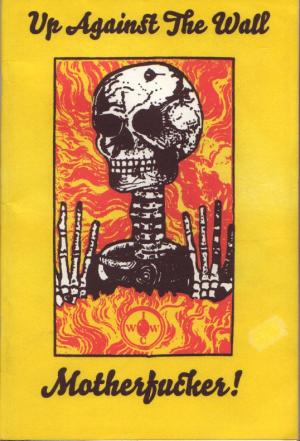
Sat Jan 31: "Up Against the Wall Motherfuckers" forum in NYC

uatwmf

Saturday, Jan. 31, 2 PM

Anarchist Forum: “The Up Against the Wall Motherfuckers”

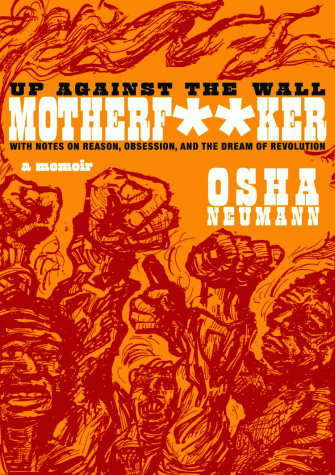
A look back at the fascinating Lower East Side anarchist group first known in ’66 as a Dada art movement called the Black Mask, but then in ’68 became more active by feeding the poor, setting up crash pads, occupying a Columbia University building, promoting surrealist protests, shutting down MOMA, providing free weekly musical events and irritating the police. They became known widely as the Up Against the Wall Motherfuckers.

Speakers at the forum will be the Living Theatre’s Judith Malina, whose conversations with the painter Ben Morea, one of the group’s founders, led him deeper into anarchism, and Osha Neumann, who was an early member and has this year published a book on the history and soul of the group.

The event will take place at The Living Theatre, 21 Clinton Street, Manhattan (just south of Houston St) (212-792-8050). Coming from uptown, take the F or V train to “2nd Avenue” (exit front of train on 1st Ave, walk east along Houston and turn right on Clinton) or coming from downtown, take the F, V, M or Z train to “Delancey – Essex” and walk east on Delancey three blocks and turn left on Clinton for 2 and a half blocks.

Everybody is welcome and invited to come and to have their say. There is no set fee for the presentation, but a contribution to aid the LBC is suggested.

If you have questions, contact the Libertarian Book Club/Anarchist Forum, 212-475-7180 or e-mail: roberterler (at) erols.com

WIKIPEDIA: http://en.wikipedia.org/wiki/Up_Against_the_Wall_Motherfuckers

oshuamemoir

Reggae for the weekend: Coxsone Dodd

When they were at the top of their game, the tuneful curators at the Magic of Juju were running one of the best audioblogs on the web. They’ve been quiet of late, but most of their collection of Indian ragas, Malian guitar jams and Indonesian field recordings is still available for your perusal.

They’ve also got a friend named “Jah(n)” who drops in every once in awhile to offer us these wonderful collections of classic reggae and dub, often previously unreleased and almost always ripped from the original vinyl singles. The last post from Jah(n) and the Juju crew came at the end of November, and it’s a doozy: Seven hours, give or take, of sides from seminal Jamaican producer C.S. “Coxsone” Dodd. Go check it out here.

Dodd–the founder of Kingston’s Studio One label–was born this week back in 1932, so we figured now is as good a time as any to overload our hard drives with his sweet irie jams. That, and, of course here in the Atwater office we’re looking at 80-degree temperatures this weekend and want to be ready should barbecues begin to spontaneously alight.

DAILY MAGPIE – January 31st at DEATH BY AUDIO

jonasreinhardt

Did you miss THIS tour? That’s a shame. But if Cluster, Harmonia, Goblin or general krautrock-style psychedelia is your thing, try catching JONAS REINHARDT this weekend at DEATH BY AUDIO. The band is comprised of members from The Fucking Champs, Mi Ami, Crime in Choir and Trans Am, and they just put out a new record on the KRANKY label. This will be their first performance in Brooklyn after a while of touring with the likes of White Rainbow, Lucky Dragons and other friends on the west coast. Also on the bill are Aa, WHITE HILLS, ( ( ARP ) ) and SOFT CIRCLE. Guaranteed a good choice for your evening.

Date & Time: Saturday, January 31st – 8PM
Venue: DEATH BY AUDIO (BROOKLYN)
Location: 42 S. 2nd at Wythe / Brooklyn, NY 11211
Price: $TBA (Go here for more info)

"We're all going one way, but we may as well get down to it while we're here"*

(*John Martyn talking about the themes of mortality on 1970’s Road To Ruin)

stormbringer

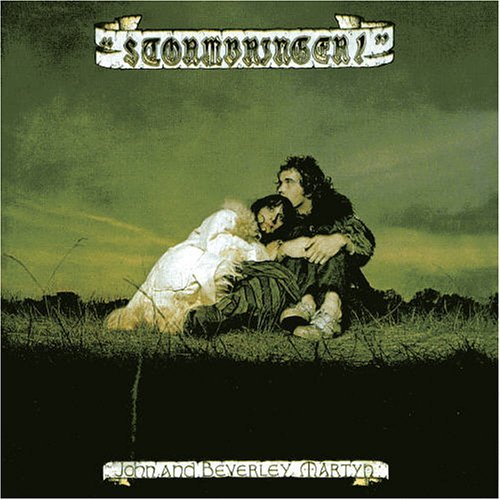
John Martyn’s two 1970 albums with his wife Beverley — Stormbringer! and Road to Ruin — are near perfect examples of lush, freewheeling ’70s folk music. There’s the intricate guitar picking that characterized his earlier work on albums like The Tumbler, and there are a few of the jazz affectations that defined his later, more experimental efforts like Bless The Weather and Solid Air. But mostly this is the sound of two people in love, holed up with pals like Levon Helm in the idyllic countryside of Woodstock NY — e.g. just look at the two Martyns huddled together on Stormbringer!‘s awesome cover (later appropriated by Wooden Wand & The Sky High Band for their 2006 album, Second Attention). On his website, John offers these memories of the sessions:

“It was the year of the festival. We just lived there and worked with Paul Harris very quickly and very briefly and we just went into the studio and did it very one-off, very swift. Levon Helm and Harvey Brooks we met in Woodstock and used them, just because they were friends. It seemed obvious that they should be on it. Dylan lived up the road, and Hendrix lived virtually next door. He used to arrive every Thursday in a purple helicopter, stay the weekend, and leave on the Monday. He was amazing…a good lad.”

Here’s my favorite song from the album, the absolutely magnificent “John The Baptist.”

Download “John The Baptist”

On his 2006 tour Will Oldham was playing a hybridized cover version of Martyn’s “John The Baptist” and another song on the same subject by Virginia country gospel players E.C. and Ornal Ball. Here’s an acoustic version of Oldham’s medley, from his August 2006 run at Joe’s Pub in NYC. (Thanks to Aquarium Drunkard for posting the complete Joe’s Pub sets back in December).

Download Will Oldham’s “John The Baptist”

Road to Ruin–also recorded in 1970–has more of the same but with lots more jazz playing. It includes the melancholy vacation anthem “Give Us A Ring,” in which the couple ask their friend Nick Drake to bring them something cool back from his time abroad.

Download “Give Us A Ring”

Martyn went on to make weird, wonderful records that spanned folk, improv, ambient and reggae, but those two albums with his wife — they divorced in the late ’70s — will always be my favorites.

John Martyn died today of pneumonia. He was 60. Various obituaries and remembrances after the jump.

Continue reading

"My relationship with the ninja was interesting on a couple of different levels."

Alison Levy is a curator, writer and a blogger at the 2012 apocalypse fan-fiction forum Reality Sandwich. She’s posted a great interview with Arthur columnist Aaron Gach, of The Center for Tactical Magic. Check it out here.

In the midst of all the New Age therapy-speak in the comments — e.g. “i was the canvas i was doing the painting on, it was a shamanic abstract x-pressionist personal human sculpture” — “sonofman” jumps in to direct the RSers over here to Arthur to check out some of the Center for Tactical Magic’s contributions. Thanks, sonofman. Here’s a quick digest of the Center’s “Applied Magic(k)” columns, for your consideration:

Vanishing Act, from Arthur 32/December 2008

An Open Invocation, from Arthur 31/October 2008

The Roots of Culture, from Arthur 29/May 2008

Will Power To The People! from Arthur 27/November 2007

Calling All Ghosts, from Arthur 25/Winter 2006

BONUS: The Center for Tactical Magic at Psychobotany at Echo Park’s Machine Project, May 2007

Read an excerpt from the interview–in which Aaron explains what he learned from private eyes, ninjas and magicians–after the jump.

Continue reading