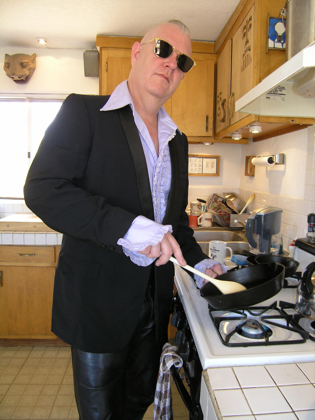
A poem from Thurston Moore

thurstonmoore
1995
by Thurston Moore

sonic youth is playing
a tiny club in new orleans
with unwound and polvo and
the place is a pressure cooker ready to blow. a girl in
the audience scales the club wall
and stands
precariously
on a lighting rig
beam. we have to
stop playing and try to coax
her down. kim asks her why she is up there.
she explains she can’t see and for $30
she wants to see. we tell her
that tickets
are only $15 and she confesses
she had to buy one
for her boyfriend. kim sez,
“that was yr first mistake.”

MONSANTO-RESISTANT

from : http://spectregroup.wordpress.com/2010/05/06/monsanto-resistant/

SuperWeeds
http://sourcewatch.org/index.php?title=Monsanto_and_the_Roundup_Ready_Controversy
http://nytimes.com/2010/05/04/business/energy-environment/04weed.html
“Just as the heavy use of antibiotics contributed to the rise of drug-resistant supergerms, American farmers’ near-ubiquitous use of the weedkiller Roundup has led to the rapid growth of tenacious new superweeds. To fight them, farmers are being forced to spray fields with more toxic herbicides, pull weeds by hand and return to more labor-intensive methods like regular plowing. The first resistant species to pose a serious threat to agriculture was spotted in a Delaware soybean field in 2000. Since then, the problem has spread, with 10 resistant species in at least 22 states infesting millions of acres. “What we’re talking about here is Darwinian evolution in fast-forward,” Mike Owen, a weed scientist at Iowa State University, said.”

Sterile Seed Monopoly
http://npr.org/templates/story/story.php?storyId=125906838
http://npr.org/templates/story/story.php?storyId=122498255
“It’s time to buy seed again, but hundreds of seed companies have gone under in the past two decades. Critics of the big agriculture biotech company Monsanto say its popular Roundup Ready technology is to blame for that. Roundup Ready is a line of gene-modified seeds that inoculate plants against a herbicide, Roundup, also made by Monsanto, that kills just about everything else. Ulrich says his seed costs shot up almost 50 percent last year. That’s because farmers are contractually prohibited from saving seeds and planting them the following year. Farmers face lawsuits if they try to save and replant the genetically modified seed because they don’t own the technology. More than 9 out of 10 soybean seeds carry the Roundup Ready trait. It’s about the same for cotton and just a little lower for corn. Now Monsanto has invented something new, called Roundup Ready 2 Yield. It uses the gene as the original, just placed in a different spot in the genome. Monsanto says that boosts yield. Interesting timing: Monsanto’s patent on Roundup Ready 1 expires in 2014 and with it, a revenue stream of maybe half a billion dollars a year in royalties. That’s unless it can switch farmers over to Roundup Ready 2. Meanwhile, the end of the Roundup Ready patent will very likely give farmers a chance to do something they haven’t for years: plant the seed they’ve harvested. “I don’t care how good Roundup Ready 2 is; if you tell me I can save back my own seed, I’m going to plant my own seed,” Ulrich says. The problem for guys like Ulrich will be finding seed that has just the Roundup Ready gene alone, one not stacked with other patented traits. After all, if he can’t find the seed in the first place, he can’t grow it.”

Nature Predictably Defiant
http://blogs.discovermagazine.com/loom/2010/05/04/how-to-make-a-superweed/
“In the ancient empire of Sumer 4500 years ago, farmers put sulfur on their crops. The Romans used pitch and grease. Europeans learned to extract chemicals from plants. In 1807, chemists isolated pyrethrum from an Armenian daisy. To stop the San Jose scale, they tried whale oil. They tried kerosene and water. One of the best treatments they found was a mix of lime and sulfur. After a few weeks of spraying, the San Jose scale would disappear. By 1900, however, the lime-sulfur cure was failing. An entomologist named A. L. Melander found some San Jose scales living happily under a thick crust of dried lime-sulfur spray. In the short term, Melander suggested that farmers switch to fuel oil to fight scales, but he warned that they would eventually become resistant to fuel oil as well. In fact, the best way to keep the scales from becoming entirely resistant to pesticides was, paradoxically, to do a bad job of applying those herbicides. By allowing some susceptible scales to survive, farmers would keep their susceptible genes in the scale population. “Thus we may make the strange assertion that the more faulty the spraying this year the easier it will be to control the scale the next year,” Melander predicted.

In 1970 a scientist at the Monsanto Corporation found a chemical that seemed to hold out great hope–glyphosate, also known as Roundup. Glyphosate kills weeds by blocking the construction of amino acids that are essential for the survival of plants. It attacks enzymes that only plants use, with the result that it’s harmless to people, insects, and other animals. Roundup went on the market in 1974. In 1986, scientists engineered plants to be resistant to glyphosate, by inserting genes from bacteria that could produce amino acids even after a plant was sprayed with herbicides. In the 1990s Monsanto and other companies began to sell glyphosate-resistant corn, cotton, sugar beets, and many other crops. But after glyphosate-resistant crops had a few years to grow, farmers began to notice horseweed and morning glory and other weeds encroaching once more into their fields. What’s striking is how many different ways weeds have found to overcome the chemical. What makes the evolution of Roundup resistance all the more dangerous is how it doesn’t respect species barriers. Scientists have found evidence that once one species evolves resistance, it can pass on those resistance genes to other species. They just interbreed, producing hybrids that can then breed with the vulnerable parent species. In a recent interview, Powles predicted that the Roundup resistance catastophe is just going to get worse, not just in the United States but everywhere where Roundup is used intensively. It’s not a hopeless situation, however. Farmers may be able to slow the spread of resistance by mixing up the kinds of seeds they use, even by fostering vulernable weeds in the way Melander suggested.”

No Recusal
http://scotuswiki.com/index.php?title=Monsanto_Company_v._Geertson_Seed_Farms
http://current.com/news/92330224_conflict-of-interest-ex-monsanto-lawyer-clarence-thomas-to-hear-major-monsanto-case.htm
“In Monsanto v. Geertson Seed Farms, No. 09-475, the U.S. Supreme Court will hear arguments in a case which could have an enormous effect on the future of the American food industry. This is Monsanto’s third appeal of the case, and if they win a favorable ruling from the high court, a deregulated Monsanto may find itself in position to corner the markets of numerous U.S. crops, and to litigate conventional farmers into oblivion. Here’s where it gets a bit dicier: from the years 1976 – 1979, Clarence Thomas worked as an attorney for Monsanto. Thomas apparently does not see this as a conflict of interest and has not recused himself. Alfalfa is the fourth most widely grown crop in the United States, behind corn, soybeans, and wheat. Alfalfa is very easily cross-pollinated by bees and by wind. The plant is also perennial, meaning GMO plants could live on for years. “The way this spreads so far and wide, it will eliminate the conventional alfalfa industry,” said Trask. “Monsanto will own the entire alfalfa industry.””


http://www.jonathanterranova.com/order81.php

“New Orleans Soul Red Beans, Rice and Corn Bread” recipe by DAVID CATCHING (Arthur, 2004)

Here’s an old “Come On In My Kitchen” column from Arthur’s March 2004 issue (No. 9.) Our star chef that issue was Dave Catching, gentleman guitarist of Joshua Tree, California…

This issue’s chef: David Catching of Joshua Tree, California


David Catching is currently a member of earthlings?, Yellow No. 5 and Mondo Generator and appears on The Desert Sessions Volume 9 & 10 (Rekords Rekords/Ipecac). Take it away Dave…

Hey y’all, Mardi Gras season is here and I hope you’re lucky enough to be celebrating it with me in New Orleans. If you are, you’re probably drunk, still drinking, dancing, chasing members of the opposite or same sex all night, and will be pretty tore up tomorrow. Here’s a little recipe I learned from my friend Jimmy Ford at the Jimmy Ford Clinic (thanks for showin’ me the way) and my friend Chef Big D, of the now-defunct Harbor Bar and Restaurant (R.I.P.), both of New Orleans, Louisiana. It’s easy and oh-so-cheap, which will be helpful while your scrambled brain tries to figure out what you spent all your money on. I’m giving you the vegetarian version here, but it’s also killer when cooked with smoked sausage. It ain’t my fanciest recipe, but it is great and will cure the meanest of hangovers for pennies. Regarding Tony Chachere’s Cajun spice: if you can’t find it in your neighborhood stores, I would recommend a trip to New Orleans. That means you’re probably overdue for at least a weekend there anyway…

New Orleans Soul Red Beans, Rice and Corn Bread
feeds six tore-up folks

one pound dried red beans
two cups white rice
one yellow onion
one half red onion
eight cloves garlic
two vegetable bouillon cubes
two tablespoons Tony Chachere’s Cajun spice
three pinches salt
two pinches black pepper
one pinch white pepper
one cup water
one box Jiffy cornbread mix (I know, but real soul food restaurants really do use this mix)
one jalapeno pepper
six ounces grated cheddar cheese
one egg
one cup milk
optional: one pound smoked sausage cut in one-inch length pieces

Wash and soak red beans overnight and rinse. Add water and boil beans until cooked, then simmer on low. Saute onions and garlic, with spices. Add onion, garlic and spices to simmering red beans and cook a few hours to taste. Follow rice cooking instructions. Follow Jiffy cornbread mix directions, then add chopped jalapeno pepper and most of the cheese. Sprinkle remaining cheese on top and cook per Jiffy cornbread mix instructions. Serve a mountain of beans (with or without the smoked sausage) on a nice thin bed of rice.

My first taste of this particular recipe was at the Harbor Bar and Restaurant (the best soul food joint anywhere, ever) on Mardi Gras Day, 1993. This was without a doubt one of the best days of my life. I marched with the Lions Carnival Club, starting at 6am, with our second line brass band leading the way, from the sparse uptown gatherings, through to the thousands gathered at Lee Circle with Rex and Zulu, finally reaching the unbridled revelry of the French Quarter at 3pm, our costumes and masks obscuring the awe and joy we all were experiencing, some of us having imbibed many brands and colors of hard alcohol, psychedelics, prescribed and non-prescribed medications, marijuana and, from what I can gather through hearsay and gossip, stimulants of all kinds. In the madness of Frenchman Street at sunset, I met a beautiful stranger, who led me to the Harbor Bar and Restaurant. There, I was saved by the red beans and rice…

….and a double turkey and seven.

79-minute GRATEFUL DEAD MIX Volume 2 by Greg Davis

gratefuldeadmix2

Grateful Dead Mix – Volume 2
by Greg Davis
(April / May 2010 – Burlington VT)

Stream: [audio:http://www.arthurmag.com/magpie/wp-content/uploads/2010/05/01-Grateful-Dead-Mix-Volume-2.mp3%5D

Download: Grateful Dead Mix Volume 2 (mp3, 146mb)

track listing:
Yamantaka (from Mickey Hart, Henry Wolff & Nancy Hennings Yamantaka) + Bill Graham Presents… (from The Bugs – unreleased radio play 1982)

Ollin Arageed (from Rocking the Cradle – live at the Pyramids Cairo Egypt 09/16/78)

Stage Banter / Technical Difficulties (live at Woodstock Festival Bethel NY 08/16/69) + Seastones (from Seastones Sessions 11/28/73)

Fire On The Mountain (live at the Pauley Pavilion UCLA Los Angeles CA 12/30/78)

Bugs On Broadway (from The Bugs – unreleased radio play 1982) + Magnesium Night Light (from Infrared Roses)

Casey Jones (from Workingman’s Dead Sessions)

Franklin’s Tower (from Blues for Allah)

…Quick, the Baby Is Crying… (from Home Recordings Summer 1969)
The Barbed Wire Whipping Party (from Aoxomoxa Outtakes)

Seastones (from Seastones Sessions 11/28/73) + Magnificent Sevens (from Diga Rhythm Band) + Music To Be Born By (from Mickey Hart Music To Be Born By)

Stella Blue (from Steal Your Face – live at The Winterland San Francisco CA 10/20/74)

Eyes Of The World (from Wake Of The Flood)

Crowd Sculpture (from Infrared Roses) + The Bells The Bells (from The Bugs – unreleased radio play 1982)

Ollin Arageed (live at Uptown Theatre Chicago IL 11/18/78)

China Doll (from From The Mars Hotel)

Drone Collage includes The Revolving Mask of Yamantaka + Yamantaka + Solar Winds (from Mickey Hart, Henry Wolff & Nancy Hennings Yamantaka) + Love Scene Improvisations (Take 4) (from Zabriskie Point Soundtrack outtakes by Jerry Garcia)

Touch of Grey (from In The Dark)

So it Came To Pass (from The Bugs – unreleased radio play 1982) + Seastones (from Seastones Sessions 11/28/73)

Dark Star (studio version from What A Long Strange Trip It’s Been)

Dark Star (live at The Family Dog San Francisco CA 08/30/69) + Dark Star (live at The Fillmore East New York NY 01/02/70) + The Bells The Bells Reprise (from The Bugs – unreleased radio play 1982)

Estimated Prophet (live at Barton Hall, Cornell University Ithaca NY 05/08/77)

Star Spangled Banner & Closing Remarks (from The Fillmore Acid Test San Francisco CA 01/08/66)

Bird Song (from Ladies and Gentlemen live at The Fillmore East New York NY 04/28/71)

Love Scene Improvisations (Take 3) (from Zabriskie Point Soundtrack outtakes by Jerry Garcia)


Previously: Grateful Dead Mix Vol 1 by Greg Davis

GREG DAVIS IS A MUSICIAN:

http://www.autumnrecords.net
http://www.myspace.com/gregdavismusic
http://www.myspace.com/suncircle
http://www.myspace.com/cwgd

Arthur Radio Transmission #16 w/ Spectre Group

This week on Arthur Radio we invited the Spectre Event Horizon Group to create an original and undoubtedly mind-expanding segment for the show (you may otherwise know them on the Arthur blog as secret santa, purveyors of obscure and highly relevant technological, biological and environmental information of this day and age). Here’s a description of their first audio documentary contribution, straight from Spectre themselves:

Spectre begins its experiment with radio by getting a tutorial from Albie Tabackman, an inventor + osteopathic physician who – among many other cool projects – has got a customized electric delorean up on blocks in his backyard. He’s also our friend Max Fenton’s dad, who joins us as well: lately Albie’s been working with stirling engines, and today they both kindly help us understand how it is stirling engines work and why we should each have one under our kitchen sink. Or don’t you want your own personal emission-free power plant?

More on stirling engines from the Spectre vault: http://spectregroup.wordpress.com/2010/04/09/the-stirling-age/


Stream: [audio:http://www.arthurmag.com/magpie/wp-content/uploads/2010/05/Arthur-Radio-Transmission-16-w-Spectre-Group-5-2-2010.mp3%5D

Download: Arthur Radio Transmission 16 w/ Spectre Group 5-2-2010

This week’s playlist…
Continue reading

WHY WAS THAT GUY SO DUMB?

From The New Yorker

Last week, before the Times Square incident, I was talking with a former U.S. intelligence officer who worked extensively on jihadi cases during several overseas tours. He said that when a singleton of Shahzad’s profile—especially a U.S. citizen—turns up in a place like Peshawar, local jihadi groups are much more likely to assess him as a probable U.S. spy than as a genuine volunteer. At best, the jihadi groups might conclude that a particular U.S.-originated individual’s case is uncertain. They might then encourage the person to go home and carry out an attack—without giving him any training or access to higher-up specialists that might compromise their local operations. They would see such a U.S.-based volunteer as a “freebie,” the former officer said—if he returns home to attack, great, but if he merely goes off to report back to his C.I.A. case officer, no harm done.

Whatever the narrative behind Shahzad’s case turns out to be, we can take solace that we will hear it in a court of law. Amidst the country’s often self-defeating search for a justice system to address terrorism, his is not a particularly hard case—a U.S. citizen arrested on U.S. soil for a crime against Americans carried out in New York. We can nonetheless look forward to “The Daily Show” clips showing cable television anchors railing about the Obama Administration’s failure to recognize him as a warrior. Fortunately, like one of those Eleven O’clock News bank robbers who tries to rob an A.T.M., only to topple it over on himself, Shahzad’s case may help to illuminate a truth larger than himself: Terrorists are criminals, and the great majority of criminals are prosaic.