Sean Christensen aka Awesome But True aka Glass Moustache is a prolific comics maker and mega awesome bro from way back. When he’s not getting radical or enjoying life… oh wait… that’s never. So in the midst of all that awesomeness you know he’s drawing pictures and making comics with his friends here in Portland.
One of his newest books is Labanotation: The Center of Weight, a collaboration with the incredible Amy Kuttab. We’re pleased to present some pages from a new odyssey in progress, ‘2005’.
The art of losing isn’t hard to master;
so many things seem filled with the intent
to be lost that their loss is no disaster.
Lose something every day. Accept the fluster
of lost door keys, the hour badly spent.
The art of losing isn’t hard to master.
Then practice losing farther, losing faster:
places, and names, and where it was you meant
to travel. None of these will bring disaster.
I lost my mother’s watch. And look! my last, or
next-to-last, of three loved houses went.
The art of losing isn’t hard to master.
I lost two cities, lovely ones. And, vaster,
some realms I owned, two rivers, a continent.
I miss them, but it wasn’t a disaster.
Even losing you (the joking voice, a gesture
I love) I shan’t have lied. It’s evident
the art of losing’s not too hard to master
though it may look like (Write it!) like disaster.
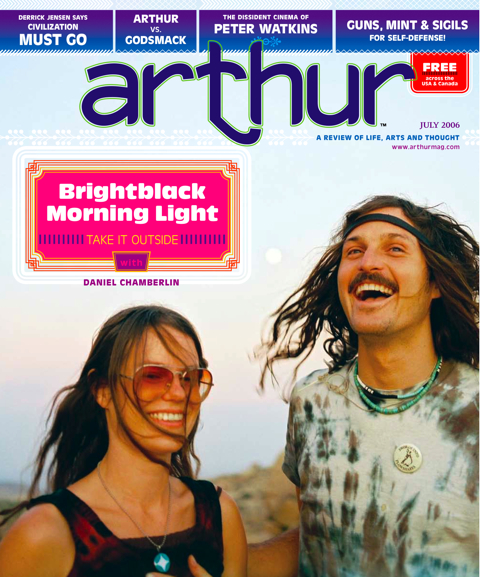
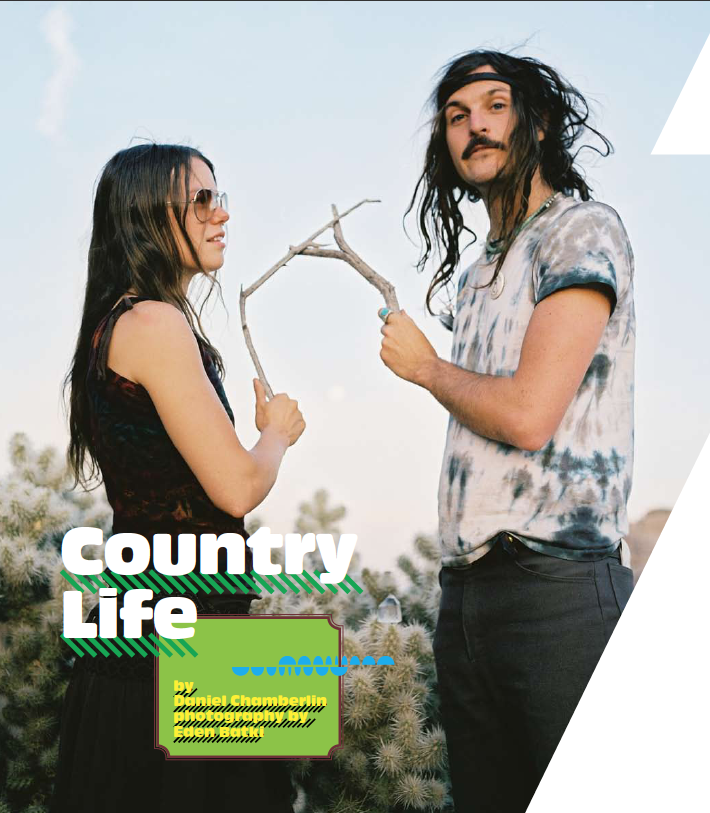
Country Life For the beatific country-soul musicians of Brightblack Morning Light, there’s no place like Nature By Daniel Chamberlin Photography by Eden Bakti
Originally published in Arthur No. 23 (2006)
When they weren’t slumming it with us youngsters at the all-ages hardcore shows, the older dudes at my Indiana high school would spend their weekend nights going “country cruisin’, reminiscin.” They’d all pitch in on a six-pack, score a dime-bag and then pile into somebody’s old car—preferably a late ’70s model sedan with stained plush upholstery and bench seating in front—and drive slowly down the deserted gravel roads and empty dirt tracks that criss-crossed the corn and soybean fields that spread for miles in every direction from the small town we called home. Though I never went on these sentimental rides—I was too young, pot-phobic and already knew that drunk driving was trouble—I was in love with their soundtrack: long-form blues from the Allman Brothers and heartbroken redneck ballads from Lynyrd Skynyrd.
These days, I score my drives back from walks in the San Gabriel Mountains north of my home in Los Angeles with the same music, maybe a bit more Neil Young and Fairport Convention in the mix. It sets the tone for the silent trekking to come and eases the re-entry into the urban landscape on the way back down. The Grateful Dead’s American Beauty and Will Oldham’s Ease Down The Road are ideal albums to soundtrack trips to the deserts and mountains. I’ve added Brightblack Morning Light’s new album of organic wilderness soul to the list of music perfect for such peaceful expeditions.
The two core members of Brightblack are Rachel “Rabob” Hughes, 29, and Nathan “Nabob” Shineywater, 30. Their self-titled debut for Matador Records has the dense harmonic blur of My Bloody Valentine but the music is made with the kind of instruments you’d expect to find the world famous session musicians—the Swampers—of Muscle Shoals putting to good use behind Aretha Franklin or Mavis Staples. (The album actually features two of the Staples Singers along with a trombone player from Nashville, Andy McLeod of White Magic on bongos and Paz Lenchantin—the Argentinean-American multi-instrumentalist known for her work with A Perfect Circle, Silver Jews and Entrance—on guitar.) It’s perfect for coming down from the mountains, and custom made for coming down on Sunday morning. It has an almost gospel feel—since soul music is just gospel without as much god—that invites comparisons to the lonely space-age-blues of Spaceman 3 or Spiritualized. But where Jason Pierce put opiates on the altar formerly occupied by the Holy Trinity, Brightblack has placed a respect for nature, an amalgam of environmental convictions and Native American spiritual practices. Which is sort of obvious from song titles like “A River Could Be Loved” and “We Share Our Blanket With The Owl.”
Their live performance is as quiet and intimate—maybe even more so—than their album. The most recent incarnation of their touring band includes Oregonian Elias Reitz on congas and tablas and West Virginian Ben McConnell behind the kit, with their friend Mariee Sioux, who Nabob is careful to identify as a full-blooded Paiute, opening each show. They often bring sticks and other woodland artifacts onto the stage, erecting small lean-tos or tipi-like structures. All of it swirls and refracts in the rich, resinous sound of Rabob’s Fender Rhodes organ. The vocal harmonies are chorus of whispers, while the brushed percussion is more of a sparkle than a clatter. The instruments are so quiet that cash registers at the bar interrupt the spell. Nabob’s slide guitar work hangs in the dim lights of the stage, glowing and vibrating in the air. On his instrument, a wolf cub suckles at a woman’s breast.
10 Billion farm animals will be
slaughtered next year,
and 60% of each body
will be buried in pits
in
Texas, Ohio, California
I grew up in the grass
in summertime Ohio,
a little girl blowing bubbles and skinning
knees, and all the while
calves were being blasted
‘tween the eyes with
buzzing
prods all across
the U.S.A.
In China, they use
organic waste to produce
energy, but there are many
problems, see,
the fat, see,
it leaves a layer
at the end of it all, and
bones, they just won’t
break
down.
This week’s episode of Arthur Radio begins with a late summer breeze, wafting between blades of bright green grass under a saturated blue sky, not a cloud in sight. Saturday morning cartoons creep out of an open window, on the other side of which the smell of hot cornbread begins to fill an empty kitchen. Beyond billowing white curtains, a lonesome gray-haired wolf rambles through the rolling meadows, whistling a nostalgic tune… in the distance, a soaring note begins to accompany his song, which soon escalates into a full-on bittersweet dirge of emotion.
“The festival will be held at Old Mill Farm, located deep in the redwoods near the town of Mendocino, 150 miles north of San Francisco. The roads out to the farm are very narrow and blind, so please be EXTREMELY careful when driving. Because the farm is so remote, we suggest stocking up on anything you might need for the weekend before you make the drive. Camping is included with your ticket, but please bring a tent and other camping gear. Tickets are $30 in advance, $35 at the gate. Price includes overnight camping and a full dinner with farm-grown veggies and meat…”
Dragon’s Tongue Bean: $3.50 / $3.00 for members
Stringless purple-striped wax beans are delicious for fresh eating and make great dry beans for soup. Illustration by Arik Roper. 50 seeds per pack.
The filmmaker’s description reads: “Short film exploring a dystopian vision of London in the near future. The economic meltdown of 2009 has left the financial district abandoned, allowing space for nature to reclaim it’s [sic] iconic structures, and a new community of scavengers to settle within its midst.”
Not sure what’s so dystopian about this, and the music is eh, but certainly worth viewing (and enacting!)…





 Arthur Magazine