Arthur presents "BAPTISM IN MAVERICK JUICE!" by Paul Krassner

Baptism in Maverick Juice!
A special sneak preview of this fall’s Palin-McCain reality sitcom
by Paul Krassner

Referring to the Ronald Reagan presidency, Neal Gabler has written about “the triumph of entertainment over political ideology of any sort.” And Kurt Andersen labeled Bill Clinton the “Entertainer-in-Chief.” The voters are the audience, conditioned to fear and superficiality in commercials for erectile dysfunction and political campaigns alike, both having scary side
effects. And now the injection of Sarah Palin and her family into the McCain campaign makes one wonder whether the winner of this race will ultimately depend on which candidate presents the better sitcom. It already isa reality show. Do you know what the difference is between a sitcom and a reality show? The laugh track. Otherwise, how would the masses be able to tell whether something is funny or not? Hmmmmm… In any case, we’re pleased to present several scenes from the pilot episode of…

BRIDGES TO NOWHERE

[The theme song by Britney Spears, “Oops! I Did It Again,” is accompanied by a montage of Sarah in different contexts, as the opening credits are superimposed on those images: In a helicopter, using a machine-gun to shoot a wolf running away in the snow. As a contestant in the Miss Alaska competition. A wedding photo. Burning a pile of books. Jumping high to block a shot in a basketball game. Seated at her desk in the governor’s office. At a barbecue with her children. Giving a speech to a large crowd. At the bank, exchanging a wolf’s left foreleg for a $150 bounty.]

* * *

[Sarah and Todd Palin are slumped down on the living-room sofa.]

SARAH: I’m exhausted and exhilarated at the same time. I was at the Learning Annex all day, taking that course in “How to Be a Vice President.”

TODD: And I was interviewing potential nannies all day. No one fits the bill yet. But I just keep calling the agency. Maybe I’ll try Craigslist.

[The telephone rings. Todd picks it up.]

TODD: Hello…thanks, I will. [Hangs up the phone and clicks on the TV That was McCain. [Looks at TV Guide for the channel number and clicks the TV on.]Keith Olbermann is doing a Special Comment about you on MSNBC.

Continue reading

Against iPodiphilia: Or, Cory Doctorow’s way of listening to music is freaking Erik Davis out (Arthur, 2008)

Art: M. Wartella

THE ANALOG LIFE: a column by ERIK DAVIS

“Archive Fever”

(originally published in Arthur No. 30, July 2008)

Last month Paul Miller—the avant-garde DJ, musician and theorist who always appends his name with “aka DJ Spooky that Subliminal Kid”—finally released a collection of essays he has been editing for ages on digital and sampling culture, called Sound Unbound. It’s a cool book, and I’m not surprised. I first met Paul at the Village Voice in the early 90s, when I recognized the voodoo vévé for Legba that appeared on one of his stickers. Over the years, his DJ mixes, thoughts, and restless career represent a lot of what I continue to love about digital culture. Paul is relentlessly interconnected and multi-disciplinary, refuses to be locked into one career identity or scene, and restlessly moves between worlds. He thinks and acts like he spins, an endless collage that draws equally from high and low, here and there, old and new.

All this is reflected in the book, a somewhat amorphous but fascinating collection of essays by musicians (Steve Reich, Brian Eno), techies (Bruce Sterling, Jaron Lanier), edge academics (Ron Eglash, Manuel De Landa), and nomads like me. I contributed an essay I wrote over a decade ago called “Roots and Wires,” about dub music, polyrhythm, the African diaspora, and their digital mutation into drum’n’bass. (Today I would talk about dubstep, though I would be rather less enthusiastic.) In retrospect, I realize that my desire to uncover both the spiritual roots of the dub virus and its futuristic implications was another version of my concern with understanding the rapport—and conflict—between the digital and the analog, coding strategies that are also metaphors for much larger processes of understanding and experiencing culture and the world.

I like roots with my wires, but that’s not always how it goes. How much digital and analog can diverge was starkly brought home to me in the foreward to Paul’s book. The short piece was written by Cory Doctorow, a tireless electronic freedom fighter who writes science fiction and posts frequently at the popular group blog BoingBoing. The stark part came a few paragraphs into the piece where, after explaining that he can’t work without music, Doctorow describes how he manages the 10,000 tracks he keeps in iTunes:

“I’ve rated every track from 1 to 5. I start every day with my playlist of 4- to 5-star music that I haven’t heard in thirty days, like making sure that I visit all my friends at least once a month…After that, I listen to songs I haven’t rated, and rate them. Then it’s on to 4- to 5-star songs I’ve heard fewer than five times, total. I don’t want random shuffle: I want directed, optimized shuffle.”

There is no other way to say it: this vision of listening to music blew my mind. It seemed so alien to my way of listening, so alienating in general, that I had to write a column about it to figure out the source of my freaked-outedness.

Some caveats first. One is that Cory Doctorow seems like a prince among übernerds. His Boing Boing posts about the ongoing intellectual property wars are always sharp and informative, and they help insure that the website remains an exuberant if sometimes goofy bastion of old school counter-cultural net values. I haven’t read Doctorow’s SF, but I do admire what he does with it. For one thing, he gives it away for free online—as pure a gesture of ethical culture a professional author can make. And his new book, Little Brother, is a piece of tactical genius: a young-adult near-future novel about a group of kids in San Francisco who use a variety of real-world hacking and encryption tools to take on the Department of Homeland Security in an era of civil liberties crackdown. Lifting a page or two from Encyclopedia Brown, Doctorow includes actual tips and technologies so that kids reading the novel can get their cyberactivist groove on right away.

My other caveat is that listening to recorded music is a matter of pleasure, and it seems silly to spend much time worrying about other people’s pleasures. I think its fine to judge music, and to judge other judgments as well—part of the enjoyment of music for many of us is the pleasure in discussing it, describing it, even arguing about it, although I believe the depth of those conversations are not weathering the Internet well. In any case, it’s hard to overturn the core wisdom of chacun à son gout. Doctorow clearly enjoys music, and I enjoy the enthusiasm. But his pleasure also seems deeply bound up with the process he has created to manage, filter, and tag all those MP3s. This is where we part ways, because all this algorithmic fiddling seems less like listening to music that doing something that, for most of us, is much less fun: data-processing.

Here’s the nub: the more we deal with recorded music in the form of digital files, the more that music takes on the characteristics of data, and the more its specific qualities as music melt into that multimedia torrent of bits that keep us chained to our screens. From a new media perspective, this breakdown sounds kind of cool and futuristic, and it certainly opens up new possibilities of expression and intervention. But I’m not sure these transformations really support deep and engaged listening. Amidst the endless brouhaha over downloading and the radical shake-up of the music market, we have yet to come to terms with this massive transformation in the culture of collecting and engaging recorded music.

Recordings have always been a form of data of course. The music itself can be quantified by wonks as a species of information, while covers and labels come printed with all sorts of words and numbers. Vinyl hoarders face issues of organization as well as physical storage, while the records not yet in one’s collection are also forms of data that hover around your music. Collectors of, say, deeply obscure R&B singles trade lists of recordings so obscure that even almighty Google does not know they exist. But recordings become much more data-like once they go digital. With the severing of music from vinyl discs, magnetic tape, and increasingly compact discs, recorded music does not transend the body but takes on a new one—a body furnished by binary code, the new vehicle of song.

The simple equation of these new bodies is more for less: more tracks cost less money and require much less storage. At the same time, collections always expand to fill all available space—hard discs fill up as reliably as physical bookshelves do. As the capacity of digital memory increases—in inverse proportion to its price—our compulsion to gather bits is compounded, and we hoard. I held off from mp3s so long that I missed the great Napster potlatch, but when I did start hunting and gathering I could not stop, and amassed hundreds of gigabytes in a very short period of time. This is just my experience, but it is hardly unusual. Once touched with archive fever, the forest grows more important than the trees, and the forest keeps growing.

It grows in part because our field of attention is constantly being seeded with information about further recordings, which are themselves multiplying like mad. Your older sister or Spin or the cool guy at the record store has been replaced with a myriad of online environments designed to expose and communicate commentary or links or streams directly to fans: social networks, listservs, collaborative filters like Pandora, online stores with samples, emusic, the blogosphere, myspace. Behind a lot of this proliferating metadata—information about information, in this case, musical information—is the urge to share. This is cool, but it doesn’t necessarily have much to do with listening. Music becomes a chip in a game—a sign rather than a sound, or even—in the case of closed file-sharing communities that demand uploads—an entrance fee. Perhaps the cultural Darwinists are right, and music is just a selfish gene—restless sonic DNA seeking to reproduce itself within this dank hothouse environment of copying and transmission. But I think the aptness of this evolutionary metaphor says more about the environment than the thing itself.

Within this environment, our collections take on the sprawling hairiness of the databases that everywhere process and capture our lives and labors. We are inevitably faced with the problem of organizing, managing, and processing the material, not to mention figuring out a way to extract pleasure from it. Every music fan becomes her own sysadmin. I often ask people how they deal with their mp3s, and am amazed with the ingenious and obsessive systems of rating, tagging, categorizing, and file shuffling that some develop. Others throw up their hands, resist the endless fiddling that technology demands, and allow the mysterious algorithms of the Apple corporation to determine the programming on their portable radio stations. Because I court synchronicity, this is often my method. Doctorow’s system, in this light, is ingenious, as it balances the need to process (rating tunes), and to enjoy, and to enjoy in a quasi-controlled, quasi-random manner that maximizes the efficient delivery of pleasure.

But there’s the rub, at least for me. The efficient delivery of pleasure is not what I want out of listening to music. In fact, the technical cult of efficiency, of developing algorithms to maximize pleasure, is part and parcel of the calculating, over-processed and data-saturated world that I turn to good music to escape, to interrupt, or to buffer. I don’t want to listen to what Heidegger, in his famous essay “The Question Concerning Technology,” called a “standing reserve.” What bothered Heidegger was not machines themselves, but the way that machines turn everything into a reserve of potential usefulness. Once you create a hydro-electric dam, then the rushing stream that inspired poets or musicians or hippie trippers becomes, inevitably, a “standing reserve” of power, another item in civilization’s immense calculus of extraction.

While all music collections can be seen as standing reserves in a sense, the dynamics of digital collections invites that number-crunching calculus much more intimately into the heart of the experience. When I review records, I am sometimes forced to assign a rating, and I understand the value of such consumer guidance. But if I tried to rate every single track as I listened to it, I would feel like a foot-soldier of the machine, because one of the core moves of the machine is to quantify quality, to take fuzzy values and translate them into numerical values. Listening itself becomes processing rather than process, an endless taxonomical twitch mediated by yet another window on yet another screen. And not even a very useful one at that, at least according to my own hedonic calculus. A lot of my favorite music bugged me or flew over my head the first half dozen times I listened to it, while a lot of the pop gems that instantly floated my boat lost their glamour after two or three listens. How do you rate that?

In a way I envy übergeeks like Doctorow. They take the bull by the horns, and tweak the systems that other übergeeks have developed to manage the glorious excess still other übergeeks have helped create. Their engines of musical discovery and pleasure seem like crisp, smoothly oiled machines, controlling the uncontrolled, managing the mania. I look at my collection and my listening habits and just see a big fucking mess. My stereo is in a room without computers, where I love listening to vinyl I still buy because it sounds better and is really fun to shop for. But I don’t have any room for it so it seems kinda stupid too. I am way too lazy and cheap to do lossless rips of the thousands of CDs I have. Besides, even though these pieces of plastic hog my office, I prefer to have my digital memory externalized in a three-dimensional world of objects and colors and images. But of course now I also possess lots of burned CD-Rs and tons and tons of mp3s, which reside on various pods and drives split between my office, my car, and my home. I don’t know where to begin and where to end, but somehow, lumbering around like a dinosaur, I am blessed with an abundance of marvelous encounters.

How to effectively subvert corporate branding and manufacturing: an interview with Rasmus Nielsen of SUPERFLEX (Arthur, 2005)

Originally published in Arthur No. 14 (January 2005)

A DRINK WITH A TWIST

How art collective/company SUPERFLEX is changing the world, one soda pop at a time.

Text by Jay Babcock, photography by W.T. Nelson.


Openings at art galleries always offer beverages, but this is taking the concept to the extreme: here, at downtown Los Angeles’ Roy and Edna Disney/Cal Arts Theatre (REDCAT) gallery one night this past spring, the drink—which is being bottled and sold in the gallery itself—is the art.

The drink on offer is a berry-flavored energy soda called Guarana Power, jointly developed in the last year by two cooperatives: a three-man Copenhagen-based art collective called Superflex and COIMA, a guarana berry farming collective based in Maues, Brazil. For the next month, REDCAT will be transformed into an in-house Guarana Power bottler and an instructional workshop in a strategy as delicious and inspiring as the drink itself: the exploitation of powerful transnational corporations by an alliance of self-organizing third-world farmers.

Intrigued by the underlying concept, the accompanying literature and the simply unbelievable documentary films being screened in the gallery, I contacted Superflex’s Rasmus Nielsen, in town with fellow Superflexer Jakob Fenger as visiting faculty at CalArts for a semester, for an interview.


ARTHUR: How did the Guarana Power drink come about?

Rasmus Nielsen: We were invited by the Amazon Government to a residency in Brazil. We were contacted by this cooperative of guarana farmers, who wanted to present themselves and wanted to talk about their organization, because we had said we were interested in how various people locally have organized themselves They came to us and explained to us why they had formed this organization.

Guarana is a berry, it looks like an eye, it grows on these bushes, it’s a very old Indian tradition that you dry it and then you pound it and then you mix it with water or juice and then you drink it. It has caffeine and other kinds of energetic elements—it’s like an energy drink, and it’s used in sodas. The biggest soda in South America, bigger than Coca Cola, is a guarana-based soda called Antarctica Guarana.

What had happened was these small breweries had merged and founded their own big company which was called the American Beverage Company, AMBEV. Pepsico was a part of that also, that major fusion. It was kind of a classical trend that comes with globalization, you have these big fusions, which then begin to monopolize the purchase of the raw commodities.

Because they are basically one big group, they can dictate the price they purchase the berries at…

And there’s nothing illegal in that, they’re not committing any kind of crime or anything. But what happened was prices fell 80% in just a couple of years! That affected this area a lot, because selling their guarana is their area’s main income. So these guys had formed this cooperative to try and deal with that situation. They didn’t want to have to sell their guarana to AMBEV at these low prices—but then they didn’t who else to sell it to.

So we agreed on making a workshop. The whole cooperative came and we showed them some ideas we had seen in other places and situations, the main idea being, What if you twist the situation? The way these big multinationals work is they use the raw material coming from farmers. What if the farmers used the raw materials that the company is producing, which is their identity, their brand, their logo, all this kind of stuff?

That was one part of it. We also agreed that unless you have to have some part in the next phase of the commodification of the guarana. If you don’t, you are fucked, basically. This is case for most of the Third World farmers; this is the logic of the present global economic structure. If you are a sugar or coffee producer or whatever, if you’re only a producer of raw materials, then you are screwed. The raw material producers be part of the commodification, or own elements of the chain, that’s the key.

And it’s not gonna be sold as a high-end soda, or a “fair price” soda. A lot of the alternatives to big global market structures try to talk to your moral sense, like “Be ethical. Buy this coffee that costs ten dollars more per kilo.” We don’t wanna go that way. We wanna totally appropriate the rules of the basic soda. This is not gonna be pushed as a fair-price thing, but as a soda, where you like it. Of course you like the idea, but you don’t buy it necessarily because of your moral point of view. Cuz I think those attempts have failed, somehow. Not totally, but it will always only be a small portion of the people. Like, how often do you buy “fair price” coffee? It’s really hard to find! So we try to not make something special, but just do the same thing as the normal sodas, same price as normal sodas. Same level, somehow. But it’s owned by the producers, rather than multinationals.

How did you come up with this idea?

For a long time we’ve worked in Thailand, where copying as an economic strategy. You copy a Rolex watch or a shirt or something and sell it. It’s an economic strategy. But then there’s another element to it, which is the interesting part: you copy something, and you TWIST it a little bit, and then you send it back. Maybe you change the name a little bit. Maybe you add your local flavor.

So we showed the guarana collective a couple examples of this, one of them being an example from France, where some French Tunisian second-generation guys have launched a product called Mecca Cola. They use the Coca Cola imagery with red and white and cursive but then substitute the word “Mecca,” which is the city in Saudi Arabia of great importance. Mecca Cola has succeeded in making politics in the framework of the market, basically: the surplus of the Mecca Cola goes to so-called humanitarian issues in Palestine. I don’t know exactly what that means [laughs] but anyway it makes a policy using Coca Cola as a medium, somehow. That strategy we found interesting.

We also know, because we have communicated with these Mecca Cola people, that the guy who started it was a radio journalist.

They had no experience in making sodas, but they were able to do it.

Right. So people started thinking and then coming up with ideas and what came out of the workshop was, We should make a soda. That’s the most obvious thing. Then we discussed how this would look and things like that. We made a prototype of this soda which we showed in the Venice Biennial in Italy last year. Now we’re showing it here in L.A. The next step is there are some people who want to put money into it. The final goal of course is to get in to a market situation and then make a foundation that owns the recipe and takes care of it. This cannot develop into a copy of the structure that these multinational corporations represent, but something that has a different character, that is owned by the people who are producing the guarana and the idea.

You had to figure out the recipe. Reverse-engineering.

We took one of these big sodas that we were somehow copying, that we wanted to modify, and took it to a chemist. He deciphered it, and came up with a recipe, which is probably pretty close to the original one. Exactly. But then we added a lot more of guarana to it. We modified it. But taste-wise, it follows close to the original one.

Of course this is slightly dangerous. Copyright-wise, you can get into trouble. But that’s consciously built into our strategy. We thought, Well if these people come after us, that also highlights the problem that they are causing.

Have you got in trouble yet?

Not yet. We have with other projects. We made a modified Danish lamp that we had copied in Bangkok, and we made it so it would work with biogas instead of electricity. But that lamp is illegal. I can’t show you a picture of it. It would be illegal! Copyright law is stretching out to more and more areas of society, and of course that’s usually serving the guys on top.

You’re taking the “open source” idea from software development—Linux, etc.—and taking it to things much more fundamental: what we drink, how we light our homes…

Yeah. We did a project in Italy where we had art students copying things from 7-11, like Mars Bars and toothpaste. Copying them, changing them maybe a little bit, and then selling them at a market. When I was a kid, we used to have this soda fountain machine, where you could make your own soda at home. It felt as a kid so empowering. You could make your own soda! Of course it was a soda company selling it to you anyway but that idea of reverse-engineering–I think it’s very interesting. Imagine if you started making your own Mars Bars! It’s a very small political act but if a lot of people would do that it would change fundamental economic structures.

Copying is a strategy of economics, but it’s also a strategy of some kind of counter-identity strategy. The potential empowerment in doing that, taking apart, reverse engineering these brands, this specific capitalist cultural power that comes from these brands, taking it a part bit by bit somehow… It’s about being on top of things you put in your mouth, things you buy, things you wear.

For Guarana Power, it looks like you stamped your new logo literally on top of the “Antarctica Guarana” logo.

Yeah. Actually in the beginning we modified the original logo just a little bit. We were showing it in the National Gallery in Finland, and their lawyer was afraid that they would sued by Pepsico or Ambev or something. Which is interesting that even before you do something in a museum , there’s a lawyer’s copyright checking you! It shows you how far the copyright law stretches out into contemporary culture. We were sitting and talking with her and we said, “Well okay what about if we self-censor it? Just put a black box in front of it.” But she was like, “Yeah but you can still see it in the back.” Then we were like, “Okay we will make it a little bit bigger.” She’s a lawyer, knowing about these things, and then at the end she says, “Okay now it’s big enough, now you can do it.” We ended up kind of liking it, that it was sort of censored but you could still… In South America, you will recognize it. It’s like if you used the red color with a Coke with a black color, then it’s Coca Cola. And Coca Cola tried to copyright those two things together, the color red and Coke, which they failed in. That’s like copyrighting a car, or shoes, or something.

You come from Denmark. How did you become interested in people in the plight of third world farmers?

Basically just being there. We were in a residency in the Amazon, and we were just listening to what they were telling us. Of course they are living in a totally different situation then us—I come from a Northern European, very rich country—but somehow we are part of the same economic structure, and we are both faced with economic and cultural pressure coming from this contemporary capitalist culture. They are the producers of the stuff we drink. Even Coca-Cola takes caffeine out of guarana and puts it in Coke! It’s all very linked. In that way, it’s natural to be interested in where things come from.

I’m trying to think really hard about how did I get interested. I wouldn’t say it’s just ethics: ‘I’m trying to be a good moral person and therefore I should do something good.’ That’s not the issue. Their situation is so typical. You don’t need to be an economist to figure this out. Things get produced in the Third World, gets commodified and branded by the First World, and sold and the profit gets made. That’s why things are so cheap here. That’s kind of how it works. I feel if I could change that just a little bit, that makes my day somehow.

Not all of the projects we do are Third World-based. They all deal somehow with elements of empowerment and self-organizing. It’s somehow a trend in contemporary capitalist logic to disable community structures: it could be family structures in America, it could be guarana farmers in Brazil – so we try to make these tools that empower people with creating their own TV stations, or energy systems, or soda, or whatever.

You come at this from an art angle, not an activist angle. You’re an art collectiove. How can you afford to do this?

We were trained in sculpture at the Denmark Royal Academy of Fine Arts. But the framework of the art world seemed too narrow, somehow. On the other hand, it was a space available that was not totally defined by the same parameters that you would find in business, where you basically have to make a surplus, or in academia where you somehow have to produce a specific kind of result, which is very often also based on some kind of economic thinking. So we found this area that was a white space where you could experiment with things and do things that failed. You could ask questions without necessarily having answers. You could make models, propose projects that may not be sound or economically viable. All these opportunities put together made us not totally leave the art world, while also having an activity that’s going on totally outside.

In a museum situation, like here at Redcat, it’s showing a model, it’s showing a prototype, it’s discussing a problem in a public forum. I guess you could do that somewhere else, also, but in this particular case, the context of art facilitates a project like that. We’re basically just pirating on that structure, and they don’t seem to mind!

Of course there’s potentially also a danger. You have to be aware when you use this strategy, it could also turn out, “Well this is kind of JUST art, therefore it’s not really serious, maybe doesn’t really mean anything.” There’s a certain element of repressive tolerance built in to that structure also. You just have to be aware of that when you work there, that this can happen, that it can be commodified as an art object. Everything can be turned into objects within this context. You just have to work with that, somehow.

And Superflex is a company as well as an artists’ collective.

Yes. If you want to achieve something today, what form can you choose that is most flexible in contemporary society? The role of the artist is definitely pretty limited. You do a project like the soda project or biogas and you go out to an investor, they wouldn’t take you seriously because you’re an artist. But as a corporation? Suddenly they listen. You just use the language that this world understands. It’s somehow about appropriating identities to make things happen.

The projects have different spaces that they operate in. One can be an artspace and one can be a farm in Africa. Sometimes they merge. Sometimes funding from one place goes to the other. Like this biogas project: it’s basically a system that makes energy out of shit. It makes gas in your kitchen, so you can make food on waste, basically. We made a small system that facilitates that. It’s an energy system that enables people to become self-sufficient in energy: you don’t have to buy energy, or firewood or charcoal, you don’t have to walk really far to the forest to get firewood, you can make your own energy from basically the shit that your household generates. It is not a new invention, we took some technology and scaled it down, so it’s basically on a family level for families in Cambodia or Thailand. For that project, there were investors who came and put money in the project as a kind of investment thing, totally outside the art context, and part of that money we have also used within the art context. And vice versa.

You just have to remember in the morning what hat to put on. It’s a little bit confusing sometimes. It’s like applied schizophrenia. You try somehow to avoid specialization, which is a global tendency also. Because, for example, if this project ONLY was an art project, I think it would have limits. It would probably be commodified and then some kind of art collector would buy it and it would end up in a corner in a … That kind of limit.

We think of our work as tools that can work on different levels at the same time, without that sort of opposing each other. Right now we teach at Cal Arts. We’ve also taught at an agriculture school in Cambodia. In that situation, our background as artists doesn’t have any importance at all. It’s not a secret… but in that situation we are agricultural consultants. Again, just remember what hat to wear.

When did Superflex start, and how big are you now?

We started working together in ’93 in art school. There was three when we started and there’s still three and it’s the same three. It’s similar to marriage! [laughs] We live in Denmark, and then depending on the project we go and stay a month here and a month there. Bjorn [Christiansen, the third Superflex] is in Germany now, doing this open-source Mars bar thing with some German students. Basically he’s making a market where you copy things from 7-11 and sell them, close to another 7-11.

For different projects, there’s usually specialists involved. For example with Guarana Power, we work with a chemist. Of course, these technicians we work with, we can’t pay them what they’re worth, but they think it’s interesting to maneuver in different spaces as well. For example this guy we are working with now, he’s making a whiskey for Saudi Arabia, without alcohol. He’s using some kind of chili pepper to fake the alcohol feeling. And he says people get drunk! So, he likes trying out things like that. He gets to play!

POSTSCRIPT: An update from Superflex, October 16, 2004:
“Guarana Power is now on the market in Denmark, mainly in cafes and small shops. It’s small-scale distribution, but it’s going well. We have also opened a Guarana Power Bar in our office that runs every weekend. More info at guaranapower.org


WHERE THE SIGNAL DECAYS: Erik Davis on the spiritual difference between digital and analog television (Arthur, May 2008)

“Tube Toss” by Erik Davis

from Arthur Magazine No. 29/May 2008

Last month I ditched my old 17-inch Sanyo TV and bought a big flat acronym—a Samsung LNT2653H LCD HDTV to be precise. My main motivation was visual hedonism. Though I don’t watch a ton of movies, I am something of a cineaste, having gone to college in the days when a decent sized campus like ours might boast a dozen film societies. Until recently, I fed my Janus jones in repertory cinemas, while at home I watched lighter fare—B movies or anime or leeched HBO shows. But rep cinemas are dying, even in a deeply mediated town like San Francisco, and I am simply not willing to squint any longer at letter boxed DVDs. I wanted a screen with an aspect ratio, if not a size, worthy of The Man From Laramie or Kagemusha. And so I entered the cacophonous purgatory of Best Buy to check out the wares.

I’ve always found TV shops kind of disturbing. It’s something about having all the machines simultaneously replicating the same program, like a flickering clone farm. But what really spooked me out this time was an immense split screen that was designed to demonstrate some Samsung feature called Auto Motion Plus 120Hz. On deck was the last Pirates of the Caribbean movie, a product that will also get you thinking about clones. On the right, you had the “normal” image, which looked like a somewhat tinny and pointilistic film—HDTV’s reasonable digital echo of the silver screen. But the Auto Motion Plussed image on the left was so lifelike and three-dimensional that it destroyed any sense of film at all. It was as if the screen was no longer an enchanted mirror, but a telepresence window onto a Hollywood sound stage where an overpaid babe in a costume was stumbling around with some dumb props hoping the CG guys would make it all make sense.

In his much-reproduced essay “The Work of Art in the Age of Mechanical Reproduction,” written in 1936, Walter Benjamin saw cinema as the paradigm of a new kind of technological media that would undermine the traditional “aura” of art, the semi-sacred quality of being that once infused individual works of creative genius. Looking at Keira Knightly’s makeup flake into the empty air of Auto Motion Plus, it was suddenly clear to me that we still have some aura left to lose: the analog aura of film itself, an aura that has a great deal to do with the complex chemical processes which give certain film stocks and eras an unmistakable timbre. This is the sunset of cinema, folks, a blazing analog dusk, and it is giving way to a digital night that is full of data and noise and still can’t really get the blacks right.

Then all the screens around me started throwing footballs in unison, and it started to make sense. The future screen, the future TV, is not about cinema but about simulating presence, a carnal ultrafidelity that’s good for sports, and reality TV, and porn. I must have had low blood sugar or something—box stores do this to me—but a vague apocalyptic dread descended upon me, as I imagined these home theaters invading millions of homes and literally sucking the life out of them, like phantasmic vampires, or digitally remastered portraits of Dorian Grey. Screens that grow more lifelike in exact proportion to the ontological exhaustion of the world outside, a world flattened and set groaning under the weight of us, our distractions, our hunger for figments. A verse from the book of Ezekiel welled up from the depths: “Son of man, hast thou seen what the ancients of the house of Israel do in the dark, every man in the chambers of his imagery? for they say, the Lord seeth us not; the Lord hath forsaken the earth.”

That said, as long as we are stuck in our chambers we might as well get some good imagery on the wall, which is why I shook myself out of my apocalyptic fugue and continued to shop. But what to buy? If I were a rich guy with a big house I’d definitely buy one of the big LCD HDTVS with Auto Motion Plus (for the…sports). But I share a small apartment with a lovely lady who doesn’t really watch or want a television at all, and who certainly does not want one lording over our wood-paneled living room with all the warmth and grace of an MRI machine. So I bought a 26-inch LCD with good stereo sound to keep in the office. That night I emailed the Pilkdown Man in London, and mentioned the TV’s “unfortunately small” size. “Wow,” he wrote back, “we’ve entered a world where a 26″ telly is small.” I felt like an idiot.

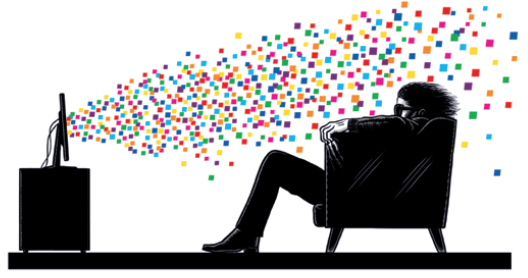
We are not a cable household, which means that when we watch TV, we watch it the old fashioned way: by sucking analog signals from the sky with a cheap V-shaped antenna stuck on top of the set. Though this method may strike you as Paleolithic, old school aerials are still the signal suckage method of choice for roughly 20 million American households. These include folks who can’t be bothered, people who can’t afford cable or satellite, and cranks like us who don’t want all that shit lurking just one remote away, ready to strike. Whoever we are, a great sword of Damocles now hangs in the airwaves over our heads, or rather, over our sets. Because as of February 17, 2009, the FCC has proclaimed that the entire analog broadcasting system, known as NTSC, will be permanently retired to make way for all-digital television. Without digital tuners, our old analog TVs are nothing more than monitors.

The United States is by no means paving the way here. Some European countries have already left analog behind, and pretty much everybody is signed up to make the switchover. The main reason for the change, of course, is money: manufacturers get to sell new-fangled sets, TV stations have the possibility of creating a number of new revenue streams, and the government gets to auction those tasty, wall-penetrating frequencies previously occupied by NTSC. One of the first things the government will do with that cash is to turn some of it over to local artists, pirate radio crews, and media activists who are being empowered to create innovative noncommercial programming and micobroadcast it over the freed-up channels—which after all are a public resource, like the national parks—to help prepare local communities for the imminent collapse of postmodern America.

JUST KIDDING! Actually, some of that auction money—up to a billion and a half dollars—will be used to cover the cost of a conversion program that will allow owners of analog TVs to continue to use their rigs. If you want to, your household can call up the National Telecommunications and Information Administration (Orwell anyone?) and demand up to two $40 coupons for digital-to-analog converter boxes to extend the life of your tube. Of course, the government stands to earn much more from auctioning off the spectrum, and their pals will do quite well selling the converters, so don’t feel like we’ve gone socialist or anything.

For the rest of us, broadcasters are promising a new magical world of digital television, because, after all, digital is “better.” Because my Samsung picks up both NTSC and digital signals, I can tell you that the quality of a strong digital transmission is definitely richer. But as usual, digital is not a standard but a sword that can be wielded with widely varying degrees of finesse. In order to make more money, broadcasters can choose to compress their digital channels in order to pack more services into the available bandwidth—including, possibly, other stations that would be sent over the same digital channel. The more you compress, the more lame artifacts are destined to spooge up your screen. If you already use the Internet to liberate movies and TV shows from the evil grip of copyright holders, you will know what I mean: the splotchy walls, the stuttered time-slips, the eruptions of Cubist ectoplasm.

The spiritual difference between digital and analog, it seems, is clearest where the signal decays. A weak analog signal is often bathed in snow, and its fuzzy “ghosts” can not only be tolerable and even charming, but can still be reasonably enjoyed way out in the boonies. Millions of earthlings have had ecstatic TV experiences watching World Cup matches on 13 inch TVs with crap reception. The relative smoothness of analog noise makes it simply easier for the mechanism to receive signals and for our eyes to make sense out of faces in the clouds. Ghosts like it, because ghosts like organic things. Digital signals, on the other hand, decay with neither grace nor charm. Instead, as the signal weakens, it swiftly passes over what is known as the “digital cliff”: a sharp, jarring plunge into jagged visual noise followed by zippo.

Cathode ray tubes are strange devices: evacuated glass teardrops outfitted with what amounts to a ray gun, blasting electrons at an array of glowing phosphors that, in color TVs anyway, look like psychedelic Op-Art. Sending phantasms invisibly through the air to dance across the surface of these crystal balls has always been a somewhat necromantic act. But if we are going to talk of analog ghosts, we need to talk of analog corpses: the millions of old school TVs that are now being sacrificed to the landfill lords of forced obsolescence. Plenty of people will get their hands on converters, of course, but plenty more will just toss out their CRTs and dive, like me, ever deeper into the digital wave. The guy who runs Electronic Recyclers, one of the largest e-waste recyclers in America, thinks that roughly 80 million analog sets will get tossed out over the next year or two. According to a back-of-the-envelope calculation, that’s just under a million and a half tons of TV—a mass that surpasses the weight of the Twin Towers. And that’s not to mention the amount of lead oxide in the glass. Let’s just say I hope outfits like Electronic Recycler are ready to get their hands dirty.

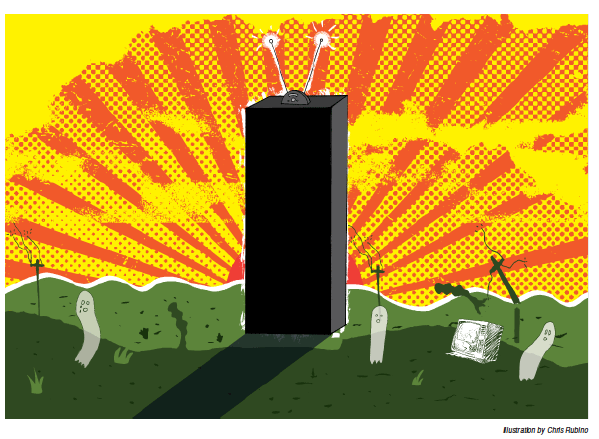
I just left my Sanyo on the street one night and it was gone by morning. In San Francisco, the street still giveth and taketh away. But a relic of the boob tube remains. Because we don’t have cable, we still need to use an antenna to pick up the terrestrial digital broadcast signals. So there sits my home theater: a sleek, if modestly-sized Samsung LNT2653H, looking like the monolith from 2001 laid on its side, topped by a pair of bent aluminum rabbit ears, duct-taped to the back of the set, flashing its peace sign at the principalities of the air.

ERIK DAVIS is a writer, fingerpicker and speaker who lives in San Francisco. His last book was The Visionary State: A Journey Through California’s Spiritual Landscape. Nearly all of his published articles can be found on his website, techgnosis.com, where he regularly posts on music, religion, technology and other abiding mysteries.


ARTHUR BEST OF 2007 LISTS No. 18: Paloma Parfrey

PALOMA PARFREY TOP 20 OF 2007

1. PJ Harvey, White Chalk, vinyl, {back to the old grade}
2. Advanced Adult Enzyme Blend, Udo’s Chioce
3. Hemp Seed Oil, lots of omegas but not as eggy fishy as flax, instead it’s nutty!!!
4. Wing Hop Fung for herbs & teas
5. The Ego & the id
6. Tamala Poljak’s hair
7. Devon Williams & Allen Bleyle
8. Bible Children
9. Punky Reggae Party @ la cita
10. Grand Hotel
11. Anna Oxygen
12. Sara Paul & the jean seam
13. Dirt Bird
14. Lily Marlene
15. grain-free cat food
16. Big Sur’s bran muffins & the library
17. Sarah Cake’s outfits
18. E.S.P.S.
19. the smell, echo curio, tiny creatures, per space
20. Echo Park farmer’s market

The amazing Paloma Parfrey fronted the late great Sharp Ease, featured in Arthur No. 24. She is adventuring across Europe this winter doing musical performances with Tamala Poljak. Her new band is TEMPORARY WAR AND PEACE; they are debuting Sunday, January 6 at Part Time Punks at the Echo.


“WILLPOWER TO THE PEOPLE!”: Applied Magic(k) column by the Center for Tactical Magic (Arthur 27, Nov. 2007)

WILLPOWER TO THE PEOPLE

by the Center for Tactical Magic

Art direction by Molly Frances and Mark Frohman

printed in Arthur Magazine No. 27 (November 2007)

Cognitive scientists use the term “Magical Thinking” to describe a lack of causal reasoning. According to them, the belief in superstitions, lucky charms, and rain dances often falls into this category. But the term can be applied to any situation where one makes judgments based on a cause-and-effect rationale that wouldn’t hold up under scientific scrutiny. Simply put, magical thinking is (from a cogsci perspective) the analytical by-product that occurs when your hopes, fears, desires, prejudices, and beliefs take over your decision-making.

Child psychologists often use the term slightly differently. For a child, magical thinking often refers to conditions in which the cause and the effect are disassociated. For example, the kid sees you grab a remote control from the table and hears the stereo turn on, but doesn’t yet understand that the two actions are related. It is primarily this aspect of magical thinking that stage magicians rely on when performing illusions. In feats of magical reverse engineering, a good magician will think about a desired effect to be produced, and then work backwards to plan the method. The success of the effect is then greatly enhanced by the magician’s ability to conceal the method from the audience. In essence, the magician returns the audience to a state of child-like perception where causes and effects are distant strangers. Some embrace this sense of wonderment while others resent the inflicted feelings of naiveté. Yet, it should be noted that while such magical thinking evokes a child-like sense of the world, it does not limit us to childish behavior.

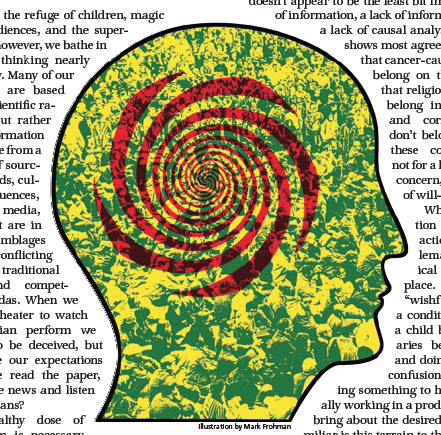
It would be easy to believe that magical thinking is merely the refuge of children, magic show audiences, and the superstitious; however, we bathe in magical thinking nearly every day. Many of our decisions are based not on scientific rationale but rather on information we receive from a variety of sources – friends, cultural influences, mass media, etc. And many of these sources are in fact assemblages of conflicting truths, traditional bias, and competing agendas. When we enter a theater to watch a magician perform we expect to be deceived. But what are our expectations when we read the paper, watch the news, and listen to politicians?

Continue reading

Greg Saunier of DEERHOOF on the ALL-AGES gig ethic (Arthur, 2007)

WHERE MUSIC LIVES
Deerhoof dude Greg Saunier on how all-ages is the gig that gives and gives

(originally published in Arthur No. 26/Sept 2007)

Deerhoof are an adventurous art-rock ensemble from the San Francisco Bay Area whose mix of playfulness, technical facility and unpretentious musical/conceptual ambition has gained them an ever-growing (and awesomely devoted) underground following. Not long after seeing Deerhoof play a giddy early-evening set to an all-ages audience of Giant Robotniks, punk rockers, noiseheads, pop geeks, art students and awed musos, I spoke by phone with drummer-keyboardist Greg Saunier about how the band’s insistence on playing all-ages shows has been crucial—perhaps even pivotal—to their continued artistic growth and commercial success. Following is part of our conversation.

Deerhoof ‘s latest album, Friend Opportunity, is available from Kill Rock Stars; a DVD of the Courtney Naliboff-adapted ballet version of Deerhoof’s 2004 concept album Milk Man, featuring students from the K-12 North Haven Community School in Maine, is available from http://www.milkmanballet.com —Jay Babcock

Arthur: What is Deerhoof’s policy regarding playing all-ages shows?

Greg Saunier: Basically we try to play all-ages shows wherever we can. It’s not always possible. I have some friends who have bands that are 100 percent insistent, but by demanding that every show be all-ages, they sometimes go for long periods without playing any shows. Or they aren’t able to play certain cities, period. But wherever we can, we try to do it.

Why is it important?

Greg Saunier: Our music, and I think music in general, is not just for people who are a certain age or who have necessarily already experienced certain things. We aren’t trying to make music that’s meant to be an in-joke, just for people who’ve already lived through certain things or already are familiar with certain bands of the past. We try to make music that could have something to say to any kind of person—or at least any age of person. We’ve had quite a few shows where a kid and her parent will come, and both claim to be fans, which is really mind-blowing to me, and really gratifying, because I want it to feel like it’s not exclusive to a certain clique.

What were some of the shows you saw as a teenager?

Greg Saunier: I grew up in Columbia, Maryland. One of the first concerts I saw was the Police, at a basketball arena. And it occurs to me that the same is still the case—when Christina Aguilera plays a show, she plays arenas so she play all-ages every time. Within the world of pop music, it’s not even an issue. It’s only in this world of—I don’t even know what this world is, but it’s some other world where music is only associated with bars and with drinking and with people over a certain age and with a certain world-weariness already built in, a certain jaded quality. Of course that’s not everybody, and you can retain that kid-like innocence about new things in music your whole life. But I don’t even drink, so the last place I thought I’d be forging a career would be in bars! I actually don’t mind playing in bars, but if we do it’s always about trying to transcend the surroundings and the normal association with bars and what it’s there for and what it’s meant to do.

Were there shows that you wanted to see as a kid that you couldn’t because you were not of age?

This is going to make it sound like as a teenager I was completely obsessed, but actually I remember Andy Summers, the guitar player from the Police, did a solo show one time at the 9:30 Club in D.C., and it was an over-21 show. I remember just being crushed for several weeks that there was no way I was going to be able to go to this thing. I got really involved in starting to listen to classical music a lot, and classical music shows are always all-ages. That’s what I was getting fed by my parents and I gobbled it up and got a lot out of it.

That’s a good point, that classical music is not a “beer experience.”

In a way, it is another alternative music culture. I was totally dependent on either friends or my parents to get around as a teenager, and there was no place to see a concert in the town where I grew up. Any concert-going required going to D.C. or Baltimore. I felt like a rebel, honestly, in my teen and high school years because of the fact that I listened to classical music. It didn’t really make any sense to any of my friends, and I definitely felt like a real oddball. At the same time in high school, as I just barely started to get a slight awareness that there was underground rock music and punk music, I started to make friends with a few people who were into that and I identified with them in a very strange way. The hardcore scene of the early ’80s and classical music scenes obviously couldn’t seem to be more opposite, but for me and my punk rock friends, it served a very similar purpose. It was something that wasn’t already figured out for you. It wasn’t thrust upon you with the sheen of the mainstream, and the mainstream was the only other choice available to kids.

I remember hearing about this straight-edge music and I was absolutely fascinated. I was very much a late bloomer as far as understanding that there was anything called punk rock. I mean, when Minor Threat was going I was listening to Top 40, I had no idea. I later discovered another band from the area called Void, and they are actually from my hometown. They were just a hair older than I was, and looking back, I bet I knew some people who did go see them. But I was just totally entranced when my friends would describe these Minor Threat shows where kids were going there with the express intent of not drinking, and they would never say bad words and everybody was really nice to each other. I just couldn’t believe it, you know? I never experienced it firsthand, so my mental image of it is untarnished: I have a fantasy of this utopian situation where somebody put the kids in charge and they’re doing so much better than when the adults were in charge. Everybody’s getting along and it’s creative and everybody’s happy and everyone’s accepted. I think that I’ve been kind of seeking the re-creation of that fantasy ever since, you know, when I go to show or especially when we play shows. We want to create that kind of feeling.

Was that part of the original impetus when Deerhoof began?

In the beginning we were desperate to play and totally innocent of how to set up shows or tour. And we were very shy people; it was just two of us at first and then [vocalist-bassist] Satomi joined to make three, and she didn’t make the band any less shy than we already were. Basically, if another band asked us to play a show with them, we’d be like ‘Yeah!’ and be unable to sleep for the next week or something! So in the first couple years of Deerhoof we didn’t have the gumption to dictate anything or make any suggestions. We basically just followed whatever was handed to us and felt lucky if we got to play at all. But what ended up happening was we didn’t play all-ages shows, and the first several years of the band, we had no kid fans seeing us, it was all people our age or older. Satomi and I realized that there was something not satisfying about this. I don’t want to spend the rest of my life just playing in bars and having the success of the night be judged merely on how many drinks we got everybody to buy, you know? Probably in 1998 or ’99 I started to feel like this was a dead end. It wasn’t a stimulating situation, always playing with the same bands, playing the same songs to the same people just passing time in a smoky little room. My first impulse was to go back to school so I could get back into classical music. So I went to graduate school for music, and felt very frustrated there too. In both cases, it’s a mutual admiration society. It’s an ‘in’ crowd. The people who go to see Deerhoof, or the people who are studying music at music conservatory, both can have the sealed feeling where everybody’s patting each other on the back. That’s their only audience, you know? So that was a turning point for the band, too, where we felt like ‘We need to start branching out.’ And frankly, that feeling has never gone away. We have managed for the most part to be able to play all-ages shows everywhere we go, but even then it can feel … we still feel confined in some ways.

Like, why do shows always have to be so late at night? And why do they have to cost $18?

Yeah. Even when you call a show quote-unquote ‘all-ages,’ obviously if it’s late at night on a school night and it’s really expensive then no kid’s going to be able to go. So we’re always looking for something other than just the prescribed venue, or the prescribed way that we’ve been told our music is supposed to be presented. That’s the crazy thing about kids, and the many adults who have an open mind: they don’t conform to any marketing person’s concept of their target demographic characteristics. They look for something that’s cool, they look for something that strikes them a certain way, and maybe as they grow with it they figure it out in a more sophisticated way. Kids surprise adults all the time, because adults would never have guessed what kind of styles that kids would come up with. You think of clothes as the obvious example, where adults are constantly rolling their eyes: ‘What are the kids wearing nowadays?!’ But it’s the same thing with music, and it’s very exciting. And that’s another great advantage of playing all-ages shows: sometimes we can play with under-21 bands.

A couple of years ago, we played in Minneapolis, and Minneapolis is actually very difficult for all-ages shows, but there’s one venue called the Triple Rock where we have often played that will do all-ages shows early; basically, before the “real” show that they’re still going to have that night. Anyway, John has an old friend, Milo Fine, who does only free improvisation. The guy’s possibly in his 50s … real hardcore. He doesn’t do free improvisation for fun, but has for decades been cultivating this and only this and refuses to play a single note of written music period, you know? Extremely obscure, but in his tiny circle, he is sort of a legend. Basically, ultra avant-garde and not the type of music that you would normally associate with kids liking. We asked him to open for us. He was playing percussion with another guy in an improvisational duo, and we were talking before the show, and he was sure that he was just going to bomb. The place was filled with kids, and de was like, ‘This is not my normal audience, I normally play in bars.’ So he came out and played and you could hear a pin drop. The kids were just so focused, they were just totally taking it in. They didn’t judge things the same way that a mob of adults might. There were just no preconceptions. After the show he was just kind of stunned, and really really happy. And I felt so proud, too, that we had managed to put this bill together.

Oh! Here’s a story that totally illustrates how important all-ages is. We played on a tour opening for Unwound, and Unwound was one of those bands that insisted on all-ages shows. That was kind of our introduction to the whole concept. We played at the J.C. Hall, just a tiny shack of a room in Biloxi, Mississippi. There’s no stage, we just played on this linoleum floor. A lot of kids were there. There was this one 16-year-old kid who came up to our merch table after we played and he’s like, ‘I want everything, give me everything.’ It was the first time in however many years we’d had the band going where somebody had ever come up to the merch table and wanted to buy everything. Two days later, our show is in Pensacola, Florida, and not only does he show up but he’s so excited he brings his kid brother, who’s 14 and sick with the fever at the time! But they still felt that it was enough of a priority that they needed to come see this band again. We ended up keeping in touch. And that was Chris and Steve Touchton who very soon after that, decided to form their own band, XBXRX. Later, they moved out to the Bay Area and they live here now and are quite successful.

The music XBXRX make doesn’t really sound like Deerhoof—it’s their music, that somewhere deep inside he wanted to make but couldn’t find the permission anywhere in his universe to do what he really wanted to do. When you see something that’s not the mainstream shows, which are the only ones you’re allowed to go to, that’s what can inspire you to say, ‘I’m going to do my own thing, too.’ A person can do something that’s really different and creative. All these rules that I thought were there aren’t really there. [Those rules] are just from tired musicians and tired, bored marketing experts who are just going on some kind of endless rote, trying to recapture the success of last year’s successful band and think that there are all these rules of how your music’s supposed to sound and what’s going to make it sell.

You really want to make sure technically that the show can include people under 21, but once you’re there it’s like… You’d have to actually step back and say, well how would this be different if the ‘kids’ weren’t here? I really can’t tell who is above 21 and who’s are under 21 in a lot of cases. But it’s great at shows when I’m chatting to somebody who came to the show, and I can tell by looking at them that they’re quite young, and they’re telling me that they came because they’re a fan of our music and that they’ve been listening to it, and I think back to when I was at that age and what music I was listening to. And I say to myself, ‘Whatever music I was listening to, that music totally just re-wired my nervous system.’ I just know how important the music that I listened to in those years was to me. And when I think, ‘Wait, here’s a real human being standing right in front of me, for whom that music is our music!’ well you can’t imagine the overwhelming joy that I feel. You want to inspire people, you know?

originally published in Arthur No. 26/Sept 2007


LOVESONGS TO THE WORLD: A conversation with Lavender Diamond’s BECKY STARK (Arthur Magazine, 2007)

beckyportrait.jpg

Is Peace Enough?

Old people cry, young lovers smile and cynical hipsters get confused when she’s onstage. What is Lavender Diamond’s love-and-ecology frontlady BECKY STARK up to?

By Jay Babcock, with photography by Mark Frohman & Molly Frances
Originally published in Arthur No. 26/Sept 2007


Recently Becky Stark and her mother dropped in on Arthur’s Thursday social at a pub in Los Angeles. Talk about the fruit not falling far from the tree: Diane Stark, an ordained minister serving at the Unity Church of Practical Christianity in Grand Rapids, Michigan, effortlessly owned the place. At a table of Becky’s friends, she told stories about her own mother, a spiritualist who gave public lectures on metaphysics in the ‘40s and completed an unpublished book entitled “The Meaning of Love.” She talked about working as a stripper on Sunset Boulevard in the mid-1970s; about witnessing Martin Luther King, Jr. give his “I Have a Dream” speech; about her own life philosophy (“I like to act as if I’m inside a fable”); about how you should hold a loved one when she’s asleep; and, of course, about Becky being born (“She was happy to be here”). Then someone put on Link Wray and it was time for the Stark women to dance—or, as Diane put it, “have a conversation at the energetic level.”

If that doesn’t explain Becky Stark, here are some other true stories. One of the first books she read was a collection of Gandhi’s writings given to her by a friend of the family who was active in the nuclear freeze movement. She joined the League of Women Voters at age seven and in seventh grade, traveled through the Soviet Union with 13 other American kids as part of a cross-cultural exchange initiative called Peace Child. The three-week tour included a stay with 500 Soviet kids at a Young Constables youth camp on the Volka River and participation in a youth choir performance opening for American poodlerockers Skid Row at the Moscow Peace Festival in Red Square. (“Peace Child” was the title of a hit song in Russia, and Becky can still sing it on demand.) From eighth to tenth grade, Becky was the head writer, anchor and host of “Kids’ Point of View,” a weekly 20-minute television show sandwiched on UHF between the World Wrestling Federation show and Gorgeous Ladies of Wrestling. At 14, she started a local youth chapter of the National Organization of Women. As a teenager, she developed her range by studying modern and romantic opera (as well as Tin Pan Alley and other classic American pop music), but her opera singing career was ended when her body failed to develop the large lung capacity required to sing at a professional level. She studied Russian as a Comparative Lit undergrad at Brown, and dance at the Merce Cunningham Conservatory in New York City. In 2000, Time Magazine published a photograph of Stark wearing a bright yellow dress levitating in front of riot police during a protest march at the Democratic Convention. In 2003, she toured across the country with Xander Marro, performing “Birdsongs of the Bauhauroque,” an operatic fable/comedic poem involving puppetry, keyboards and costume drama. Returning to Los Angeles, Stark worked a series of comical dayjobs and started performing solo as Lavender Diamond and doing stand-up at the Improv and other comedy clubs

Over the next two years, Lavender Diamond evolved from a one-woman act into a four-piece symphonic folk-pop band featuring composer Steve Gregoropoulos on piano, Jeff Rosenberg on acoustic guitar and Stark’s boyfriend, the cartoonist Ron Rege, Jr., on drums. The band’s sadness-and-ecstasy four-song EP The Cavalry of Light was self-released in 2005. At ArthurFest that year, they played into the sun with such beauty that left many (including poet Charles Potts) teary-eyed. During the next year, as they were recording with Vetiver/Brightblack Morning Light/Devendra Banhart producer Thom Monahan, Lavender Diamond were signed by the legendary Geoff Travis to Rough Trade in Europe and then to Matador in North America.

Imagine Our Love, Lavender Diamond’s debut full-length, was released earlier this year to the kind of divided response the band has often received live. Stark’s Lavender Diamond persona is unique: think of a cosmic grade school teacher, or maybe Mary Poppins, returned to talk to you later in life, heartbroken at first to have to remind her former pupils about the importance of sharing and respect for Nature, but happy to encourage you to do better, using music, humor and imagination. When Stark sings “You broke my heart” over and over, pointing her finger directly at specific audience members, it’s a loaded—transgressive, even—move in a culture built on evading responsibility; you can see how it might not fly with every jaded urban hipster. But Lavender Diamond’s music is for the entire school, not just the kids too cool to be there. It’s pop music for peace, simple songs pitched somewhere between Linda Ronstadt, Jefferson Airplane and Yellow Submarine. Or, as Stark says, “It’s lovesongs to the world.”

Here’s part of our recent conversation.


Arthur: So many people think you’re being ironic. Does that bother you?

Becky Stark: I thought our music was simple enough for anyone to get, and so it’s kind of confounded me when people think we’re joking. Why on earth would we do that? Every time anyone asks if I’m serious about celebrating peace on earth I have to say, “Are you seriously asking me that question?” For real. I’m the weirdo? For talking about peace? In the midst of a horrific insane war? What? What have things come to that people think it’s a joke to play music that celebrates peace? I guess that in the performance of Lavender Diamond I am trying to create an antidote to the degradation of our times—it’s like we are trying to run an interference pattern. It’s pretty extreme, and maybe that’s why people think it couldn’t be sincere. I think it’s our responsibility to be understood. Maybe some people think we’re kidding because we look silly. Well, I’ll have to work on my delivery and fashions so that we are taken more seriously. Maybe I’ll have to start wearing all grey and black and frowning! Seriously…maybe we just have to be more elegant…? More sexy? We’ll keep working on it. I probably need to be more dignified and not as loopy. If we’re being misunderstood, it’s because we’re not being powerful enough or intelligent enough in our communication.

Talk about the source for the title “Imagine Our Love.”

Ron [Rege, Jr.] was reading Peace Is Every Step by Thich Nhat Hanh and came across the phrase “imagine our love” in a passage about covering the world with loving prayer. Thich Nhat Hanh is a peace activist from Vietnam who was brought to the U.S. by Martin Luther King, Jr. in an effort to end the Vietnam War. Peace Is Every Step teaches how to cultivate the strength and power of a loving heart, about love and communication. How to be a peaceful person—a warrior of peace. He talks about how the people he was with in Vietnam had to heal from the war. It is very beautiful and inspiring and heartbreaking. He’ll be at MacArthur Park in Los Angeles leading a peace walk in September. Peace is every step!

Is peace enough?

Yes. That’s the definition of peace, I think: understanding that we already have enough. Peace, by definition, is enough.

What do you think music is for?

Music is for celebration, for having a great time. Music is like touch, language and medicine: it’s for healing, for uplifting. Music is a source of strength for people in a time of trouble. Music gives people a way of expressing joy and sorrow. Music is for communicating poetry and new ways of living and being, for communicating ideas of how we can transform our world and guide it into liberation of the mind and spirit.

The whole world seems to be getting stupider a la Idiocracy‘s predictions. Have we entered a new Dark Age, and if so, how can smart people—the ones who aren’t sharks or demagogues—survive in a devolving situation?

We have to be smarter. We have to grow. We have to evolve ourselves consciously—by being part of the consciousness revolution. We have to build the understanding of the nature of consciousness until it is understood as a fact like the world being round. People have to understand the reality that all of us have power and responsibility and that everyone matters. Everyone is you. The paradox of your own individuation—how at once your life can be whole and part, like a grain of sand—is a source of great pleasure and mystery. What a glorious paradox! It is liberating to discover that your life has meaning, whether you like it or not.

It’s a good thing that our terracidal economies are coming to an end, because our ways are not sustainable. We have to build new models that work so that when the current idiotic models come crashing down, we can be ready with the new ones. An end is a beginning. We have to build the new beginning! We have to be mischievous and intelligent. We have to build templates and demonstrate how to live in a sustainable way. That way it’ll be all figured out and everyone can just copy. We have to make harmonious living delightful. And exciting. And awesome. We should make eco-amusment parks. We could have rides like “It’s a Small World After All”—but everything demonstrating harmony with nature and sustainability. The energy sources for the rides will be transparently built as attractions. We’ll have the artists and engineers create gorgeous, exciting attractions around the energy sources, so that the kids are mesmerized! We’ll have murals, laser light shows. People can come with their families and have a delightful, uplifting, exciting, healing experience that is all powered by the sun and the wind.

I think that if we put our minds to it we can figure out ways to heal our environment.
Sometimes I think about public healing rituals for the earth, holistic remedies for planetary toxicity, like our toxic urban rivers. Maybe baking soda would work? The best way to treat completely toxic water is to run it through a system of plant filters. A lot of ferns. Another powerful way to filter water is to run it down a path in the shape of a figure 8—it oxygenates the water. In China, they build gigantic figure 8 sculptures in the parks. I’d love to start an eco-village community that’s built around urban river water usage. That way we can figure out how to clean our rivers and live with them again and teach everyone else to do it too.

And—also—I think the way to progress/survive is to practice radical compassion, to relate to the world in a completely non-adversarial way. It’s a waste of energy to be against anything or anyone. We have to stop wasting energy. Change our energy source. Change our relationship to nature. Change our relationship to each other. Redirect our energy source from fear to love. From limited to unlimited. Perceive no enemies and no limitations. I have a feeling that we can come up with all the solutions we need.

But aren’t some people more responsible for what’s going on than others? Like the rich and powerful, for example. They seem fundamentally different to most people.

I love the rich and the poor just the same—it’s the middle class that’s the problem! Just kidding. It is true that sometimes it is staggering to witness the way that the rich go on with lives involved in the accumulation of power. But the rich aren’t the only ones in the death grip of the paradigm of domination and control—everyone is! Well, not everyone—but a lot of people are. Time to give it up! Sure, debutante balls and Wall Street culture are weird and corrupt but your question smacks of bigotry. Everyone needs healing and needs to grow. We have to stop dividing the world! Stop it! The only way to solve the world’s problems is for everyone to work together and love each other no matter what class you come from. I have friends who are homeless and friends who are billionaires. I used to have a lot of class rage but I’ve given it up completely. I grew up in a poor family, on the wrong side of the tracks (literally—the train tracks were down the block), but I can’t stand all this bigotry. It’s a cult mentality, a false reality. So, stop it. The most beautiful and gentle soul I ever met, who taught me chess and tai chi, inherited billions of dollars when he was 21. He died of a drug overdose on the street a year later. He was so lost. I think if people would have embraced him in our community he wouldn’t have gone astray. Who knows what would’ve happened if he hadn’t died? Maybe he would’ve used his money for good. It hurts my heart, all this dividing everybody up. If you think the rich are different from everybody else, you are operating in the paradigm of domination and control just like all the other idiots! When the earth becomes so toxic nobody can live on it, the rich die too! No one escapes!

Sorry, but you made me mad with that question. Don’t pull that shit. [laughter] There’s no time to fight.

Speaking of dividing up: why aren’t Lavender Diamond playing all-ages shows? It seems like all you played on your last tour were over-21 bars and nightclubs.

We realize that our music resonates for people of all ages so we’re playing as much as possible at all-ages places. We’re organizing a tour to schools where we’ll play with the student bands and choirs. But I do like club shows, though, because you can be more wild and dark.

You once told an interviewer “dancing should be the number one priority of the nation.” But I’ve never seen people dancing at your shows!

Maybe Lavender Diamond is part of the problem! [laughter] People do dance at our shows, but not enough. These days I always wish before the shows that we were making a dance party, but it’s true that we are definitely not making a dance party. That’s why our next record is definitely a dance party record. But yes, Lavender Diamond is part of the problem until we start to make better dancing music. Maybe we need help from the DFA, or M.I.A. Or I could help them, Donna Summer style…?

beckyheels.jpeg

Who are your favorite dancers? What are your favorite dances?

In terms of historical dancers and choreographers, I love Alvin Ailey, Martha Graham, Merce Cunningham, George Balanchine, Maria Tallchief, so many great dancers from the 20th century. Busby Berkeley! I would love to make a musical film with David Parsons’ choreography. I love Ryan Heffington. I want to do some Gene Kelly-style duets. I really love the Singing in the Rain dance, the dance from the end of Lili, and the dances from West Side Story. I love the dead doll pas-de-deux from the ballet coppelia. I love the Balanchine Firebird dance—it’s psychedelic! Twentieth century ballet is so extreme. I like folk dancing too: the polka, the waltz, the do-si-do, square dancing, all the hip-hop dance grooves. I like West African dances—they organize their dances according to ritual purpose, so there’s a marriage dance and a crop dance and death dance and so on. And in Mali they don’t differentiate between the word for language, medicine, and dance. Everyone dances, it’s like yoga—healing codes and positions for your body. It’s like the opposite of ballet. West African dance is all down and ecstatic; ballet is lifting up and is really masochistic. I like ballet but I like the folk kind, not the masochistic high art style. Although I do really love to watch the great ballerinas, with them it doesn’t seems to be about suffering but is about ecstasy. And I want to dance with Patrick Swayze! The dance from Dirty Dancing. That reminds me that tango is the best dance ever. I also like meditative dance like tai chi.

And—I love Mecca Andrews. She is my favorite dancer, she dances in our video. I can’t wait to make more dances with her. Also I love the way Miranda July dances, she’s a great dancer. I love the way my sister dances and my mom dances. I love the way Ron Rege, Jr. dances, he’s a great dancer! I love the way Maximilla [Lukacs] dances!

I guess I really love the way that everyone dances. Everybody is a great dancer!

SCREAM AT THE SKY: Thurston Moore & Byron Coley talk with YOKO ONO (Arthur, 2007)

SCREAM AT THE SKY
Thurston Moore & Byron Coley talk with YOKO ONO

Photography by Eden Batki

Originally published in Arthur No. 26 (Sept. 02007)

Yoko Ono is a beauty. When we walk into the room for our interview she is stunning, vivacious, delightful and welcoming. We discover her handlers have deemed us worthy of only half an hour of access. Because our interests lie in focusing on specific, somewhat more arcane aspects of Yoko’s career, particularly those related to her access points into the avant garde of the 1950s and 60s, we are bummed about these time constraints. Yoko is an extremely significant figure in the flow of much that is radical and/or experimental in visual art and musical culture of the last half-century. Our century, the century where media, performance and multi-disciplinary expression was galvanized into wholly new alloy.

The avant garde and its attendant testing, prodding, trapping, releasing, liberating and wildly intriguing vocabulary is something that looms large in Yoko’s history. It was a driving force for her transformation as an artist, and is an exploratory philosophical stance she has embraced for well over 40 years. Her physical trajectory took her from Japan in the 1940s to America in the ’50s and ’60s. There was a momentary return to her homeland in the early ’60s, then back to America (specifically New York City). After that there’s her mid-’60s visit to London, where she meets John Lennon, and all that transpires henceforth—famous and infamous. Hers is a spectacular timeline through the counterculture of the late 20th century.

The celebrated flash notes of her life with Lennon have been obsessively documented and analyzed. Yoko’s own, autonomous history as an academic, musician, artist, filmmaker and a radical innovator in all of those fields has been perenially overshadowed in mainstream journals. It has only been within the last decade that serious consideration of Yoko’s work by above-ground culturistas has even been considered. But it remains a subject that most media-types approach with mincing trepidation and uncomfortable jokes.

When the fantastic Yes Yoko Ono exhibition (and its amazing catalogue, published by Harry N. Abrams) was realized at Japan Society in New York in 2000, art critic Michael Kimmelman reviewed it succinctly in the New York Times (October 27, 2000), detailing Yoko’s rich art lineage. He noted how Yoko established, alongside La Monte Young, the first real artist’s loft, where music and performance were united with the shock of art-as-action. This was where Yoko created works such as “Smoke Piece,” where the audience were asked to burn the art and the self-explanatory “Painting To Be Stepped On.”

Yoko’s loft is where the iconoclast George Maciunas—an amazing outsider force in his own right, who ran the AG Gallery uptown—first became entranced by Buddhist positivity with its smiling, gentle nature. This was an element he immediately grabbed and threw into the berserk counterculture soupcon he christened “Fluxus.” If there’s anything that prefigures punk rock, it’s Maciunas, Yoko and the Fluxus movement. And even more than punk, they’re the direct antecedents of No Wave, that hermetic period in New York City between 1977 and 1980, where actual rock music, regardless of sub-genre, was temporarily obliterated. Yoko spoke of how the Fluxus movement consisted mainly of a single small group of individuals, most of whom were somehow connected to the scene’s own creative process. This is basically the same script the No Wave scene followed in its day, in terms of being part of a small, consistent and almost-fully-participatory community. The biggest parallel is that both scenes, as marginalized as they were at their times, continue to be living underpinnings (or secret histories) of contemporary avant-garde activity.

Interestingly, Kimmelman blows his cover as one art critic who might fully grasp Yoko’s genius, by denouncing her musical activities. He proclaims her visual art, in retrospect, to be underappreciated. He posits her marriage to Lennon as a leap into celebrity, but one to which she absolutely brought an awareness of celebrity-as-performance. He even opines that her films are her greatest achievements (alongside her brilliant, pre-feminist performance masterwork, “Cut Piece”). But he negates these opinions by tossing out a dismisssive kneejerk comment about her music, one whose idiocy is not mitigated by its wide currency. “The music is unbearable,” he writes. “And let’s leave it at that.”

An art critic without the ability to assess musical art with the same aesthetic consciousness he applies to visual art is, to some degree, crippled. But Kimmelman’s myopia is not confined to the compartmentalized world of conventional art critics. There has been a general idea batted about that Yoko Ono’s art, particularly in its musical form, is not worth much or is some kind of cruel joke being played on the public. This idea is so foreign to our ears that it’s almost ungraspable.

Yoko’s music and her visuals have always been stunning, and not easily separable. Yoko Ono as musician, as composer, is inhabiting personae explicitly integral to her life and career as an artist. The ideas and sounds that run throughout her compositions are as filled with wonder and humor and ingenuity as her most engaging work in film, object art, et al. Indeed, her vocal concepts, inside the context of Beatles recordings—the highest profile pop music recordings in history—are astounding, not only for their organic thought-tongue individuality, but also for their ability to deliver genuinely avant-garde statements to a mainstream world.

The fact that this person is female, Japanese, an artist, and was married to John Lennon is something people are still trying to figure out. For many, it’s just a weird bit of proof that there’s a world out there (somewhere) far more fascinating than Main Street. But Yoko’s music is still regarded by the straight press and the bulk of its adherents as an anomaly, some sort of eccentric affectation. The truth is that Yoko studied and practiced traditional composition in the 1950s, while simultaneously exploring ideas of alternative notational theory. This places her right in the same class as such acknowledged transitional thinkers as John Cage, Henry Cowell and David Tudor. Yoko’s compositional work, perhaps especially the “instruction pieces,” and her sharp-edged performances, were profound by any measure. When you factor in her ethnicity and gender, it’s easy to believe her efforts were more functionally radical than those of any contemporaries. In the context of her partnership with John Lennon, we got to experience a premier avant garde artist’s attempt to unify her own process with a rock n’ roll dynamic. Which, alongside the art/music relationship of Andy Warhol and The Velvet Underground and the influence these mutually beneficial connectives have had on the modern state of art/rock, is pretty goddamn great.

Anyway, the time constraints meant we were only able able to get a small taste of Yoko’s incredible history. But with Yoko a taste is way more than a mouthful.

Continue reading

A Witnessing: David Katznelson guides us through BROTHER JT’s vast and beguiling career (Arthur, 2004)

A Witnessing: David Katznelson guides us through BROTHER JT’s vast and beguiling career.

Originally published in Arthur No. 8 (January, 2004) as sidebar to an interview with Brother JT by Jay Babcock.


For the past twenty years Brother JT has made records that exemplify the “freeness” and dark-green/blood-red hazy warmth of true psychedelia. As a songwriter, he is so proficient that no one takes notice; as a guitar player, he subtly outshines any slinger around (besides the Cheaterslicks’ Dave Shannon) with riffs, leads and solos that are consistently bewildering; as a rock star…well, he was just born for the job, regardless if anyone ever figures it out. He writes one-liner bits of philosophy that are as memorable as those of Yogi Berra, H. L. Mencken, or Will Rogers. JT is, in short, the most hidden of greatest treasures.

I have been a big fan of the music and vision of Brother JT since first hearing seminal, mind-altering tour-de-force Meshes In the Afternoon in the early ’90s. As I am prone to do, I have since collected his entire output…carrying my fanaticism so far as to release a record of his on my own label. If you are able to find a Brother JT record in a store–and it can be difficult (see bottom of page for record-location people who can help you)–know that it will most certainly do all the things you assume it will do: it will move you, it will rock you and it will uplift you. You will be swept away to a cloudy island where ideologies of a time long past are channeled through a devout soul whose musical prowess and ability to create a perfect melody welcome all and conquer all.

The following spew examines the mind-blowing, intolerably under-appreciated recorded output of Brother JT. Please note that it does not include the great recordings of his band The Original Sins, who deserve their own, separate celebration.

Descent
Brother JT
(1991, Twisted Village)
JT’s solo debut was a standard-setter for the mighty Twisted Village label and a good launching place for our now-Original Sins-less psychedelic hero. Beautifully packaged in a Folkways-meets-Impulse handmade black-and-white homage to John Coltrane’s Ascension, this platter features two sidelong drones. The Spacemen 3 called such constructions ‘ecstasy symphonies,’ but these two are dirtier and much less calm inducing.

Continue reading