Arthur may have a low print run of 50,000, but its influence is unquantifiable. The lefty counterculture magazine has been ground zero for antiwar activists, psychedelic drug enthusiasts, and, most importantly, weird-ass music. Arthur has been an early enthusiast for aberrant strains of exciting, adventurous artists, from the bone-quaking drones of SunnO))) to Devendra Banhart’s mystical folk and international beatmakers Delia Gonzales & Gavin Russom. The free publication carries with it an unflinchingly anti-corporate, anti-soundbite attitude, running rants and expositions on the far-flung subjects captivating its writers. And even when you didn’t want to slog through, say, a 10,000-word feature on magic mushrooms, it was good to know that there was a publication so forceful and singular in its vision and so timelessly relevant in its musical taste.
Arthur championed its unique tastes regardless of the publishing date of a new release or its place on Billboard, and created an international following in the process. In June, London’s Sunday Times wrote, “[Arthur has] its finger on America’s eccentric and softly anarchic countercultural pulse,” and the New York Times has lauded it as an important leader in the new folk movement.
So when trouble hit Arthur’s ranks in February, it seemed we were witnessing the loss of a significant voice in tastemaking music journalism. Citing irreconcilable differences to the press, publisher Laris Kreslins left Arthur, and editor Jay Babcock told the Village Voice his publication was dead. As we reported here in March [“Rest in Peace,” March 7, 2007], Babcock tried to buy out Kreslins, but their inability to come to agreeable terms locked Arthur’s credit line and put the magazine on indefinite hiatus.
You thought Arthur was gone for good? The indie magazine beloved for its music coverage and antiwar politics will resume publishing this summer.
by KEVIN MCCARTHY
THE NATION — July 16, 2007 issue
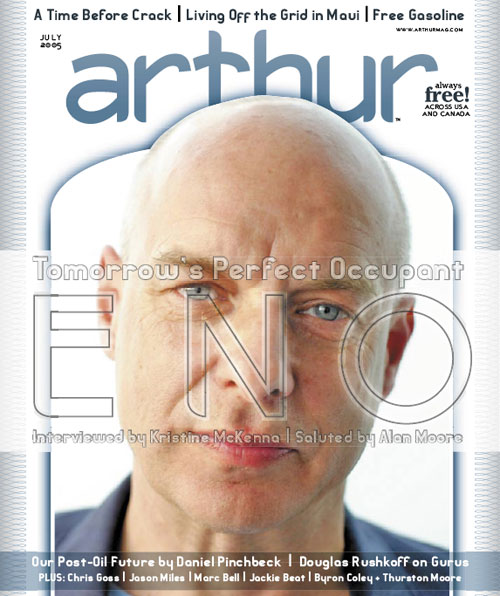
In 2002 a free counterculture music magazine, Arthur, came onto the underground scene and won readers in just about every city where young people (and some older ones) still flouted local noise ordinances. Edited by LA-based music journalist Jay Babcock and published by Philadelphia-based independent media veteran Laris Kreslins, it was distributed by volunteers across the nation who delivered issues to coffee shops, record stores and bookstores. With contributors like Thurston Moore of the legendary punk/noise band Sonic Youth; T-Model Ford, the elder blues statesman and Arthur advice columnist; and writer Trinie Dalton, the magazine specialized in long stories and interviews on wide-ranging subjects, from ’60s “White Panther” leader and MC5 manager John Sinclair, to ambient music pioneer Brian Eno, to novelist J.G. Ballard, to contemporary folk musician Devendra Banhart–each representing a segment of the counterculture.
Arthur’s music coverage has been among the most influential of its era, but the magazine was never just about music–it was from the beginning fiercely political. Babcock, who studied political science at UCLA, had at one time worked for Congressman Henry Waxman and drafted Waxman’s anti-NAFTA position paper. As the magazine was launching, the war in Iraq was being sold, and Arthur defined itself as a virulently antiwar publication; the magazine dedicated its fifth issue to a critique of the war. (The cover of that issue depicted comedian David Cross as a soccer mom cheerleading the war surrounded by the words “Hooray for Empire” and “USA #1 with a Bullet.”) The editors never stopped questioning the war and military recruitment. In 2004 Arthur teamed with the American Friends Service Committee (AFSC) to run a PSA for antirecruitment campaigns in its pages. Then in May 2006, in an issue of Arthur, Babcock challenged Sully Erna of the rock band Godsmack for licensing his music to the military for use in recruitment ads and for using military images at concerts. The magazine’s pages were a regular space for artists and writers like Talking Heads frontman David Byrne and Kyp Malone, of the indie band TV on the Radio, to speak out against the war and President Bush.
Earlier this year, Arthur announced that it would no longer continue printing. Not long after, however, Babcock reached a deal with Kreslins and is about to relaunch the magazine as its editor and publisher. The next issue will arrive in record stores sometime in August. The Nation recently spoke to Babcock by phone about publishing a counterculture magazine in the current economic and political environment.
What drove you to start Arthur?
[As a culture/arts journalist] I grew more and more frustrated with the limitation of subject matter, technique and the length of story available to me in the outlets that existed. I realized that many other writers were feeling the same way. I thought the only way to do what I wanted to do was instead of campaigning for somebody to come to their senses, I would start my own magazine.
How did you get the magazine going?
I didn’t come from money, and I didn’t have any money. Laris didn’t come from money. So we pooled our credit cards and were able to start to pay the printer and so forth. The publishing situation in the United States has gotten to the point where you really do have to be wealthy in order to publish. Everyone can have access to a printing press, but hardly anyone outside the wealthy has access to the newsstands. It requires a huge amount of capital to start up a magazine and print it, and then convince the distributors that it deserves to distributed, and then be able to wait for them to pay you. The newsstand distribution system in this country is notoriously inefficient and corrupt…. That wasn’t an option for us. So what we did was, we created essentially an underground, alternate form of distribution.
What is the vision behind Arthur?
The biggest underlying idea is that the culture drives everything else. Culture creates the metaphors and the landscape on which politics and economics and so forth take place. And so then you ask: What kind of culture are you making, or taking part in, or helping to exist? Our idea was to do what all the other underground magazines or publications in America have done over the last 200 years or whatever, which was to attempt to infuse into the culture at large all of the liberatory, progressive and expansive ideas of freedom and values from the traditional underground, and to celebrate them, propagandize for them and push them.
What were your models?
We want to be in the tradition of the American underground press. Especially the twentieth-century underground press. Whether it’s the punk magazines, or the rave magazines, or the amazing underground press that was happening in the late ’60s and early ’70s, or the mimeo scene before that in the ’60s and ’50s, with the Beats and the whole literary poetic scene–there’s a whole tradition you can go back to: anarchist magazines, Wobbly magazines and so forth. And there’s always been artists and poets, and the serious ones have always been political, engaged and very far to the left.
Arthur grew more and more political. The fifth issue is dedicated almost entirely to looking at American imperialism. How did that political consciousness develop?
By the second issue the war stuff was starting to happen, and by coincidence we had a section about [civil rights and antiwar protest photographer] Charles Brittin. We found out that he had a photo of a parade of veterans against the Vietnam War that happened in LA in the late ’60s. It’s an incredible photo from the corner of Wilshire and Vermont that was just mind-blowing for those of us who live here in LA, to see this familiar landscape filled not with cars and billboards but with ex-soldiers protesting the war as far as the eye could see. So we elected to make that a centerfold.
For the third issue we did a back page that said “What War Looks Like,” and it was a picture from a book by [LA punk musician] Exene Cervenka, a photograph of an Iraqi soldier, dead, from the first Gulf War, with parts of his body blown off. It’s an extremely gruesome black-and-white photo that says all sorts of things about what war is, what it does to people, what people who kill have to look at. And you look at what the soldier was wearing–he’s wearing dress shoes, which shows how mighty the Iraqi army was that we were so afraid of. It was nothing–they didn’t even have boots.
And by the time we got to the fifth issue the war had started already and it was getting worse. We went all the way. We solicited special advertising saying we were doing an emergency issue of Arthur. We assembled it in just four weeks. Arthur isn’t exactly the biggest megaphone–but the megaphone that we did have was very carefully directed at this cultural class where things develop and bubble up occasionally into the mainstream consciousness. We wanted to be an incubator space. No other pop culture or culture magazine was taking any stand like that. We did it and we didn’t think we’d have much effect, but we did think we would be a comfort and an aid to those people in the culture who were doing good work but who needed to know that they weren’t the only ones out there, which would allow them to go on with what they were doing and to feel that what they were doing was worthwhile.
You mention in the editor’s notes in a later issue that you got a lot of mail about the fifth issue, some supportive and some very critical.
When you’re a small magazine, you need every issue that you put out to say the same thing over and over about what you’re doing, so that people who see it for the first time can get an idea about what it is you do. So it was very dangerous for us to completely depart from any music coverage, any arts coverage, and devote almost an entire issue to a radical political position stated in pretty blunt terms. We thought, Are we endangering our relationship with our advertisers? But because what we had done was something no one else was doing, it worked in our favor as a business. It won us a good amount of readers who were just shocked that there was this publication in record stores and coffeehouses for free, where you’re usually supposed to find pretty superficial status quo stuff—instead you’re finding this radical, impassioned and very smart talk about what was going on that you couldn’t find elsewhere. That a tiny magazine, with no budget and no capital, could put that together and nobody else could do that with their vast hundreds of millions of dollars, while the Hollywood liberals were all wringing their hands–that says something, not about how great we were but about how awful everybody else was.
Whom were you trying to reach?
We were very conscious that our audiences, our people, were artists themselves, musicians themselves, the record store clerks of America, and we wanted to remind them that they’re being told to shut up and not have an opinion and not state your opinion unless you are a politician or a Middle East expert. And we wanted to remind them that actually the voice of the poet, and the artist, and the musician is often where the deeper wisdom comes from. Those voices have always been heard, have always needed to be present and have always played a role.
By the time you get to the ninth issue [of Arthur], every artist we’re covering is talking out loud about what’s up. In that issue we ran a whole page put together in conjunction with the AFSC about how to counter military recruitment on campuses, in high schools and colleges. We’d already moved to the next part–you can’t have a war unless you have soldiers, so let’s try to convince kids not to be soldiers. That’s something everybody can do in their own neighborhood. Anywhere you live in America there is a high school.
You got a lot of attention for your interview with Sully Erna of Godsmack, in which you confronted him for allowing the military to use his band’s music in its recruitment ads and for using military images at concerts. That seemed to me to be kind of a cultural turning point–after years of hearing people called traitors and such for speaking out against the war, here’s someone challenged to explain why he supported it, and in the end he tried to distance himself from Bush and the war.
I conducted that interview over the telephone just a couple days after Stephen Colbert did his speech at the White House Correspondents Dinner. I believe that was the real turning point. At the time, the mainstream media didn’t pick up on it. It took a few days before they realized that it was the hottest thing on YouTube. The cultural press had figured out that it was the real story, not George Bush and his doppelgänger doing a comedy routine. Colbert had done something absolutely heroic. And Neil Young was just about to come out with his Living With War record. So there was this sort of surge that happened, and the interview with Godsmack happened right in there. I’d been waiting to talk with that guy for years. When that invitation to interview him arrived in the mail, it was like a gift.
So you had been following him?
Oh, I’d been following him for years. I keep files. I do my best to do what Ed Sanders does–to keep files, and wait and wait. It’s the only way to be a journalist and advocate sometimes–keep track of stuff the best you can, and when the moment happens, seize it. To me it’s fair game to ask someone why they’re licensing their music to a certain cause. I would be derelict in my duty as a journalist to not talk about that in a time of war. When someone’s doing live concerts that are essentially war rallies, that naturally should be a subject of conversation with that person.
In a later issue, you talked to Kyp Malone, from the band TV on the Radio, about his experiences playing shows where the promoter had allowed military recruiters in to sign up kids against the band’s contract. Is this something you’ve seen a lot of with the artists you cover?
Kyp was the main one who would talk about that, but there have been other things that had happened. [The country-soul band] Brightblack Morning Light had some trouble in Tucson, because they have it in their rider that they don’t want recruiting to go on at their concerts. It’s kind of ridiculous that you’d have to say that…. But if word gets out that that’s in your rider…that was a problem for them.
Have you noticed artists that you cover becoming more radical or speaking out on politics or against the war?
I think that most musicians in the underground tend to be antiwar, peace people, and some of them are more open about it than others. Some of them feel more confident about it and have figured out a way to deal with it onstage or in the press in a way that they think is going to get across something valuable. Devendra [Banhart] didn’t have antiwar songs on his early records, but he did on his last album, and that’s clearly because of what’s been going on and because the situation keeps getting worse and worse.
Do we have someone just churning out the anthems like John Lennon was doing? He was writing song after song over a few months that would go from his guitar to being sung by people in protests. There is nobody doing that right now. I think there are people that are capable of doing it, but they’re not high-enough profile yet.
Outfest Screening at Redcat Saturday 7/14 9:30 PM $12.00, Curated by José Muñoz and Nao Bustamante. -Live Performance by My Barbarian -A Family Finds Entertainment Directed By: Ryan Trecartin -Artist Statement Directed By: Daniel Barrow -Bra Burn Directed By: Marget Long -Dynasty Handbag: The Quiet Storm Directed By: Jibz Cameron, -Mata Hari Directed By: Alexis Del Lago -Nelson & Christina Directed By: Robert Coddington
Additionally 2 other great looking screening of shorts Sunday Night 7 & 9:30.
Cover photograph by Jose Villarrubia. Art direction by W.T. Nelson.
Magic Is Afoot
Celebrated comics author ALAN MOORE gives Jay Babcock a historical-theoretical-autobiographical earful about the connection between the Arts and the Occult
Gen’rals gathered in their masses/Just like witches at black masses/Evil minds that plot destruction/Sorcerer of death’s construction/In the fields the bodies burning/As the war machine keeps turning/Death and hatred to mankind/Poisoning their brainwashed minds” — Black Sabbath, “War Pigs” (1970)
As author Daniel Pinchbeck pointed out in Arthur’s debut issue last fall, magic is afoot in the world. It doesn’t matter whether you think of magic a potent metaphor, as a notion of reality to be taken literally, or a willed self-delusion by goggly losers and New Age housewives. It doesn’t matter. Magic is here, right now, as a cultural force (Harry Potter, Buffy, Sabrina, Lord of the Rings, the Jedi, and of course, Black Sabbath) , as a part of our daily rhetoric, and perhaps, if you’re so inclined, as something truly perceivable, in the same way that love and suffering are real yet unquantifiable–experienced by all yet unaccounted for by the dogma of strict materialism that most of us First Worlders say we “believe“ in. Magic is here.
It’s the season of the witch. And arguably the highest-profile, openly practicing witch–or magus, or magician, or shaman–in the Western world is English comics author Alan Moore. You may know Moore for the mid-’80s comic book Watchmen, a supremely dark, exquisitely structured mystery story he crafted with artist Dave Gibbons that examined, amongst other things, superheroes, Nixon-Reagan America, the “ends justify the means” argument and the nature of time and space. Watchmen was a commercial and critical success, won numerous awards, and made the tall, Rasputin-like Moore a semi-pop star for a couple of years. Watchmen re-introduced the smiley face into the visual lexicon, the clock arrow-shaped blood spatter on its face studiously washed off by the late-’80s/early ‘90s rave scene. Rolling Stone lovingly profiled Moore; he guested on British TV talkshows; he was mobbed at comics conventions; and he got an infamous mention in a Pop Will Eat Itself song.
Recoiling in horror from the celebrity status being foisted on him, Moore withdrew from public appearances. He also withdrew from the mainstream comics industry, bent on pursuing creative projects that had little to do with fantasy-horror and science fiction and adult men with capes. Some of these projects, like the ambitious Big Numbers, fell apart; others were long-aborning sleeper successes that took years to produce, like From Hell (Moore and artist Eddie Campbell’s epic Ripperology), Voice of the Fire (Moore’s stunning first novel) and The League of Extraordinary Gentlemen (a clever Victorian pulp hero romp in comics form, drawn by Kevin O’Neill); and still others were good-faith genre comics efforts to pay the rent and restore certain storytelling standards to a genre (superhero comics) in decline.
In recent years, Moore’s public profile has been rising again, partly due to the embrace of Hollywood. This summer will see the release of the second high-profile film based on an Alan Moore comic series in three years: a $100-million film version of League of Extraordinary Gentlemen, starring Sean Connery. But like the Hughes Brothers’ 2001 radically simplified, arthouse/Hammer adaptation of From Hell starring Johnny Depp and Heather Graham, League will only have some surface similarity to the comics work that inspired it. That’s down as much to typical Hollywood machinations as much as the sheer unadaptability of Moore’s comics–these are works meant to function as comics. Even Terry Gilliam couldn’t see a way to make a film out of Watchmen. Moore’s comics are as tied to the peculiar, wonderful attributes of the comics form as possible.
Comics is itself where the magic comes in. The comics medium is one of the few mainstream entertainment industries open to folks who are openly into what is considered to be very weird, spooky and possibly dangerous stuff. Alejandro Jodorowsky, best known for the heavily occultist films El Topo and Holy Mountain, has been happily doing comics in France for decades. The English-speaking comics industry, meanwhile, has always been open to these sorts of people; indeed, Steve Moore (no relation) and Grant Morrison had been doing magic long before Alan Moore’s late-1993 foray into magical practice. Comics, it seems, attracts–or breeds–magicians, and magical thinking. Perhaps it’s that the form–representational lines on a surface–is directly tied to the first (permanent) visual art: the paintings on cave walls in what were probably shamanistic, or ritualistic settings. In other words: magical settings. Understood this way, comics writers and artists’ interest in magic/shamanism seems almost logical.
For Alan Moore, as the conversation printed below makes clear, this stuff isn’t just the stuff of theory or history or detached anthropological interest. It’s his reality. It informs his daily life. And it informs his artistic output, which in recent years, has been a prodigious outpouring of comics (his ongoing Promethea series, ingeniously drawn by J.H. Williams III, is by far the best), prose essays, “beat seance” spoken-word recordings and collaborative magical performances–one of which, a stunning multimedia tribute to William Blake, I was lucky enough to witness in London at the Queen Elizabeth Hall in February 2000. I did not get to meet Alan Moore at that performance, but I was able to interview him later that year by telephone. We talked for two and a half hours. Rather, Alan talked and I made occasional interjections or proddings. What I found is that Alan doesn’t speak in whole sentences. He doesn’t speak in whole paragraphs. He speaks in whole, fully-formed essays: compelling essays with logical structure, internal payoffs, joking asides, short digressions and strong conclusions. Reducing and condensing these enormously entertaining and enlightening lectures proved not only structurally impossible, but ultimately undesirable. So here are thousands upon thousands of words from Mr. Moore, with few interruptions, assembled from that first marathon in June 2000 and a second in November 2001. Don’t worry–these conversations are not out-of-date. They were ahead of their time. Their time is now.
Because Black Sabbath told us only half the story. There are other, largely forgotten purposes for magic…
Arthur: How did your interest in becoming a magician develop? How has being a magician affected how you approach your work?
Alan Moore: Brian Eno has remarked that a lot of artists, writers, musicians have a kind of almost superstitious fear of understanding how what they do for a living works. It’s like if you were a motorist and you were terrified to look under the bonnet for fear it will go away. I think a lot of people want to have a talent for songwriting or whatever and they think Well I better not examine this too closely or it might be like riding a bicycle–if you stop and think about what you’re doing, you fall off.
Now, I don’t really hold with that at all. I think that yes, the creative process is wonderful and mysterious, but the fact that it’s mysterious doesn’t make it unknowable. All of our existences are fairly precarious, but mine has been made considerably less precarious by actually understanding in some form how the processes that I depend on actually work. Now, alright, my understanding, or the understanding that I’ve gleaned from magic, might be correctly wrongheaded for all I know. But as long as the results are good, as long as the work that I’m turning out either maintains my previous levels of quality or, as I think is the case with a couple of those magical performances, actually exceeds those limits, then I’m not really complaining.
Arthur: You work mostly in comics, which is interesting, as so many magicians–maguses? magi?–have been involved in the visual arts in the last century. Austin Osman Spare, Harry Kenneth Anger, Maya Deren. Aleister Crowley did paintings and drawings.
Crowley lamented that he wasn’t a better visual artist. I went to an exhibition of his and well, some of the pictures work just because they’ve got such a strange color sense, but…it has to be said that the main item of interest was that they were by Crowley. But yes, there’s that whole kind of crowd really: Kenneth Anger, Maya Deren, Stan Brakhage, Harry Smith. And if you start looking beyond the confines of self-declared magicians, then it becomes increasingly difficult to find an artist who wasn’t in some way inspired either by an occult organization or an occult school of thought or by some personal vision.
Most of the Surrealists were very much into the occult. Marcel Duchamp was deeply involved in alchemy. “The Bride Stripped Bare by Her Bachelors”: that relates to alchemical formulae. He was self-confessedly, he referred to it as an alchemical work. Dali was a great many things, including a quasi-fascist and an obvious scatological nutcase, but he also was involved deeply in the occult. He did a Tarot deck. A lot of the Surrealists were taking inspiration from alchemical imagery, or from Tarot imagery, because occult imagery is perhaps a natural precursor of a lot of the things that the Surrealists were involving themselves with.
But you don’t have to look as far as the Surrealists, really. With all of those neat rectangular boxes, you’d think Mondrian would be rational and mathematical and as far away from the Occult as you could get. But Mondrian was a Theosophist. He [borrowed] the teachings of Madame Blavatsky–all of those boxes and those colors were meant to represent theosophical relationships. Annie Besant, the Theosophist around the turn of the last century, published a book where she had come up with the idea, novel at the time, that you could represent some of these abstract energies that Theosophy referred to by means of abstract shapes and colors. There were a lot of people in the art community who were keeping up upon ideas from the occult and theosophy, they immediately read this and thought, Gosh you could, couldn’t you? And thus modern abstract art was born.
One of the prime occult ideas from the beginning of the last century, which is also interesting because it was a scientific idea, and this was the sudden notion of the fourth dimension. This became very big in science around the end of the 19th century, beginning of the 20th, because of people like these eccentric Victorian mathematicians like Edwin Abbot Abbot–so good they named him twice–who did the book Flatland, and there was also C. Howard Hinton, who was the son of the close friend of William Gull, he gets a kind of walk-on in From Hell, who published his book, What is the Fourth Dimension?
And so ‘the fourth dimension’ was quite a buzzword around the turn of the last century and you got this strange meeting of scientists and spiritualists because the scientists and the spiritualists both realized that a lot of the key phenomena in spiritualism could be completely explained if you were to simply invoke the fourth dimension. Two woods of different materials, two rings of wood, different sorts of wood, but at seances could become interlocked. Presumably. This was some sort of so-called stage magic. The idea of the fourth dimension could explain that — how could you see inside a locked box? Or a sealed envelope? Well in terms of fourth dimension, you could. Just as sort of three-dimensional creatures can see the inside of a two-dimension square. They’re looking down on it through the top, from a dimension that two-dimensional individuals would not have.
So you got this surreal meeting of science and spiritualism back then, and also an incredible effect upon art. Picasso spent his youth pretty well immersed in hashish and occultism. Picasso’s imagery where you’ve got people with both eyes on one side of their face is actually an attempt to, it’s almost like trying to create, to approximate, a fourth dimensional view of a person. If you were looking at somebody from a fourth dimensional perspective, you’d be able to see the side and the front view at once. The same goes with Duchamp’s “Nude Descending A Staircase” where you’ve got this sort of multiple image as if the form was being projected through time, as it descends the staircase.
The further back you go, the more steeped in the occult the artists become. I’ll admit to you, this is looked at from an increasingly mad perspective on my part, but sometimes it looks to me like there’s not a lot that didn’t come from magic. Look at all of the musicians. Gustav Holst, who did The Planets? He was working according to kabbalistic principles, and was quite obsessed with Kabbalah. Alexander Scriabin: another one obsessed with Kabbalah. Edward Elgar: He had his own personal vision guiding him, much like Blake had got. Beethoven, Mozart, these were both alleged, particularly Mozart, were alleged to belong to Masonic occult organizations. Opera was entirely an invention of alchemy. The alchemists decided that they wanted to design a new art form that would be the ultimate artform. It would include all the other artforms: it would include song, music, costume, art, acting, dance. It would be the ultimate artform, and it would be used to express alchemical ideas. Monteverdi was an alchemist. You’ve only got to look at the early operas, and see just how many of them are about alchemical themes. The Ring. The Magic Flute. All of this stuff, there’s often overt or covert alchemical things running through it all.
And there’s Dr. Dee, himself. One of the first things he did, he used to do special effects for performances. He got a reputation for being a diabolist just through doing…I suppose it was a kind of 14th-century Industrial Light and Magic, really. He came up with some classical play, which required a giant flying beetle. He actually came up with a giant flying beetle! [laughs] I think that did more to get him branded as a diabolist than any of his later experiments in angels. No one could understand all this stuff that he was doing with the Enochian tables–they weren’t really bothered by that. But he’d made a man shoot up into the air! [laughter] So he must be the devil or something…
Given the sheer number of people from all fields that would seem to have a magical agenda, it’s even more strange that magic is generally held in such contempt by any serious thinkers. I think that most people that would think of themselves as serious thinkers would tend to assume that anybody in Magic must be some kind of wooly headed New Age mystical type that believes every horoscope that they read in the newspaper. That would be completely dismissive of giving the idea of Magic any intellectual credibility. It’s strange–it seems like you’ve got a world where most of our culture is very heavily informed by Magic but where we almost have to keep up the pretext that there isn’t any such thing as magic, and that you’d have to be mad to be involved in it. It’s something for children or Californians or other New Age lunatics. That seems to be the perception and yet once you only scratch the surface in a few areas, you find that magic is everywhere.
BEFORE AND AFTER SILENCE On the eve of the release of his first album of vocals songs in decades, pioneering musician-artist-thinker BRIAN ENO speaks with Kristine McKenna in a conversation as wide-ranging and profound as his singular career.
I’ve met lots of charming people in my life and Brian Eno may well be the most charming person I’ve ever met. What’s the secret of his devastating charm? It comes down to a few things. He has impeccable manners. He gives you his full, undivided attention when he speaks with you. He’s interested in everything under the sun. He has a wonderful sense of humor. Finally, and most importantly, he has an incredibly light touch. What I mean by that is that he can discuss just about anything and be genuinely involved without getting hot and bothered. Eno so relishes the process of examining things from various angles that he can’t be bothered to take it personally if you don’t agree with him. He’s fun.
Born in Suffolk, England in 1948, Eno was in art school in the early‘70s when he became a founding member of pioneering glam band, Roxy Music. He left the group in 1973 and embarked on a solo career that quickly expanded in several directions at once. Regarded as the inventor of ambient music—atmospheric washes of sound that settle in like weather and eschew the linear structure central to most music—Eno helped pioneer the use of sampling and computers in the recording studio, has contributed to more than 150 albums as producer, composer or performer, and has overseen the making of critically acclaimed records by David Bowie, U2 and Talking Heads. A visiting professor at London’s Royal College of Art since 1995, Eno has created audiovisual art installations at sites around the world since the early ’80s, and in 1983 he was a co-founder, with Anthea Norman-Taylor, of Opal Records. Five years later the co-founders married and settled in London, where they’re raising two teenage daughters. (Eno also has a 30-year-old daughter, Hannah, from a previous marriage).
One thing Eno hasn’t done for quite a while is sing, so the release of Another Day on Earth—his first record of songs in more than two decades—is something of an occasion. This was the ostensible reason we recently hooked up to chat, but as is always the case with Eno, our conversation roamed far and wide. Herewith, a few of the high points.
Arthur: What seemed desperately important to you as a young man that no longer seems quite so pressing?
Brian Eno: I’ve somewhat lost faith in art and the cultural world because I think it has no faith in itself. Culture is the most important thing we do, but it seems to me that we don’t take it seriously, and the visual arts in particular are in very dire straits at the moment. I don’t think any of it makes much difference, although there are some painters working now that I like very much. Lari Pittman, for instance, makes beautiful paintings that absolutely blow me away.
If you could own any artwork, what would you want?
There’s a room at the Museum of Modern Art that has a beautiful Rothko, two de Koonings, and a huge Monet Water Lilies. I’d be happy to have that room.
What aspect of middle-age weren’t you prepared for?
That women would find me more attractive. I’ve never thought that highly of myself so this came as a bit of a surprise. Perhaps it’s just that as you get older women are more inclined to tell you how they feel. When people are young they tend to beat around the bush a lot of the time.
How many times have you been in love?
Maybe half a dozen times.
What do you know about romantic love today that you didn’t know ten years ago?
That women are much more romantic than they care to let on—the old clichés are much truer than people care to admit. I would add, however, that notions of romance seem to become more potent for men as they age, too, and it starts to seem like more of the reason that you’d want to do it. You get into the joy of the process more as you get older and care less about the cum shot.
Why does love die?
It often happens that you love someone because they reflect you particularly well, and you basically like the person because they like you. This is a rather slender basis for building a relationship but it’s a trick people use to intrigue you—they look very interested so you think gosh, what a clever person! They’re really interested in me!
How do you explain the aversion to aging that’s an intrinsic part of western culture? Is it simply a fear of death?
I don’t think it’s fear of death so much as fear of the loss of one’s powers. For instance, I notice it in my eyesight. I hate the fact that I can’t see as well as I used to, I’m aware that I’m not seeing the detail I used to see, and I miss that visual side of my life everyday. It’s interesting that as you get older your vision treats your contemporaries better. You look at people your own age and think O.K., she looks nice, then you put your glasses on and think, good lord, do I look like that?
What’s the greatest privilege of youth?
The fact that nobody wants anything from you, you’re free to do anything and you’ve got every avenue open to you. When you’re young you have this capacity to roam, which just disappears. When you’re older either you’re not successful, and many avenues have consequently closed to you, or you are successful and there’s a huge pressure to do more of what you’ve done before. I know so many musicians who’ve told me that when they were young words just flew out of them—sometimes they didn’t even know where they came from—because when nobody cares, you don’t have all these voices in your head saying “that’s immature, you’ve been there before, we’ve heard so-and-so do that.” Because there are no critical voices in your mind it just throws out stuff. I’ve lost that freedom as far as lyric writing goes.
Your new record has a very wistful quality; were you feeling that way when you made it?
Yes, it is something of a getting older record. The other thing I hope it conveys is the idea that each day will pass as all the others have, and it will be just as amazing and disappointing as all the others have been.
The feeling you just described has to do with the fleeting and ephemeral nature of existence, and yet the work you do with the Long Now Foundation is predicated on notions of permanence and longevity.
Yes, Long Now is about thinking long term and was conceived to pose the question; if you really believed there would be people on earth 10,000 years from now, how would that affect how you live today? Most of us live as if there isn’t going to be a future, and few of us are conscious of how heavily we tread on the earth and what we leave behind. These are hard questions to ask ourselves, of course, because essentially they ask you to unpick your life. We’re born into intensely constructed lives that involve high energy consumption, the eating of expensive food—all the things I do along with everybody else I know.
We all live in varying states of denial of the fact that there are a number of converging crisis bearing down on us right now. One of them is the increasing prevalence of really nasty diseases spread by air travel—I have a theory about air travel, by the way. I think we’ve reached the peak of air travel and that it will go into decline for three reasons. One is that it will become associated with the spread of diseases — people will be unwilling to expose themselves to just to go on holiday. People will either drive somewhere or they’ll stay home. Two, there will be a few more spectacular terrorist incidents, and we all remember the effect that had on air travel last time. Three, sooner or later governments are going to have to tackle the fact that air travel is the hugest producer of pollutants we have. There’s been a big debate going on in England about a wind farm they’re thinking of building in the north of the country, and the argument for it is that it would prevent 250,000 tons of pollutants going into the air per year. That sounds good until you realize that one plane doing a London to Miami route for a year releases half a million tons of pollutants into the atmosphere per year. I’d be quite happy if there was a credible world movement against travel because communities would begin to return and people would start to rediscover where they are now. And needless to say, the romance of travel is diminished dramatically by the fact that no matter where you go there will be a Gap store.
Who makes you feel starstruck?
No stars do—it’s funny but I’ve never been impressed by those kind of celebrities. The closest I’ve come to being star struck is by the biologist Richard Dawkins. I’m so impressed by the work he’s done that when I met him I found myself wondering what I could say that would possibly be of interest to him.
What do you long for?
Discipline and some kind of routine. There always seem to be so many things going on in my life and I’m never quite prepared for any of them. Take a simple thing like collecting cuttings out of the newspaper—you’d think that would be a pretty easy thing to organize. I’m always cutting things out, and there are little stacks of clippings all around my studio, but there’s never any time to create a filing system and actually file them. In my imagined life of discipline and routine there would be 20 minutes each morning to file clippings, then half an hour for a swim, which is something I actually do manage to do most days. I just wish there was more of that structure.
What’s your idea of an important achievement?
Years ago my assistant bought a chair for a thousand pounds at a fishing lake owned by 300 fishermen, and nearly every weekend he goes there and basically meditates with a fishing rod in his hand—that’s what people are really doing when they fish. This strikes me as a great thing to achieve, probably because it speaks to my hankering for simplicity and routine. I also admire people who say ‘fuck this’ to the lot they’ve been dealt in life and demand something more for themselves. I have a nephew who has Lowe’s Syndrome and he’s got very poor eyesight and several other little things wrong with him, but this kid is so full of life, partly because my sister—his mother—told him ‘don’t accept your lot.’ She could’ve taken the attitude, ‘oh he’s disabled, he can’t do much,’ but she just sort of threw him into life. So, to make maximum use of what you’ve got is an important achievement. Take Lou Reed as a guitar player. The early records by the Velvet Underground have some of the most inspiring guitar playing I’ve ever heard, but I don’t think anyone would say Lou Reed is a great guitar player. He just knows how to use the gift he has to maximum effect.
Which song is in your mind when you think of Reed’s playing with the Velvet Underground?
“What Goes On.” I almost included a cover of the Velvet Underground song “I’m Set Free” on this record. I did rather a good version of it, too, and I will release it, but I didn’t want to make a record that was too long because I hate long records and think people don’t listen to them. I remember working on Laurie Anderson’s album Bright Red and there was a song on there that was just gorgeous, but she made it track 13 and I’ve never met anyone who’s heard it. By the time people get to track 13 they’re off somewhere else.
What’s your favorite song today?
I can never give one answer to any question, so I have a few. I spent the day digging a fish pond so I was listening to my Ipod, and I’d programmed a song into it by a Turkish singer named Belkis Akkale who has the most erotic voice I’ve ever heard. It absolutely drives me mad and my hear leaps with joy when she sings. Funnily enough, there’s a song I did with Bowie on the record Outside called “We Prick You,” which is amazing. When I heard it today I thought to myself, how on earth did we get that? I rarely listen to my old records and I must say, I was impressed. I’ve also been listening to an inspiring song by Me’Shell N’dege’Ocello called “Loyalty” that’s on a beautiful album she made called Bitter.
What was the last thing you learned?
I’m reading a fabulous book at the moment called Seeing Like a State: How Certain Schemes to Improve the Human Condition Have Failed, by a guy called James Scott. The first section of the book deals with city planning, the science of forestry, the invention of surnames, and weights and measures, and it made me realize that everything in society is built on fundamental infra-structural divisions. They’re so deeply embedded in the way we live that we’re often unaware that they’re at the core of many of the problems we wrestle with. That’s why the attempt to export free market capitalism to what was formerly the communist world hasn’t gone smoothly; there’s an intricate infrastructure of social agreements that must be in place for such things to work.
The first time I interviewed you was 25 years ago, and thinking back to that time it seems the world was a much safer and slower place. Is it simply a trick of the mind that we tend to recall the past as somehow simpler, or is the world actually picking up ever greater speed and complexity?
I don’t think it’s a trick of the mind. A few years ago the U.N. published a graph that charted various indicators of human well-being like security, equality, freedom, employment, access to clean water—all sorts of things. It was interesting to me that there is objective evidence for the incremental changes people feel, and the rather alarming conclusion they drew was that Western civilization peaked in 1976. I think it’s true that up until the early ‘80s people felt they were on an upward curve, at least in our culture. This isn’t true for every culture, but here in the West I think people believed things were getting better and globalization was a good idea. Today, most people seem to feel that the threats outnumber the promises and the dangers outnumber the freedoms.
So what are the long-term implications of this U.N. graph? That man’s on the road to extinguishing himself?
I think there’s a very good chance of that, actually, and having young children I find it absolutely alarming to contemplate what kind of world they’ll be living in when they’re my age. There have been various points in human history when people felt the end really was near, but the difference now is that we’re more powerful than we’ve ever been. Any one of us as individuals is almost as powerful as whole nations were in the past, in terms what we can handle, damage and effect. Of course, we can do good things too, but those things are less easy to achieve single-handedly. Good projects require co-operation, but you can create quite a lot of damage all by yourself.
An unfortunate shift in America’s political landscape is the fact that the will of the people no longer seems to mean much; our government does what it damn well pleases regardless of public response to their decisions.
I think that’s true. In the ‘60s people perhaps naively thought that democracy meant what it’s supposed to mean, but today, with Fox News and professional liars in politics, we’ve come to realize that democracy doesn’t mean anything really. As was evidenced in the recent U.K. elections, things aren’t quite so dire yet in England. Yes, Tony Blair was re-elected, but he won with a much reduced majority and a strong message from the people which was this: don’t fuck about with us. It became increasingly obvious to the British people that Blair had deceived them, and that the story of why we were going to war was untrue, and his re-election was essentially a vote of confidence for the Labor Party which has been a quite successful government in many ways—except for its alignment with Bush. England is basically a center-left country and I don’t think any members of the Labor Party approve of Bushism as a style. Bush is a very charismatic man, though, and I think Blair is a bit of a groupie. Obviously, Bush is an ignorant bully but he’s a confident man, and lots of people really go for that.
What’s the first thing you’d do if you were running the world?
I’m a patron of this thing called the Global Ideas Factory that was founded 15 years ago, and it’s an organization that collects ideas about how to make the world a better place. These ideas range from what to do with dog pooh to how to solve the global energy crisis, and some of these ideas are totally amazing. The first thing I’d do would be to set up an international body to examine the feasibility of some of these ideas. We simply waste the wisdom of our great thinkers—it’s amazing how little we use of human intelligence—and creating an internationally funded global ideas bank committed to actually doing something would be a way of putting a world changing culture in place.
To what degree do we inadvertently fictionalize our own past?
I’ve often thought that children should be taught how to watch television, read papers and listen to the radio, because most of our experience now is lived through media in one way or another. That’s particularly true in America where many people get most of their information about the world from television, which fictionalizes the past to a dramatic degree. That’s part of their raison d’etre, to tell us stories about the past.
Towards what end? How does it serve us to fictionalize the past?
It doesn’t serve us at all. Occasionally, for the sake of family coherence, you might tell a story that you know is a rather rosy version of events, but generally it’s imperative to maintain as accurate a grip on the past as one can manage. Very few people seem to appreciate the effort the Germans have made to not fictionalize their past, and it really pisses me off when that idiot Rumsfeld talks about old Europe as if to imply, “what do they know?” Germany has made a huge effort to face its past and come to terms with the fact that it acted absolutely abominably, and this is something America never has done and never will do. America will never ever say the Viet Nam War was a terrible mistake and what happened to the Vietnamese people was a disgrace, but young Germans talk about World War II with genuine passion and honesty.
There’s been quite an uproar about Downfall, the recent film about Hitler; many people have objected to the film on the grounds that it’s dangerous to humanize Hitler. Do you find any merit in those objections?
No, I think this is an important aspect of not fictionalizing the past. It’s a dangerous fiction to regard Hitler as a one-of-a-kind monster. I read an interesting book last year called Defying Hitler by a German historian named Sebastian Haffner, who was born in 1906 and grew up in Berlin where he watched the growth of the Nazi phenomenon. What becomes terrifyingly obvious in reading his book is how easy it is for a society to slip into barbarism. It starts very gently with all the intellectuals and clever people saying ‘bloody Hitler, what an idiot, he’s not going to last.’ All the things we’ve been saying about Bush, who was regarded as just a joke when he first appeared on the political scene. Things get worse and people start saying ‘shocking, disgraceful, we must get rid of this guy, but I’m busy right now writing a book—when it gets bad we’ll all pull together.’ But by the time it reaches that point it’s too late and there is no easy exit.
This is why I’ve started to get political in the last few years—I think we’re at the beginning of a new kind of technocratic tyranny. The manipulation of public opinion is so easy now; for evidence of that look no further than the fact that in a matter of months it was possible to convince most Americans that Saddam Hussein was responsible for the Twin Towers. It was just incredible. A key strategy in the manipulation of public opinion is to get the public excited about moral issues that don’t really matter like abortion and gay marriage. In England the issue is immigration, which is a minor problem but is something everyone feels they must have an opinion about. Governments love those issues because while everybody’s arguing about them, they’re left alone to pursue the business of world domination.
How did having children change you?
It certainly anchored me much more. I don’t like to be away from my children for too long because I hate the thought that I might miss some little part of their story. It also made me think about the future a lot more, and made me realize I had the capacity to feel absolutely unqualified love. One day a situation came up where there was some danger and I realized that without question I would’ve sacrificed my own life without even thinking about it. This came as a surprise to me because I’ve never considered myself a generous or altruistic person, and I don’t regard myself as brave in any way at all.
Do you believe in destiny?
No, but I believe that if you believe in destiny it will make a difference in what happens to you. Some people think ‘I am chosen and I’m a favored person,’ and that gives them a confidence that has the effect of making them chosen. The reverse happens as well. Some people consider themselves cursed and believe nothing will ever go right for them, and of course, nothing does.
What role does faith play in your life?
Last year I went to see Archbishop Desmond Tutu speak, and I was struck by the fact that on several occasions he made the observation, ‘you have no idea what goodness there is in people.’ This really impressed me, given that this was a guy who’d really seen some of the worst that people are capable of. He was talking about the Truth and Reconciliation Council and the great surprise of that endeavor was the incredible generosity of feeling people had, and their ability to forgive really awful things. So, I agree with Desmond Tutu’s comment, for the simple reason that I have faith in human intelligence.
Kristine McKenna is a Los Angeles-based writer. She recently co-curated Semina Culture: Wallace Berman & his Circle, a historical survey of West Coast Beat culture that opens in September at the Santa Monica Museum, accompanied by a catalogue published by D.A.P. She is presently co-producing a documentary film about the Ferus Gallery.
L.A.’s counterculture core is smiling a little more this week with the news that Arthur magazine has come back from the dead. Whether that means the magazine will return to mounting its music and culture celebration, ArthurFest, remains to be seen.
Of course, the spirit of Arthur — champion of the freak folks, waver of the herbal flag and thorn in the side to all things bloated and consumptive — never went away, even after the magazine drowned in a pool of bad blood between co-founders Jay Babcock and Laris Kreslins in January.
Some of the material intended to run in the ill-fated issue No. 26 is being posted at the Arthur website. There’s still good reading from myriad contributors at the Magpie blog run by Babcock. And there is still fellowship to be found at the weekly Echo Park Social(ist) & Pleasure Club on Thursday nights at the Little Joy.
Babcock — now in hock after having bought out Kreslins’ share of the publication — also says an ArthurFest documentary is nearing completion; a “unique Arthur benefit performance” is in the works; and the mag’s compilation album “So Much Fire to Roast Human Flesh” (an anti-military recruiting benefit) is out.
And what about ArthurFest? “No comment,” Babcock says.
TRIGGER HIPPIES “Do the Math” column by Dave Reeves originally published in Arthur No. 23 (July 2006)
Blackout. Summertime. Populace accepts that utility companies have again fried the grid for profit. Hours go by. Americans go without television, SUVs, flash-fried food. Coffee runs out. Shortages of chronic and chronic shortages. Rumor becomes news. Alcohol reserves are drunk away and the rabble seethe in the street, commiserating about how it was this very publication that printed the recipe for the diabolical bomb that left the assholes standing but killed their precious machines. [see our Q&A with Derrick Jensen from Arthur 23 – ed.]
Emergency personnel stay at home because, like that great American Bob Dylan said, “The cops don’t need you and, man, they expect the same.” The National Guard is busy on the border, the French Quarter and Iraq. Everyone is a suspect.
“There he is! I saw him reading that Arthur!” the mob yells.
And then, dear reader, you realize that when the transistors are dead, the world is run by a lower phylum of machine: the gun.
Now I’m not saying you need to get one, but you can never be too careful what with this Arthur magazine monkeying around with these new-fangled technology bombs. Of course you are scared of guns because the liberal media constantly portrays people misusing these valuable tools. The smart hipster won’t let crappy television writers’ abuse of the pistol as a modern day Deus Ex Machina divert her from the path of preparedness. Just think of a gun as one of those “Talking Sticks” at a Rainbow Family Gathering: if you have a Talking Stick, you get to say something and people have to listen, and if you don’t have one you have to shut the hell up.
Here’s a list of “sensitive weapons” that even a vegetarian could use in the near future, cribbed in these last precious moments while this computer still works. I’ve listed them in the order that they should be purchased, so that you may gradually warm to the idea of being a citizen capable of doing what it takes to keep America on course.
Let the Kids In Too: A History of All-Ages, Part One by Jay Babcock
After this spring’s ArthurBall, someone posted to our website saying, “Hey, how was Growing? I really wanted to see them, but I’m only 17.” Now, if anyone needs to see Growing—a drone duo who are making a very challenging, contemplative sound right now, not unlike the first Fripp & Eno album—it’s a 17-year-old: talk about raw material for a formative experience. And yet, he—or she—was denied, because ArthurBall was an 18 & over event. Which meant that I was partly to blame.
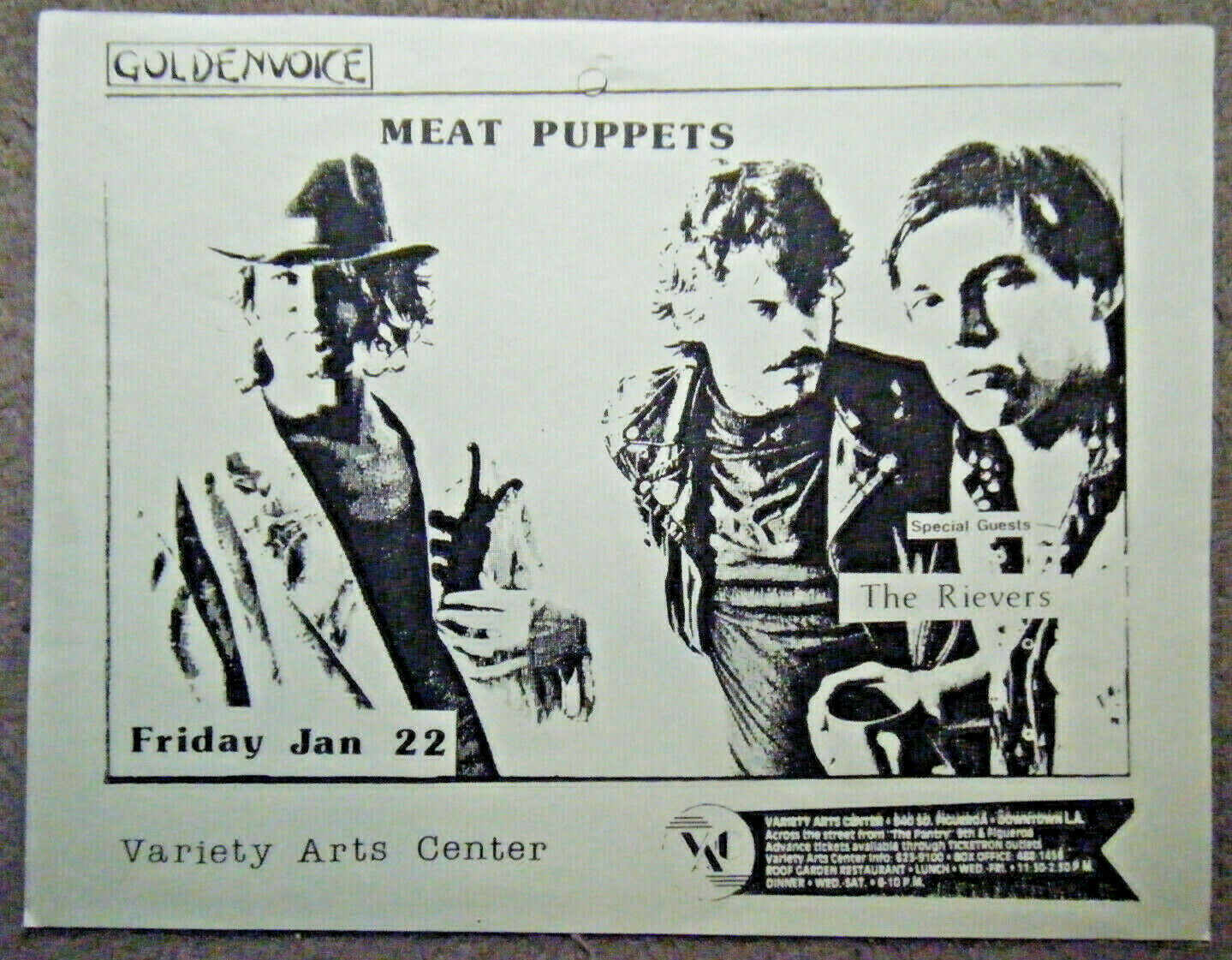
That wasn’t a happy thing to realize. I’d been 17 once. I still haven’t recovered from my own formative experience back in 1988 when I saw the Mirage/Huevos-era Meat Puppets at Variety Arts Center in L.A. I was a teenaged square amidst 1500 freaks of the universe at a cheap, all-ages gig headlined by true goners: enduring the Kirkwood brothers’ 20-minute encore cover of the Beatles’ “She’s So Heavy” left a much deeper, richer impression on my tender, gradually opening mind than seeing U2 and the Pretenders at the Coliseum a couple months before. That was a painfully loud, stage-managed spectacle, a queasy mix of overwhelming power, machine precision and mass audience; the pajama-clad Meat Puppets, on the other hand, were… well, they were fun. They operated on a scale that was recognizably human. They seemed genuinely off-the-cuff, in-the-moment, willing to misfire. Their single stage prop, a pair of Playboy bunny ears spontaneously draped on a microphone, resonated with me in some deep, pleasantly weirdifying way. That Meat Puppets show pointed to a way out: a different way of leading one’s life—of embracing your idiosyncrasies and weird visions and interests rather than suppressing them. It was like some beautiful rite of passage, an initiation into art and imagination and other people—a sideways welcoming into a more creative, fertile, vibrant, rich way of being. Years later, I’d find out that, of course, I wasn’t the only one who’d undergone such an experience: almost everyone I know who is involved with music as a performer or enthusiast or whatever can point to some bizarro show that changed their life when they were a teenager, that lit up new paths.
I wonder if that kind of experience is readily available anymore to those who want it. I mean, the Mars Volta are amazing, but you have to pay $65 to see them open for the Red Hot Chili Peppers at a basketball arena. Growing are cool, but Arthur Ball is 18 & up. And so on. The sad truth is that although exciting music is regularly performed all over L.A.—at backyard barbecues and loft district rent parties, dive bars and supper clubs, nightclubs and art galleries, high school football games and homecoming dances, city parks and Sunday morning church services, street corners and subways, outdoor amphitheaters and baseball stadiums—maybe the only time when a good number of people of all ages can gather together to witness quality music, at an affordable price, with a good sound system, is when an artist plays an in-store set at Amoeba Music on Sunset Boulevard. Kudos to Amoeba for providing this basic public service to arts-starved Angeleno teenagers, of course—it’s more than the public schools and mainstream broadcast media do—but surely it’s not a positive indicator of a culture’s health when the best venue for all-ages music is a record store. ‘Dancing in the aisles’ should mean something more than grooving politely in the Used Funk/Soul section as cash registers ring in the distance.
We lose something as a society when we don’t allow our youth to experience music—by which I mean real, living, breathing music, as opposed to commerce-driven pop—in a decent, accessible, affordable, relatively intimate setting where music is given the opportunity to be truly experienced as music. Something has gone wrong here. But what has happened, exactly, to get us to this point? And is it just Los Angeles, or is it nationwide? What can we do about it? What did they do in the past?
I decided it was time to call John Sinclair.
During the 1960s, John Sinclair founded the Detroit Artists Workshop, managed the MC5, headed the anarchist White Panther Party and got thrown in jail for 10 years for giving two joints to an undercover cop. He was freed after serving two years due to the intervention of John Lennon, who wrote a song for him and appeared at a 15,000-plus arena rally to bring attention to Sinclair’s case (check out the “The US vs John Lennon” documentary for more details). He is a renowned poet, scholar, deejay and journalist, and at 64, still a towering presence. We talked about all-ages shows outside a brandname coffeeshop in Culver City over half-finished crossword puzzles.
John Sinclair: Here’s a point I want to make about this right off: This whole ‘age’ thing is a function of the whole white American culture—it isn’t a universal thing. When I was coming up, you had no congress with anyone more than two years older or two years younger than you, unless they were your brother and sister. You had no congress with adults, with anybody but your own age peers. Everything you did was around that; we were alienated from all the others.
Now, I grew up listening to blues and R&B on the radio in the Fifties. I’m not into country music. I avoided it like the plague. I came from a farming community, and I didn’t want no part of that! Once I heard black music on the radio, I wanted to be where those people were. They were having a lot more fun than anybody I knew, and then when I started going to their dances. It was a beautiful thing. They had big shows in Flint, Michigan. Rhythm and blues shows. I saw everyone that came to Flint between 1955 and 1960. I went to these rhythm and blues shows and there’d be 3,000 black people and 20 white kids who were music freaks and liked to dance. The thing that hit me the hardest about these shows was that there were people of all ages there: little kids, grandmas, and most of the crowd was young adults who were older than us. The teenagers like us were only a stratum. There were people in their 60s, people in their 40s, the finest women you’d ever seen in their 20s just dressed to the nines, red dresses and shit. Knock your eyes out. And there’d be little kids running around and it was no big deal. And the people who wanted to have a drink, they had a flask in their pockets. If they wanted to smoke a joint, they had a joint. It was just like going to a different planet. It was so much hipper. And they were also so accepting. It wasn’t like you would be nervous about being there. They’d let you have your fun, you’d dance with the black girls. It was just like being in heaven for me, man. Because where I lived, I hated everything.
BOMB POP Born in war-torn Sri Lanka and bred in London, rising star M.I.A.’s pop instincts, radical consciousness and proudly pan-ghetto sound have no easy origin. As the defiant singer/MC explains to Piotr Orlov, it’s both where she’s from and where she’s at. Cover photo by W.T. Nelson.
“The mask is the face.” – Susan Sontag, “On Style”
“I don’t have a side, I’m spread out but I’m a mile wide/I got brown skin but I’m a west Londoner, educated but a refugee” – M.I.A., “MIA”
What, if anything, do we look for in a “pop” star worth supporting? Or more to the point, what are we willing to put up with, besides some gratuitous chart-topping populism and the 15-minutes of media-saturated intrigue, of course? Do we have any right expecting pop stars—not to be confused with musical artists whom luck, trends, circumstance or one great tune propels towards the mainstream—to influence a greater cultural conversation? Pop is, after all, the most powerful global transmitter of ideas in the information age, receiving over the past fifty years equal credit for the democratic tilt of history (Ted Turner’s comment that Western cultural export helped bring down the Berlin Wall) and civilization’s moral decline (Elvis, Madonna, Gangsta Rap, et al.). So, what effect can be brought about by a beautiful young woman whose looks and dance moves, globally minded outlook, state-of-the-art sonics, and spirited attitude recall any number of recent kiddie-pop models—yet whose life experience is based not on driving-towards-stardom dreams and Mickey Mouse Club auditions, but a mix of Third World civil war fatigue and immigrant struggles, Western art-school opportunity and hip-hop generation rebellion, independent experience and mod cons?
Meet Maya Arulpragasam, a 28-year-old Sri Lanka-reared, London-educated singer/MC with the stage-name M.I.A., who is approaching her pregnant pop moment, that inexplicable period when a confluence of fates—real and manufactured, critical and social, art and market—align to create sensations, and, at times, freak cultural anomalies and paradigm shifts. Since late 2003, she’s released a steady stream of dancehall-meets-hip-hop-meets-pop singles (“Galang” and “Sunshowers” being the most prominent) and one mix-tape (“Piracy Funds Terrorism, Vol. 1,” co-produced by Philly DJ wunderkind Diplo), blowing up via underground and Internet delivery systems (MP3 bloggers adore her), setting record companies frothing trying to pick up the rights to her debut album, Arular. (One succeeded: The album has just been released by the indie XL, but will soon be worked by Interscope.)
“Nor is it to be thought that man is either the oldest or the last of earth’s masters, or that the common bulk of life and substances walks alone. The Old Ones were, the Old Ones are, and the Old Ones shall be… They walk serene and primal… They walk unseen and foul in lonely places where the Words have been spoken and the Rites howled through at their Seasons. The wind gibbers with Their voices, and the earth mutters with Their consciousness. They bend the forest and crush the city, yet may not forest or city behold the hand that smites…. Man rules now where They ruled once; They shall soon rule where man rules now. After summer is winter, and after winter summer. They wait patient and potent, for here shall They reign again.” — from “The Dunwich Horror” by H.P. Lovecraft
It begins in an ancient temple, or a temple that certainly looks antediluvian, deserted except for a young man who lays upon the floor, insensate. He wakes slowly. Dressed in raggedy homespun, he looks like an androgynous gutterpunk, circa 960 A.D. The temple is wide and long, bounded on both sides by columns hewn from rock. At one end of the temple, on a stone bier at the top of a short flight of steps, lays a young woman, sleeping a deathless fairy-tale sleep. Or dead, perhaps, awaiting burial. Indistinct voices speaking no known language can be heard, faintly when you (as the young man) approach her, and though nothing is clear, your purpose seems obvious and instinctual: wake the girl, somehow. Her resting place is at the end of the temple open to the vast countryside, and the light that comes from the outside is hazy and autumnal, golden.
You are, inevitably, armed. Your arsenal includes, and will only ever include, a plain sword and bow and arrow. The sword is, of course, magic: when you hold it aloft in the sunlight, it seems to collect the light, grabbing sunbeams from the air and focusing them into a bright beacon. You discover that if you experiment with turning in certain directions, the formerly disparate and scattered beams tend to form into a focused, single beam. The only other living thing in the temple is a horse, which allows you to mount it. Being no dummy in the ways of video games’ enchanted objects, you decide to aim your horse in the direction the beams collect. Your trip is untroubled. The verdant but quietly desolate and melancholy countryside seems to number only you and your horse as living inhabitants. The scent carried on the wind would be, if you could smell anything, narcotic and mournful, an opiate of burning, fallen leaves and other dying things.
The beams of light lead you to a cliff face that, if it could, would drop to its knees and beg you to climb it, so you do after a bit of trial and error experimentation, driven by a strange sense of purpose and obligation to the sleeping girl, feeling that at the top of this cliff, something awaits. This is important, you think. And then you are there at the top of the cliff, and it is there that you finally see it: standing at least one hundred feet tall, the minotaur-thing strides back forth across the length of a small valley. It doesn’t drip blood from its fangs, snatch cows from a fleeing herd and toss them into its mouth like popcorn, or even open its mouth to spray great gouts of fire at an unfortunately located village. It simply walks back and forth carrying a great club, looking as if it was born equally of stone, metal and flesh, possessing the ground it strides as befitting a godlike force of nature, and you know, with a heavy heart, that your task is to use your basic tools of war to achieve the impossible: the destruction of this beautiful behemoth before you. The first part of the destruction is an academic puzzle: how do you scale such a thing and find its weaknesses? And once you find its weaknesses, how do you humble it and then slay it? And once you do this impossible thing, you know that you cannot rest, and that the girl sleeping in the temple cannot wake, until you find the other towering creatures, Colossi, titans, Old Ones, whatever they are, and destroy their terrible beauty as well.
And that’s it. There’s no expository dialogue explaining the plot in the comically serious jargon as common as air in the videogame world. There’s no attempt to set your Quixote-esque pursuit of the ever-larger and ever more fancifully rendered Colossi in the rigid frame of good versus evil or right versus wrong, as the conventional wisdom of storytelling demands. You simply are, and your quest simply is. It is, quite simply, an extraordinarily exhilarating and confoundingly beautiful experience. And this is a videogame, for pete’s sake: a heavy, heavy videogame full of weird wonder, atavistic dread and thrillingly bizarre, avant-garde leanings.
In fact, at times Shadow of the Colossus feels more like an epic-length stoner rock record than a videogame.



 —his first record of songs in more than two decades—is something of an occasion. This was the ostensible reason we recently hooked up to chat, but as is always the case with Eno, our conversation roamed far and wide. Herewith, a few of the high points.


 Arthur Magazine