“Most High”: How—and why—Om builds its minimalist, contemplative metal (Arthur, 2006)

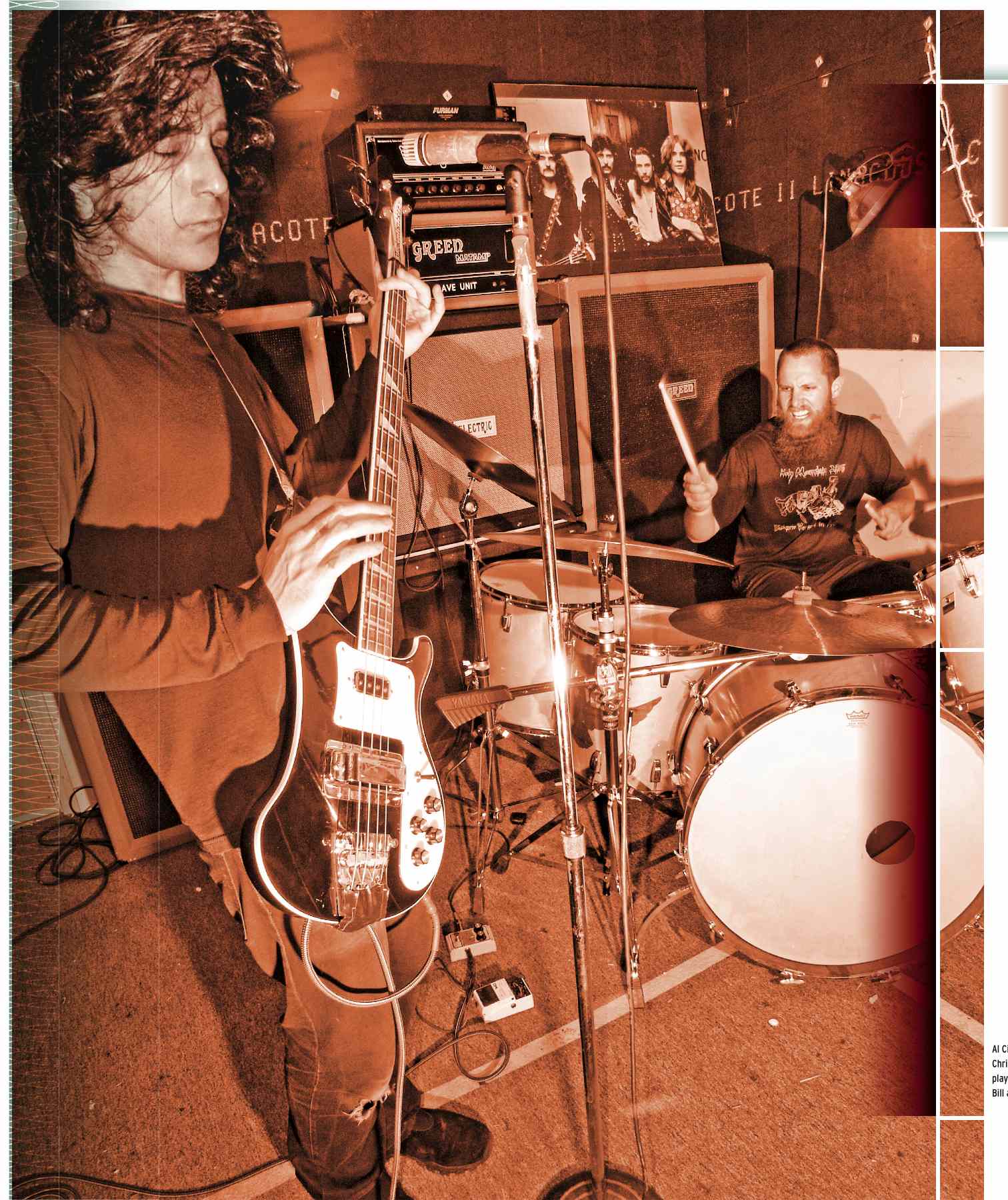
Page from article. Photograph by Lars Knudson, design by W.T. Nelson. Bassist/vocalist Al Cisneros on left. Drummer Chris Hakius, pictured right. Note Black Sabbath altar.

“Most High”: How—and why—Om builds its minimalist, contemplative metal
Text by Jay Babcock

Photos by Lars Knudson

Art direction by W.T. Nelson
Originally published in Arthur No. 22 (May 02006)

Sleep were a tightly focused, intensely dedicated super-heavy riff band from the San Francisco Bay Area who gained a small but devoted following during their time. Even if, like me, you never listened to a note of their music or saw them perform, you probably heard about these guys somewhere: they were the monastic goners who delivered an hour-long narrative song (about caravans of marijuanauts and weedians crossing riff-filled desert lands on an epic drug run) to their record label as their big-label debut (and third overall album)—and then disappeared in the proverbial cloud of smoke… The song/album “Jerusalem” was never released by London/Polygram, the band split up, years passed. Eventually, in 1999, “Jerusalem” was released under still-mysterious circumstances (a better version, entitled “Dopesmoker,” is now available) and the Whispers With Smiles From Those Who Know were proven right: this was a breakthrough masterpiece—deceptively repetitive minimalist heavy metal of such single-minded all-vision that every ridiculous element of the project was rendered sublime by minute three.

When ex-Sleep guitarist Matt Pike’s new band High On Fire debuted in late ’99, it was easy to think this would be the closest you’d ever get to witnessing the now-legendary Sleep: the music heavy yet progressive, the songs endless, the lyrics suitably Old Testament. It was not a repeat of Sleep—there was more emphasis on high velocity—but it was innovative and staggering in its own right.

A closer (which is not to say superior) continuation of “Jerusalem”-era Sleep surfaced in 2004, with the release of Om’s debut album, “Variations on a Theme.” Om was ex-Sleep bassist/vocalist Al Cisneros and ex-Sleep drummer Chris Hakius: a power duo without need of a guitar. “Variations”’ three songs clocked in at 21:16, 11:56 and 11:52. Cisneros’ lyrics—sung (“bravely,” as one friend put it) in an affectless drone-chant—echoed “Jerusalem” but had lost their weed-centricity and become even more hallucinatory; “Approach the grid substrate the sunglows beam to freedom/Winds grieve the codex shine and walks toward the grey” is a typical couplet. A new kind of purity—thinner but deeper, maybe?—had been achieved.

Om’s second album, “Conference of Birds,” is released this month. It has two songs, each over 15 minutes in length. The first, “At Giza,” takes Cisneros and Hakius’ music to an even sparer place of un-distorted bass, drums and vocals. As with these guys’ previous work in Sleep and Om, “Giza” points out new horizons even as the duo hone their own gaze ever sharper.

I spoke with Al Cisneros by telephone from his Bay Area home in late March. Here’s some of our conversation.

Continue reading

“One Nervous System’s Passage Through Time”: GRANT MORRISON interviewed by Jay Babcock (Arthur, 2004)

Originally published in Arthur Magazine No. 12/Sept. 2004


“One Nervous System’s Passage Through Time”: Magic works, says genius comic book scribe GRANT MORRISON, and he would know—he’s been exploring it for 25 years. He talks with Jay Babcock about what he’s experienced and What It (Maybe) All Means.

Cover illustration by Cameron Stewart.


Although he has claimed to be an heir to an immortal space dynasty who stays cheerful by imagining that aliens “will probably be turning up to rescue him any day now,” Grant Morrison was in fact born in 1960 to a pair of liberal activist Earthlings. Growing up in the slums of Glasgow, Scotland, where he was brought up by his mother while being “barely educated” in public schools, Morrison developed an early enthusiasm for all things pop and fantastic: rock n roll music, science fiction and fantasy literature, mythology and the occult, punks, mods, beatniks and, of course, foxes and cats.

But the early love that would bear the most fruit was for comic books, which he began writing and drawing as an adolescent. Foregoing higher education and living on his own in a Glasgow ghetto from age 19, Morrison gradually built a career as a comics writer of prodigious imagination, armed with a sense of humor: the title of his first published story was “Time Is a Four-Lettered Word.”

After years of toil writing in the British sci-fi comics world while making psychedelic mod-pop with his Glaswegian band The Makers, Morrison landed work at American publisher DC Comics, where his deeply unsettling Batman graphic novel Arkham Asylum, illustrated by Sandman cover artist Dave McKean, was published in 1989. It remains Morrison’s bestselling work but in the wake of his work since then—his two-year run on Animal Man, in which the lead character, refashioned as a superpowered animal-rights activist, gradually becomes aware that he is a character in a comic book; four years of Doom Patrol, a deeply Surrealist four-color romp starring a superhero team of mental patients; shorter works like the multi-meta-superhero comic Flex Mentallo and the controversial-for-obvious-reasons Kill Your Boyfriend; The Invisibles, an epic for would-be technoccult anarchists; and The Filth, a seriously dark and bizarre 13-issue series, discussed at length in this interview—it seems relatively minor.

“You don’t get much time on Earth to do stuff, so I like to keep busy,” Morrison told one interviewer last year, and so he has: in addition to the aforementioned work, Morrison recently completed a 40-issue run on New X-Men and Seaguy, a picaresque three-issue series drawn by this Arthur’s cover artist Cameron Stewart; an original screenplay for Dreamworks; and scripts for two more three-issue series debuting in the next few months, We3 and Vimanarama.

Recently returned from a wedding honeymoon that included a week’s stay in Dubai (where “they’re building the 21st century out of sand,” he says), Morrison spoke at length by phone from his Glasgow home about the whys and wherefores of his work, his life and the Present Situation in Our World.

Arthur: Did you see the news about the super-strong German toddler? I was reminded where you were saying your run on X-Men was a set of fables for the coming mutant, which you thought might already exist or be on their way.

Grant Morrison: I figured even within 50 years we’ll probably have quite a few superhumans on the planet. There’s something about the superman idea that’s pushing itself closer and closer to reality, to the real-life material workaday world that we can touch. The supercharacters began in the pulps and then worked their way through comics, and they keep moving to more and more extensive mass media. Now it’s everywhere, and it’s become the common currency of culture. I said, way back, almost joking, that I thought the super-people were really trying very hard to make their way off the skin of the second dimension to get in here. They want to be in here with us. They’re colonizing people’s minds, and they’re now colonizing movies, so the next stage is to clamber off the screen into the street. I think what you’re starting to see, with things like this weird kid, and also the experiments that are going on with animals, the cyborg experiments and genetic manipulation that is now possible, is that pretty soon there’s gonna be super-people. You’ll be able to select for superpeople: “I want my kid to have electric powers.” That kind of thing.

And when supermen do come along, what are they gonna want to find? A role model. Like everyone else on the planet. We all want to find people who’ve trod our path before, who can suggest some ways to help us feel significant. So the idea behind a lot of what I was doing in X-Men and really all of my comics is to give these future supermen a template, to say “Okay you’re a superhuman, and maybe it feels a little like this. I’ve tried really hard as one of the last of the human beings to think what it might be like in your world.” Rather than bring them to us, which is what a lot of superhero fiction in the past has tried to do, I’ve tried to go into their world and to understand what’s going on in the space of the comics, and to try and find a way to make that into a morality, almost, or a creed, or an aesthetic, that might make sense to someone who has yet to be born with powers beyond those of mortal man. I think we have to give them images of rescue and ambition and cosmic potency, rather than images of control and fascist perfection.

Arthur: Can a cartoon code of ethics really deal with real-world subtleties?

In a sense it is a cartoon code of ethics, but these will be cartoon people, having to live in a real world. And I think the cartoon code of ethics stands up as well as anything Jesus came up with. Don’t kill. Don’t let bullies have their way. Use your powers in the service of good. I think we should be focusing towards that, rather than providing images of destruction or of despair.

Purely on a conceptual level, the Justice League were created to solve every possible problem, right? [chuckles] That’s what they’re there for. They never fail. These are things that the human imagination has created and put on paper and they exist – they have a more than 40 years’ lifespan. Still existing, still clinging to life, these images. So I think if we’ve created something in our heads that’s so beautiful and so strong and so moral that it can solve all our problems with justice, intelligence and discrimination, then why don’t we use it? Tap into it a little more and understand what these images mean and what they can do for us beyond the obvious. Why was Superman created? That’s the really important thing. What kind of imaginative need was being served by that? And to access that again, to make it vital again, to empower the fiction again, I think, would help our culture deal with some of the implications of its own future.

We have to hang onto the immense power of that imaginative world. Every creed, every weapon, every invention or symphony began as an idea in someone’s head. We’re very good at making insubstantial ideas into physical artifacts or systems of conduct—which is magic, of course, humanity’s greatest skill.

Yeah, you can imagine that the first Aryan superman will probably crawl out of his test tube and want to subjugate us all with the hammers of his fists, but by using the power of imagination right now maybe we can provide his mighty brain with something better than conquest to think about.

Continue reading

HEAVY RIFFING: An interview with WINO by Joshua Sindell (Arthur, 2004)

HEAVY RIFFING

Legendary doom metal/stoner rock lifer SCOTT “WINO” WEINRICH lays some typically heavy thoughts about politics, music, hallucinogens and life on Joshua Sindell.

Photo by Brian Liu

(originally published in Arthur No. 9, March 2004)


For a musician whose music has earned him such respect from his peers, the elusive, grim-faced figure known as Scott “Wino” Weinrich has always existed in a zone far apart from even the darkest cult spectrum of rock’s unsung heroes.

Wino grew up around the Washington D.C. area, and became well-known among the hardcore-punk-loving kids in the early ’80s as “that amazing guitarist” for Warhorse, a local metal band, later to be known as the Obsessed. Wino stood out in any crowd, not only from his formidable rep as a musician, but because he was an imposing, long-haired, denim ’n’ leather-wearing dude who, appearances aside, expressed solidarity with the burgeoning D.C. punk scene, led by such bands as Minor Threat and Bad Brains. In return, Obsessed shows were routinely filled with short-haired fans who wouldn’t have been caught dead at an Iron Maiden or Judas Priest concert. Black Flag’s Henry Rollins, Fugazi’s Ian MacKaye and Nirvana’s Dave Grohl were diehard Obsessed fans, reverently viewing Wino out of a sense of awe and fear in equal measures. “Wino plays guitar with that up-all-night-drinking-Clorox sound,” Rollins once said admiringly.

In 1985, Wino accepted an invitation to sing for Californian stoner-rock forefathers Saint Vitus. They were his sole focus of musical attention for the rest of the decade as the band released several albums and EPs on SST Records, home to so many of the ’80s’ best bands. Joe Carducci, author of Rock and the Pop Narcotic, and Vitus’s SST producer, explained the appeal thus: “What I hear in Wino is a natural who’s not like other musicians. He always has a trailing shimmer on all of his playing, and when he is just doing downstrokes to mark the rhythm, he’s shaping that as well—dragging the rhythm from the guitar.”

Continue reading

“Nearer the Heart of Things”: Erik Davis profiles JOANNA NEWSOM (Arthur, 2006)

Always Coming Home

How California harper JOANNA NEWSOM’s masterpiece album Ys grew from a time of personal turmoil, ambitious collaboration and eating hamburgers again.

BY ERIK DAVIS
Photography by Eden Batki

ORIGINALLY PUBLISHED IN ARTHUR MAGAZINE No. 25/Winter 02006

Last February in Los Angeles, Joanna Newsom took to the stage at the ArthurBall and performed, for the first time in their entirety, the five loonnggg songs that make up her new album Ys. Many folks present were already chest-deep in the cult of Joanna, a fandom that made 2004’s The Milk-Eyed Mender a leftfield indie hit and turned Newsom herself into the sort of music-maker who inspires obsessive devotion as well as pleasure. At the time I admired Mender, but was, as of yet, no acolyte. I dug a handful of songs, but like many listeners, I found Newsom’s eccentric voice sometimes grating. I also feared that the outsider waif thing was just an underground pose stitched together with lacy thrift-store duds and an iPod stuffed with rips of the Carter Family and Shirley Collins.

My bad. The performance I saw that night was preternatural: a young artist stretching beyond her art towards something even more essential, simultaneously in command of her craft and caught in the headlights of her own onrushing brilliance. The song cycle she played was to Mender what, I dunno, Astral Weeks is to Blowin’ Your Mind, or what Smile is to The Beach Boys Today! She sang of meteorites and bears and ringing bells, of her and him and you, and she played not for us, it seemed, nor for herself exactly, but for the very presences her music conjured. Her songs were not performed so much as drawn from herself like nets dredged from the sea, heavy with kelp and flotsam and minnows that flashed before darting back into the deep. When she occasionally stumbled and lost her way, the material itself would pick her up again and carry her forward.

None of us standing there in that rapt crowd had ever heard music like this before. Newsom’s wild Child ballads seemed loosed from some location heretofore unseen in the realms of popular song, a secret garden lodged between folk and art music, or an unnamed island lying somehow equidistant from Ireland, Senegal, and California’s redwood coast. The music fluttered and leapt, and though there were few obvious refrains, the patterns she played circled round some magnetic core of return, at once familiar and strange. Yes she was genius. But genius has become such a throwaway word, a thumbtack of muso claptrap that marks the person rather than the source that lies behind the person. And this music was all source. And yet, it was she and not the source we heard—this charming young harper with the arresting voice and the awkward stage patter and the lacy thrift-store duds.

Sorry to keep the tankards of Kool-Aid raised high, my friends, but Newsom’s album is also pretty dang nifty: the cult disc of the decade, like the aforementioned Astral Weeks or In The Aeroplane Over the Sea. She is supported on the album by Van Dyke Parks, the sometimes Brian Wilson collaborator who feathered four of Newsom’s five songs with vivid and sprightly arrangements. The orchestration adds another dimension to Newsom’s already evocative ramble through memory and desire, a journey that goes in turns intimate and cryptic, like the alchemical meanderings of a deep dream.

Faced with music as singular as Ys, it seems almost churlish to try to pin the butterfly down. (Or is that a moth?) That said, there is no denying that the spirit of prog has moved across the face of its waters. The album, after all, has an allegorical Renaissance portrait for a cover, features oboes and French horns, and draws its odd, difficult-to-pronounce title from the Celtic folklore of France. (It sounds like ees, as in “Oui, Serge Gainsborough ees very heep.”) And indeed you must return to Van Der Graaf Generator or Trespass-era Genesis to find this sort of dramatic and, sorry, literary fit between highly wrought lyrics and the dynamics of long, intricate, tempo-twisting songs. However, I would urge you even farther back, to the great songs on the great Incredible String Band records, which also embroider earth visions onto patchwork tunes that combine heavy insights and bucolic play. For though the landscape of Ys is not particularly psychedelic, its peaks are very high, from “Emily”’s invocation of the cosmic void to “Cosmia”’s final ascent through the moonlight.

Happily for all, Newsom approaches such high-fallutin matters with a demotic American spirit and a folk fan’s love of homespun melody and pastoral grit—not to mention a canniness that makes her at once too young and too old for the truly pompous. Ys may be precious, but it is precious because the spirit behind it is rare. It does not rely on sentiment, nor does it make Great Statements. It is, rather, a Great Work: an organic but deeply intentional labor from start to finish, from the inspiration through the cover art, from the arrangements through the final, analog mixdown. Newsom gathered a stellar cast of characters around her, including Steve Albini, Jim O’ Rourke, and Van Dyke Parks, who contributes some of the best work in his career. But it is Newsom’s own visionary ambition that makes this record the very opposite of a sophomore slump. A lesser artist would have simply ridden the quirky crest of The Milk-Eyed Mender, but Newsom glimpsed a golden ring glittering on the far horizon, and she stretched beyond herself with pluck and hooked it good.

HOMESTEAD
The house that Joanna Newsom recently purchased is, well, rather Joanna Newsom. The building lies in the outskirts of Nevada City, an old mining town nestled in the western foothills of California’s Sierra Nevada range. It has a small circular driveway, rose bushes, and a broken fountain with two cherubs smeared with mud up to their necks. The one-acre property is fringed by sycamores and pines, and two massive ivy-swaddled conifers loom over the patio out back, dripping gobs of sap onto a weathered table. The firethorn bushes that cloak the breakfast nook and the porch haven’t been trimmed in a while, deranging the otherwise orderly air of a proper British cottage. Past their plump clusters of golden berries, you can glimpse her old, worn-out pedal harp, peeking through the window like a stage prop.

Newsom answers the door with a smile and invites me in. She is dressed in a knitted brown skirt, a low-cut sleeveless shirt, chocolate brown knee-high socks and moccasins. The wide leather belt tugged snug around her waist looks a lot the belt she wears in her portrait for the cover of Ys. The bangs are gone, and she’s cute as a vintage button.

“I’m sorry. I just moved in and I haven’t really been here much.” There is not much furniture beyond a couch and, alongside her harp, a gorgeous Craftsman wooden stool inlaid with turquoise. There is hand-written sheet music scattered on the floor and one large decoration waiting to be mounted on the wall, a nineteenth-century funereal display scavenged from a San Francisco thrift store. “It was there for years, and finally I had to have it.” Having spent the last few weeks obsessively listening to Ys, I can see why, so crisply does the thing reflect some of her major themes and images: inside the large glass case, two stuffed doves face off over clusters of dried wheat, neatly arranged over a fat and faded ribbon printed with condolences.

We settle down on the table outside, and dig into the past. Newsom grew up around Nevada City, but she lived for years in the Bay Area, where she studied composition and creative writing at Mills before dropping out, writing some songs and recording them with her first boyfriend, the musician and producer Noah Georgeson. Even then, she kept returning to the nest on weekends, but feared the phenomenon an old Austin friend of mine referred to as the velvet rut. “It’s a real easy place to get kind of stagnant in your head, to get overly comfortable and have the years pass by.” Now that her career has taken off and she is constantly traveling, she decided to return to the place that, in her words, makes her feel happiest and most at home.

Continue reading

THE BLASTER OF CHOICE by Dave Reeves (Arthur, 2006)

“Do the Math” column
by Dave Reeves

(published in Arthur No. 25/December 2006):

Fairweather Americans, I want to point out that regardless of other shortcomings, the Middle East strategies of the Bush administration have made it possible for several young citizens to acquire real estate. Sure, the plots are only three feet long and six feet wide, but it’s a quiet neighborhood. The soldiers can’t complain.

That’s right, for 3,000 American soldiers every day is Earth Day, and will be until the worms finish them off. American dead are the only ones that count as the road to peace is traditionally paved in hearts, minds and other charred viscera of the country you’re freeing.

The freedom America is pushing on Iraq isn’t the standard “Statue of Liberty” brand of freedom. No, if you read the bold type this is actually “Enduring” Freedom, which is more like a “just another word for nothing left to lose” type of freedom. Enduring freedom means freedom from having to go to school. Freedom from sewage and electric power.

For many, the Iraqi occupation is a no brainer. Iraqis with brain in skull are plenty pissed. It’s like this: guys like Wariz My-Roof in Fallujah or Burli the Kurd up in the mountains stay on the Sunni side of the street and don’t take no Shi’ite. The Shi’ites feel the same about the Sunnis and Kurds, only more so. We’re not sure what the beef is about. Even when we figure out which side we’re on, these damn Semites all look the same to an Apache helicopter.

The beef that started Cold and hot wars between the Soviet Union and the United States was this: “How can communism hope to compete with the infinite genius of greed?” This question forced the two great powers to produce an infantry weapon which manifested their philosophy to best achieve peace on earth. War is just debate carried on by other means.

Continue reading

ARTHUR NIGHTS (2006)

Poster by Maya Hayuk.

(Late booking, not on poster: KYP MALONE (TV on the Radio) solo set)


INS & OUTS ALL NIGHT * ALSO CHECK OUT CLIFTON’S CAFETERIA FOR AFFORDABLE AMERICAN FOOD FARE AND A DECOR THAT WILL GIVE YOU A CONTACT HIGH — OPEN ONLY TIL 9PM *

GOOD AFFORDABLE FOOD TOO, RECORDS AND BEAUTIFUL HANDMADE CLOTHES PLUS MORE ON THE FOURTH FLOOR


THURSDAY, OCT. 19, 2006 [stage/schedule is lost, sorry!]

DEVENDRA BANHART
a special performance to close the current cycle

BERT JANSCH
first US visit in 8 years from the ex-Pentangle musician–a guitar hero to Neil Young, Jimmy Page, Johnny Marr and countless others–his new album just got 5 stars from Mojo magazine

ESPERS
gorgeous psychedelic folk-rock from Philly co-ed ensemble

JACKIE BEAT
singing spirit guide to Silver Lake scene queens

BELONG
ambient post-My Bloody Valentine fog-throb duo from New Orleans, spotlit in Arthur 23

BUFFALO KILLERS
lumbering, melodic rock ‘n’ roll from Cincinnati bros featuring former members of Thee Shams

YELLOW SWANS
psychedelic Bay Area agitnoise peacegrunt duo

GROUPER
Bay Area neo-ambient noiselady — ‘some of the most ethereal and powerfully heavy-lidden sounds this side of Brian Eno and Arvo Part’ says Mojo

AXOLOTL
San Francisco drone/noisefella

PLUS:
DJ sets by Dublab rats, Brian Turner (WFMU) and The Numero Group


FRIDAY, OCT. 20

7:20 MAIN HALL

AWESOME COLOR

awesome garage-mantra rock in a Stooges/Spacemen 3 ancestor worship mode

7:30 FIFTH FLOOR

SEAN SMITH

Berkeley-based fingerpicking acoustic guitarist in the great John Fahey-Robbie Basho tradition, part of the Imaginational Anthem tour 

8:05 MAIN HALL

THE HOWLING HEX

He was a prime mover in Pussy Galore and Royal Trux… a brilliant solo career and now his latest project, The Howling Hex… guitarist/genius Neil Hagerty in harmolodic prog-jazz-rock-whatsit flight 

8:15 FIFTH FLOOR

CHRISTINA CARTER

Texan matriarch of the current avant-folk-psych scene, and member of Charlambides, in solo guitar and voice set, part of the Imaginational Anthem tour

8:55 MAIN HALL

HEARTLESS BASTARDS

walloping Ohio rock trio led by wailer/guitarist Erika Wennerstrom–second album just out on Fat Possum

9:05 FIFTH FLOOR

FORTUNE’S FLESH

features ex-Starvations members; “Cockroach’s larvae stage of death doo-wop”

9:45 FIFTH FLOOR

TALL FIRS

mellowside trio on Thurston Moore’s Ecstatic Peace record label

9:55 MAIN HALL

BE YOUR OWN PET

Nashville teenage action-punk quartet led by firecracker vocalist Jemina Pearl

10:30 FIFTH FLOOR

SHAWN DAVID MCMILLEN

“Soporific, glazed” (sez ‘The Wire’) Texas psych, part of the Imaginational Anthem tour

10:50 MAIN HALL

TAV FALCO & THE UNAPPROACHABLE PANTHER BURNS

Charlie Feathers, Alex Chilton, Rural Burnside and more…The truly legendary ‘Dorian Gray of Rock ‘n’ Roll’ from Memphis–admired by rock n roll luminaries like Spiritualized’s Jason Pierce, The Cramps and The Black Keys–in his first L.A. appearance in a decade!

11:15 FIFTH FLOOR

CHARALAMBIDES

beyond-rare L.A. perf by co-ed twin-guitar psych/dream duo on the brilliant Kranky label

12midnight MAIN HALL

BORIS

Japanese doom/rock/blissout superpower trio in performance ahead of the Halloween release of their devastating new album-length collaboration with dronekings Sunn0))) 


Saturday October 21

4:00-on FOURTH FLOOR

SCHOOLHOUSE DROP-INS: “Visit the geodesic tent as the 9 Sundown Schoolhouse residents present projects to partake in, forums for engagement, acts of interaction, thoughts for collective inquiry and general happenings.”

4:20 MAIN HALL

RESIDUAL ECHOES

Stomping West Coast high-energy rock attack unit who blew us away at loast year’s ArthurFest.

5:10 MAIN HALL

FUTURE PIGEON

galactic dance-dub heroism from local ensemble 

5:30 FIFTH FLOOR

WOODEN WAND

mercurial, provocative, prolific folk-rock dude in a solo turn 

6:10 MAIN HALL

WATTS PROPHETS

righteous word jazz elders 

6:25 FIFTH FLOOR

NVH/BEN CHASNY

noize proj from Comets on Fire’s echoplexist/drummer Noel Von Harmonson and guitarist Ben Chasny

7:10 MAIN HALL

MONEY MARK

always imaginative keyboardist/music man–best known for co-writing work with Beastie Boys 

7:10 FIFTH FLOOR

MIA DOI TODD

L.A. singer/instrumentalist on guitar, vocals and harmonium

8:05 FIFTH FLOOR

RUTHANN FRIEDMAN

Folk singer-songwriter, a real child of the ‘60s canyon scene, introduced at Big Sur Folk Festival in 1967 by Joni Mitchell –She wrote “Windy” and so much more–now returning to live performance at age 62!–she lived the ’60s and she remembers it 

8:10 MAIN HALL

SIX ORGANS OF ADMITTANCE

apocalyptic free-mind guitar & voice from Ben Chasny 

8:55 FIFTH FLOOR

MICHAEL HURLEY & JOSEPHINE FOSTER

Hurley is a legendary mellow bard with a hint of wry 

Josephine – you gotta hear this woman sing! “She’s a genius” – Joanna Newsom

9:10 MAIN HALL

WHITE MAGIC

long-awaited return of Mira Bilotte’s NYC-based unclassifiable folk band, new album out next month; this perf will feature Dirty Three drummer Jim White!

10:10 MAIN HALL

OM

return of Bay Area metal trance/mind expander duo who laid peacewaste at this spring’s ArthurBall

11:00 FIFTH FLOOR

LIVING SISTERS

joyous acoustic trio featuring Inara George, Eleni Mandell & Becky Stark (Lavender Diamond), with special guest VAN DYKE PARKS 

11:20 MAIN HALL

SUN RA ARKESTRA

11-piece Arkestra still going deep, now led by the great Marshall Allen 

~12:30am MAIN HALL

NUMERO GROUP DANCE PARTY

“Misplaced soul/funk hits” dance party DJed by the 20th-century pop archaelogists of THE NUMERO GROUP label from Chicago… They’ll be spinning throughout the day, with special sets before and following the Sun Ra Arkestra….


Sunday, Oct 22 

4:40pm in the Main Hall

SSM

John Szymanski, David Shettler and Marty Morris –rawk n roll from Deeetroit on the Alive label

5:30pm on the Fifth Floor

C.B. BRAND

local cosmic California country rock

5:30pm in the Main Hall

THE NICE BOYS

grade-AAA glam rock from Birdman recording artists

6:15pm on the Fifth Floor

THE COLOSSAL YES

Comets on Fire’s Utrillo’s brilliant piano pop proj 

6:20pm in the Main Hall

THE SHARP EASE

Paloma Parfrey-led liberation rockers featured in current issue of Arthur 

7:05pm on the Fifth Floor

CHUCK DUKOWSKI SEXTET

L.A.’s own… featuring Ms. Lora Norton – Vocals, Mr. Chuck Dukowski – Bass (Black Flag), Mr. Lynn Johnston on Horns, Mr. Milo Gonzalez – Guitar, Mr. Tony Tornay – Drums (Fatso Jetson)

7:10pm in the Main Hall

ARCHIE BRONSON OUTFIT

sharply shaped rock music from new English four-piece

7:55pm on the Fifth Floor

EFFI BRIEST

all-female experimental/noise combo

8:05pm in the Main Hall

KYP MALONE

extremely rare solo set from the TV on the Radio singer-guitarist–he’s flying in from the Darfur benefit show in Philadelphia

8:55pm on the Fifth Floor

OCRILIM

solo electric guitar hotwork set from prog-metal-avant maestro Mick Barr 

9:15pm in the Main Hall

THE FIERY FURNACES

justly acclaimed thrill-a-minute brother-and-sister-led clever combo, gifted with pop sense, improvisational chops and conceptual ambition

10:45pm in the Main Hall

COMETS ON FIRE

Quite possibly Earth’s greatest living rock ‘n’ roll band–see present issue of Arthur for more details

DJ sets by Dublab rats and Brian Turner (WFMU)

JAMES PARKER IN THE BOSTON PHOENIX ON PINCHBECK, JENSEN, ARTHUR.

The Phoenix – Aug 17, 2006

The New New Age

The movement pulls away from the mainstream and gets apocalyptic

By: JAMES PARKER

“In the United States,” wrote novelist and poet Jim Harrison in 1976, “it is a curious habit of ours to wait for the future when it has happened already.” Thirty years on, how much deeper is that swoon of postponement, and how much more pressing the crisis. In weather systems, in belief systems, the planet condenses with rage; the blandest recital of the facts can shake the air like a Yeatsian prophecy. Faces averted, we peck out text messages. At the political level the most complex issues are debated in the style of barking dogs, while at the counter of your local Starbucks a man is placing an order as nuanced and sophisticated as a 17th-century sonnet. And on the street the Hummers roll, driven by small, blond college girls, as if America had invaded itself.

But if the future won’t stop happening, neither will the past. Because here’s both the good news and the bad: the ’60s never ended. That decade’s chaotic drive toward collective rebirth — stalled, dissipated, betrayed, backlashed, and broken down — was not (it turns out) the endpoint, but the augury. “The Sixties,” says Daniel Pinchbeck, author of 2012: The Return of Quetzalcoatl (Tarcher/Penguin), by phone from New York City, “were an attempted voyage of initiation on a mass-cultural level, but at that point it couldn’t be completed. The maps weren’t there, there were no guides, and a lot of people kind of lost it.” Pinchbeck, a thirtysomething former journalist who has transformed himself — with the help of mind-ripping pharmaceuticals and organic hallucinogens like iboga and ayahuasca — into a multi-disciplinary critic of the “design problems” in Western civilization, is standing by for the next stage. “There’s some kind of process of assimilation that required those currents which came out so powerfully in the ’60s then to go underground and become subliminal,” he says. “But they’ve had a major effect on people in the West, whether through access to indigenous shamanism or in the extraordinary growth of yoga, and in a way they’ve been preparing the container so that if we were to go through another kind of initiatory level, there would be people ready to hold it together.”

Shamanism? Yoga? Welcome to the New New Age — the just-in-time resurgence of the holistic, anti-materialist worldview, garbed in esoterica, brandishing its own style of drugs and music. And brace yourself for a major paradigm shift: at the vanguard of the armies of transformation is … Sting! “Daniel Pinchbeck’s 2012,” he blurbs on the book jacket, “is a dazzling kaleidoscopic journey through the quixotic hinterlands of consciousness.” Yes indeed, someone got his message in a bottle. “I became friends with Sting after my last book [Breaking Open the Head],” says Pinchbeck. “He got in touch with me and I actually stayed with him in his house in Italy.

“He’s had contact with indigenous shamanism, and he’s aware of the importance of the material. He’s kind of like an elder statesman, and he’s been giving me a lot of support.”

The sins of the old New Age, of course, are still with us: Celtic muzak, little polished rune-rocks, bumper stickers that say THE GODDESS IS ALIVE AND MAGIC IS IN THE AIR! Seeking balm for the psychic wounds they had sustained in the ’60s, ex-hippies opted en masse for a sort of consoling and watered-down paganism: ancient energies were domesticated, to the point where almost anyone could have a print from the Mahbarata on their kitchen wall, or an Odinist living downstairs. “The original New Age was a little bit on the flimsy side,” says Pinchbeck. “Channelling, UFOs … all that stuff was kind of floating out there. What I’m trying to do with the new book is to show that it’s possible for someone with a rational modern intellect to go through this material in a reasonable way, and to integrate Western philosophy with this shamanic/psychedelic worldview.”

What most viscerally separates the New New Agers from the old is their crisp and eager apprehension of imminent system crash — what our inheritors, stumping for food in the poisoned mud flats, may well call The Great Unraveling. Take, for example, the words of eco-philosopher Derrick Jensen, author of Endgame, in a recent interview. Asked if he truly wants civilization as we know it to fall, Jensen responds: “If civilization had come down 200 years ago, the people who live here would still be able to support themselves. But if it comes down in another 30 years, 50 years, 60 years … So even from the purely selfish human perspective, yeah, it would be good for civilization to end. The sooner this civilization goes, the better, because there’ll be MORE LEFT.”

Jensen gave this interview to Arthur magazine, a lavishly appointed free bimonthly out of LA whose columnists include Sonic Youth’s Thurston Moore and media theorist Douglas Rushkoff. Since October 2002, Arthur’s editing/publishing team of Jay Babcock and Laris Kreslins has been busy streaming the revelations and imperatives of the New New Age into pop culture, where the kids can get at it. Arthur, called “the American counterculture’s answer to the New Yorker” by the London Guardian, has become the place where the ideas meet the music; where Jensen’s freefall apocalyptics can sit with total aptness beside a piece on nouveau hippie swooners Brightblack Morninglight. The same issue begins with a column about mint tea and ends with a list of “sensitive weapons” (e.g., shotgun shells taped to the end of a BB-gun barrel) for use when the grid collapses and Devendra Banhart fans are called upon to defend their homes and woolly hats.

Arthur has saturated itself in the ’60s, via features on the Weather Underground, the MC5, the 1967 March on the Pentagon, and also in the post-psychedelic slant of the music coverage. But there’s nothing regressive here. From the freaky folkers to the acid rockers, Arthur bands have their eyes on the advancing historical horizon: the same rumble of tribal disturbance is heard beneath the dragon-groan of SunnO))) and the fey, brilliant stylings of harpist/singer Joanna Newsom. A tastemaker and an advocate, Babcock has probably done more to promote and consolidate this intangible consensus than anybody else. He calls it “naturalismo.” [That’s a term coined by Devendra Banhart, actually. -JB]

Daniel Pinchbeck used to write for Arthur, as (full disclosure) did I. I stopped because I could no longer afford to write for free; he — rather more nobly — was fired, after submitting a post-Katrina column in which various apocalyptic scenarios of military clampdown were hypothesized.

Babcock smelled “Art Bell–style” paranoia (referring to the conspiracy-mongering host of radio’s Coast to Coast AM), and wouldn’t print it; Pinchbeck recoiled, hurt. “I think Jay’s aiming more at the mainstream,” he says. “He wants his magazine to be the new Rolling Stone.”

What is beyond dispute is Babcock’s commitment to reaching “every generation of bohemian currently living.” “When we run a piece about the MC5,” he says by phone from LA, “it’s not just to educate the youth or to remind ourselves of something. It’s also to say to the original people: your work wasn’t forgotten, and maybe you should pay attention to the kids who are interested in what you did. I think they’re going to start to come back, the ones that went back to the land and just disconnected from contemporary culture for the last twenty years — and they’re gonna find that they have more in common with these kids in their teens and twenties than they do with their fellow retirees at this point. And I don’t even KNOW where that could lead.”

Babcock’s most recent and widely-broadcast prank was an interview showdown with Sully Erna, over the use of Godsmack music in Army-recruitment ads. Unimpressed with his own generation’s efforts at protest, he is trusting to demographics to get the job done: “By 2010 we’ll have a youth bubble, a huge population under 25. And they’ll be stronger, more willing to take risks, to cope with transformation — even to demand it. Who will be their leaders? What kind of culture are they going to inherit? So that’s part of what we’re doing — to try and preserve, elevate, incubate if you like, these ideas.”

The imminent crisis, the next initiatory level — Pinchbeck’s “prepared containers” and Babcock’s wised-up and transformation-ready youngsters. What the New New Agers all agree on is that change is not over there, but here: vast, cruelly accelerated, streaming with possibility. “I’m trying to define this transformative process,” says Pinchbeck, “but it’s already under way.” “Right now,” says Babcock, “we’re like the Beatniks of the Fifties — a little isolated, a little dispersed, driven a little crazy by the culture.

“But different, too. Because unlike the Beats, we have the benefit of knowing that the hippies are coming.”

ARTHUR ON AIR AMERICA WEDNESDAY NIGHT…

Arthur editor Jay Babcock will guest on national progressive radio network AirAmericaRadio’s “The Marc Maron Show” on Wednesday, May 31 . He’ll be discussing the Arthur vs Godsmack kerfuffle and also Arthur’s forthcoming CD (curated by Josephine Foster) which will benefit anti-military recruiting campaigns. It’s going to be AWESOME.

Info on the show: www.airamericaradio.com/maron/

AirAmerica radio network stations: www.airamericaradio.com/stations

Listeners on the internet can stream live at www.airamericaradio.com while the show is on the air. Air America Premium members can podcast and hear archived shows they missed.

MORE INFO ON THIS WHOLE RUCKUS:

Transcript of the Arthur v Godsmack interview (May 1, 2006), with Introduction, Afterword and Footnotes: www.arthurmag.com/magpie/?p=1244

MP3 of the Arthur vs Godsmack interview (May 1, 2006) (courtesy Crooksandliars.com and Bobby Tamkin): http://movies.crooksandliars.com/arthurvsgodsmack.mp3

Streaming audio of Arthur vs Godsmack interview (May 1, 2006) (courtesy Apollo Audio and Bobby Tamkin): http://www.apolloaudio.com/lt.asp?name=AA32

New York Daily News on Arthur vs Godsmack (May 10, 2006): www.nydailynews.com/news/gossip/story/416382p-351810c.html

CNN Headline News’s “Showbiz Tonight” interviews Godsmack on controversy – transcript (May 11, 2006):http://transcripts.cnn.com/TRANSCRIPTS/0605/11/sbt.01.html

Howie Klein commentary at The Huffington Post (May 8, 2006): www.huffingtonpost.com/howie-klein/not-all-rock-stars-are-li_b_20648.html


MOMUS

“It seems clear to me that this song ‘came’ to me complete and finished. I didn’t need to work on it. I didn’t compose
it, it just arrived ‘from another realm’. Musicians often say this. In an interview in today’s Japan Times entitled ‘Melody of the Inexpressible’, Kazu of Blonde Redhead says: ‘It’s not so much in your control. You never feel like it’s your creation. You happened to walk by and pick it up.’…”

More: http://imomus.com/thought220102.html