
Download: “I Just Don’t Know Where I Stand Anymore” – THE FLIPS (mp3)
[audio:http://www.arthurmag.com/magpie/wp-content/uploads/2010/09/01-I-Just-Dont-Know-Where-I-Stand-Anymore.mp3%5DAvailable on REAL VINYL from HoZac

Download: “I Just Don’t Know Where I Stand Anymore” – THE FLIPS (mp3)
[audio:http://www.arthurmag.com/magpie/wp-content/uploads/2010/09/01-I-Just-Dont-Know-Where-I-Stand-Anymore.mp3%5DAvailable on REAL VINYL from HoZac

The show at Pappy and Harriet’s in Pioneertown (near Joshua Tree) is FREE and (as always) ALL AGES. See ya there…

From Ondi McMaster:
A BENEFIT FOR IRA COHEN
Poet, Publisher, Photographer, Filmmaker, Media Shaman
September 8, 2010 7-10pm
(Yes it is the first night of Rosh Hashana)
Bowery Poetry Club
308 Bowery New York, NY 10012
(212) 614-0505
The evening’s suggested donation is $20…. or more if feeling compassionate and generous. We will do a drawing among the donating guests for one of his signed prints. Ira Cohen himself may appear in the beginning of the evening and there will be a 9:30 showing of Invasion of Thunderbolt Pagoda.
Readings by poets and music of magicians, friends and peers of Ira, including
ALLAN GRAUBARD
CANNON HERSEY
DEER FRANCE & Friends
JIM FEAST
JORDAN ZINOVICH
COSMIC LEGENDS : SYLVIE DEGIEZ, WAYNE LOPES, PERRY ROBINSON
MARIANNE VITALE
PETE DRUNGLE
ROBERT GALINSKY
STEVE BEN ISRAEL
STEVE DALACHINSKY
SHIV MIRABITO
VALERY OISTEANU
& others
We will be selling special CDs of Ira’s past readings($10) and signed photo giclees of a few images from his mylar series of the ’60s (see below). The giclees start at $250 each for 8×10’s $600 for 11X14, Jimi Hendrix or William S. Burroughs with cobra). (I will take preorders on these and you can pay now with Paypal by contacting me)
We need to raise money for Ira Cohen and his archives that have been displaced by the effects of the bedbug condition of his building. It has been an expensive and torrential experience, though Ira is for now staying peacefully at the Chelsea Hotel until he can return home.
This night is dedicated to him. Be inspired by his work. Come and support this benefit.


Here’s a story I did for the LAWeekly on Ira Cohen back in March, 2002, on the occasion of his reading at the Sonic Youth-curated All Tomorrow’s Parties at UCLA…
AKASHIC OFFERING: Ira Cohen, human being
By Jay Babcock
“Know that it is not imagination, but experience, which makes poetry. And that behind every image, behind every word, there is something I am trying to tell you, something that really happened.”
Ira Cohen said that, on a CD he made with DJ Cheb i Sabbah (The Majoon Traveler, Sub Rosa) back in 1996. And if any living American poet has experience to draw from, it’s the Earth-trotting Cohen.
Born in 1935 to deaf parents, raised on 92nd Street in New York, and higher-educated at Cornell and Columbia, Cohen went on to spend substantial creatively productive periods of his life in happening locations with adventurous people: the years in Morocco with Brion Gysin, William Burroughs and Paul Bowles; the mid- to late ‘60s in New York with the Living Theater, filmmakers Jack Smith and Alexandro Jodorowsky, and musicians like Tony Conrad and original Velvet Underground drummer Angus MacLise; and the ’70s, when he spent two and a half years in India, a year in Nepal, and the rest of the decade — in what Cohen calls his “Shangri-la period”—in Kathmandu, living with artists like MacLise and other members of Asia‘s “hippie-drug dealer-saddhu fraternity.” Today, Cohen reclines amid book landslides in a Manhattan apartment like some kind of psychedelic-in-residence, regaling visitors and phone callers with a steady stream of bohemian biography, financial complaints, and improvised observational poem-riffs that drip with the gathered wisdom of a uniquely blessed life and learned, generous, unrepentant “been there, smoked that” perspective.
“In the West, everywhere you look you see some kind of desecration of the human spirit,” he snorts. “Graffiti and ads. Used condoms in the Hudson River. Commercialized crapola. In the East, what you find on a comparable level is acts of consecration. That’s a very, very great difference. Now, yeah, there‘s a lot of poverty and suffering there. But there’s a lot of dignity in poverty—I saw people in Ethiopia starving during the famine who had more dignity than anyone on the planet. I can‘t say I’ve seen people putting flowers in little boats with candles and sailing them up the Hudson River with hopes for divine indulgence—not asking for something, but offering something, rather than trying to take something.”
Cohen‘s wide-ranging career—encompassing poetry, experimental and documentary filmmaking, audio recordings, astonishing “Mylar chamber” photographic portraiture, publication of the infamous Hashish Cookbook, and the editing of the landmark underground magazine Gnaoua (included on the cover of Dylan’s Bringing It All Back Home)—is about offering something back to the world. Cohen calls that something—his collected works—the Akashic Record.
“Akashic basically means timeless thoughts,” he explains. “It‘s Sanskrit for ’toward the shining manifestation. A spot in the ether, a point where a potential thing is about to occur.‘ Or, as Judith Malina said, ’the hidden meaning of the hidden meaning.‘ Or, as Paul Bowles said, ’God‘s home movies.’ I never wanted to be a photographer like the commercial photographers. For me, it was more about the involvement of the mirror, and scrying, reflection, crystal-ball-gazing, trying to get to some other place. It was all about reflection, in the deepest sense of the word. Like a shamanic trip: A shaman is some kind of magician who can take on all kinds of special journeys like astral travel and come back with answers by putting himself into a certain space. He takes on the pain, he goes out there, he comes back with the answer or with the medicine. He‘s a healer. I like all those words — tantra, akasha, healing, shamanism. Add a touch of surrealism and humor, and you’ve got me dead in your sights.”
What‘s been Cohen’s response to the 9/11 attacks and their global aftereffects?
“It hasn‘t impinged on what I do on a given day, but . . . my dreams are stranger. My fears are greater. I feel somewhat depressed, because I feel that there are millions of people out there who are hell-bent on one thing only, which is destruction. Think of it! That’s never been true before. Sometimes I consider human almost a bad word.
”As an artist, you just keep writing what you feel, and what you think, and be the conscience of Planet Earth. I feel that my arms are extended as a human being across another chasm, I‘m trying to think intergalactically, I’m living my life as best I can. I‘ve been pushing a peanut with my nose ever since I can remember, and I don’t know what else to do! I don‘t have a big podium—I just have a small pen.“

A song from Swans’ new album, My Father Will Guide Me Up a Rope to the Sky, their first in over 13 years, out September 27 via Young God Records.
Download: Swans – “Eden Prison” (mp3)
[audio:http://www.arthurmag.com/magpie/wp-content/uploads/2010/09/07-Eden-Prison.mp3%5DNew York Times on Swans’ return. Michael Gira, pictured upper left, is interviewed, Thurston Moore provides testimony & insight.
Gira describes the album, track by track, to The Quietus

photo: Leanna Asheton
Great, heavy interview with Iggy by Greg Kot: Chicago Tribune
Stooges in Arthur in 2003, on the occasion of their reactivation: The Arthur Store
Sean Christensen aka Awesome But True aka Glass Moustache is a prolific comics maker and mega awesome bro from way back. When he’s not getting radical or enjoying life… oh wait… that’s never. So in the midst of all that awesomeness you know he’s drawing pictures and making comics with his friends here in Portland.
One of his newest books is Labanotation: The Center of Weight, a collaboration with the incredible Amy Kuttab. We’re pleased to present some pages from a new odyssey in progress, ‘2005’.
http://seanchristensen.blogspot.com/
http://awesomebutcomics.blogspot.com/


One Art
by Elizabeth Bishop
The art of losing isn’t hard to master;
so many things seem filled with the intent
to be lost that their loss is no disaster.
Lose something every day. Accept the fluster
of lost door keys, the hour badly spent.
The art of losing isn’t hard to master.
Then practice losing farther, losing faster:
places, and names, and where it was you meant
to travel. None of these will bring disaster.
I lost my mother’s watch. And look! my last, or
next-to-last, of three loved houses went.
The art of losing isn’t hard to master.
I lost two cities, lovely ones. And, vaster,
some realms I owned, two rivers, a continent.
I miss them, but it wasn’t a disaster.
Even losing you (the joking voice, a gesture
I love) I shan’t have lied. It’s evident
the art of losing’s not too hard to master
though it may look like (Write it!) like disaster.
Click to enlarge…

See the rest of The LongHair Times’ first issue, dated April 1, 1966, at International Times Archive
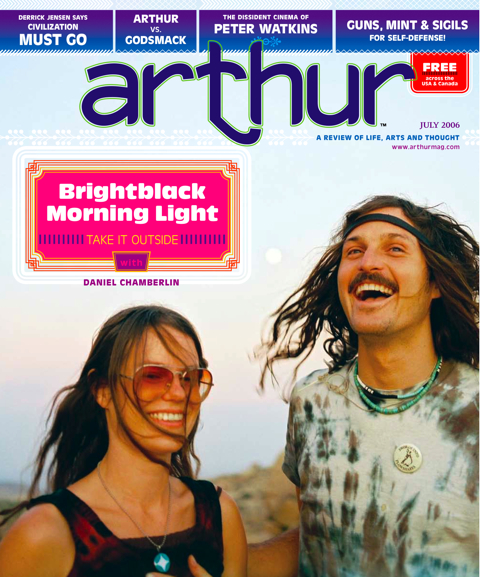
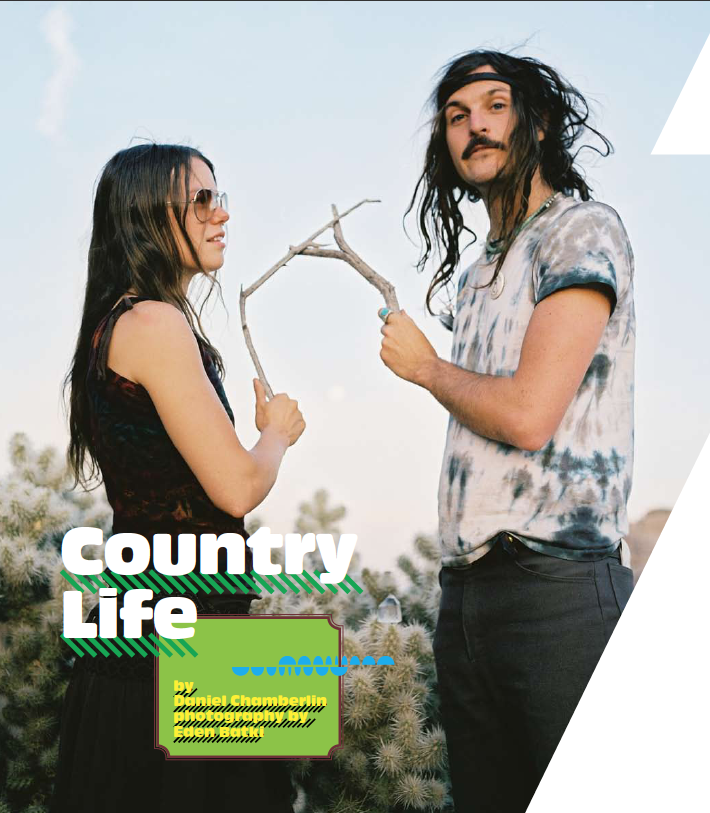
Country Life
For the beatific country-soul musicians of Brightblack Morning Light, there’s no place like Nature
By Daniel Chamberlin
Photography by Eden Bakti
Originally published in Arthur No. 23 (2006)
When they weren’t slumming it with us youngsters at the all-ages hardcore shows, the older dudes at my Indiana high school would spend their weekend nights going “country cruisin’, reminiscin.” They’d all pitch in on a six-pack, score a dime-bag and then pile into somebody’s old car—preferably a late ’70s model sedan with stained plush upholstery and bench seating in front—and drive slowly down the deserted gravel roads and empty dirt tracks that criss-crossed the corn and soybean fields that spread for miles in every direction from the small town we called home. Though I never went on these sentimental rides—I was too young, pot-phobic and already knew that drunk driving was trouble—I was in love with their soundtrack: long-form blues from the Allman Brothers and heartbroken redneck ballads from Lynyrd Skynyrd.
These days, I score my drives back from walks in the San Gabriel Mountains north of my home in Los Angeles with the same music, maybe a bit more Neil Young and Fairport Convention in the mix. It sets the tone for the silent trekking to come and eases the re-entry into the urban landscape on the way back down. The Grateful Dead’s American Beauty and Will Oldham’s Ease Down The Road are ideal albums to soundtrack trips to the deserts and mountains. I’ve added Brightblack Morning Light’s new album of organic wilderness soul to the list of music perfect for such peaceful expeditions.
The two core members of Brightblack are Rachel “Rabob” Hughes, 29, and Nathan “Nabob” Shineywater, 30. Their self-titled debut for Matador Records has the dense harmonic blur of My Bloody Valentine but the music is made with the kind of instruments you’d expect to find the world famous session musicians—the Swampers—of Muscle Shoals putting to good use behind Aretha Franklin or Mavis Staples. (The album actually features two of the Staples Singers along with a trombone player from Nashville, Andy McLeod of White Magic on bongos and Paz Lenchantin—the Argentinean-American multi-instrumentalist known for her work with A Perfect Circle, Silver Jews and Entrance—on guitar.) It’s perfect for coming down from the mountains, and custom made for coming down on Sunday morning. It has an almost gospel feel—since soul music is just gospel without as much god—that invites comparisons to the lonely space-age-blues of Spaceman 3 or Spiritualized. But where Jason Pierce put opiates on the altar formerly occupied by the Holy Trinity, Brightblack has placed a respect for nature, an amalgam of environmental convictions and Native American spiritual practices. Which is sort of obvious from song titles like “A River Could Be Loved” and “We Share Our Blanket With The Owl.”
Their live performance is as quiet and intimate—maybe even more so—than their album. The most recent incarnation of their touring band includes Oregonian Elias Reitz on congas and tablas and West Virginian Ben McConnell behind the kit, with their friend Mariee Sioux, who Nabob is careful to identify as a full-blooded Paiute, opening each show. They often bring sticks and other woodland artifacts onto the stage, erecting small lean-tos or tipi-like structures. All of it swirls and refracts in the rich, resinous sound of Rabob’s Fender Rhodes organ. The vocal harmonies are chorus of whispers, while the brushed percussion is more of a sparkle than a clatter. The instruments are so quiet that cash registers at the bar interrupt the spell. Nabob’s slide guitar work hangs in the dim lights of the stage, glowing and vibrating in the air. On his instrument, a wolf cub suckles at a woman’s breast.
Continue reading Arthur Magazine