How to Get Into the Grateful Dead (Arthur, 2005)

LISTEN TO THE DEAD

Originally published in Arthur No. 18 (Sept 2005)

Dear Arthur,
Okay, so a lot of people in Arthur have been coming out of the Deadhead closet lately [cf. “Uncle Skullfucker’s Band”, Arthur No. 11]. Someone, maybe Bastet, maybe someone else, should put out a mix CD or two of some of the Dead’s material that might be most likely to impress the contemporary drone/noise/psych/improv and/or free(k) folk scene(s). I have enjoyed a very small percentage of the G.D. that I have heard, and have been unwilling to delve through the catalog in search of the gems. I am willing to give them the benefit of the doubt, and would like to hear a carefully selected mix made by discerning ears. Example: Garcia solo piece on Zabriskie Point soundtrack.
Rick Swan
via email

Dear Rick,
There are over 2,800 Grateful Dead shows available for free download at archive.org, and depending on who you talk to at least a half-dozen studio albums worth checking out. That’s a lot of music to sort through, even if you can get your hands on most of it without laying down any cash. We convened a conclave of reconstructed Deadheads in order to help you and any other greenhorn seekers of the Dead find your way around. The Knights present for this meeting were:

Geologist, a member of Animal Collective, that incredible international post-hippie string band.
N. Shineywater, of Alabama’s creamiest slow-folk practitioners, Brightblack Morning Light. It is worth nothing that Brightblack’s cover of “Brokedown Palace” with Will Oldham on vocals makes us weep.
Ethan Miller, of the mighty Comets on Fire.
Daniel Chamberlin, a contributing editor at Arthur, and the author of “Uncle Skullfucker’s Band” (Arthur No. 11) about life as a closet Deadhead.
Denise DiVitto & Brant Bjork: Owner-operators of Duna Records, which releases records by Mr. Bjork (co-founder of Kyuss) and other worthy artists. Two mellow souls who hang in the desert.
Erik Davis, Arthur contributor, native Californian and the author of Techgnosis: Myth, Magic and Mysticism in the Age of Information.
Barry Smolin, the host of the essential “The Music Never Stops” Dead showcase on Los Angeles’s KPFK, 90.7 FM.
Michael Simmons, a contributing editor to Arthur.
The Seth Man, a/k/a The Seth Man, editor of FUZ and author of “The Book of Seth” on Julian Cope’s website.

PART ONE

GEOLOGIST (Animal Collective)
The birth of my father was a mistake; an unplanned pregnancy in the 1950s. As a result, his brothers, and my cousins, are much older. During the ’80s, my cousin Adam was my idol. I was in grade school, he was in high school and later went to college in Athens, GA. The guy was all about “rock & roll.” He had Live…Like A Suicide by Guns N’ Roses on vinyl in 1986. He predicted the worldwide stardom of REM and the B-52’s as far back as I can remember. But his first musical love was, and as far as I know, still is The Grateful Dead. By the end of the ’80s he had been to over 100 shows.

As I got older and began to hunger for more music than what was being fed to me on MTV, I of course turned to him. Like any true Deadhead, my cousin immediately pushed me towards their live material. His Dead collection was just a box of tapes with dates written on them; I don’t really remember seeing any albums. It is to this aspect of the Dead’s output that I would direct any new fan. I listen to the ’66-’74 era, pretty much exclusively. An easy place to start is the live albums released during this period, specifically Live/Dead (from ’69) and Europe ’72. The former has my all-time favorite Dead jam, “Dark Star” into “St. Stephen,” and the latter contains my second favorite, “China Cat Sunflower” into “I Know You Rider” (affectionately known to Dead fans as “China Rider”). In addition, there is a killer CD release of a Fillmore East show from 2/11/69, which has some of the same tunes. And for 1974, the Winterland shows from February of that year totally rule, even though you have to endure the awful background singing of Donna Godchaux.

I certainly don’t mean to discount the worth of their studio albums, because there is no denying the greatness of Anthem Of The Sun, Aoxomoxoa and American Beauty. I love them all and listen to them frequently, but I still lean towards the live stuff. The reason for this is simply “good times.” I recently got into an argument at a bar about whether or not you can give credit to someone for nothing more than “good times.” I say you totally can. Why not? Isn’t that pretty much what most of us want on a day-to-day basis? I was fortunate enough to see the Dead on one of their last tours in 1994. I was 15 years old, and had moved from Philly to Baltimore, where I was in the early stages of becoming best friends with the dudes I still consider my closest friends in the world. At the time, however, I dearly missed my old friends from middle school. They managed to get tickets to the Dead show at the Philly Spectrum, and my parents, being the wonderful folks they are, let me skip school for three days and hop on the train to catch the show. Jerry may have been old and forgotten some lyrics here and there, but man, good times were had by all. I’ve never since been in an environment as positive as that concert. As people who are passionate about music, especially music that is outside of the mainstream, we sometimes get caught up in our own brand of snobbery. But when I catch myself acting like a dick, I try and think back to that night wandering around the burrito stands and hacky-sack circles in that parking lot. If people continue to care about the music we make and continue to come see us play, I really hope our parking lots will look and feel like that one day. Good times.

N. SHINEYWATER (Brightblack Morning Light)
Early-era Dead songs resonate with me, so I would maybe dig a collection of songs featuring Pig Pen. The first recording I heard by Grateful Dead also served as a successful backdrop to a good time. It involved my native Alabama woods, an old Jeep chasing another old Jeep through the mud, and the constant doobie. The friend of mine who was driving the jeep let The Dead’s American Beauty repeat over and over … Somehow a very long early-version of the song “Dark Star” appeared on the homemade cassette, and when this came on we had just taken a doobie break. One friendly sister starting throwing mud at me so I threw mud back at her and the next thing I saw was this dancing grey mud flying and hitting smiling bodies of friends.

One time this same Jeep-friend has to drive across the country in a new Ford van. He happened to know he was going to be using reefer along the way. The van had only one sticker, plain in style, that read, “GOOD OL” really large, followed very small by “GRATEFUL DEAD.” It wasn’t the kind with little orange bears; it was red, white and blue. He chose this plain sticker to avoid attracting the Man. Yet he knew that he wanted to share his love of Grateful Dead music. It was a risk he didn’t mind taking.

Later in life he led a Greenpeace effort to successfully lower himself and a few others over the side of the Mitsubishi building in Oregon with banners that read, “BOYCOTT MITSUBISHI, MITSUBISHI DESTROYS RAINFORESTS.” The last I heard of him he became a river guide.

ETHAN MILLER (Comets On Fire)
First off, I also loved that article by Daniel Chamberlin in the July 2004 Arthur also and found it very inspiring to try and track down the more extreme avant-garde Dead stuff that the author of that piece talks about being fooled that it was Dead C. or Sonic Youth or whatever.

Continue reading

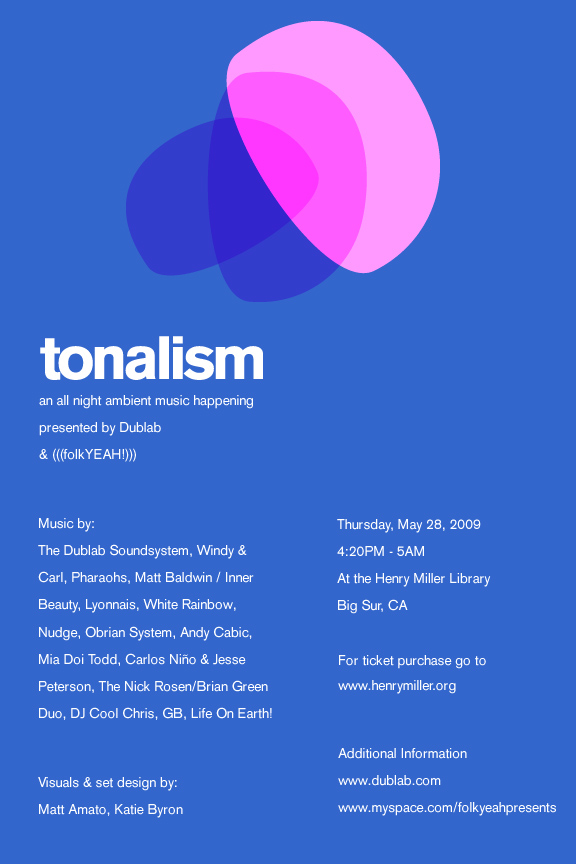
May 28: Dublab Presents All-Night Ambient Music Happening in Big Sur (CA)


Dublab has done it again! California’s favorite non-profit radio collective has been bringing choice, culturally responsible programming to the Los Angeleno airwaves for around ten years now, but its mission to foster “the growth of positive music, arts, and culture” takes place both on the air and off. Among the many live events on the Dublab calendar this Spring, the TONALISM mini-fest in Big Sur on May 28th is bound to knock your socks off– or at least lull you into a smiley, sound-drunk dream-state.

A description of TONALISM from the Dublab family:

Inspired by La Monte Young’s “Dream House” as well as the work of musicians and composers such as Terry Riley, Yoko Ono and John Cage, Tonalism combines harmonious textures with visual elements to create an atmosphere where the audience is encouraged to bring pillows, cushions and sleeping bags to lay down, listen and watch for an extended period of time. DJs, live musicians and VJs play and perform throughout the night; starting at sunset and ending at sunrise. Complimentary tea and water are provided to all who attend.

ON THE REDWOODS STAGE:

Live Performances by:
Windy and Carl (Kranky)
Pharaohs (members of Languis and Big Swell)
Matt Baldwin / Inner Beauty
Lyonnais
White Rainbow (Kranky)
Nudge (Kranky)

DJ Sets by:
Obrian System (very special guest)
frosty (dublab)
Jimmy Tamborello (Dntel, Postal Service, dublab)
Part TIme Punks DJ Michael Stock
Andy Cabic (Vetiver)
Katie Byron (dublab)
Nanny Cantaloupe (dublab)
Turquoise Wisdom (dublab, Small Town Talk)
matthewdavid (dublab, Leaving Tapes)

Visuals by:
Matt Amato (The Masses)

ON THE CANYON STAGE:

Performances Curated by Carlos Niño for dublab:
Mia Doi Todd
Carlos Niño & Jesse Peterson
The Nick Rosen/Brian Green Duo
The dublab Drone-Dreamers
DJ Cool Chris of Groove Merchant
GB
Life On Earth! (of Dungen)
and Special Guests

Set Design by:
Katie Byron

TONALISM
Thursday, May 28, 4:20 pm – 5:00 am
Henry Miller Library
Highway One, Big Sur, CA 93920
$20, all ages (does not including venue fees)
Complimentary tea will be served throughout the night.
Bring pillows, blankets, beanbags, sleeping bags, cushions, lay down and listen.
There will be a fire pit and heat lamps but make sure to bring warm clothes because it gets cold at night.

Buy tickets


La Monte Young and Marian Zazeela’s “Dream House”, Mela Foundation, Tribeca, NYC. Find out more about La Monte Young and the Mela Foundation here.

Blaster Al Ackerman & the Hellishness of High School and/or Throbbing Gristle

You are the entity.

This world is full of folks (like me) who are too scared to be dumb or gross or fun, no matter how smart they are. On the other hand, blessings on the head of Blaster Al Ackerman, a writer, painter and correspondence artist who has produced a massive body of work, much of it untrackable due to his pervasive use of pseudonyms (and, for that matter, anonyms) one of which you, Arthur reader, will find in your own home in the form of the song “Hamburger Lady,” the best song by the rock band Throbbing Gristle. I’ll save the long story of Mail Art that brought about this happenstance for another day, though.

What’s important to know for now is that Ackerman has been producing a lot of text and image huzz for the private consumption of a handful of huzz-hufferers, and its taken form of a handful of side-splitting books (The Blaster Omnibus, Let Me Eat Massive Pieces of Clay, I Taught my Dog to Shoot a Gun and, most recently, Corn and Smoke among them), earning him a place in some circles as the contemporary equivalent of Poe. If you have not previously encountered his writing or drawings, we highly recommend that in advance of the short interview that follows you familiarize yourself with his work, at the least, with his recent text at the Lamination Colony site, “Eel Leonard’s Class Prophecy” and/or the free downloads of his spoken-word LP masterpiece I Am Drunk.

Also, in advance of the exchange that follows, it is worth knowing that as a young person in Texas the 50s, Ackerman became absorbed by the world of pulp fiction and attempted to become a writer, although during the pulps’ waning years he only got published in romance magazines. He did, however, strike up a correspondence with science fiction writer Frederic Brown. In the 60s, he worked as a children’s TV show writer and in a carnival before going to Vietnam as a Medivac and then working in burn wards in U.S. hospitals. In the early 70s, he got heavily involved with Mail Art, ultimately centering around David Zack and Istvan Kantor with whom he co-generated the Neoist banner of 80s pranks, plagiarism, art and multiple identity. Through the 80s and 90s, he published frequently in magazines like The Lost and Found Times (edited by frequent collaborator John M. Bennett) and the Shattered Wig Review (edited by Rupert Wondolowski)

Q: I know you were a fan of the rhythm and blues singers of the 50s as a young person in Texas. Could you tell us a little about those concerts and how they might have shaped you?
Ackerman: The first R&B concert I ever attended was probably the greatest. It took place at the Municipal Auditorium in downtown San Antonio, Texas. This was in the very early 50s and admission was only $4 or $5! A true bargain, especially when you consider who all was on the bill. An unbelievable line-up consisting of Chuck Berry, Fats Domino, Frankie Lyman, Little Richard and “Mr. Please Please Please Himself” James Brown. Big Joe Turner (the Boss of the Blues) was the headliner, which seem strange today, especially considering the talent on hand but back in the early 50s Joe Turner was the most prominent name.
San Antonio was a heavy pachuco town so audience participation ran high with many seat cushions slashed; there was also wholesale bopping and vicious horseplay on the railing of the balcony upstairs and frequent injuries from falls.
Through it all, I might add, speculation ran rife over the burning question: “Is Frankie Lymon a hermaphrodite?!” (In rock circles in the early 50s this was one of two questions which engaged the brains of all true R&B fans; the other being “Is Brenda Lee a midget?”)
Anyway, I would have to say that in my experience the only other R&B shows that ever came close happened a few years later at the “Dars” Miller in Austin, Texas, when Bo Diddley and Bobby Blue Bland appeared, the crowd became so worked up that they locked the security guards in a closet, took their guns away and fired them off into the air while Bo stayed on stage and got down with “I’m a Man.” Too much.

Q: What’s the best job in the carnival, job-gratification-wise?
Ackerman: Running the Duck Pond Ride and sleeping down by the river in your duck mask, if you go in for that sort of thing.

Q: Once a person finds his way into an artform, he or she begins, over time, to recognize the mistakes or foolishness of those who preceeded him or her in that form. I wonder, once you’d gotten into mail art, in which ways did you think that Ray Johnson had slipped, a little or a lot?
Ackerman: This is a hard one, especially when you realize how I idolized Ray. And so while it’s true that Ray fell victim on occassion to a certain loquaciousness, especially in the later years, I prefer to remember when he was right on target such as the time when Art Forum was asking for an important statement and Ray came out with, “Every time I walk down the street, the little birdies go tweet-tweet-tweet.”
Really, though, in Mail Art, the real “slappage” comes when you’re on tour and you stop by somebody’s keen little house in Tulsa or Louisville and you’ve been slugging the vodka in the backseat for 3 or 400 miles so that you find upon getting into their guest room that you’re overflowing the bowl and ruining an expensive carpet and priceless antiques. What then?

Q: In Frederick Brown’s story “Come and Go Mad,” there’s long repetition of the colors, “the red and the black,” and it’s left open to interpretation, to say the least. Any thoughts on that passage?
Ackerman: I would guess that Fred was figuring that the name Stehndhal would pop into your mind, comme pour troutes les simmiennes?

Q: What’s your favorite L. Ron Hubbard story about?
Ackerman: Just about anything–uh, just about anything L. Ron wrote before WWII is worth your attention. My own big favorite is “Fear,” a classic from a classic 1940 issue of Street & Smith’s Unknown magazine. “Fear” is available in paperback today so I would greatly urge every literate person to check it out and if you happen to be illiterate, why get a friend to read it to you. You’ll be glad you did.

Q: (Bonus Question) Fill in the blanks: Answering these questions gives me a feeling of both ____ and _____.
Ackerman: To paraphrase John Berndt when he was shimmying across the plains of India, “Answering these questions gives me a feeling of both Spanish Fly and Salt Peter.”

Roadburn: "A time and place to get high en mass [sic] and bask in the heaviness"

Whether you’re looking for leaks and bootlegs from across the spectrum of doom and stoner rock, or you simply want to peruse Photoshopped images of topless, winged women wielding a variety of Renaissance Faire weapons, Doomed To Be Stoned In A Sludge Swamp is the audioblog for you.

Sludge Swamp is a collaborative affair, and right now their contributors are commemorating last weekend’s Roadburn Festival — an annual Dutch gathering focused on the hard rock underground, well known among European burners as a “time and place to get high en mass [sic] and bask in the heaviness,” to quote from its MySpace profile — by uploading live sets from Roadburns past.

Right now the archive includes recordings from Witch, Sunn O))), The Melvins, Om, Wolves in the Throne Room, Brant Bjork & The Bros, Masters of Reality, Hawkwind and Earthless (along with loads of lesser knowns) for your downloading pleasure.

Check out the full list of sets available by clicking here.

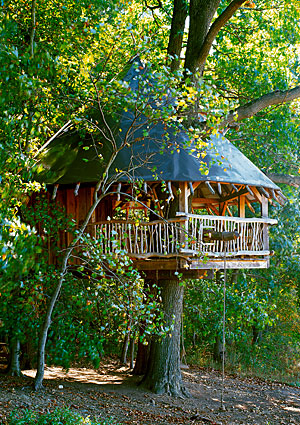
"New Treehouses of the World" by Pete Nolan (2009)

Anonymous, Tee Pee Treehouse, Eastern Pennsylvania. Made almost entirely of recycled materials.

Tee Pee Treehouse, interior. Rafters recycled from a nearby 100-year-old barn.

“New Treehouses of the World”, TreeHouse Workshop founder Pete Nelson’s fifth book, shows us how he constructs some of his own architectural creations, then brings us on a tour of some of the most breathtaking woodland habitations around the world. On shelves in May. Full sneak-preview on the LA Times website.

Visit Pete Nelson’s blog for information on house-building workshops and other upcoming TreeHouse Workshop projects.

Iraqi Maqam

Iraqi Jawza player Salih Shemayyil at the First Cairo Congress of Arab Music (1932)

When London-based Honest Jon’s Records compilation Give Me Love: Songs of the Brokenhearted – Baghdad, 1925-29 appeared last year, it was a ear-opening and mind-expanding glimpse into a world few of us in the U.S. had even imagined – the glorious music of Iraq as it was recorded generations ago by musicians long since gone. For many, it and the Choubi Choubi comp on Sublime Frequencies may have provided a first look at Iraqi musical culture, since so little else (Munir Bashir and Rahim AlHaj excluded) has ever been available in the West.

But just in the past few week and seemingly out of the clear, blue sky comes the staggering Iraqi Maqam blog and its accompanying YouTube channel which focus exclusively on the uniquely Iraqi take on maqam, the umbrella of elevated Arab classical musics. Drawing mainly from exceedingly scarce recordings of the 1920s-30s, already Iraqi Maqam has provided a dizzying wealth of musicological, biographical and anecdotal information in both Arabic and English to hours and hours worth of virtuosic and deeply moving recordings (including truly precious translations of the poems sung), profusely illustrated with period photographs. That such a monumental, thoroughly-researched and thoughtfully-presented body of work even exists, not to mention that it is appearantly a free gift to mankind, is fortifying and exciting stuff in a hard, old world.

Ron Regé, Jr.'s "The Cartoon Utopia" at Thanky Arts Space in Richmond, VA


A message from the good people of Thanky, a temporary arts space in Richmond, Virginia devoted to bringing positive vibes and quality visuals to the community over the space of one year (September 2008 – August 2009):

“Thanky is proud to present “The Cartoon Utopia”, a show of new work by Ron Regé, Jr., a cartoonist and musician from Plymouth, Massachusetts. Ron Regé, Jr. began publishing his own minicomics while attending Massachusetts College of Art in 1988 and has since been published by Kramer’s Ergot, Buenaventura Press, Drawn & Quarterly, Highwater Books, Fantagraphics, and McSweeney’s. His illustrations have appeared regularly in The New York Times and Canada’s National Post. Ron Regé, Jr. currently lives in Los Angeles where he plays drums in the band Lavender Diamond. Regé possesses a big heart and a steady hand, creating intricate lines and patterns, cute cartoon people and creatures that inhabit a fantastic universe with stories that dive into the deepest or darkest notions of our experience. His perception of human nature is always keen and precise and his work vibrates with a joyful energy. He has exhibited at The Hope Gallery in LA and at the Librarie Drawn & Quarterly in Montreal. As a performance art act, Regé performs solo as the Discombobulated Ventriloquist.”

A description of “The Cartoon Utopia” in the artist’s own words:

“At the beginning of 2008 – I started to create a series of numbered 4×6” drawings as an exercise – to start to flesh out ideas for a kind of “science fiction universe” that I’ve been slowly imagining over the last few years – the idea of a “Cartoon Utopia.” So many imagined futuristic “fantasy worlds” seem to be “dystopian” in nature –dark and pessimistic. I thought it would be nice to imagine a “futuristic” fantasy where humanity had progressed in a more positive way.”

Ron Regé, Jr, “The Cartoon Utopia”, Opening Reception
Friday, May 1, 6pm-9pm
Featuring performances by Discombobulated Ventriloquist and Dearraindrop
407 Brook Road, Richmond, Virginia 23220 (off W. Broad Street)
Complimentary cupcakes will be on hand

White Rainbow checks in

Video of White Rainbow, ARP and Lichens’ improvisational accompaniment to Doug Aitken’s “Migration” Installation.


Adam Forkner, the guy behind maximum bliss-out drone project White Rainbow, has six different outlets by which enthusiasts of his inner space sounds can follow his activities. For those fans — such as your contributing editor — who were mostly oblivious to this WR media empire, Forkner has provided a digest update of his most recent activities on his old fashioned blog, or “Life Log.” Of particular interest:

• Upcoming shows with drone-happy lovebirds Windy & Carl take White Rainbow up and down the West Coast in late May 2009, with stops in Seattle, his home base of Portland, Big Sur and two shows here in Los Angeles. The Arthur Atwater office is raising its STOKED level to Red.

• Tracks for the next White Rainbow full length, New Clouds, have been delivered to the mastering dude, with a tentative September 2009 release date on Kranky.

• A WR collaborative EP with Stag Hare is due out “as soon as humanly possible” on Marriage Records.

Stag Hare you ask? Stag Hare is a crunchy fellow from Utah, and his self-released album Black Medicine Music was the best ambient trail mix of 2008. Thanks to Forest Gospel for being the first to hip us to these nuts and berries desert ragas. Don’t sleep. Though its rustling drum pattering and Juniper-scented driftscapes may have pleasantly soporific effects.

• And new White Rainbow music is available RIGHT NOW and FOR FREE by way of audioblog Raven Sings The Blues, which posted its first compilation, RSTB Presents Vol. 1, back in mid-March. The comp also has top ranking earth psych and noisenik sounds from Wet Hair, Plastic Crimewave Sound, Sic Alps and more. Go get it here.

• Forkner is considering “qutting pizza” for his health. We feel you bro.

And that’s just the White Rainbow stuff. Click here to check out the full post with info on all of his doings.

We’ve been hungry for new White Rainbow jams for awhile now, so here’s a few other Forkner curated emanations that we discovered deep in the Gooogles …

Continue reading

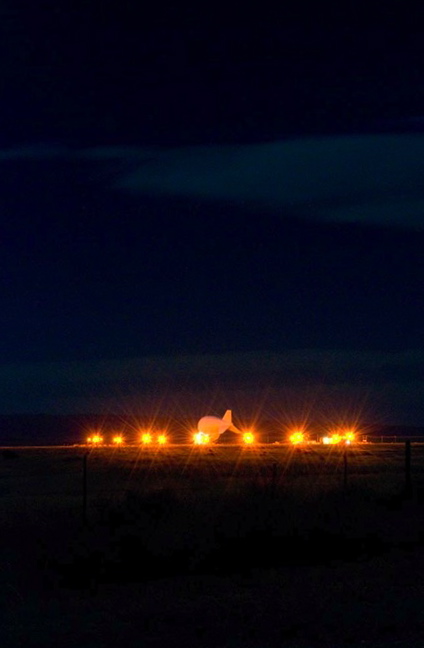
Dread Zeppelins: Letter from West Texas

Q: Where does the Border Patrol’s “drug blimp” go at night?
A: It sleeps in a field outside of Marfa, Texas.


The Marfa aerostat, aloft in daylight


The so-called “drug blimp” is actually a tethered aerostat — a white helium balloon as big or larger than the portly tire-company-maintained dirigibles that flock to parades and sporting events — operated by the U.S. Air Force, which makes the data it collects available to NORAD and the U.S. Border Patrol. It is by far the most tangible of the lazy clouds floating through the skies of the southern region of Far West Texas, its onboard radar system keeping an eye out for drug smugglers flying or driving loads of cocaine and or marijuana over from the deserts of Northern Mexico. It’s unmanned and controlled from the ground, attached via a tether cable to some kind of rail system. Similar aerostat sites can be found in the Bahamas, Arizona, and broadcasting decadent episodes of “Nanny 911” or whatever via TV Marti into Communist Cuba from Cudjoe Key, Florida. Or at least that’s what the Air Force has to say about it.

The Marfa aerostat, grounded at 2:45am


I came across it moored, at about 3am, in a blazing circle of orange halide security lamps on my way from Los Angeles to visit friends in Marfa and Terlingua. I stopped and started snapping away with my camera, but kept getting that “willies” feeling that goes along with standing on a windy, deserted Texas road in the middle of the night, taking pictures of a government surveillance aircraft that chases narcotraficantes around.

Pinto Canyon Road, West Texas, by moonlight


The Marfa aerostat is part of Far West Texas’ complex system of border monitoring technology that includes triggers on rural routes that insure government agents will be checking up on late night back road cruisers. Or so I was warned by two local joint-passing bros when I inquired as to where my friend Sasha and I might catch a glimpse of the Marfa Lights, or at least document the West Texas hills in the light of the full moon. They pointed us down Pinto Canyon Road, but told us to expect company. No Border Patrol 4x4s were waiting for us though (nor were the mysterious Marfa Lights); there were only a few wary horses on hand to monitor our activity.

Continue reading

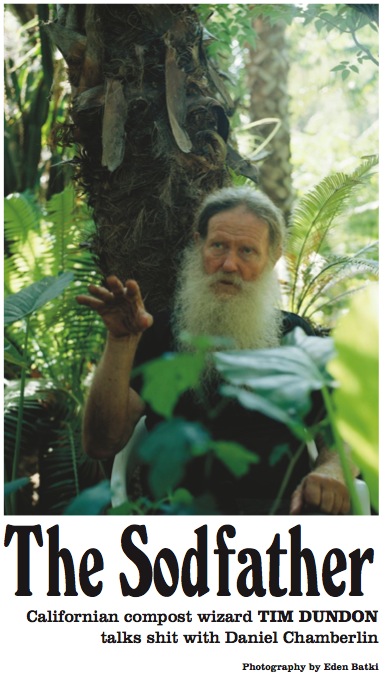
THE SODFATHER: Californian compost wizard TIM DUNDON — text by Daniel Chamberlin, photos by Eden Batki (Arthur, 2007)

The Sodfather
Californian compost wizard TIM DUNDON talks shit with Daniel Chamberlin.

Photography by Eden Batki

Originally published in Arthur No. 27 (Dec 2007)

Original design by Molly Frances and Mark Frohman.

Find bonus Sodfather photos by Chamberlin at Into The Green.

Alchemists are often characterized in modern times as bumbling would-be wizards at best, greedy charlatans at worst. They’re portrayed as fumbling hopelessly in cluttered laboratories, unenlightened madmen trying to turn lead into gold. The reality is more complex, of course.

Alchemists were up to plenty of things, many of them having to do with relating to the natural world—and understanding its processes of transformation and transmutation—in philosophical and spiritual dimensions that transcended traditional religious thinking, both Christian and pagan, and preceded modern scientific thought. The whole “lead into gold” thing was but the most lucrative of the alchemical —or hermetic—practices in the eyes of the monarchs and rulers. Alchemy’s material prima as Peter Lamborn Wilson writes in the recent collection Green Hermeticism: Alchemy and Ecology, “can be found ‘on any dung hill.’ Hermeticism changes shit into gold.” It’s an image memorably realized in Alejandro Jodorowsky’s 1973 film The Holy Mountain wherein the thief character takes a dump in a fancy bucket, and Jodorowsky, playing an alchemist, distills those fresh turds into a hefty chunk of golden bling.

Such fantastical processes are well known to dirt-worshipping gardening sage Tim Dundon, the beneficent caretaker of California’s most famous compost pile and the kindly warden of the tropical forest that has fruited from its rich humus. It’s here that Dundon, a scientist-poet in the truest hermetic sense, finds hope and salvation in the transformation of death into life—of rotting organic matter into nutrient-rich soil—that takes place daily in the fecund jungle he maintains on his one-acre yard.

The botanical odyssey of Dundon, the self-proclaimed “guru of doo-doo” and the man whose mammoth compost pile once covered a football-field-sized lot, begins in 1967 with a marijuana shortage. Like any good gardening story, it encompasses Hollywood producers, fires, suicide, PCP injection, a nude Quaker iconoclast, standoffs with city officials and a violent pet coyote.

Continue reading