Celebration Doesn't Care About The Vampires Anymore

Baltimore’s psychedelic rock & soul saviors Celebration have two brand new songs up for free download on their website, Celebration Electric Tarot. What’s more, they’re gonna be releasing all their new music in this manner. Once they’ve got enough new songs for an album, they’ll do a proper vinyl release, but if you’re happy with 192kbps MP3s, it’s all gratis when it comes to their shimmering guitar trance workouts. From their manifesto:

We, as Celebration, have felt the continual growth of web culture’s need for barrier-free exchange. We also feel that the traditional methods of releasing music have put too much distance between us. As we see it, the current music business model is crumbling. We believe their methods waste resources and time in a “print for market world” that no longer makes sense. The birth of the MP3 has dreamt the death of the CD format, and so all across the board, CD sales have dropped. What has given way is something so magical and evolutionary, music has grown, that we have only begun to understand the cultural impact of this sharing. So, past the piles of broken CD cases and badly scratched polycarbonate rainbow discs, there lies a fantastic world of freedom –freedom to share instantly with little or no impact on the environment, in a seemingly infinite, eternal and virtually cost free universe of the world wide web. This is our emancipation. Without the need for manufacturing CDs and the danse macabre of the promotional corporate machine, we can be free to release our music when and how we want –no waiting. We know nothing of the marketing world and don’t care about the vampires any more.

For more on Celebration, we would like to direct your attention to Ian Svenonius’s Q&A with the band from Arthur 27 (December 2007). You can download the PDF or purchase a hard copy by clicking here. Visit Celebration’s website to download “I Will Not Fall” and “What’s This Magical”. Read their full manifesto after the jump. (once again via Gorilla Vs. Bear).

Continue reading

Monday Evening Awesome African Tape

Another awesome tape from Africa, courtesy of the blog of the same name. Karamoko Keita does mellow guitar jamming with male-female call and response vocals. “This tape is legendary in my world,” writes ATFA proprietor Brian Shimkovitz. He continues:

I bought this tape in a neighborhood in Accra, Ghana. Known for its high concentration of people from other West African countries, Nima is one of the busiest, and toughest, places in town. Several tape shops lie along the main road that bisects this enormous slum. The shop where I found this Karamoko Keita recording has tapes you can’t find anywhere else in the city, tapes from Nigeria, Mali, Ivory Coast…that shop is chill.

Head over to Awesome Tapes From Africa to access the full 41 minutes of African guitar bliss.

Follow Vulcan on Twitter

As you probably know, Alaska’s Mount Redoubt has been blowing up for most of today, as reported by Louisiana governor Bobby Jindal‘s arch-enemies at the Alaska Volcano Observatory. But did you know that you can read about this historic eruption in oddly truncated sentence fragments on the Twitter? Click here to do that. Or head over to the AVO website for actual pitchers of the asplosions.

THE VOICE OF COSMIC INDIA

We ran a feature (actually, a book excerpt) on Pandit Pran Nath in Arthur a while back. Now one of the records that started Pran Nath’s legend in the West is available again on vinyl through a subsidiary of the dependably wonderful Mississippi Records (see J. Spaceman interview in Arthur 30, as well as Ian Nagoski’s text in the unprinted Arthur 32) of Portland, Oregon. The Big States blog has posted a digital verz of the record; click on the album cover to go there…

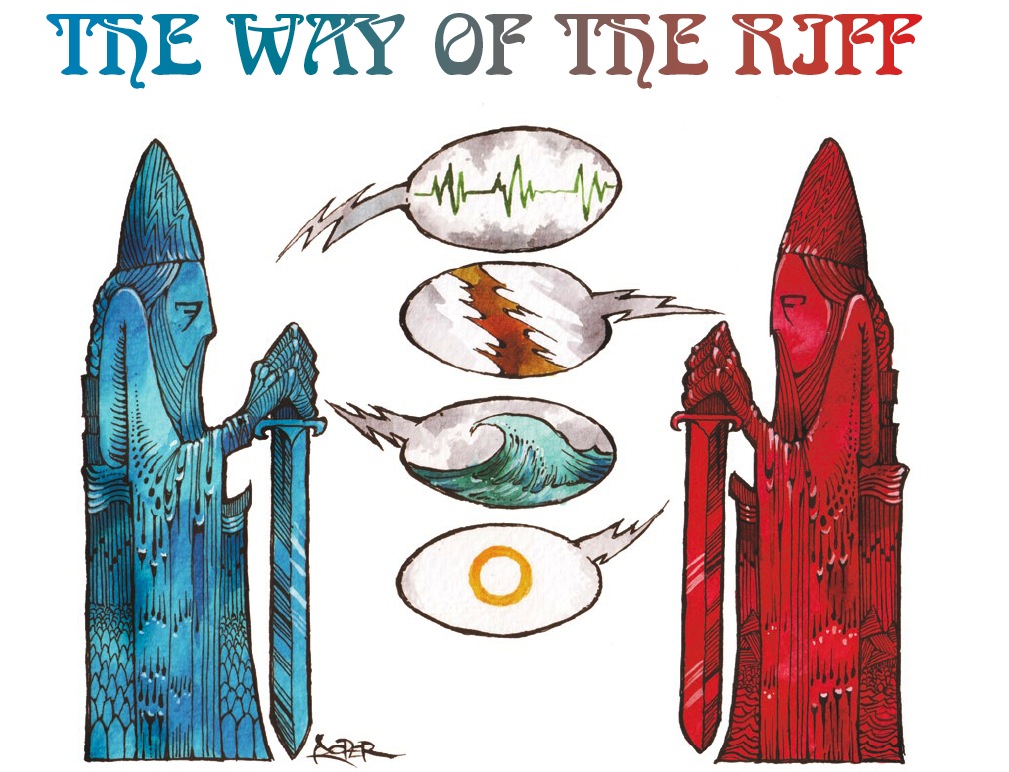
The Way of The Riff: Contemplators Ben Chasny (Six Organs of Admittance) and Al Cisneros (Om) discuss roots, rock, rhythm and chess (Arthur, 2007)

Originally published in Arthur No. 27 (Dec 2007)

Artwork by Arik Roper
Introduction by Daniel Chamberlin

My favorite story about Om, the bass and drum duo of Al Cisneros and Chris Hakius—the rhythm section of now defunct drone metal icons Sleep—takes place on the back patio of Los Angeles club The Echo. It’s a cool winter night in 2007 and we’re all gathered here—hippie goners, young punks, indie rock squares—to take in a few breaths of fresh air before the band takes to the stage inside. One group stands out from the crowd: two women and a guy who are having a whale of a time, gesticulating wildly and laughing like crazy. At one point the dude approaches a hipster who’s nervously dragging on a toothpick joint. Our man offers his flask to the young fellow and a confusing exchange takes place: I can tell that he’s looking to swap quaff for toke, but for some reason he’s having trouble communicating this. I catch on about the same time the stoner does, giving up the doobie to the guy and his gal pals: They’re deaf, this happy trio of Om heads. That’s how deep the band’s sensual, mantra-like music goes.

Continue reading

Buy American?

Not to get all protectionist-ically jingoistic, but wouldn’t it be great if there were a way that we could produce marijuana without having to deal with directly fund Mexican drug cartels?

Imagine, a pot-farming Shangri-La where most of the gunfire is some penny-ante bullshit between paranoid trigger hippies and trigger-happy meth heads popping off into the open sky, trying to figure out who has the bigger box of bullets. Or hey, maybe forget the guns altogether (except for target practice and varmint deterrence, of course) and see if some New Age-type hippies can find a way to cultivate cannabis for medical use, etc. without torturing and killing thousands of their neighbors?

Perhaps someday we’ll find a way to grow our own. Until then, we’ll have to rely on the dirt weed that psychopathic gangsters and their terrified migrant-labor minions are smuggling in through sewer pipes, raising in environmentally-devastating wilderness grows and ramping over the border in pickup trucks. Wait, what?

From the February 1, 2009 New York Times:

Tougher Border Can’t Stop Mexican Marijuana Cartels
By SOLOMON MOORE

TUCSON — Drug smugglers parked a car transport trailer against the Mexican side of the border one day in December, dropped a ramp over the security fence, and drove two pickup trucks filled with marijuana onto Arizona soil.

As Border Patrol agents gave chase, a third truck appeared on the Mexican side and gunmen sprayed machine-gun fire over the fence at the agents. Smugglers in the first vehicles torched one truck and abandoned the other, with $1 million worth of marijuana still in the truck bed. Then they vaulted back over the barrier into Mexico’s Sonora state.

Despite huge enforcement actions on both sides of the Southwest border, the Mexican marijuana trade is more robust — and brazen — than ever, law enforcement officials say. Mexican drug cartels routinely transported industrial-size loads of marijuana in 2008, excavating new tunnels and adopting tactics like ramp-assisted smuggling to get their cargoes across undetected.

But these are not the only new tactics: the cartels are also increasingly planting marijuana crops inside the United States in a major strategy shift to avoid the border altogether, officials said. Last year, drug enforcement authorities confiscated record amounts of high potency plants from Miami to San Diego, and even from vineyards leased by cartels in Washington State. Mexican drug traffickers have also moved into hydroponic marijuana production — cannabis grown indoors without soil and nourished with sunlamps — challenging Asian networks and smaller, individual growers here.

Keep reading after the jump.

A Justice Department report issued last year concluded that Mexican drug trafficking organizations now operated in 195 cities, up from about 50 cities in 2006.

The four largest cartels with affiliates in United States cities were the Federation, the Tijuana Cartel, the Juarez Cartel and the Gulf Cartel.

“There is evidence that Mexican cartels are also increasing their relationships with prison and street gangs in the United States in order to facilitate drug trafficking,” a Congressional report from February 2008 stated. Intelligence analysts were detecting increased Mexican drug cartel-related activity in Chicago, Detroit, Minneapolis, Seattle and Yakima, Wash. — areas that used to be controlled by other ethnic networks.

Smuggling is still most conspicuous in the Southwest, which has been home to Mexican traffickers for more than two decades. From Nogales, Ariz., recently, a reporter watched as smugglers across the border, in hilltop stations, peered through binoculars at the movements of American Border Patrol agents. The agents gunned their trucks along the barrier looking for illegal crossings.

About noon, border agents saw a 60-pound bale of marijuana drop over the fence.

“That kind of thing happens every day here,” said Agent Michael A. Scioli, a spokesman for Customs and Border Protection.

For the cartels, “marijuana is the king crop,” said Special Agent Rafael Reyes, the chief of the Mexico and Central America Section of the Drug Enforcement Administration. “It consistently sustains its marketability and profitability.”

Marijuana trafficking continues virtually unabated in the United States, even as intelligence reports suggest the declining availability of heroin, cocaine and other hard drugs that require extensive smuggling operations.

By combining smuggling with domestic production, the cartels have sustained the marijuana trade despite the onslaught of enforcement actions on both sides of the border. From 2000 through 2007, Mexican authorities arrested about 90,000 drug traffickers, more than 400 hit men and a dozen cartel leaders, according to a 2008 Congressional report. The United States extradited 95 Mexican nationals last year. Seizures in the first half of 2008 outpaced the average seizure rate from 2002 to 2006.

But the price has been high. Tensions have increased among the cartels, which are warring over lucrative drug routes through Mexican border towns like Juarez, Tijuana and Nogales, Sonora. More than 6,000 people, including hundreds of police officers, were killed by drug-related violence in Mexico in 2008. United States Border Patrol agents are also reporting more violent confrontations with traffickers.

As the Mexican government and American authorities have hardened the border, drug cartels are increasing production just north of it to avoid resorting to smuggling.

Many of the largest marijuana plantations are hidden on federal and state parklands, federal authorities say. Bill Sherman, a Drug Enforcement Administration agent based in San Diego, said the authorities were also finding an increasing number of farms in Imperial and San Diego Counties, an area traffickers traditionally avoided because of the presence of border guards, various police agencies and Camp Pendleton, a Marine base.

“We’re seeing a lot more grows down here now,” Mr. Sherman said. “That is a shift.”

Drug enforcement agents uprooted about 6.6 million cannabis plants grown mostly by cartels in 2007, one-third more than the plants destroyed in 2006. In California, the nation’s largest domestic marijuana producer, the authorities eradicated a record 2.9 million plants by the end of the marijuana harvest in December.

Yet enforcement officials say they see no discernible reduction in the domestic supply. Prices have remained relatively steady even as the potency of marijuana increased to record levels in 2007, according to the National Drug Intelligence Center, a Justice Department analysis agency.

Mr. Reyes also noted that Mexican traffickers in the United States were choosing hydroponic marijuana, which is more potent, profitable and easier to hide because it can be grown year round with sunlamps. (A pound of midgrade marijuana sells for about $750 in Los Angeles, compared with $2,500 to $6,000 for a pound of hydroponic marijuana.) He noted a case last year in Florida in which Cuban growers used several houses in a single Miami tract development to supply hydroponic marijuana to Mexican traffickers.

Kathyrn McCarthy, an assistant United States attorney in Detroit, said Mexican traffickers in Michigan were trading Colombian cocaine for hydroponic marijuana from British Columbia to sell in the United States. In Washington State, now the second biggest domestic producer of marijuana, Mexican cartels are growing improved varieties of outdoor marijuana to compete with BC Bud and other potent indoor plants.

Last year, narcotics officers discovered 200,000 high-quality marijuana plants growing amid leased vineyards in the Yakima Valley. The Northwest has traditionally been the province of Asian hydroponic networks.

Despite increased planting, the cartels still rely on smuggling. Near Nogales, Ariz., Mr. Scioli pointed out several cross-border tunnels, one of which extended from the backyard of a house, under the fence and into Mexico 40 yards away. Another series of cross-border tunnels made use of existing sewer lines or drainage pipes. They were among the nine smuggling tunnels drug enforcement agents have discovered there since 2003.

Despite the fact that the authorities are discovering more marijuana production inside the United States, most of the cartels’ leadership remains in Mexico and, for now, so does most of the violence. Still, recent photographs from Mexico of the decapitated heads of Mexican policemen play in the minds of law enforcement officials on this side of the border, who are vigilant for signs of spillover.

The Mexican police in Sonora “are stuck between two warring cartels,” said Anthony J. Coulson, a federal drug enforcement agent. “The cops are being killed as pawns. They’re being used to show how much power and control the cartels have.”

Mr. Reyes, the special agent, said, “The violence is happening because of the pressure we’ve exacted, but it does not fuel any increase or decrease in marijuana.”

No one sees a quick end of the violence in Nogales, Sonora.

Sheriff Tony Estrada of Santa Cruz County said there was so much violence on the other side of the border that many Mexican police officers and politicians had become virtual refugees in Nogales, Ariz.

“The violence has left a large contingent of police on this side of the border,” Sheriff Estrada said. “The killing will stop when somebody dominates. When somebody takes control.”

Dolphins into the Sushi: Chamberlin on the downside of having thumbs

Your contributing editor was in the Trader Joe’s one day, grinding his coffee at one of their machines next to some other dude. The spoon that’s usually chained to the coffee grinder — it’s there so you can flip the last of the beans down to be crushed — was gone, so we were both using the plastic lids from our coffee cannisters to this end. Guy says to me something about how isn’t it great we have thumbs, can learn to use simple tools and ha ha ha.

My response: “Fuck thumbs man. Thumbs mean that we developed agriculture, built cities and spread civilization to the point where we gotta have jobs in order to buy food and stay alive.” The dude sorta laughs as I go on. It’s a Silver Lake Trader Joe’s in the middle of the afternoon — i.e. full of self-employed freelancers and other such bohemians and assorted leisure-seekers — so it’s not surprising that he’s somewhat sympathetic to my random, half-serious anticivilization spiel.

“Take dolphins, for example. They didn’t evolve thumbs, which means they get all the benefits of intelligence minus the drags of civilization. So they swim around all day having sex and eating sushi,” and dodging tuna nets and plastic bags etc etc, “while you and me have to scrimp and save only to settle for some lame pre-packaged California rolls. Never mind my prospects as a hetero male trying to find a date in a city where the single guys outnumber the single ladies two to one.” He laughs again and we’re both on our way home to enjoy the fruits of civilization such as the aforementioned coffee and deli-fresh sushi.

I was kidding about the sushi line, but as it turns out dolphins use — or at least are starting to use — a sushi-chef like approach to preparing cuttlefish for dining. From Discover:

Australian researchers have observed a female bottlenose dolphin using her snout to prepare a meal of cuttlefish. But instead of just gobbling up the fish, the dolphin carefully extracted its bones before dining—a display of chef-like skills that is extraordinary among marine mammals.

The feast took place in South Australia’s Upper Spencer Gulf, where cuttlefish breed. The researchers had first filmed this amazing culinary-enabled dolphin off the coast of South Australia in 2003, where they saw her preparing four different cuttlefish. They were able to identify her in 2007 by her scars (apparently the circular scars on her head were unique enough to identify her four years later). They recorded her meals with a Sony HD Cam video camera, and later used the footage to analyze her foraging behavior.

Read the original study, “Preparing the Perfect Cuttlefish Meal: Complex Prey Handling by Dolphins” at PLoS ONE.

More dolphins after the jump.

Continue reading

New Wolves in the Throne Room EP

Malevolent Grain

We’re going to go out on a limb here: Olympia, WA’s Wolves in the Throne Room are easily the pre-eminent American eco-black metal band.

For those not already in the know, there’s been a emergence in the black metal world of a sort of “shoegaze” sound — much celebrated by indie rock nerds around the globe — found on albums from old hands like Enslaved as well as relative newbies of the nascent American black metal scene (see famous Alhambra, CA shut-in Xasthur). WITTR make such dark, My Bloody Valentine-style raging guitar buzz sounds from time to time, as well as switching between cookie-monster style grunt-growling and near-operatic arias of sometimes-singer Jamie Meyers. Plus they apparently live on an off-the-grid farm in the countryside. Arthur columnist Erik Davis talked to them about this for Slate back in 2007. Check out his interview here.

Where most Scandinavian black metallers are obsessed with, say, the outcome of 10th Century battles between Vikings and German Christian colonizers, WITTR are more concerned with pagan/environmental themes, adding a decidely fresh take on subjects usually dealt with in far more pastoral sonic palette. Epic jams like “I Will Lay Down My Bones Among the Rocks and Roots” and “Hate Crystal” are rife with brutal imagery — just imagine the soundtrack to an especially grim Derrick Jensen lecture, perhaps?

Add all these things up and you’ve got a black metal band that you can actually talk to non-black metal people about, without having them suggest you take your conversation over to their younger World of Warcraft obsessed sibling.

Wolves in the Throne Room’s excellent new EP Malevolent Grain was released this weekend on vinyl, with a CD version soon to come. Check it out at the WITTR online store. New album Black Cascade due out later this spring.

More WITTR after the jump …

Continue reading

Reggae for the weekend: Coxsone Dodd

When they were at the top of their game, the tuneful curators at the Magic of Juju were running one of the best audioblogs on the web. They’ve been quiet of late, but most of their collection of Indian ragas, Malian guitar jams and Indonesian field recordings is still available for your perusal.

They’ve also got a friend named “Jah(n)” who drops in every once in awhile to offer us these wonderful collections of classic reggae and dub, often previously unreleased and almost always ripped from the original vinyl singles. The last post from Jah(n) and the Juju crew came at the end of November, and it’s a doozy: Seven hours, give or take, of sides from seminal Jamaican producer C.S. “Coxsone” Dodd. Go check it out here.

Dodd–the founder of Kingston’s Studio One label–was born this week back in 1932, so we figured now is as good a time as any to overload our hard drives with his sweet irie jams. That, and, of course here in the Atwater office we’re looking at 80-degree temperatures this weekend and want to be ready should barbecues begin to spontaneously alight.