ALL-AGES DIALOGUES, PART VI: JIM WARD of At the Drive-In, Sparta (Arthur, 2006)

The ALL-AGES Dialogues: A conversation with Jim Ward
by Jay Babcock

This interview was conducted by phone in late summer 2006, as part of a series of conversations I was doing with various folks regarding the history of all-ages, philosophy/ethic of all-ages, the state of play of all-ages, yadda yadda.

When we did this interview, Jim was 30 years old and operating his band Sparta full-time, continuing on from his work as a member of the legendary At the Drive-In, which he co-founded as a teenager in 1994 in El Paso, Texas.

This conversation shoulda been published long ago but stuff kept going awry and we didn’t get it in the mag. My apologies to Jim, and to the readers. Hopefully this piece will be of use to present-day readers. — Jay

Previously in this series:
Interview with John Sinclair (MC5 manager, activist, poet-historian)
Interview with Chuck Dukowski (Black Flag, Chuck Dukowski Sextet)
Interview with Calvin Johnson (K Records, Beat Happening, Dub Narcotic Sound System)
Interview with Greg Saunier (Deerhoof)

Interview with Will Oldham

Arthur: When you first started venturing outside of El Paso to play music, how did you do it?

Jim Ward: Well, I got a copy of Book Your Own Fucking Life, and I just started calling. My grandparents has set aside some money for college for me, like a hundred dollars a year or something like that, it wasn’t very much. But when I graduated [from high school], it was a couple grand, and so I bought a van, a $1,300 1981 Ford Econoline, with some help from my parents who were really supportive of what I did. And, yeah, just started calling people.

Were you still going with the all-ages ethic?

Yeah, basically there were no bars and booking agents in there. You were just calling somebody who was doing shows at their parents’ restaurant after it closed, or at a community center or a house. Then you just went out and played those, and from those you would meet people who were somewhat like-minded. I was 18 when I started touring, so I couldn’t even be in the bars. In L.A. in 1996, it was pretty hard to be all-ages, so you would end up playing a bar and just sitting in the parking lot all night. You were allowed to go in and play and leave.

Like a servant.

[Laughs] Yeah, sort of. I mean, I understood the rules and it wasn’t really … we weren’t really there to party or anything, we were just there to play.

It must have been strange to play places where a bunch of people were excluded.

Yeah, whenever we would end up in bars or places like that, when you had to get that show, it was rare that anyone was there, or that it was very exciting… Which I understand now at my age: to go to a bar and have some loud, crazy band playing? It’s not always what you want to do on a Friday night. But when you’re 18, 16, 15 … that’s everything in the world to you. The louder and crazier and more abstract the better.

That’s the thing: The under-21s are open to stuff.

Yeah, you’re looking for something that’s yours. You don’t necessarily want something that’s established. You want to discover, that age is all about discovery. Which is why bands come out of that culture, because it’s this intense batch of people trying to find themselves and find each other, and I love it.

Continue reading

ALCHEMY AND BANKROBBING: Applied Magic(k) column by the Center for Tactical Magic (Arthur, 2013)

Alchemy and Bankrobbing

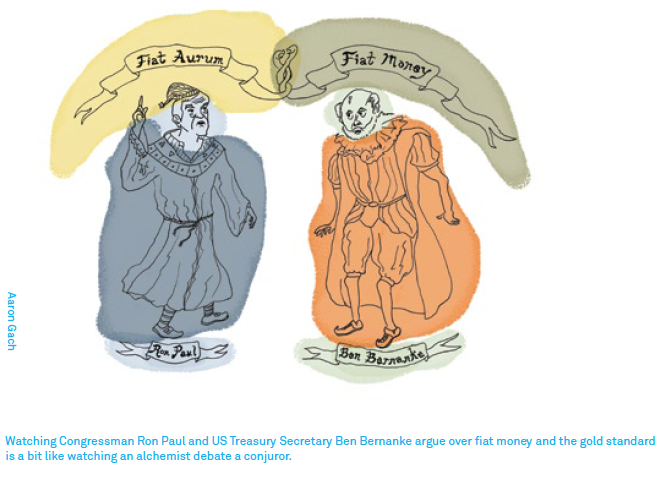
Applied Magic(k) column by the Center for Tactical Magic, illustration by Aaron Gach

Originally published in Arthur No. 33 (January, 2013)

“Money always fascinates people, and magic with money is doubly fascinating.”

—J.B. Bobo, Master Magician and author of Modern Coin Magic

You don’t have to be psychic to know that many people who want their fortunes told have concerns about money matters. Indeed, even the name ‘fortuneteller’ implies a talent for making economic predictions. However, the fortunetellers most in demand these days are a different sort of financial forecaster. Bankers, financiers, and investment brokers gaze not into crystal balls but into multiple LCD screens showing real-time and projected financial data used for profitable prophesy. To the unanointed, the machinations of Wall Street mages are masked in a mysterious lexicon; indeed, it takes a bit of translation to understand the esoteric formulas behind high-frequency trading, an investment strategy based on proprietary computer algorithms devised to exploit minute fluctuations in the markets to make numerous trades at lightning speed throughout the day.  

High-frequency trading is a bit like a magician’s performance of “The Miser’s Dream” in which the performer makes coins appear out of thin air and drops them into a bucket—except there’s no show; only money and a bucket. Oh, and also market instability that directly impacts the livelihoods of those of us who don’t even want a seat at the show in the first place. One doesn’t need an economics degree to see the Faustian bind produced through the financial industry’s flash crashes, credit default swaps, commodities speculations, scandals, fraudulent practices and whatever other demons are yet to be unleashed by undisciplined and unscrupulous dabblers.

But, dealing with devils isn’t unique to Wall Street, and ultimately, there’s nothing new about the any-means-necessary path to wealth. Through the ages, numerous grimoires have detailed spells and rituals for gaining riches.

Continue reading

ON PRACTICE: Note from the Editor (Arthur, 2013)

Originally published in Arthur No. 34 (April, 2013)


Note from the Editor

ON PRACTICE

Let’s have a happy hurrah for Byron Coley, this publication’s longest-term continuous contributor, and as of right now its first and only Senior Writer. Coley earned this title the hard way, not just knocking out hundreds of column inches’ worth of learned music-art-poetry-film-comics-whatsit reviewage over the last ten years with Bull Tongue partner Thurston Moore on deadline for no pay, but also pinch-hitting on other stuff when ye young editor had yet again foolishly over-extended himself. (Plus there was that Yoko Ono feature that shoulda been a cover, back in 2007…) No one has flown the freak flag higher or for longer at Arthur than Byron…or done a better job of explaining why exactly that old flag was still worth checking out.

From what I can tell, Byron has always been like this. I first knew him by his editor/writer byline first, as co-prime mover with Jimmy Johnson of Forced Exposure, an irregularly published magazine that somehow covered almost all that was great and interesting in the ‘80s/’90s in a style/format that didn’t exist before and hasn’t existed since: a sweet combo of smart riffs, ribald japery, ecstatic poetics, subcultural scholarship and two bits of the old hairy shockola. The breadth of coverage, the depth of thought-feel about the subjects at hand, the high quality of the radar in choosing what was worthy of ink, the guts to run ridiculously long pieces regardless of overt commercial appeal, the relentlessly inventive wordspiel that flowed across page after black-and-white page…it all made each issue of FE a necessary acquisition. It was a lotta words to the wise from wise guides.

These are very different times than the ‘80s/’90s. No single independent entity today—certainly not this humble rag—could hope to cover the same cultural terrain as FE did with the same authority or insight, given the overwhelming glut of artistic production unleashed upon us all by our misguided computer nerd lords. You can’t keep tabs on it all. But what the hell. For the advocate journalist-scholar, there’s still the Basic Practice: find good stuff, tell other people about it. And don’t waste effort—try to be of positive use in times that aren’t so great. I know I’m embarrassing him into a startling new shade of pink-purple when I write this, but I’m hard-pressed to think of a more personally inspiring figure in America in this regard than Byron.

And there couldn’t be a much worthier, more overdue subject for an extended Arthur cover feature by Byron than Matt Valentine. In a way, I’m glad it’s taken ‘til 2013 to get round to covering MV, because now we get to view such a rich, extended life/art/career trajectory—that is, how his move from college to urban to rural locale has played out, and how a musician with such a singular vision, rooted in so many intriguing aesthetics, has found a way to persist, on his own terms, for so long, in such a trying period for working artists. In short: Matt’s cracked a lot of codes, and Byron has shared them with us with 202 footnotes that only he could write.

Jay Babcock

Joshua Tree, California

“NUT IN POCKET”: Weedeater column by Nance Klehm (Arthur, 2008)

NUT IN POCKET

“Weedeater” column by Nance Klehm

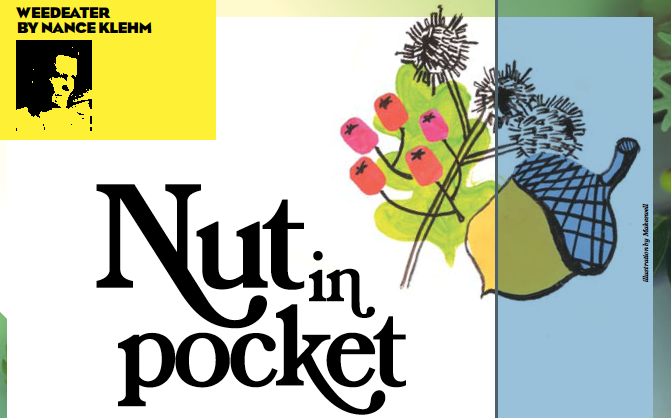
Illustration by Makeswell

Art direction by Yasmin Khan and Michael Worthington

Originally published in Arthur Magazine No. 31 (Oct. 2008)

SEED TIME

Out there, out of doors, it’s between leaf and root time. It’s seed time. In autumn, plants put their efforts into reproducing themselves via seeds, both bare and covered with delicious flesh. Right now it’s time to collect these offspring—juicy apples and pears for cider, seeds to grow next year’s harvest with, and nuts and berries to make healing infusions from. 

Here are some seeds to collect before winter settles in:

amaranth seeds

burdock burs

hackberry berries

juniper berries

kentucky coffeetree seeds

lamb’s quarters seeds

rose hips

queen anne’s lace

yellow dock seeds

sumac berries

hawthorn haws

aronia berries

hazelnuts

walnuts

grapes

pawpaws

persimmons

elderberries

pears and apples (for cider…)

Each of these seeds has practical medicinal uses, which you can research on your own. But if you want the full-on benefit from the plants you decide to put in your body, you have to allow the plants to help you. 

Long infusions, which are like concentrates, are an easy way to allow plants to do their work on you. You don’t need to use bagged herbal tea or other plant materials from a store to make an infusion. Nor do you have to buy it in bulk. Instead, you can forage, gathering plants that grow wild in our cities. 

Continue reading

LOVE AND DEBT: Note from the Editor (Arthur, 2013)

Jack Rose got paid.

Note from the Editor

LOVE AND DEBT

Originally published in Arthur No. 33 (Jan 2013)

“Follow your bliss”… “Do what you love, the money will follow…” —probably the two worst pieces of counsel that can be given to a young person seeking career advice—unless the counsel-giver is a credit card company, in which case they stand to profit handsomely from young people going into debt while following their dream, expecting the money to flow right in.

Jack Rose, a working musician who died suddenly three years ago this month at the unfair age of 38, knew that this kind of life advice was utter horseshit. Nothing magically comes to you because you do what you love. It can be hard for solo practitioners to stand up for themselves, to merge commerciality and hustling with artistic creation and expression. But there’s no getting around it. Jack made sure he always got paid, and he was justifiably proud of it. Jack knew that you gotta get compensated for your work, or have another source of income that funds your labor of love, or else you go into debt.

I got Arthur into a lot of debt. Giving away the magazine for free from 2002-2008 while relying on revenue for the enterprise from advertisers didn’t work. There were never enough advertisers, and all too few of them paid on time. Arthur was always short on cash. Writers, photographers and artists labored for free. By the end of 2008, when Arthur ceased print publication, I’d worked my way into six-figure nightmare debt trying to keep Arthur going, becoming a constant walking bummer to close friends and family. When Wall Street brought the global economy to a halt in September 2008, it was impossible for Arthur to go on. We weren’t alone, of course—countless other folks saw their worlds collapse as the economy contracted that winter.

But Jack Rose’s world kept getting brighter. Not only had he found a rich artistic path to follow, one that so many of us were eager to listen to him tread, he’d figured out a way to pay the toll for the road. That said, Jack wasn’t ever just about himself. Quite the opposite: Jack’s tenacity at getting audience members to pay a pitiable cover charge for performing musicians at Philadelphia house parties was legendary. I found out later that this was not an activity limited to Philly.

Jack looked out for Arthur, too. In early 2009, not long after we put the magazine on hiatus, sweet Michael “Mountainhood” Hilde organized Arthurdesh, an impromptu benefit concert for the magazine in Brooklyn, produced by the wonderful Todd P. Jack was one of the first performers to donate his services. Jack not only played onstage that night—a set that, typically for Jack, shushed and awed and moved a crowd waiting for louder fare—but he also helped hustle stuff at the Arthur merch table, standing there next to fellow performer Peter Stampfel, perhaps the most effortlessly hip/soulful odd couple I’ve ever been lucky enough to gaze upon.

Four years later, we’re back in action. I like to think that Jack would be happy to see Arthur alive again, and happier that we are charging five dollars for it, so that contributors can get paid, and nobody goes into debt doing it. Lesson learned, Jack.

Thank you for supporting our efforts by paying for the rag you’re holding. It’s good to be alive again, doing something that we love.

You might even call it a collective dream.

Jay Babcock

Joshua Tree, California

UP IN SMOKE: Weedeater column by Nance Klehm (Arthur, 2012)

Up in Smoke

by Nance Klehm

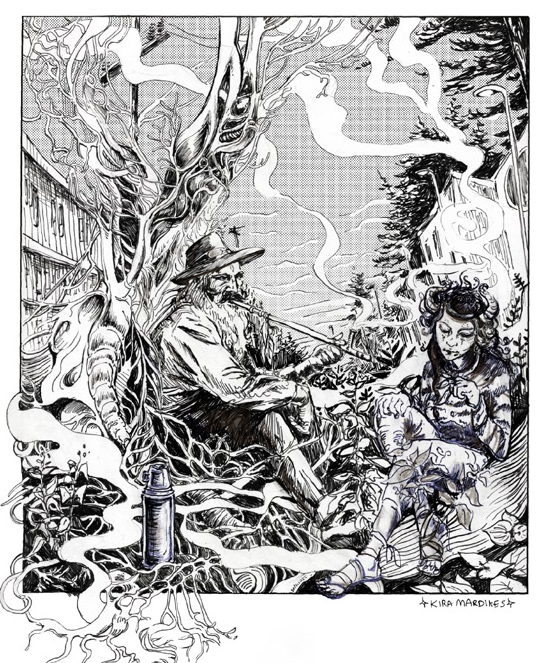
Illustration by Kira Mardikes

Originally published in Arthur No. 33 (January 2013), art direction by Yasmin Khan

Reginah Waterspirit, aka Brown Dove of Albuquerque, told me this story. 

Her husband Bearheart had been reading from his book at a major bookstore in town. Afterwards he was approached by a woman who he’d noticed had arrived at the reading late. She didn’t ask any questions, just looked into his eyes and gave him a paper, folded up. He put it into his pocket without looking. Later in the evening, Regina asked him what the woman had given him. He had forgotten about it entirely. He reached into his pocket and pulled out a wrinkled piece of paper holding a yet-to-be-used teabag. So they put the kettle on.

* * *

We are in an age of contraction that has the potential to unlock hidden economies. We all carry the scars and burdens and gifts of our ways of being. Tension exists between our desire to connect and our need to protect ourselves. There is a disconnect caused by doing this. As my friend Bill Wheelock told me: ‘I am a post-worker in a post-work economy.’ And he is right on. We’re dang uncomfortable about this structural unemployment. We have been made more vulnerable now with loads of sticky edges and on top of that we feel constricted by our own eggs.

Since so much of what we exchange, or have within us, is difficult to value in market terms, how do we even begin to form new economies?

In the economic monoculture of money, money is traded for money and devalues large classes of goods and services. Goods and services have concrete value. Money is only worth what it can buy; and indeed, money is an efficient shorthand for distributing goods and services. In the ecological, non-monied world, economic transactions happen across kingdoms—Bacterial with Animal (lacto-bacillus and animal gut) and Fungal with Plant (yeast and sugar) are recognizable economies.

If someone comes to your door, you help them out. If someone helps you out, you show your gratitude for what they have shared with you. This is part of the hobo ethical code. This is also an economy. And maybe, this give-and-take rocks back and forth, creating a rhythm of more mini-economic transactions and a relationship is nourished into being. And, maybe, in this flurry of synergistic exchange, the original impetus to engage is lost. It’s from here that our new economies emerge.

Most economies now relate to information. Getting it from somewhere quickly and at no cost so we can pack our heads with it. Hit the internet and books all you want, but when you ask someone to share something garnered from what they have lived, whether they have lived it easily or with difficulty, following a path chosen or given, and from whom you have no prior relationship, no prior economy, you should come without empty pockets.

Even better, before you ask them, slow down and ask yourself if your question is really that important. The answer is frankly, most likely, NO.

But if the answer is YES, here is an urban-foraged weedy smoking mixture that you can easily find, gather, dry and mix yourself to later put in your pocket and pull out for payment or sharing when needed. 

Continue reading

LEAVE IT TO THE BEES: Weedeater column by Nance Klehm (Arthur, 2013)

Leave It to the Bees

by Nance Klehm

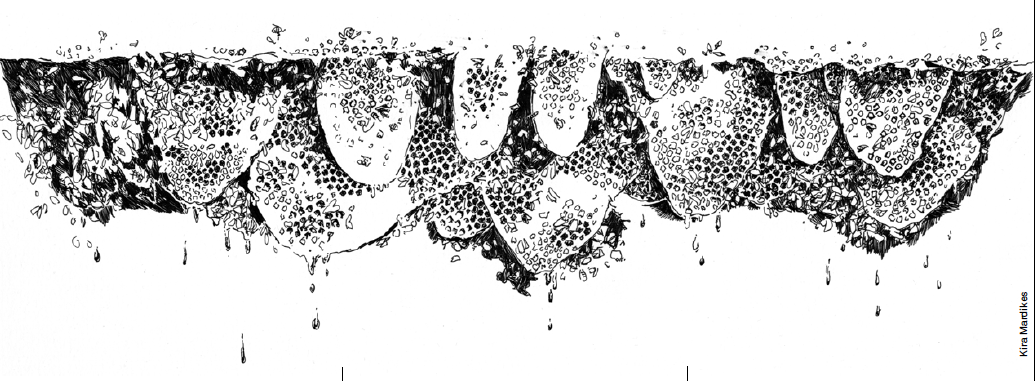
Illustration by Kira Mardikes

Originally published in Arthur No. 34 (March 2013), art direction by Yasmin Khan

Honey, wax and wisdom is true currency. You can eat, heat, fuel and chew on it, and, hopefully, on this, too:

Two years back, I worked for a fifth-generation beekeeper who keeps bees in the 500,000 acres of wildlands that border Arizona and Mexico. Her 600 hives are located in several handfuls of bee yards scattered across the vast acreage of federal wildlife preserve and private large ranches of the Avra Valley.

In this valley vibrates the peak Babaquiviri, center of the Universe to the Tohono O’odham people. Nearby stands Kitt Peak Observatory. And down below is the favored crossing point of pharmaceutical traffickers and need-driven people, inciting the U.S. border patrol to comb the area with ATV’s, man multiple dusty checkpoints and store buses in the sagebrush for large hauls of captured humans. In the Avra Valley, cattle range, quail nest, coyotes hunt and bees pollinate.

Lady D’s bee yards are carefully situated near rangeland watering holes and on long slopes, offering a diverse spectrum of ecosystems, each supporting its own palette of plants of which the bees forage. She supplements the hives with little else but this well-considered placement—no supplemental sugar feed, no fats or essential oils to deter Varroa mites. Like most commercial beekeepers, she doesn’t strip the bees of their winter food source, aka their honey. D leaves them essentially to do their own thing which, of course, they do very well. Her hives are undeniably stronger than most hives I have ever seen. Her varietal honeys are Sonoran: Cats Claw, Mesquite, Ironwood, Sagebrush… far away from the pale and delicate Clover, Linden or Orange Blossom sold at farmer’s markets and on most grocery store shelves. Her honeys are dark, low moisture and carmelly. They crystallize easily. They are toothy.

D’s own property is piled high with antique, handmade hive equipment—much of it over 50 years old—that needed a good cleaning with a wire brush and spackle knife. Which is what she and I spent hours doing every week while I was there. I would scrub and scrape petrified bee bodies, dusty crusty wax and crystallized honey drips from the ancient wire and wood frames at half her speed. She never neglected to remind me of this. She talked non-stop. I listened and worked. Outside her honey house were 55 gallon drums (660lbs honey) that she would sell whole or pour off into five gallon buckets.

And so, this is where the story stops: Lady D had two barrels set aside of honey from an extraction from many years past. Honey has no shelf life—it’s always good. One day I asked her about why she was keeping these barrels aside from the rest she poured to sell from. She told me to think on it a bit. After a few hours under the cloudless sky, scraping… scrubbing… the answer floated in: ‘TO MAKE FUEL.’ She kept honey around to make into alcohol to run her generator. To have around when the North and South Poles flip.

Now, making alcohol… I assume most of you know how to do this already. But if you don’t, I hope you will consider learning to do so before next month. You don’t do this because of some fear of impending fossil fuel scarcity or some other apocalyptic scenario (no matter how keen that fantasy is or how likely we will see the first of these), but because it is a handy and accessible technology to embody. 

Following are the basics to make a simple and direct sort of brew, not beer or wine per se, but an alcohol that when distilled, you could generate some power with (or use to clean wounds, or make your own herbal tinctures with, or…etc.)

Continue reading

PIXEL DEEP: Gabe Soria talks with “You” novelist/video game developer Austin Grossman (Arthur, 2013)

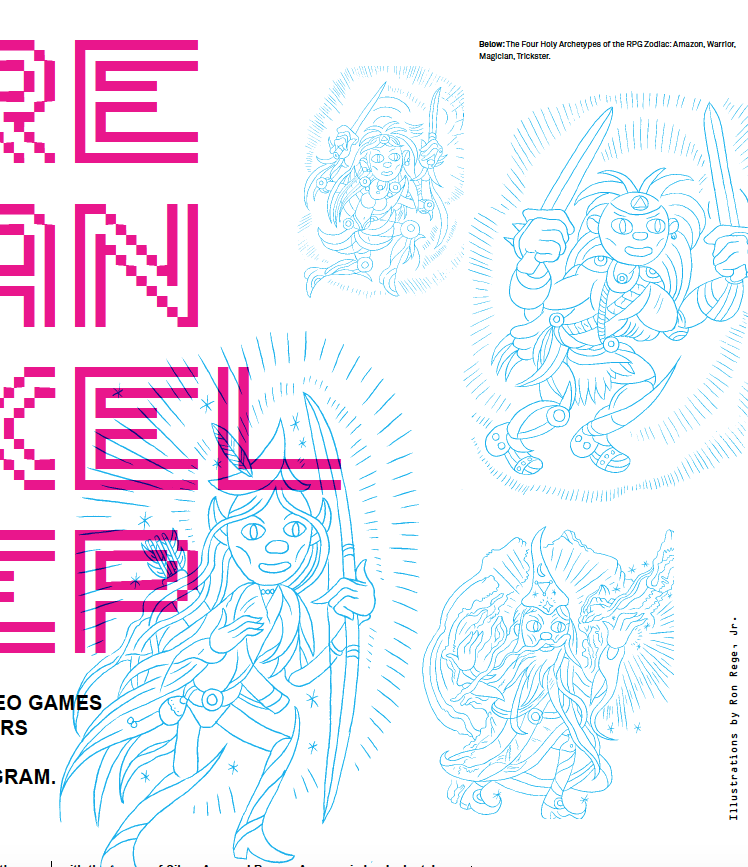
The Four Holy Archetypes of the RPG Zodiac: Amazon, Warrior, Magician, Trickster., by Ron Rege Jr.

PIXEL DEEP

Novelist Austin Grossman is obsessed with both the video games people play and the developers who make them. Gabe Soria gets with the program. 

Illustration by Ron Rege, Jr. , art direction by Yasmin Khan

Originally published in Arthur No. 34 (April, 2013)

You, the new novel from Austin Grossman, is a testament to the enduring appeal and agony of fictional world-building. Framed as a quasi-coming of age tale, the book is narrated by the prodigal member of a crew of four computer game enthusiasts who create an enduring, Eternal Champion-esque video game franchise while still in high school. Seen through the prism of the video game industry from the homebrew days of the early-80’s to the tech explosion of the late-90’s,You explores what video games mean to us and how they both shape and distort the lives of those who create and consume them. 

Grossman’s first novel, Soon I Shall be Invincible!, played with the tropes of Silver Age and Bronze Age comic books by taking the standard stories of a would-be world-beating villain and rookie superhero and digging deep into the motivations behind each as they move toward a standard epic confrontation. You does the equivalent for the world of a fantasy video game, delving into the motivations of not only the creators, but of the characters in the games themselves. It’s a strange and affecting experience that gets close to the reasons behind why we sit by the console campfire to both tell and have stories told to us. Arthur rang up Grossman—a veteran video game writer and consultant—to have a chat about all this mess.

Q: Video game novels, besides novels actually based on video games, it’s a very small club: Lucky Wander Boy (see Endnote 1), Ready Player One (2), Microserfs (3), Reamde (4) and now You. What inspired you to set a novel in a world that doesn’t lend itself so much to stories about its creation?

A: Gamers feel like an embattled minority. The public think they’re either pathetic or violent, and I don’t feel like that myself. I felt that this was an area of the culture that hadn’t been described too deeply or clearly or truthfully as it could be, so someone should take a whack at this, and I nominated myself. Video games are a really kind of an odd and varied and deep experience, and that needs to be represented. It was an interesting experiment so I gave it a try.

Q: While You is a book about video games, it’s a book about storytelling. It’s a book about the stories we tell each other, the stories we want to hear. And the title itself: You. It seems to evoke that special place in storytelling that video games occupy. Life itself is a first person experience, most novels you read are third person experiences, but video games themselves, as a method of storytelling, are in the second person. It’s all about pointing at you, the player.

A: That’s exactly the sense of the title, that’s exactly the weirdness that the book tries to grapple with. The storytelling of videogames is something that the closer you get to it, the weirder it is. Is a video game telling you a story? Is it telling itself a story? It’s kind of in this weird intermediate state that’s hard to map to anything. When I lecture about video games I talk about LEGOs and Barbies a lot, because you have to go to these places to find good analogies for the storytelling in games. I think that’s probably why storytelling in videogames has kind of lagged behind, because we can’t get a handle on what that moment is, you know, when you pick up the controller and you commit to making yourself a character. It’s really odd, and no one is done figuring out what exactly that means.

Continue reading

“21 Recently Discovered Delights” by Elisa Ambrogio (Arthur, 2008)

Originally published in Arthur No. 29 (May 2008)

Above: Elisa at the 2007 Arthur benefit in L.A.

“21 Recently Discovered Delights”

by Elisa Ambrogio

A Tragic Honesty: The Life and Work of Richard Yates by Blake Bailey (Picador, 2004)

The Bailey came out this past year or so, but I would recommend first reading Yates’ easiest-to-find novel, Revolutionary Road, before it goes out of print again. Eros, pathos, flop sweat, it’s all there; a man outside and inside his own time. Highs and lows as a writer, but at his best it does not get better; more of a grown man than Salinger and less of a prick than Updike: the comic and horrible desperation of the 1950s middle class white guy. I can’t get enough! The biography is filled with his drinking, mother, teaching, TB, women, self-defeat, madness, work, beard-growing and sadness. 

Alex Nielson & Richard Youngs Electric Lotus LP (vhf, 2004)

Two guys make glue-sniffing rock and roll cast in the crucible of the entire recorded history of time and act really nonchalant about it. 

Giant Skyflower Band show at the Hemlock

Closing out the show under swirling lights, Jason stumped out deep crazy timpani, Glenn sawed away at melodies and chords like a old-timy German cobbler channeling Dave Kusworth and Shayde “Mushmouth” Sartin slunk out basslines like a somnambulant Greg Lake. It was a night to remember. They’ve got a cd on Soft Abuse called Blood of the Sunworm, and name notwithstanding, it is effen rad.

The Evolution of a Cro-magnon by John Joseph (Punk House, 2007)

Finally. But don’t take my word for it, Adam Yauch has this to say:“So if you want to remember what NYC was like in the ’70s and ’80s, if you are interested in selling fake acid at Madison Square Garden, or dressing up like Santa Claus in a wheelchair to hustle money for the Hari Krishnas…put a read on this.” Also available in…audio book form, AH! Now, anyone who is anyone knows that this year John Bloodclot is also coming out with his own nutrition and fitness guide. Here is what he had to say in his press release: “I’m sick of people, who are either ignorant of the facts, or even worse, have hidden agendas, dissing vegetarians because we care about animals and the environment. What do you want to live in a barren wasteland dick wad?” Amen.

Joshua Burkett Where’s My Hat (Time-Lag, 2008) 

The album long awaited by those who played holes into Gold Cosmos so many years ago is finally here. Joshua Burkett is known for co-owning Mystery Train—the best record store in Western Massachusetts—and for being a bit of a mystery train himself. Though a master musical craftsman, he rarely plays live and takes years to release records. Where’s My Hat starts with a bold electric bagpipe somewhere between  an emergency siren and a diseased fog. Josh’s guitar braids mental rugs and smoothes down the rough edges. Though I think of Simon Finn at his gentlest, or Pip Proud or Skip Spence, it is not like anything else. And if you think there is you are wrong. There are efforts that wish they were this but they are not. You can hear the difference. Attempts at peace and a knawing  ill-ease permeate the record, but it is above all a work of intricate idiosyncratic beauty. 

Moving to San Francisco 

I can’t believe this place. Lousy with people with the right ideas, jamming, playing good records and eating salmon tacos on the edge of green cliffs over the ocean.

Continue reading

“Someone knew someone who knew a rabbi” by Gabe Soria (Arthur, 2008)

Originally published in Arthur No. 29 (May 2008)

Dear Arthur,

So it’s been a few months since the clan decamped from Brooklyn and moved back to my old stomping grounds of New Orleans, and it’s been an incredible experience so far, and if I had to sum it all up all of its strange beauty in one sentence, it would have to be this:

I’m convinced that if New Orleans didn’t exist, Alan Moore would have to invent it.

Folks here are dreamers and schemers, and the majority of the scheming and dreaming goes on in the city’s bars, taverns, watering holes, speakeasies and so on. Tall tales, big plans and big ideas are everyday currency, and whether they realize it or not, it’s my opinion that everybody in New Orleans is a pulp writer at heart, a spinner of weird tales of the fantastic and supernatural, a closet Stan Lee or Robert E. Howard. Everybody here is a godlike creator of alternate realities. There’s one New Orleans, the “real” city, which is pretty bizarre and fantasmic in its own right. It needs no help to be confounding, dangerous and beautiful, because it’s all of those things automatically.

But then there’s the Uber-New Orleans, the even stranger city, the one invented in the bars. (Let’s pay DC Comics a tribute and call it New Orleans-2) is populated by armies of great bands, classic films, sublime paintings, amazing books and so on. This is not to say that people here DON’T produce things—there’s art going on in New Orleans, art and industry and mad creativity that is at a constant boil. But coming up with mad, drunken ideas for epic works of fiction is a favorite sport of three in the morning New Orleanians, a pastime so endemic that folks here joke about the amount of effort spent talking about things instead of doing them.

If ten percent of these ideas were ever seen to completion, the world would be a much weirder, much more interesting place. I’m certain that the same story could be told about bars the world over, but there’s just something about the way it’s done in New Orleans that makes me feel that it’s a city of a million would-have-beens and could-have-beens, the urban equivalent of a thousand issues of What If…? comics.

But let me get to my point. Every once in a while, just like in a comic book, New Orleans and New Orleans-2 intersect and there’s a massive crossover event and continuity just goes all to hell and it’s wonderful. This happens when someone makes one of these bar ideas actually happen, as was the case recently when my friend Alison Fensterstock had a brainstorm. The idea? To have the Noisician Coalition, a marching club made up of a loose aggregate of ne’er-do-wells and malcontents who bang on trashcan drums and jerry-rigged electronic noisemakers, to play at a local Purim service. Of course!

And this is where New Orleans-2 comes in – the idea was repeated in the light of day and it was run with. Someone knew someone who knew a rabbi, and the rabbi was cool, so the gig was booked—the Noise Parade would be part of the traditional drowning out of Haman’s name at the Anshe Sfard Synagogue over on Carondelet Street. When yours truly got the news that members of the N.C. were needed to add to the ruckus, he was in a bar and semi-disbelieving, but agreed to it nevertheless.

So cut to Purim – only six members of the group can make it, but that’s plenty: group founders MattVaughan Black and Robert Starnes, L.J., Churchy, Fensterstock and me. We’re decked out in our traditional red, black and white garb. The congregants in the synagogue are dressed even more outlandishly and it’s rad. Finally, the service starts. An older gentleman begins to read the Megillah of Esther in Hebrew and we’re all waiting around to hear the magic tragic name of that sneaky murdering bastard Haman to be uttered and when it is – wham! The Noisician Coaltion erupts quickly and messily. Sirens wail, Theremins are distorted and I, the sole member on percussion, bang out the barely recognizable rhythm of “Big Chief.” Smiles erupt throughout the synagogue. This, the assembled folks seem to be thinking, is RAD.

And so the megillah continues, and with every “Haman” we blast it out again and again and again, even going so far as to actually parade around the joint a couple of times. The service winds down, then, and everybody hustles down to the basement for raspberry hamentashen, meatballs, kosher wine and whiskey. Dancing erupts, thanks to the tunes of awesome local jazz-klezmer-marching mutants the Panorama Jazz Band. Dudes are doing flips, people are clapping and every once in awhile a teenager tries to snake a drink.

Later, as yours truly and a few members of the Coalition share a butt in front of the synagogue, a car rolls up, stops. The passenger side window rolls down and an African-American gentleman leans over to speak.

“What y’all doing in there?”

“It’s a Purim celebration, man!”

“Can I come?”

“Hell yeah. C’mon in.”

“Okay,” he says. “But you see, I’m in a wheelchair. I drive with some gears.”

He demonstrates how the gears work. We’re all impressed – it’s a cool set-up.

“So I’m going to drive around and be back later. Is that okay?”

“Sure!”

And then he drives off, using his gears, and we watch him go and, well, all there is to say is thank heavens for New Orleans-2 and crossovers in general.

Until the next time, I remain,

Gabe Soria