Excerpted from unreleased festival concert film “ArthurFest,” directed by Lance Bangs
A Poem by Dennis Held

Air, Conditioned
by Dennis Held
I am dry, I am droll
And that’s just how I roll:
Call me Billy.
I’m not mad, I’m not bleak
I’ve a Frenchman’s physique,
I’m not silly.
I like gin, I like jazz
You can take what I has–
That’s just me.
You won’t mind what I write
And if it’s patently trite,
We’ll agree.
I can toss this stuff off
I don’t work for no boss
I am poemy.
And if you pay my fee
My verse isn’t free:
Nor me.
Dennis lived in Missoula, Montana for five years and was awarded the MFA in poetry writing. Taught writing, editing and literature at Lewis-Clark State College in Lewiston, Idaho, from 1994 until 2001. Betting on the Night, a collection of poetry, was published in 2001 with Lost Horse Press, and was reprinted in 2003. Now living in Spokane, Washington, he teaches writing at Eastern Washington University. His second book of poetry, Ourself, was published in January 2011 by Gribble Press. He continues to publish essays, book reviews, and articles in magazines and for public radio.
JACK ROSE discography by Byron Coley (Arthur, 2013)
As published in Arthur No. 33 (Jan 2013), accompanying the Jack Rose interview…
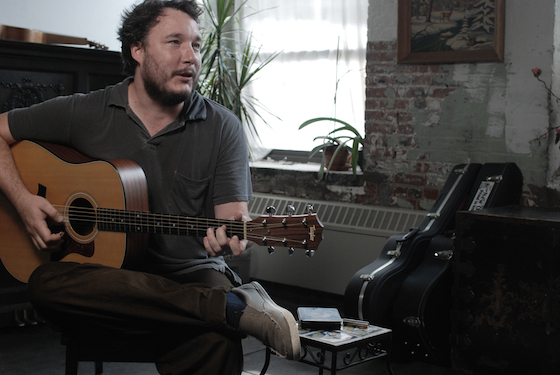
Above: Still from Jack Rose & Glenn Jones: The Things That We Used to Do film/dvd, courtesy Jesse Sheppard and Glenn Jones.
JACK ROSE DISCOGRAPHY
by Byron Coley (with thanks for help from Mike Gangloff & Glenn Jones)
Hung Far Low, Portland Oregon (Klang CDR, 2001)
Doctor Ragtime (Tequila Sunrise CDR, 2002)
Red Horse White Mule (Eclipse ECL-012 LP, 2002)
“Red Horse II” on Wooden Guitar (Locust Music 33 CD, 2003; 2LP, 2008)
Raag Manifestos (VHF #85 CD, 2003; Eclipse ECL-039 LP, 2004)
Opium Musick (Eclipse ECL-026 LP, 2003)
“White Mule” on Golden Apples of the Sun (Bastet BAST-0001, 2004)
Kensington Blues (VHF #92 CD; Tequila Sunrise TS-12001 LP, 2005)
“White Mule III” on Imaginational Anthem (Tompkins Square TSQ0531 CD, 2005)
“Box of Pine” on This Side Up (UK Ptolemaic Terrascope POT-35 CD, 2005)
“Sun Dogs” & “Now That I’m a Man Full Grown” on By The Fruits You Shall Know The Roots (Time-Lag/Eclipse 3LP, 2005)
“Hey Fuck You Rag” on Two Million Tongues Festival (Bastet BAST-0006 CD, 2005)
“Variations on Fleur de Lis/Be The Name of the Lord” on Dream Magazine #5 comp (SWE Dream Magazine CD, 2005)
“Untitled (Parts I & II)” (Tequila Sunrise TS-7002 7”, 2006)
“Cross the North Fork II” on Imaginational Anthem Volume Two (Tompkins Square TSQ1424 CD, 2006)
“Amp” on Less Self Is More Self (A Benefit Compilation for Tarantula Hill) (Ecstatic Peace E#107 2CD, 2006)
Jack Rose (aRCHIVE 28 CD, 2006; Tequila Sunrise TS-12006 LP, 2007)
“How Green Was My Valley/Buckdancer’s Choice” (split with Silverster Anfang) (BEL Funeral Folk ff015 7”, 2007)
“Since I’ve Been a Man Full Grown” on The Great Koonaklaster Speaks: A John Fahey Celebration (Table of the Elements TOE-CD-91 CD, 2007)
“Revolt” on Mind the Gap Volume 68 (BEL Gonzo Circus GC084, 2007)
I Do Play Rock and Roll (Three Lobed TLR-049 CD/LP, 2008)
Dr. Ragtime & His Pals (Tequila Sunrise TS-12007R, 2008)
“Mr. Rose Visits Washington DC” on Meet the Philly Eilte (BEL K-raa-k 7”, 2009)
The Black Dirt Sessions (Three Lobed TLR-066 LP, 2009)
Luck in the Valley (Thrill Jockey 229 LP, 2010)
“Moon in the Gutter” on Rough Trade Shops – Psych Folk 10 (UK Rough Trade COOPR250 CD, 2010)
Unrock Series – 12.11.2009 (GER Unsound UNR-009 CDR, 2010)
As Dr. Ragtime:
“Buckdancer’s Choice/Dark Was the Night, Cold Was the Ground” (Sacred Harp Library 7”, 2005)
“Alap/Flirting with the Undertaker” (Tequila Sunrise TSR-6, 10” 78, 2005)
(compiler) Dr. Ragtime Presents Nice and Nasty (Ecstatic Yod CDR, 2008)
Jack Rose & Jason Bill:
Via St. Louis (Drunken Fish dfr-36 CD, 1996)
Jack Rose & Glenn Jones:
“Linden Avenue Stomp” on The Wire Tapper 17 (UK Wire Magazine CD, 2007)
The Things We Used to Do DVD (Strange Attractors Audio House SAAH058 DVD, 2010)
Jack Rose & the Black Twig Pickers:
Jack Rose & The Black Twig Pickers (Klang Industries 008 LP; VHF #116 CD, 2009)
“Revolt/Soft Steel Prison” (UK Great Pop Supplement GPS28 7”, 2008)
“Shooting Creek/Rappanhannock River Rag” (UK Great Pop Supplement GPS49 7”, 2009)
Jack Rose with D. Charles Speer & Helix:
Ragged and Right (Thrill Jockey 12.42 mini-LP, 2010)
with Ugly Head:
Spoon Knife Fuck (Transparanoia 7” , 1994)
A Bowl of Fever (Transparanoia 7”, 1994)
“These Drugs Aren’t Working” & “Throttled Sleep” on Dixie Flatline (Radioactive Rat CD, 1994)
Silence Is the Mystery of the Future Age (Transparanoia CD, 1997)
with Pelt:
Brown Cyclopedia (Radioactve Rat 333 LP, 1995)
“Big Stick and Little Sweet Play ‘In the Pocket’” (possibly) on With Pure Hell Raying From Our Sacs (no label MC, 1995)
Burning / Filament / Rockets (Econogold Ego-002 CD, 1995)
Snake to Snake (Klang Industries LP, 1996)
Woove Issue Five split with Soma 77 (WUVT-FM 7”, 1996)
Max Meadows (VHF #28 CD, 1996)
Techeod (VHF #36 CD, 1997)
For Michael Hannahs (no label CDR, 1997; VHF #38 CDR, 1998)
Black Florida split with Harry Pussy (Klang Part 3 7”, 1998)
“Zinc Mine” on untitle comp (UK Ptolemaic Terrascope POT-24 7”, 1998)
“Tibetan Ass Hash” on Umlauted Roman Numeral Five (Klang Industries Fifth Anniversary) (Klang 2CDR, 1999)
Empty Bell Ringing in theSky (VHF #43 2LP, 1999)
Rob’s Choice (VHF #54 CD, 1999)
two untitled tracks on Pelt/Pengo/Andy Gilmore Live At The Vilage Gate Carbon CR33 CDR, 2000)
Keyhole (w/Keenan Lawler, Eric Clark) (Eclipse ECL-006 LP, 2000)
Ayahuasca (VHF #62 2CD, 2001)
Houston 2001 (Klang CDR, 2001)
Six of Cups (Klang CDR, 2001)
“The Signal Tower at Murraysville, Pennsylvania” on The Invisible Pyramid (Last Visible Dog 2CD, 2003)
Keyhole II (w/Keenan Lawler, Eric Clark) (Eclipse ECL-017 LP, 2003)
Pearls from the River (VHF #76 CD, 2003)
A Capsized Moment/Paris 3.5.04 (Klang CDR, 2004)
Untitled (VHF #90 CD, 2005)
Skullfuck/Bestio Tergum Degero (VHF #98 CD, 2006)
“Sunflower River Blues” on I Am the Resurrection: A Tribute to John Fahey (Vanguard 79789-2 CD, 2006)
Heraldic Beasts (Eclipse ECL-050 2LP, 2006)
with Pelt/Rake:
United Supreme Council/Oastem! Vibe Orchestra (Eclipse ECL-009 LP, 2001)
with Dredd Foole & the Din:
The Whys of Fire (Ecstatic Yod #49C/FYPC20 CD, 2003)
with Glenn Jones:
“Linden Avenue Stomp” (unique version) on This is the Wind That Blows It Out (Strange Attractors Audio House SAAH024 CD, 2004)

AH, MAN: A career-spanning conversation with JACK ROSE by Brian Rademaekers (Arthur, 2013)
As published in Arthur No. 33 (Jan 2013)…

AH, MAN
A career-spanning conversation with JACK ROSE, American musician, recorded just a few months before he died in 2009
By Brian Rademaekers
When I started covering music in Philadelphia in 2007, my beat—the city’s crumbling post-industrial river wards—felt like a veritable nexus of weird folk and psychedelic experimentation. The Espers clan and their compound, Fern Knight, Fursaxa, and heavy-hitters like Bardo Pond were all there, churning out a storm of beautiful, strange music that seemed in part a product of the ancient, twisted alleyways of Fishtown and Kensington.
Here, Jack Rose was the benevolent, unassuming King—a master set apart from his peers by a massive presence and an indomitable, mystical talent that elevated him from mere musician to magician. He was a dark alchemist, transforming calloused flesh, polished wood and taut steel into the intoxicating, intricate worlds of sound that were his music. Not that Jack — Jack the giant, hulking Virginian — would ever presume to wear a crown; it was just something that he brought into the room with him, disarming all with a humble warmth offset by a blunt, caustic confidence that he wielded like a knife at just the right moments. These days, most of the musicians from that scene are gone from the neighborhood, though none as gone as Jack.
When I first heard Jack’s 2005 album Kensington Blues, I was thunderstruck, lost in awe that such a masterpiece not only existed, but that it was made in my time, by a man whose elbows polished the same bar counters as mine. Listening to Jack’s recordings was great [see sidebar for a complete discography] but best of all was seeing Jack live, spreading his gospel in church halls or little clubs or living rooms and, finally, along the banks of the Delaware River for a summer concert series shortly before he died.
Watching him amble up to his chair with guitar in hand signaled the start of near-religious experience. He would hunch over the instrument, cock his head to the side and, with closed eyes, unleash wild syncopated layers of rhythms, leaving listeners rapt in a sort of devastated trance. Here was this giant bearded man suddenly becoming seamlessly enmeshed in his guitar to create these idiosyncratic spells that were at once as delicate as flowers and as forceful as hurricanes. Seeing that miracle in the flesh, there was nothing else like it in the world. For me, it was like being a jazz freak in the ’40s and living down the street from Charlie Parker.
So began a years-long obsession. I felt compelled to document this genius quietly living in our midst. And Jack obliged. It never seemed to bother him that some reporter from a little local paper was always pestering him, asking for details about a show or politely begging for an advance copy of a record. In that way, Jack betrayed the appearance of a dominating, cocksure master and revealed a man with a very big heart.
My pretext for interviewing Jack in the summer of 2009 was his forthcoming long-player on Thrill Jockey, Luck in the Valley. Jack was elated. He and his wife, Laurie, had just bought a tidy little brick rowhouse a few blocks from the city’s blasted Port Richmond waterfront. He bragged about his new car, a Honda that he loved for its efficiency in carrying his guitars from gig to gig. He raved about a pizza joint he’d found down the street, about how quiet his block was. To him, the Thrill Jockey release was the milestone he’d been awaiting, a culmination of years of hard work and mastery that meant he could finally say he was making good bread on the merit of his music.
For three hours, he let me follow him around the house, tape recorder in tow, as he smoked and poured tea and pulled LPs from his wall of records. He was a man satisfied, a musician reveling in the feeling that his art was finally about to find the place in the world that it deserved.
When Jack died a few months later, I groped through the shock, looking for some way to respond to the ugly, gaping hole that had so suddenly appeared, and decided on transcribing the whole of our conversation from that summer day on Ontario Street. That tape is presented here, and captures Jack in a bright mood at the peak of his career, ruminating on everything from his first lessons to his labor on “Kensington Blues” to the joy of landing the Thrill Jockey deal.
* * *
THIS HAPPENED
Comets on Fire live at the White Horse – 26 November 2013
Know a Boomer who took LSD as a youngster and needs to take it again?
Maybe give them this bk for xmas…
The Acid Diaries
by Christopher Gray
CHRISTOPHER GRAY (1942-2009) was well known for his involvement in the 1960s with Situationist International, for his various radical writings, and as Swami Prem Paritosh, disciple of the guru Osho.
Toward the end of his fifties, Gray took, for the first time in years, a 100-microgram acid trip. So extraordinary, and to his surprise so enjoyable, were the effects that he began to take the same dose in the same way–quietly and on his own–once every two to three weeks.
In The Acid Diaries
, Gray details his experimentation with LSD over a period of three years and shares the startling realization that his visions were weaving an ongoing story from trip to trip, revealing an underlying reality of personal and spiritual truths….
Publisher’s website (excerpt, purchase info, etc): Inner Traditions
Buy: Amazon
2013: FUNKADELIC (!) COVERS LORD BUCKLEY (!!) WITH SLY STONE (!!!!!!!) ON VOCALS
How did we miss THIS all-timer? Came out in April! This isn’t out of nowhere… Sly’s always been a Lord Buckley freak — but what a pleasure to hear…

Via georgeclinton.com –
The single “The Naz” features Sly Stone on vocals telling the story of Jesus Christ of Nazareth as told by beat poet Lord Buckley in his famous poem “The Nazz”. Sly uses his trademark radio rap that he used to kick as a DJ on San Francisco’s radio station KSOL-AM. “He just laid it down and we built the entire song around it,” says Clinton.
The second song on this single is “Nuclear Dog”, an instrumental rock reworking of Clinton’s 1983 chart topping hit “Atomic Dog.” In classic Funkadelic tradition, “Nuclear Dog” features blazing solo after solo from long time P-Funk guitarist DeWayne “Blackbyrd” McKnight. Jazz fans should know Blackbyrd from his start with the great Sonny Rollins and subsequent legendary work as a member of Herbie Hancock & The Headhunters before he joined P-Funk.
Available on itunes
SCENE FROM A HIGH POINT IN WESTERN CIV CULTURAL HISTORY
From the very active and highly illuminating George Clinton and Parliement Funkadelic Facebook stream:
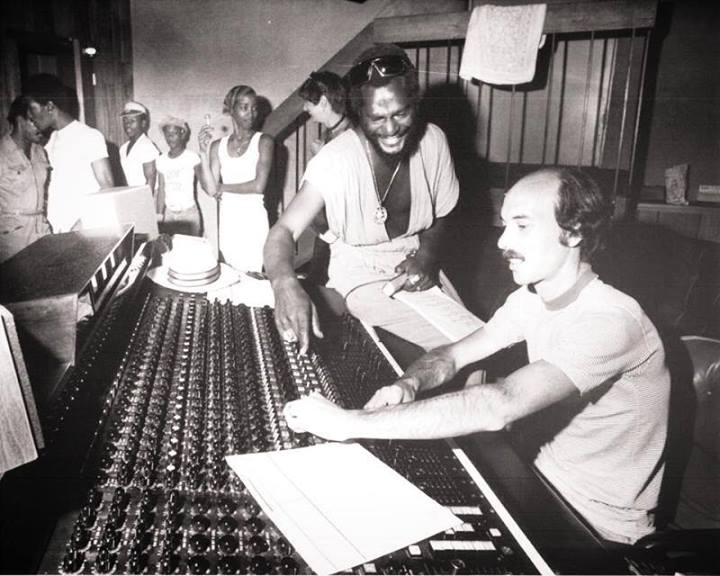
Starting from far left: maybe Ron Ford, Glen Goins, Garry Shider, Cordell Boogie Mosson, Debbie Wright, Me -George Clinton and Jim Vitti at the board at United Sounds in Studio A. Mixing one of the songs from Funkentelechy Vs. The Placebo Syndrome in 1977.
[SUNDAY LECTURE NO. 2] "RESTORING RELATIONS: The Vernacular Approach to Ecological Restoration" by Freeman House

“Freeman House is a former commercial salmon fisher who has been involved with a community-based watershed restoration effort in northern California for more than 25 years. He is a co-founder of the Mattole Salmon Group and the Mattole Restoration Council. His book, Totem Salmon: Life Lessons from Another Species received the best nonfiction award from the San Francisco Bay Area Book Reviewers Association and the American Academy of Arts and Letters’ Harold D. Vursell Memorial Award for quality of prose. He lives with his family in northern California.”
That’s the biographical note for Freeman House on the Lannan Foundation website. We would add that earlier in his life, Freeman edited Innerspace, a mid-1960s independent press magazine for the nascent psychedelic community; presided over the marriage of Abbie and Anita Hoffman at Central Park on June 10, 1967; and was a member of both New York City’s Group Image and the San Francisco Diggers.
This is the second lecture in this series. This series ran previously on this site in 2010-11, and is being rerun now because it’s the right thing to do. Last week’s lecture is available here — “Wild Humanity: People and the Places That Make Them People”.
RESTORING RELATIONS: The Vernacular Approach to Ecological Restoration
by Freeman House
This piece is based on a keynote talk presented to the 3rd annual meeting of the Society for Ecological Restoration, California chapter, in Nevada City CA, May 1994. It was published in Restoration and Management Notes, Summer 1996.
A couple of years ago, I read a very well-written book that tried to convince me that wherever humans touched nature, nature became un-natural, its beauty and wildness spoiled .The book took notice, correctly I think, that human influence on the landscape had become universal. The writer, Bill McKibben, drew the conclusion that because of this, the end of nature was near. The name of the book is, in fact, The End of Nature (McKibben 1989). Like many environmentalists, McKibben is a passionate man, a man who grieves for injuries to nature. But during the time of writing, he seemed also to be a man who had swallowed most of industry’s argument for the inevitability and (indeed!) naturalness of its destructive behavior in regard to natural systems and human communities. If you accept these arguments—some of which are that economies must grow; that the efficiency of mass production legitimizes its brutalization of human life and and the destruction of natural systems; that mere appetite is the ruling element in human behavior—then McKibben’s conclusions must be correct. If humans are such a sport of nature, if their behavior can only be anti-nature, and if humans are everywhere, then nature must surely be on its way out. It is as if we lived somewhere else altogether than in the ecosystems which provide us with all our needs.
But in fact, humans have always been immersed in ecosystems. And for most of the time we’ve been on the planet, with the exception of the the last few hundred years, humans have behaved as if they were immersed in ecosystems. [1] The paleolithic hunter fails to find his game and returns to counsel with his people. How has their behavior strayed from the path of ample provision? The pre-industrial neolithic planter burns brush, saves seed, collects dung. Alongside deep frugality in the home exist the exuberant public indulgence in great monuments that were observatories of planetary movement, and the devotion of large amounts of time and energy to ceremonial observances of non-human processes and presences in the landscape surrounding. Throughout the industrial age, ecosystem behavior has endured even though its practitioners have been pushed back to the most marginal of land bases.
It is important to understand that behavior which rises out of ecosystems—life lived by immersion—has never been passive but diligently active: symbiotic, reciprocal, deliberately manipulative, and creative. Dennis Martinez, the pre-historian of the restoration movement, has shown us that the indigenous peoples of North America—and by extension elsewhere—have always been an interactive element of the landscape, effecting their own long-term survival with management practices so extensive that ecosystem function was affected (Martinez 1993). This is another view altogether of human relationships to nature. Rather than objectifying nature as a resource base functioning only to provide human wealth and comfort, such cultures express themselves as interactive parts of the natural systems around them. In such cultures, individuals are able to perceive themselves as having no greater (or lesser) a function in ecosystem process than algae, or deer.
Most of us have forgotten how to act this way. Over the recent few hundred years we have been encouraged to forget. There is, in fact, a whole educational industry structured for the purpose of convincing us that our primary identity is as consumers. The question is not how to mourn nature, or how to isolate and protect its tattered fragments, but how to re-engage it and thus rediscover our native wit and adaptive genius. And we will find, I believe, that this rediscovery is possible, but only ever in one place at a time. If we are to re-immerse ourselves in our larger lives, if we are to regain our extended identity, it will be through the portals of individual ecosystems and particular places. Continue reading
WHEN MANIC STREET PREACHERS PLAYED CUBA, MET CASTRO (2001)