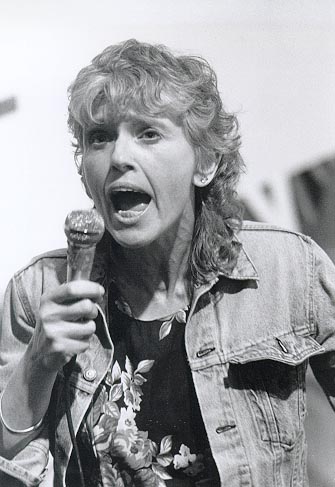
[Sunday Lecture] "Silent Future: Rachel Carson and the Creeping Apocalypse" by Freeman House

photo by Jim Korpi

Freeman House is a former commercial salmon fisher who has been involved with a community-based watershed restoration effort in northern California for more than 25 years. He is a co-founder of the Mattole Salmon Group and the Mattole Restoration Council. His book, Totem Salmon: Life Lessons from Another Species received the best nonfiction award from the San Francisco Bay Area Book Reviewers Association and the American Academy of Arts and Letters’ Harold D. Vursell Memorial Award for quality of prose. He lives with his family in northern California.”

That’s the biographical note for Freeman House on the Lannan Foundation website. We would add that earlier in his life, Freeman edited Innerspace, a mid-1960s independent press magazine for the nascent psychedelic community; married Abbie and Anita Hoffman at Central Park on June 10, 1967; and was a member of both New York City’s Group Image and the San Francisco Diggers.

This essay was prepared with the assistance of a literary fellowship from Lannan, and was first published in Courage for the Earth: Writers, Scientists, and Activists Celebrate the Life and Writing of Rachel Carson (edited by Peter Matthiessen) on the occasion of the 100th anniversary of Carson’s birth.

You can download this ‘lecture’ as a convenient text-only PDF for $2.00, payable via PayPal, credit card or debit card.Click here to go to the order form. A link containing the PDF will be emailed to you upon payment.


SILENT FUTURE

Rachel Carson and the Creeping Apocalypse

by Freeman House

1.
It must have been in 1970 when I was working with a collective fishing venture in Trinidad, California, that Rachel Carson enrolled me into the school of ecological activism. I was in a period of my life when the affairs of the world seemed so hopelessly screwed up that I had chosen to divorce myself from mainstream culture and work with others to build a world that fit my fallible sense of the proper way to live. We were in the habit of calling our position “building a new culture within the shell of the old.” A less friendly observer of our efforts might describe them as an attempt to escape the grim imperatives of history, and I would not argue.

I did pick up a copy of the San Francisco Chronicle once in a while and in one of them I read of a scientific report that predicted the imminent extinction of brown pelicans in California due to the thinning effect of the insecticide DDT on the eggs of the birds. The article referred to Silent Spring, and made me realize how much I loved brown pelicans.

The collective had acquired a double-ended Newfoundland dory, a pretty craft that bobbed in the water like an eggshell, narrow at the beam and twenty feet long. It had two sets of oarlocks and a place to step a mast near its center. It replaced our former noisy and greasy thirty-foot scow powered by an unreliable diesel engine. With the new boat we could row out in the dawn light to the rockfish holes seaward of the monoliths of stone that rose out of the water a half-mile or so offshore, to get some fishing done before the north winds roiled the water at midday. And then we could raise the sail as we headed for home, skimming into port and luxuriating like people on a pleasure cruise. The quiet on the water was wonderful. Where before we had been isolated from ocean life by a dense aural penumbra of engine-howl, now all the lives of the sea came round to investigate. Seals and sea lions followed us as if we were a carnival show; the gulls circled shrieking about our heads while common murres sped across our bow like very fast windup toys.

In the middle distance always the pelicans. They look like creatures from another age, their overlarge heads stretching forward, heads and beaks that from some angles appear to be larger than their aerodynamic bodies. There is rarely one alone; more often they fly in groups of six to 20. The flocks act as if they have a single mind, so precise and graceful are their formations. The pelicans fly most often in a line, one behind the other, the line rising up and plunging down thrillingly close to the water’s surface in rolling arcs that resemble drawings of a sine wave. But sometimes the birds fly in marvelously sinuous gathered formations, group mind and individual mind working in perfect harmony. The individuals within the group might glide past one another or fall back a bit, but the formation as a whole holds its shape as a mutable polygon, sometimes wheeling as a unit in a 90-degree turn, all white bellies exposed at once, to change direction. It is enough to make you forget the cuts on your hands and live for a moment in the perfect realm of the whole. It is tempting to think that the birds are tracing arabesques against the looming fog bank merely to pleasure our senses, but the pelicans are fishing, too. Perhaps the varieties of formations represent different strategies for different prey.

At the sight of a food fish, all semblance of group mind evaporates as one bird after another drops in twisting free fall, most of them entering the water head first with the perfect verticality of a practiced diver. But some birds belly flop with a huge commotion that can only be described as clumsy. It will take a few moments of shaking the water off their wings and reorienting themselves for the birds to recover their dignity. The sight can make me laugh out loud with empathy, having myself made moves equally indecorous.

Any bird that can move you to awe and, seconds later, make you laugh out loud has intrinsic value enough to burn. I was enraged that a bunch of mad utopians out to rid the world of insects that fit into no economic scheme was inflicting the collateral damage of depriving the world of pelicans. And that is how Rachel Carson, several steps removed, influenced a sense of myself as an ecological being, a reciprocal participant in the surrounding world. It was a sense that would inform the rest of my life.
Continue reading

"Transcendental Police" by Marie Pohl

I came across Marie’s (or Marijpol) work in a German comics anthology called Orang.  I was immediately attracted to her confident, cartoony style and the mysterious symbolism encoded in her work.  On her website I found this funny series of illustrations called ‘Transcendental Police’.  We decided to start with this one because the translation was pretty simple and the humor works even without the translations.  Hopefully we’ll be sharing more from this talented artist in the future.

1.Transcendental Police
2. It’s a dogs’ choice
3. In rank and file – Parade ’93
4. In honour of Hannibal
5. Gunshots to happiness
6. The confession
7. Adam
8. Intuitive paperwork
9. The new Auromat
10. has no title…

I was born in Berlin in 1982, living in Hamburg now. I have published in several comic anthologies like Orang, Spring (Germany) and Canicola (Italy). This year my first book is gonna be published by avant-Verlag(the publisher). Its title is “Trommelfels” (that is a wordgame and aproximately means eardrum but also drum made from stone).

The book is about a frustrated elderly couple.They are archeologists working at a bizarre excavation ground in the desert. They are desperate to find something sensational at the end of their career. Which they wont. But there is somebody else who is stumbling across that sensation just by chance.

"WHO KNOWS WHAT TOMORROW MIGHT BRING" – NEW ARTHUR MIXTAPE NOW AVAILABLE

STREAMING TWO-MINUTE TEASER FOR YOU:
[audio:http://www.arthurmag.com/magpie/wp-content/uploads/2011/01/WKWTMB-Teaser.mp3|titles=WKWTMB Teaser]

This new 16-track compilation/mixtape is now available direct from Arthur to your internet connection as a $4.20 digital download. It’s a collection of songs from recent (or forthcoming) releases that we’ve been digging lately that you might not have heard.

Here’s the track listing:

1. PURLING HISS – “Run From the City” (Woodsist Records)
2. TED LUCAS – “It’s So Easy (when you know what you’re doing)” (Om Records)
3. DOUG PAISLEY – “No One But You” (No Quarter Records)
4. SONNY AND THE SUNSETS – “Stranded” (Fat Possum Records)
5. TENNIS – “Take Me Somewhere” (Fat Possum Records)
6. THE INTELLIGENCE – “Like Like Like Like Like Like Like” (In the Red Records)
7. MARNIE STERN – “Building a Body” (Kill Rock Stars)
8. NOBUNNY – “Gone for Good” (Goner Records)
9. THE FLIPS – “I Just Don’t Know Where I Stand Anymore” (HoZac Records)
10. IDLE TIMES – “There You Go” (HoZac Records)
11. WOODS – “Suffering Season” (Woodsist Records)
12. JIM DICKINSON reads “The Congo” by Vachel Lindsay (Birdman Records)
13. LIMES – “Good Times” (Goner Records)
14. PETER STAMPFEL & BABY GRAMPS – “Bar Bar” (Red Newt Records)
15. THE GROWLERS – “Sea Lion Goth Blues” (Everloving)
16. LOWER DENS – “Truss Me” (Gnomonsong Records)

Compiled and sequenced by Jay Babcock
Cover photography by Kevin Bauman
Design by Stephanie Smith
Engineered by Bobby Tamkin at The Sound Ranch

Click the following link to purchase using a debit card, credit card or Paypal account. A link containing the “Who Knows What Tomorrow Might Bring” zip file (digital music files [192kpbs mp3s], artwork, credits sheet, etc.) will be emailed to you upon payment.

All proceeds help Arthur Magazine to resist economic pressures.

BUY NOW – $4.20

Thank you kindly, hope you enjoy.

The Arthur Gang

NEW MUSIC: Kurt Vile – "Jesus Fever" and "In My Time"

Download: KURT VILE – “Jesus Fever” (mp3)

Stream: [audio:http://www.arthurmag.com/magpie/wp-content/uploads/2011/01/kurt-vile-jesus-fever.mp3%5D

Download: KURT VILE – “In My Time” (mp3)

Stream: [audio:http://www.arthurmag.com/magpie/wp-content/uploads/2011/01/kurt_vile_in_my_time_7.mp3%5D

Two from the fantastic new KURT VILE album, out March 8 via Matador Records.

Kurt Vile of Philadelphia: myspace

FBI AGENT PROVOCATEURS IN PEACEFUL GROUPS ARE BEING EXPOSED

From http://blogs.citypages.com/blotter/2011/01/secret_government_informer_karen_sullivan.php

Secret government informer “Karen Sullivan” infiltrated Minnesota activist groups

By Nick Pinto, Wed., Jan. 12 2011 @ 12:59PM

​The Twin Cities activists who had their homes raided by the FBI last September are starting to learn more about why they’re being investigated by a Chicago grand jury in relation to material support of terrorism.

Lawyers for the activists have learned from prosecutors that the feds sent an undercover law enforcement agent to infiltrate the Twin Cities Anti-War Committee in April 2008, just as the group was planning its licensed protests at the Republican National Convention.

Going by the name “Karen Sullivan,” the agent blended in with the many new faces the Committee was seeing at meetings in the lead-up to the RNC. But she stayed active afterward, attending virtually every meeting.

“She presented herself as a lesbian with a teenage daughter, and said she had a difficult relationship with her daughter’s father, which is one of the reasons she gave us for not being more transparent about her story,” says Jess Sundin, a member of the Anti-War Committee and one of the activists who has received a subpoena from the Chicago grand jury. “It was a sympathetic story for a lot of us.”

Sullivan told the group she was originally from Boston but that she had had a rough childhood and was estranged from her family. She said she had spent some time in Northern Ireland working with Republican solidarity groups.

Sullivan at first said that she didn’t have any permanent address in the area, but she eventually got an apartment in the Seward neighborhood. She claimed to be employed by a friend’s small business, checking out foreclosed properties that he might buy. The cover story of a flexible job schedule let her attend all the meetings she wanted to, and to have individual lunches with other activists.

​”She really took an interest,” Sundin said. “It raised some suspicions among other members at first, but after the other undercover agents from the RNC Welcoming Committee came out, and no in our organization did, we figured we didn’t have any. Besides, we didn’t think we had anything we needed to be secretive about.”

Sullivan began to take on more responsibilities with the organization, chairing meetings, handling the group’s bookkeeping, and networking with dozens of other organizations.

In the summer of 2009, Sullivan joined two other Twin Cities activists in a trip to visit Palestine. Somehow, when they landed in Tel Aviv, Israeli security forces knew they were coming, and that they were headed to Palestine.

The three women were told they could get on the next plane back home or they could face detention. Sullivan took the flight. The other two women chose detention and were ultimately deported.

Attorneys for the activists have also learned that prosecutors are especially interested in a small donation the women intended to give to their host organization in Palestine, the Union of Palestinian Women’s Committees. The group is registered as an NGO with the Palestinian Authority and not listed as a terrorist group by the United States.

Last fall, Sullivan disappeared from the Twin Cities, telling her fellow activists that she had some family business to take care of. She never came back. On September 24, the FBI launched a series of early morning raids on the homes of members of the Anti-War Committee and the Freedom Road Socialist Organization.

​The FBI would not confirm or deny Sullivan’s identity as a government agent or comment on this story by the time of publication. The U.S. Attorney’s office in Chicago has said it will not comment on anything related to the grand jury investigation.

Last fall the Justice Department’s Inspector General released a scathing report that criticized the FBI for invoking anti-terrorist laws to justify their investigations and harassment of groups including Greenpeace, People for the Ethical Treatment of Animals, and the Catholic Worker.

“This is exactly what the Inspector General’s report was talking about,” Sundin told City Pages this morning. “The FBI doesn’t have the right to spy on us. It’s an abuse of our democratic rights. We’re supposed to have freedom of association, not, ‘You can associate but we’re going to spy on you.'”

SECOND AGENT PROVOCATEUR IN RADICAL GREEN MOVEMENT EXPOSED

From Jan 13, 2011 Guardian:

Revealed: Second undercover police officer who posed as activist

Spy spent four years living in Leeds and played a central role in planning a demonstration to shut down the Drax power station

The controversy over a police surveillance network embedded in the environmental protest movement has deepened dramatically after the Guardian identified a second undercover officer who spent years living a double life as an activist.

The woman’s name has been known to a group of six activists since Mark Kennedy – the police infiltrator identified by the Guardian on Monday as having spent seven years inside the movement – claimed she was also a police officer when confronted by them about his own identity last October.

Senior police chiefs said they were concerned for the safety of the second spy, and a major operation involving several UK forces is now under way to identify other operatives whose safety may have been compromised by Kennedy.

The second spy spent four years living as an environmental activist in Leeds, gaining the trust of dozens of activists and playing a central role in planning a demonstration to shut down Drax power station in North Yorkshire.

Her deployment ended in 2008, when she told activist friends she was leaving town for personal reasons. The Guardian has established the identity of the officer, who is from a force in the south-east of England, but has decided, after representations from senior police officers, to refer to her only as Officer A, and to use pixellated pictures of her.

Meanwhile politicians across Europe demanded information about the activities of Kennedy, the first undercover operative identified, who was on Tuesday accused of having had several sexual relationships with activists while undercover. Senior police sources have described these relationships as “unacceptable”.

His UK-based handlers have flown to the US in an attempt to find an agent now accepted to have “gone rogue”.

Aside from questions over his conduct while undercover, Kennedy, a Metropolitan police officer, committed a serious breach of protocol when he told friends from the protest movement that Officer A was his colleague. A police chief with detailed knowledge of the deployments of undercover officers in the protest movement said Kennedy’s breach of protocol could lead to the “relocation of a considerable number of people”.

That included undercover officers currently involved in ongoing police investigations across the UK and their families. “This is serious stuff,” the police chief said. “Lots of people are at risk – their lives are at risk.”

Kennedy, who has expressed remorse over an operation he told friends was “wrong”, now appears to have been a key player in a pan-European network of leftwing and environmental groups.

Using a fake passport, he travelled to more than 22 countries from his base in Nottingham. A parliamentarian in Germany said Kennedy had been “operating on the border of illegality” in the country, and demanded disclosure about the operation. Kennedy’s activities in Iceland, Ireland and Italy are also coming under scrutiny.

Documents obtained by the Guardian also suggest that, after quitting the Met last March, Kennedy attempted to continue to use his adopted identity to infiltrate protest groups. In an indication he planned to turn his hand to corporate espionage, Kennedy, who is said to have had money problems, set up two companies. One is connected to an individual who previously worked at Global Open, a private security firm set up by a former special branch detective. The company specialises in keeping a “discreet watch” on protest groups.

Police chiefs discussed the unfolding crisis at a meeting of the Association of Chief Police Officers (Acpo) yesterday, which has limited company status and to which Kennedy and Officer A were seconded.

It is now believed several undercover police officers have been living long-term in the environmental movement, feeding intelligence back to the National Public Order Intelligence Unit (NPOIU), an Acpo body that runs a nationwide intelligence database of political activists. After concerns were raised about the accountability of NPOIU, police chiefs came up with a plan to move the unit to Scotland Yard. Subject to agreement, the unit will be taken over by Met officers next month.

However, a major review will now be under way into the oversight of officers such as Kennedy. Explaining why he and Officer A had spent so long undercover, the police chief said: “It is simply because of the environment. If you are a deeply ideologically motivated person … then getting close to you to understand your thought processes – and some idea of what you’re doing – takes a lot longer.”

He added that Kennedy’s numerous sexual relations with women would not have been officially sanctioned. “That is conduct that is not acceptable,” he said.

DO YOU KNOW THIS MAN?

From the Jan 9 2011 Guardian

Undercover officer spied on green activists

Guardian investigation reveals details of PC Mark Kennedy’s infiltration of dozens of protest groups

A police officer who for seven years lived deep undercover at the heart of the environmental protest movement, travelling to 22 countries gleaning information and playing a frontline role in some of the most high-profile confrontations, has quit the Met, telling his friends that what he did was wrong.

PC Mark Kennedy, a Metropolitan police officer, infiltrated dozens of protest groups including anti-racist campaigners and anarchists, a Guardian investigation reveals.

Legal documents suggest Kennedy’s activities went beyond those of a passive spy, prompting activists to ask whether his role in organising and helping to fund protests meant he turned into an agent provocateur.

Kennedy first adopted the fake identity Mark Stone in 2003, pretending to be a professional climber, in order to disrupt the UK’s peaceful movement to combat climate change. Then aged 33, he grew long hair and sported earrings and tattoos, before going on to attend almost every major demonstration in the UK up to the G20 protests in London. He was issued with a fake passport and driving licence.

Sensitive details about Kennedy’s activities had been set to be raised in Nottingham crown court in legal argument relating to a case of six activists accused of conspiring to break into Ratcliffe-on-Soar coal-fired power station.

But prosecutors unexpectedly abandoned the trial after they were asked to disclose classified details about the role the undercover officer played in organising and helping to fund the protest.

Kennedy, who recently resigned from the Met, is understood to be torn over his betrayal, telling one activist that his infiltration had been “really wrong”. “I’ll just say I’m sorry, for everything,” Kennedy said. “It really hurts.”

Apparently keen for redemption, Kennedy indicated he would “help” the defendants during their trial and was in touch with their lawyer. He backed out three weeks ago, citing his concern for the safety of his family and himself.

The Met could face pressure to explain the ethics of deploying an officer so deep undercover. It has been repeatedly criticised for its handling of protests. A Metropolitan police spokesman said: “We are not prepared to discuss the matter.”

Kennedy is believed to have been one of at least two undercover operatives working for the National Public Order Intelligence Unit, an agency that monitors so-called domestic extremists. He told friends each undercover spy cost £250,000 a year.

The officer was found out in October after friends, some of whom had grown suspicious about a seemingly “perfect activist”, discovered a passport bearing his real name. They eventually unearthed documentary proof that he had been a policeman since around 1994, and, confronted with the evidence, Kennedy confessed. He is now living abroad.

Police arrested 114 activists at a school near Nottingham in April 2009 in a controversial operation to prevent activists from breaking into the Ratcliffe-on-Soar power station the next day.

Twenty-six activists were later charged with conspiracy to commit aggravated trespass. Of those, 20 admitted they planned to break into the power station to prevent the emission of around 150,000 tonnes of carbon.

They were convicted after failing to convince a jury their actions were designed to prevent immediate greater harm from climate change. Handing down lenient sentences last week, a judge said they had been acting with “the highest possible motives”.

It is widely presumed that Kennedy tipped off police about the protest. But activists who spent four months working with Kennedy to hatch the plan now question whether he crossed a boundary and became an agent provocateur.

The allegation was set to emerge during the trial of the six defendants who – unlike the other activists – maintained that they had not yet agreed to break into the power station. According to legal papers drawn up by their lawyers, Kennedy helped to organise the demonstration from an early stage, driving on reconnaissance trips of the power station and suggesting the “best and easiest way” to get into the plant.

“He continued to participate, including hiring, paying for and driving a vehicle and volunteering to be one of two principal climbers who would attach himself to the [coal-carrying] conveyor belt. He actively encouraged participation in the action and expressed the view that he was pleased it was going to be an action of some significance,” the papers say.

The documents state that planning meetings for the protest took place at Kennedy’s house and he paid the court fees of another activist arising from a separate demonstration. “It is assumed that the finance for the accommodation, the hire of vehicles and the paying of fines came from police funds,” they state.

Lawyers for the activists submitted their demand for material about Kennedy’s role last Monday. The CPS confirmed it would not proceed with the trial, stating that “previously unavailable information” that undermined its case had come to light.

It said there was no longer sufficient evidence for a realistic prospect of prosecution.

“I have no doubt that our attempts to get disclosure about Kennedy’s role has led to the collapse of the trial,” said Mike Schwarz, a solicitor at the Bindmans law firm who represented the activists.

“It is no coincidence that just 48 hours after we told the CPS our clients could not receive a fair trial unless they disclosed material about Kennedy, they halted the prosecution. Given that Kennedy was, until recently, willing to assist the defence, one has to ask if the police were facing up to the possibility their undercover agent had turned native.”