Arthur may have a low print run of 50,000, but its influence is unquantifiable. The lefty counterculture magazine has been ground zero for antiwar activists, psychedelic drug enthusiasts, and, most importantly, weird-ass music. Arthur has been an early enthusiast for aberrant strains of exciting, adventurous artists, from the bone-quaking drones of SunnO))) to Devendra Banhart’s mystical folk and international beatmakers Delia Gonzales & Gavin Russom. The free publication carries with it an unflinchingly anti-corporate, anti-soundbite attitude, running rants and expositions on the far-flung subjects captivating its writers. And even when you didn’t want to slog through, say, a 10,000-word feature on magic mushrooms, it was good to know that there was a publication so forceful and singular in its vision and so timelessly relevant in its musical taste.
Arthur championed its unique tastes regardless of the publishing date of a new release or its place on Billboard, and created an international following in the process. In June, London’s Sunday Times wrote, “[Arthur has] its finger on America’s eccentric and softly anarchic countercultural pulse,” and the New York Times has lauded it as an important leader in the new folk movement.
So when trouble hit Arthur’s ranks in February, it seemed we were witnessing the loss of a significant voice in tastemaking music journalism. Citing irreconcilable differences to the press, publisher Laris Kreslins left Arthur, and editor Jay Babcock told the Village Voice his publication was dead. As we reported here in March [“Rest in Peace,” March 7, 2007], Babcock tried to buy out Kreslins, but their inability to come to agreeable terms locked Arthur’s credit line and put the magazine on indefinite hiatus.
You thought Arthur was gone for good? The indie magazine beloved for its music coverage and antiwar politics will resume publishing this summer.
by KEVIN MCCARTHY
THE NATION — July 16, 2007 issue
In 2002 a free counterculture music magazine, Arthur, came onto the underground scene and won readers in just about every city where young people (and some older ones) still flouted local noise ordinances. Edited by LA-based music journalist Jay Babcock and published by Philadelphia-based independent media veteran Laris Kreslins, it was distributed by volunteers across the nation who delivered issues to coffee shops, record stores and bookstores. With contributors like Thurston Moore of the legendary punk/noise band Sonic Youth; T-Model Ford, the elder blues statesman and Arthur advice columnist; and writer Trinie Dalton, the magazine specialized in long stories and interviews on wide-ranging subjects, from ’60s “White Panther” leader and MC5 manager John Sinclair, to ambient music pioneer Brian Eno, to novelist J.G. Ballard, to contemporary folk musician Devendra Banhart–each representing a segment of the counterculture.
Arthur’s music coverage has been among the most influential of its era, but the magazine was never just about music–it was from the beginning fiercely political. Babcock, who studied political science at UCLA, had at one time worked for Congressman Henry Waxman and drafted Waxman’s anti-NAFTA position paper. As the magazine was launching, the war in Iraq was being sold, and Arthur defined itself as a virulently antiwar publication; the magazine dedicated its fifth issue to a critique of the war. (The cover of that issue depicted comedian David Cross as a soccer mom cheerleading the war surrounded by the words “Hooray for Empire” and “USA #1 with a Bullet.”) The editors never stopped questioning the war and military recruitment. In 2004 Arthur teamed with the American Friends Service Committee (AFSC) to run a PSA for antirecruitment campaigns in its pages. Then in May 2006, in an issue of Arthur, Babcock challenged Sully Erna of the rock band Godsmack for licensing his music to the military for use in recruitment ads and for using military images at concerts. The magazine’s pages were a regular space for artists and writers like Talking Heads frontman David Byrne and Kyp Malone, of the indie band TV on the Radio, to speak out against the war and President Bush.
Earlier this year, Arthur announced that it would no longer continue printing. Not long after, however, Babcock reached a deal with Kreslins and is about to relaunch the magazine as its editor and publisher. The next issue will arrive in record stores sometime in August. The Nation recently spoke to Babcock by phone about publishing a counterculture magazine in the current economic and political environment.
What drove you to start Arthur?
[As a culture/arts journalist] I grew more and more frustrated with the limitation of subject matter, technique and the length of story available to me in the outlets that existed. I realized that many other writers were feeling the same way. I thought the only way to do what I wanted to do was instead of campaigning for somebody to come to their senses, I would start my own magazine.
How did you get the magazine going?
I didn’t come from money, and I didn’t have any money. Laris didn’t come from money. So we pooled our credit cards and were able to start to pay the printer and so forth. The publishing situation in the United States has gotten to the point where you really do have to be wealthy in order to publish. Everyone can have access to a printing press, but hardly anyone outside the wealthy has access to the newsstands. It requires a huge amount of capital to start up a magazine and print it, and then convince the distributors that it deserves to distributed, and then be able to wait for them to pay you. The newsstand distribution system in this country is notoriously inefficient and corrupt…. That wasn’t an option for us. So what we did was, we created essentially an underground, alternate form of distribution.
What is the vision behind Arthur?
The biggest underlying idea is that the culture drives everything else. Culture creates the metaphors and the landscape on which politics and economics and so forth take place. And so then you ask: What kind of culture are you making, or taking part in, or helping to exist? Our idea was to do what all the other underground magazines or publications in America have done over the last 200 years or whatever, which was to attempt to infuse into the culture at large all of the liberatory, progressive and expansive ideas of freedom and values from the traditional underground, and to celebrate them, propagandize for them and push them.
What were your models?
We want to be in the tradition of the American underground press. Especially the twentieth-century underground press. Whether it’s the punk magazines, or the rave magazines, or the amazing underground press that was happening in the late ’60s and early ’70s, or the mimeo scene before that in the ’60s and ’50s, with the Beats and the whole literary poetic scene–there’s a whole tradition you can go back to: anarchist magazines, Wobbly magazines and so forth. And there’s always been artists and poets, and the serious ones have always been political, engaged and very far to the left.
Arthur grew more and more political. The fifth issue is dedicated almost entirely to looking at American imperialism. How did that political consciousness develop?
By the second issue the war stuff was starting to happen, and by coincidence we had a section about [civil rights and antiwar protest photographer] Charles Brittin. We found out that he had a photo of a parade of veterans against the Vietnam War that happened in LA in the late ’60s. It’s an incredible photo from the corner of Wilshire and Vermont that was just mind-blowing for those of us who live here in LA, to see this familiar landscape filled not with cars and billboards but with ex-soldiers protesting the war as far as the eye could see. So we elected to make that a centerfold.
For the third issue we did a back page that said “What War Looks Like,” and it was a picture from a book by [LA punk musician] Exene Cervenka, a photograph of an Iraqi soldier, dead, from the first Gulf War, with parts of his body blown off. It’s an extremely gruesome black-and-white photo that says all sorts of things about what war is, what it does to people, what people who kill have to look at. And you look at what the soldier was wearing–he’s wearing dress shoes, which shows how mighty the Iraqi army was that we were so afraid of. It was nothing–they didn’t even have boots.
And by the time we got to the fifth issue the war had started already and it was getting worse. We went all the way. We solicited special advertising saying we were doing an emergency issue of Arthur. We assembled it in just four weeks. Arthur isn’t exactly the biggest megaphone–but the megaphone that we did have was very carefully directed at this cultural class where things develop and bubble up occasionally into the mainstream consciousness. We wanted to be an incubator space. No other pop culture or culture magazine was taking any stand like that. We did it and we didn’t think we’d have much effect, but we did think we would be a comfort and an aid to those people in the culture who were doing good work but who needed to know that they weren’t the only ones out there, which would allow them to go on with what they were doing and to feel that what they were doing was worthwhile.
You mention in the editor’s notes in a later issue that you got a lot of mail about the fifth issue, some supportive and some very critical.
When you’re a small magazine, you need every issue that you put out to say the same thing over and over about what you’re doing, so that people who see it for the first time can get an idea about what it is you do. So it was very dangerous for us to completely depart from any music coverage, any arts coverage, and devote almost an entire issue to a radical political position stated in pretty blunt terms. We thought, Are we endangering our relationship with our advertisers? But because what we had done was something no one else was doing, it worked in our favor as a business. It won us a good amount of readers who were just shocked that there was this publication in record stores and coffeehouses for free, where you’re usually supposed to find pretty superficial status quo stuff—instead you’re finding this radical, impassioned and very smart talk about what was going on that you couldn’t find elsewhere. That a tiny magazine, with no budget and no capital, could put that together and nobody else could do that with their vast hundreds of millions of dollars, while the Hollywood liberals were all wringing their hands–that says something, not about how great we were but about how awful everybody else was.
Whom were you trying to reach?
We were very conscious that our audiences, our people, were artists themselves, musicians themselves, the record store clerks of America, and we wanted to remind them that they’re being told to shut up and not have an opinion and not state your opinion unless you are a politician or a Middle East expert. And we wanted to remind them that actually the voice of the poet, and the artist, and the musician is often where the deeper wisdom comes from. Those voices have always been heard, have always needed to be present and have always played a role.
By the time you get to the ninth issue [of Arthur], every artist we’re covering is talking out loud about what’s up. In that issue we ran a whole page put together in conjunction with the AFSC about how to counter military recruitment on campuses, in high schools and colleges. We’d already moved to the next part–you can’t have a war unless you have soldiers, so let’s try to convince kids not to be soldiers. That’s something everybody can do in their own neighborhood. Anywhere you live in America there is a high school.
You got a lot of attention for your interview with Sully Erna of Godsmack, in which you confronted him for allowing the military to use his band’s music in its recruitment ads and for using military images at concerts. That seemed to me to be kind of a cultural turning point–after years of hearing people called traitors and such for speaking out against the war, here’s someone challenged to explain why he supported it, and in the end he tried to distance himself from Bush and the war.
I conducted that interview over the telephone just a couple days after Stephen Colbert did his speech at the White House Correspondents Dinner. I believe that was the real turning point. At the time, the mainstream media didn’t pick up on it. It took a few days before they realized that it was the hottest thing on YouTube. The cultural press had figured out that it was the real story, not George Bush and his doppelgänger doing a comedy routine. Colbert had done something absolutely heroic. And Neil Young was just about to come out with his Living With War record. So there was this sort of surge that happened, and the interview with Godsmack happened right in there. I’d been waiting to talk with that guy for years. When that invitation to interview him arrived in the mail, it was like a gift.
So you had been following him?
Oh, I’d been following him for years. I keep files. I do my best to do what Ed Sanders does–to keep files, and wait and wait. It’s the only way to be a journalist and advocate sometimes–keep track of stuff the best you can, and when the moment happens, seize it. To me it’s fair game to ask someone why they’re licensing their music to a certain cause. I would be derelict in my duty as a journalist to not talk about that in a time of war. When someone’s doing live concerts that are essentially war rallies, that naturally should be a subject of conversation with that person.
In a later issue, you talked to Kyp Malone, from the band TV on the Radio, about his experiences playing shows where the promoter had allowed military recruiters in to sign up kids against the band’s contract. Is this something you’ve seen a lot of with the artists you cover?
Kyp was the main one who would talk about that, but there have been other things that had happened. [The country-soul band] Brightblack Morning Light had some trouble in Tucson, because they have it in their rider that they don’t want recruiting to go on at their concerts. It’s kind of ridiculous that you’d have to say that…. But if word gets out that that’s in your rider…that was a problem for them.
Have you noticed artists that you cover becoming more radical or speaking out on politics or against the war?
I think that most musicians in the underground tend to be antiwar, peace people, and some of them are more open about it than others. Some of them feel more confident about it and have figured out a way to deal with it onstage or in the press in a way that they think is going to get across something valuable. Devendra [Banhart] didn’t have antiwar songs on his early records, but he did on his last album, and that’s clearly because of what’s been going on and because the situation keeps getting worse and worse.
Do we have someone just churning out the anthems like John Lennon was doing? He was writing song after song over a few months that would go from his guitar to being sung by people in protests. There is nobody doing that right now. I think there are people that are capable of doing it, but they’re not high-enough profile yet.
Cover photograph by Jose Villarrubia. Art direction by W.T. Nelson.
Magic Is Afoot
Celebrated comics author ALAN MOORE gives Jay Babcock a historical-theoretical-autobiographical earful about the connection between the Arts and the Occult
Gen’rals gathered in their masses/Just like witches at black masses/Evil minds that plot destruction/Sorcerer of death’s construction/In the fields the bodies burning/As the war machine keeps turning/Death and hatred to mankind/Poisoning their brainwashed minds” — Black Sabbath, “War Pigs” (1970)
As author Daniel Pinchbeck pointed out in Arthur’s debut issue last fall, magic is afoot in the world. It doesn’t matter whether you think of magic a potent metaphor, as a notion of reality to be taken literally, or a willed self-delusion by goggly losers and New Age housewives. It doesn’t matter. Magic is here, right now, as a cultural force (Harry Potter, Buffy, Sabrina, Lord of the Rings, the Jedi, and of course, Black Sabbath) , as a part of our daily rhetoric, and perhaps, if you’re so inclined, as something truly perceivable, in the same way that love and suffering are real yet unquantifiable–experienced by all yet unaccounted for by the dogma of strict materialism that most of us First Worlders say we “believe“ in. Magic is here.
It’s the season of the witch. And arguably the highest-profile, openly practicing witch–or magus, or magician, or shaman–in the Western world is English comics author Alan Moore. You may know Moore for the mid-’80s comic book Watchmen, a supremely dark, exquisitely structured mystery story he crafted with artist Dave Gibbons that examined, amongst other things, superheroes, Nixon-Reagan America, the “ends justify the means” argument and the nature of time and space. Watchmen was a commercial and critical success, won numerous awards, and made the tall, Rasputin-like Moore a semi-pop star for a couple of years. Watchmen re-introduced the smiley face into the visual lexicon, the clock arrow-shaped blood spatter on its face studiously washed off by the late-’80s/early ‘90s rave scene. Rolling Stone lovingly profiled Moore; he guested on British TV talkshows; he was mobbed at comics conventions; and he got an infamous mention in a Pop Will Eat Itself song.
Recoiling in horror from the celebrity status being foisted on him, Moore withdrew from public appearances. He also withdrew from the mainstream comics industry, bent on pursuing creative projects that had little to do with fantasy-horror and science fiction and adult men with capes. Some of these projects, like the ambitious Big Numbers, fell apart; others were long-aborning sleeper successes that took years to produce, like From Hell (Moore and artist Eddie Campbell’s epic Ripperology), Voice of the Fire (Moore’s stunning first novel) and The League of Extraordinary Gentlemen (a clever Victorian pulp hero romp in comics form, drawn by Kevin O’Neill); and still others were good-faith genre comics efforts to pay the rent and restore certain storytelling standards to a genre (superhero comics) in decline.
In recent years, Moore’s public profile has been rising again, partly due to the embrace of Hollywood. This summer will see the release of the second high-profile film based on an Alan Moore comic series in three years: a $100-million film version of League of Extraordinary Gentlemen, starring Sean Connery. But like the Hughes Brothers’ 2001 radically simplified, arthouse/Hammer adaptation of From Hell starring Johnny Depp and Heather Graham, League will only have some surface similarity to the comics work that inspired it. That’s down as much to typical Hollywood machinations as much as the sheer unadaptability of Moore’s comics–these are works meant to function as comics. Even Terry Gilliam couldn’t see a way to make a film out of Watchmen. Moore’s comics are as tied to the peculiar, wonderful attributes of the comics form as possible.
Comics is itself where the magic comes in. The comics medium is one of the few mainstream entertainment industries open to folks who are openly into what is considered to be very weird, spooky and possibly dangerous stuff. Alejandro Jodorowsky, best known for the heavily occultist films El Topo and Holy Mountain, has been happily doing comics in France for decades. The English-speaking comics industry, meanwhile, has always been open to these sorts of people; indeed, Steve Moore (no relation) and Grant Morrison had been doing magic long before Alan Moore’s late-1993 foray into magical practice. Comics, it seems, attracts–or breeds–magicians, and magical thinking. Perhaps it’s that the form–representational lines on a surface–is directly tied to the first (permanent) visual art: the paintings on cave walls in what were probably shamanistic, or ritualistic settings. In other words: magical settings. Understood this way, comics writers and artists’ interest in magic/shamanism seems almost logical.
For Alan Moore, as the conversation printed below makes clear, this stuff isn’t just the stuff of theory or history or detached anthropological interest. It’s his reality. It informs his daily life. And it informs his artistic output, which in recent years, has been a prodigious outpouring of comics (his ongoing Promethea series, ingeniously drawn by J.H. Williams III, is by far the best), prose essays, “beat seance” spoken-word recordings and collaborative magical performances–one of which, a stunning multimedia tribute to William Blake, I was lucky enough to witness in London at the Queen Elizabeth Hall in February 2000. I did not get to meet Alan Moore at that performance, but I was able to interview him later that year by telephone. We talked for two and a half hours. Rather, Alan talked and I made occasional interjections or proddings. What I found is that Alan doesn’t speak in whole sentences. He doesn’t speak in whole paragraphs. He speaks in whole, fully-formed essays: compelling essays with logical structure, internal payoffs, joking asides, short digressions and strong conclusions. Reducing and condensing these enormously entertaining and enlightening lectures proved not only structurally impossible, but ultimately undesirable. So here are thousands upon thousands of words from Mr. Moore, with few interruptions, assembled from that first marathon in June 2000 and a second in November 2001. Don’t worry–these conversations are not out-of-date. They were ahead of their time. Their time is now.
Because Black Sabbath told us only half the story. There are other, largely forgotten purposes for magic…
Arthur: How did your interest in becoming a magician develop? How has being a magician affected how you approach your work?
Alan Moore: Brian Eno has remarked that a lot of artists, writers, musicians have a kind of almost superstitious fear of understanding how what they do for a living works. It’s like if you were a motorist and you were terrified to look under the bonnet for fear it will go away. I think a lot of people want to have a talent for songwriting or whatever and they think Well I better not examine this too closely or it might be like riding a bicycle–if you stop and think about what you’re doing, you fall off.
Now, I don’t really hold with that at all. I think that yes, the creative process is wonderful and mysterious, but the fact that it’s mysterious doesn’t make it unknowable. All of our existences are fairly precarious, but mine has been made considerably less precarious by actually understanding in some form how the processes that I depend on actually work. Now, alright, my understanding, or the understanding that I’ve gleaned from magic, might be correctly wrongheaded for all I know. But as long as the results are good, as long as the work that I’m turning out either maintains my previous levels of quality or, as I think is the case with a couple of those magical performances, actually exceeds those limits, then I’m not really complaining.
Arthur: You work mostly in comics, which is interesting, as so many magicians–maguses? magi?–have been involved in the visual arts in the last century. Austin Osman Spare, Harry Kenneth Anger, Maya Deren. Aleister Crowley did paintings and drawings.
Crowley lamented that he wasn’t a better visual artist. I went to an exhibition of his and well, some of the pictures work just because they’ve got such a strange color sense, but…it has to be said that the main item of interest was that they were by Crowley. But yes, there’s that whole kind of crowd really: Kenneth Anger, Maya Deren, Stan Brakhage, Harry Smith. And if you start looking beyond the confines of self-declared magicians, then it becomes increasingly difficult to find an artist who wasn’t in some way inspired either by an occult organization or an occult school of thought or by some personal vision.
Most of the Surrealists were very much into the occult. Marcel Duchamp was deeply involved in alchemy. “The Bride Stripped Bare by Her Bachelors”: that relates to alchemical formulae. He was self-confessedly, he referred to it as an alchemical work. Dali was a great many things, including a quasi-fascist and an obvious scatological nutcase, but he also was involved deeply in the occult. He did a Tarot deck. A lot of the Surrealists were taking inspiration from alchemical imagery, or from Tarot imagery, because occult imagery is perhaps a natural precursor of a lot of the things that the Surrealists were involving themselves with.
But you don’t have to look as far as the Surrealists, really. With all of those neat rectangular boxes, you’d think Mondrian would be rational and mathematical and as far away from the Occult as you could get. But Mondrian was a Theosophist. He [borrowed] the teachings of Madame Blavatsky–all of those boxes and those colors were meant to represent theosophical relationships. Annie Besant, the Theosophist around the turn of the last century, published a book where she had come up with the idea, novel at the time, that you could represent some of these abstract energies that Theosophy referred to by means of abstract shapes and colors. There were a lot of people in the art community who were keeping up upon ideas from the occult and theosophy, they immediately read this and thought, Gosh you could, couldn’t you? And thus modern abstract art was born.
One of the prime occult ideas from the beginning of the last century, which is also interesting because it was a scientific idea, and this was the sudden notion of the fourth dimension. This became very big in science around the end of the 19th century, beginning of the 20th, because of people like these eccentric Victorian mathematicians like Edwin Abbot Abbot–so good they named him twice–who did the book Flatland, and there was also C. Howard Hinton, who was the son of the close friend of William Gull, he gets a kind of walk-on in From Hell, who published his book, What is the Fourth Dimension?
And so ‘the fourth dimension’ was quite a buzzword around the turn of the last century and you got this strange meeting of scientists and spiritualists because the scientists and the spiritualists both realized that a lot of the key phenomena in spiritualism could be completely explained if you were to simply invoke the fourth dimension. Two woods of different materials, two rings of wood, different sorts of wood, but at seances could become interlocked. Presumably. This was some sort of so-called stage magic. The idea of the fourth dimension could explain that — how could you see inside a locked box? Or a sealed envelope? Well in terms of fourth dimension, you could. Just as sort of three-dimensional creatures can see the inside of a two-dimension square. They’re looking down on it through the top, from a dimension that two-dimensional individuals would not have.
So you got this surreal meeting of science and spiritualism back then, and also an incredible effect upon art. Picasso spent his youth pretty well immersed in hashish and occultism. Picasso’s imagery where you’ve got people with both eyes on one side of their face is actually an attempt to, it’s almost like trying to create, to approximate, a fourth dimensional view of a person. If you were looking at somebody from a fourth dimensional perspective, you’d be able to see the side and the front view at once. The same goes with Duchamp’s “Nude Descending A Staircase” where you’ve got this sort of multiple image as if the form was being projected through time, as it descends the staircase.
The further back you go, the more steeped in the occult the artists become. I’ll admit to you, this is looked at from an increasingly mad perspective on my part, but sometimes it looks to me like there’s not a lot that didn’t come from magic. Look at all of the musicians. Gustav Holst, who did The Planets? He was working according to kabbalistic principles, and was quite obsessed with Kabbalah. Alexander Scriabin: another one obsessed with Kabbalah. Edward Elgar: He had his own personal vision guiding him, much like Blake had got. Beethoven, Mozart, these were both alleged, particularly Mozart, were alleged to belong to Masonic occult organizations. Opera was entirely an invention of alchemy. The alchemists decided that they wanted to design a new art form that would be the ultimate artform. It would include all the other artforms: it would include song, music, costume, art, acting, dance. It would be the ultimate artform, and it would be used to express alchemical ideas. Monteverdi was an alchemist. You’ve only got to look at the early operas, and see just how many of them are about alchemical themes. The Ring. The Magic Flute. All of this stuff, there’s often overt or covert alchemical things running through it all.
And there’s Dr. Dee, himself. One of the first things he did, he used to do special effects for performances. He got a reputation for being a diabolist just through doing…I suppose it was a kind of 14th-century Industrial Light and Magic, really. He came up with some classical play, which required a giant flying beetle. He actually came up with a giant flying beetle! [laughs] I think that did more to get him branded as a diabolist than any of his later experiments in angels. No one could understand all this stuff that he was doing with the Enochian tables–they weren’t really bothered by that. But he’d made a man shoot up into the air! [laughter] So he must be the devil or something…
Given the sheer number of people from all fields that would seem to have a magical agenda, it’s even more strange that magic is generally held in such contempt by any serious thinkers. I think that most people that would think of themselves as serious thinkers would tend to assume that anybody in Magic must be some kind of wooly headed New Age mystical type that believes every horoscope that they read in the newspaper. That would be completely dismissive of giving the idea of Magic any intellectual credibility. It’s strange–it seems like you’ve got a world where most of our culture is very heavily informed by Magic but where we almost have to keep up the pretext that there isn’t any such thing as magic, and that you’d have to be mad to be involved in it. It’s something for children or Californians or other New Age lunatics. That seems to be the perception and yet once you only scratch the surface in a few areas, you find that magic is everywhere.
Let the Kids In Too: A History of All-Ages, Part One by Jay Babcock
After this spring’s ArthurBall, someone posted to our website saying, “Hey, how was Growing? I really wanted to see them, but I’m only 17.” Now, if anyone needs to see Growing—a drone duo who are making a very challenging, contemplative sound right now, not unlike the first Fripp & Eno album—it’s a 17-year-old: talk about raw material for a formative experience. And yet, he—or she—was denied, because ArthurBall was an 18 & over event. Which meant that I was partly to blame.
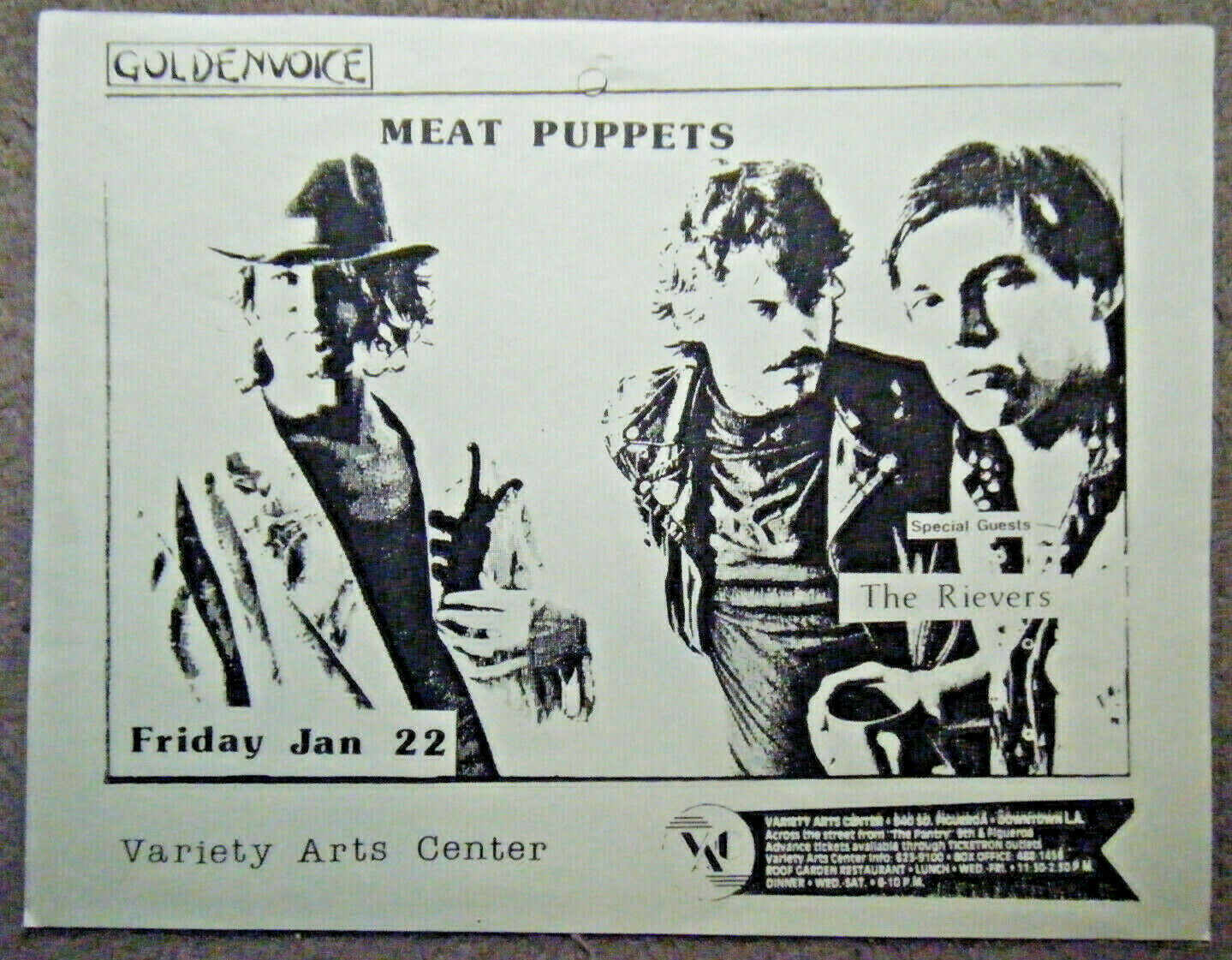
That wasn’t a happy thing to realize. I’d been 17 once. I still haven’t recovered from my own formative experience back in 1988 when I saw the Mirage/Huevos-era Meat Puppets at Variety Arts Center in L.A. I was a teenaged square amidst 1500 freaks of the universe at a cheap, all-ages gig headlined by true goners: enduring the Kirkwood brothers’ 20-minute encore cover of the Beatles’ “She’s So Heavy” left a much deeper, richer impression on my tender, gradually opening mind than seeing U2 and the Pretenders at the Coliseum a couple months before. That was a painfully loud, stage-managed spectacle, a queasy mix of overwhelming power, machine precision and mass audience; the pajama-clad Meat Puppets, on the other hand, were… well, they were fun. They operated on a scale that was recognizably human. They seemed genuinely off-the-cuff, in-the-moment, willing to misfire. Their single stage prop, a pair of Playboy bunny ears spontaneously draped on a microphone, resonated with me in some deep, pleasantly weirdifying way. That Meat Puppets show pointed to a way out: a different way of leading one’s life—of embracing your idiosyncrasies and weird visions and interests rather than suppressing them. It was like some beautiful rite of passage, an initiation into art and imagination and other people—a sideways welcoming into a more creative, fertile, vibrant, rich way of being. Years later, I’d find out that, of course, I wasn’t the only one who’d undergone such an experience: almost everyone I know who is involved with music as a performer or enthusiast or whatever can point to some bizarro show that changed their life when they were a teenager, that lit up new paths.
I wonder if that kind of experience is readily available anymore to those who want it. I mean, the Mars Volta are amazing, but you have to pay $65 to see them open for the Red Hot Chili Peppers at a basketball arena. Growing are cool, but Arthur Ball is 18 & up. And so on. The sad truth is that although exciting music is regularly performed all over L.A.—at backyard barbecues and loft district rent parties, dive bars and supper clubs, nightclubs and art galleries, high school football games and homecoming dances, city parks and Sunday morning church services, street corners and subways, outdoor amphitheaters and baseball stadiums—maybe the only time when a good number of people of all ages can gather together to witness quality music, at an affordable price, with a good sound system, is when an artist plays an in-store set at Amoeba Music on Sunset Boulevard. Kudos to Amoeba for providing this basic public service to arts-starved Angeleno teenagers, of course—it’s more than the public schools and mainstream broadcast media do—but surely it’s not a positive indicator of a culture’s health when the best venue for all-ages music is a record store. ‘Dancing in the aisles’ should mean something more than grooving politely in the Used Funk/Soul section as cash registers ring in the distance.
We lose something as a society when we don’t allow our youth to experience music—by which I mean real, living, breathing music, as opposed to commerce-driven pop—in a decent, accessible, affordable, relatively intimate setting where music is given the opportunity to be truly experienced as music. Something has gone wrong here. But what has happened, exactly, to get us to this point? And is it just Los Angeles, or is it nationwide? What can we do about it? What did they do in the past?
I decided it was time to call John Sinclair.
During the 1960s, John Sinclair founded the Detroit Artists Workshop, managed the MC5, headed the anarchist White Panther Party and got thrown in jail for 10 years for giving two joints to an undercover cop. He was freed after serving two years due to the intervention of John Lennon, who wrote a song for him and appeared at a 15,000-plus arena rally to bring attention to Sinclair’s case (check out the “The US vs John Lennon” documentary for more details). He is a renowned poet, scholar, deejay and journalist, and at 64, still a towering presence. We talked about all-ages shows outside a brandname coffeeshop in Culver City over half-finished crossword puzzles.
John Sinclair: Here’s a point I want to make about this right off: This whole ‘age’ thing is a function of the whole white American culture—it isn’t a universal thing. When I was coming up, you had no congress with anyone more than two years older or two years younger than you, unless they were your brother and sister. You had no congress with adults, with anybody but your own age peers. Everything you did was around that; we were alienated from all the others.
Now, I grew up listening to blues and R&B on the radio in the Fifties. I’m not into country music. I avoided it like the plague. I came from a farming community, and I didn’t want no part of that! Once I heard black music on the radio, I wanted to be where those people were. They were having a lot more fun than anybody I knew, and then when I started going to their dances. It was a beautiful thing. They had big shows in Flint, Michigan. Rhythm and blues shows. I saw everyone that came to Flint between 1955 and 1960. I went to these rhythm and blues shows and there’d be 3,000 black people and 20 white kids who were music freaks and liked to dance. The thing that hit me the hardest about these shows was that there were people of all ages there: little kids, grandmas, and most of the crowd was young adults who were older than us. The teenagers like us were only a stratum. There were people in their 60s, people in their 40s, the finest women you’d ever seen in their 20s just dressed to the nines, red dresses and shit. Knock your eyes out. And there’d be little kids running around and it was no big deal. And the people who wanted to have a drink, they had a flask in their pockets. If they wanted to smoke a joint, they had a joint. It was just like going to a different planet. It was so much hipper. And they were also so accepting. It wasn’t like you would be nervous about being there. They’d let you have your fun, you’d dance with the black girls. It was just like being in heaven for me, man. Because where I lived, I hated everything.
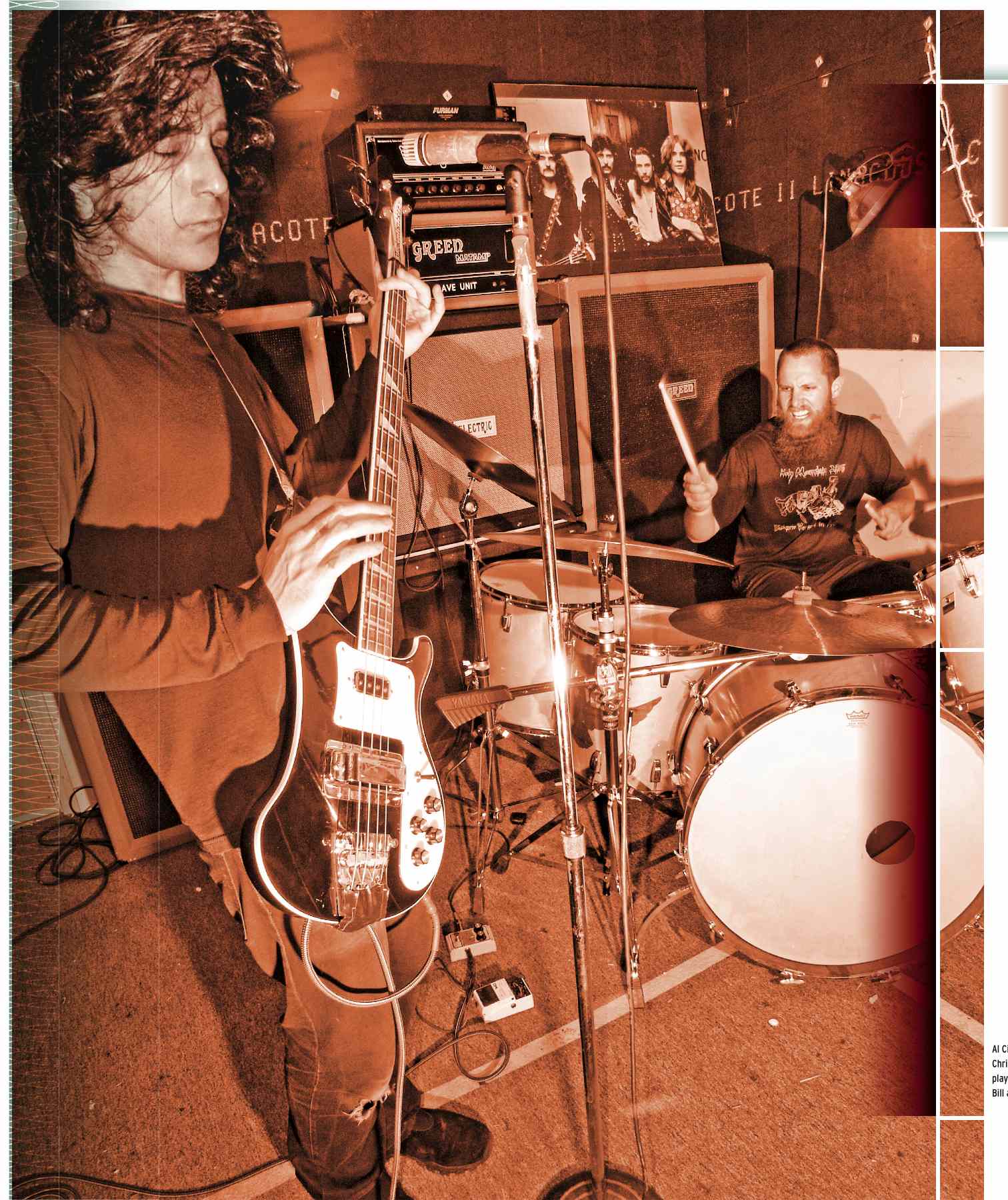
Page from article. Photograph by Lars Knudson, design by W.T. Nelson. Bassist/vocalist Al Cisneros on left. Drummer Chris Hakius, pictured right. Note Black Sabbath altar.
“Most High”: How—and why—Om builds its minimalist, contemplative metal Text by Jay Babcock
Photos by Lars Knudson
Art direction by W.T. Nelson Originally published in Arthur No. 22 (May 02006)
Sleep were a tightly focused, intensely dedicated super-heavy riff band from the San Francisco Bay Area who gained a small but devoted following during their time. Even if, like me, you never listened to a note of their music or saw them perform, you probably heard about these guys somewhere: they were the monastic goners who delivered an hour-long narrative song (about caravans of marijuanauts and weedians crossing riff-filled desert lands on an epic drug run) to their record label as their big-label debut (and third overall album)—and then disappeared in the proverbial cloud of smoke… The song/album “Jerusalem” was never released by London/Polygram, the band split up, years passed. Eventually, in 1999, “Jerusalem” was released under still-mysterious circumstances (a better version, entitled “Dopesmoker,” is now available) and the Whispers With Smiles From Those Who Know were proven right: this was a breakthrough masterpiece—deceptively repetitive minimalist heavy metal of such single-minded all-vision that every ridiculous element of the project was rendered sublime by minute three.
When ex-Sleep guitarist Matt Pike’s new band High On Fire debuted in late ’99, it was easy to think this would be the closest you’d ever get to witnessing the now-legendary Sleep: the music heavy yet progressive, the songs endless, the lyrics suitably Old Testament. It was not a repeat of Sleep—there was more emphasis on high velocity—but it was innovative and staggering in its own right.
A closer (which is not to say superior) continuation of “Jerusalem”-era Sleep surfaced in 2004, with the release of Om’s debut album, “Variations on a Theme.” Om was ex-Sleep bassist/vocalist Al Cisneros and ex-Sleep drummer Chris Hakius: a power duo without need of a guitar. “Variations”’ three songs clocked in at 21:16, 11:56 and 11:52. Cisneros’ lyrics—sung (“bravely,” as one friend put it) in an affectless drone-chant—echoed “Jerusalem” but had lost their weed-centricity and become even more hallucinatory; “Approach the grid substrate the sunglows beam to freedom/Winds grieve the codex shine and walks toward the grey” is a typical couplet. A new kind of purity—thinner but deeper, maybe?—had been achieved.
Om’s second album, “Conference of Birds,” is released this month. It has two songs, each over 15 minutes in length. The first, “At Giza,” takes Cisneros and Hakius’ music to an even sparer place of un-distorted bass, drums and vocals. As with these guys’ previous work in Sleep and Om, “Giza” points out new horizons even as the duo hone their own gaze ever sharper.
I spoke with Al Cisneros by telephone from his Bay Area home in late March. Here’s some of our conversation.
Originally published in Arthur Magazine No. 12/Sept. 2004
“One Nervous System’s Passage Through Time”: Magic works, says genius comic book scribe GRANT MORRISON, and he would know—he’s been exploring it for 25 years. He talks with Jay Babcock about what he’s experienced and What It (Maybe) All Means.
Cover illustration by Cameron Stewart.
Although he has claimed to be an heir to an immortal space dynasty who stays cheerful by imagining that aliens “will probably be turning up to rescue him any day now,” Grant Morrison was in fact born in 1960 to a pair of liberal activist Earthlings. Growing up in the slums of Glasgow, Scotland, where he was brought up by his mother while being “barely educated” in public schools, Morrison developed an early enthusiasm for all things pop and fantastic: rock n roll music, science fiction and fantasy literature, mythology and the occult, punks, mods, beatniks and, of course, foxes and cats.
But the early love that would bear the most fruit was for comic books, which he began writing and drawing as an adolescent. Foregoing higher education and living on his own in a Glasgow ghetto from age 19, Morrison gradually built a career as a comics writer of prodigious imagination, armed with a sense of humor: the title of his first published story was “Time Is a Four-Lettered Word.”
After years of toil writing in the British sci-fi comics world while making psychedelic mod-pop with his Glaswegian band The Makers, Morrison landed work at American publisher DC Comics, where his deeply unsettling Batman graphic novel Arkham Asylum, illustrated by Sandman cover artist Dave McKean, was published in 1989. It remains Morrison’s bestselling work but in the wake of his work since then—his two-year run on Animal Man, in which the lead character, refashioned as a superpowered animal-rights activist, gradually becomes aware that he is a character in a comic book; four years of Doom Patrol, a deeply Surrealist four-color romp starring a superhero team of mental patients; shorter works like the multi-meta-superhero comic Flex Mentallo and the controversial-for-obvious-reasons Kill Your Boyfriend; The Invisibles, an epic for would-be technoccult anarchists; and The Filth, a seriously dark and bizarre 13-issue series, discussed at length in this interview—it seems relatively minor.
“You don’t get much time on Earth to do stuff, so I like to keep busy,” Morrison told one interviewer last year, and so he has: in addition to the aforementioned work, Morrison recently completed a 40-issue run on New X-Men and Seaguy, a picaresque three-issue series drawn by this Arthur’s cover artist Cameron Stewart; an original screenplay for Dreamworks; and scripts for two more three-issue series debuting in the next few months, We3 and Vimanarama.
Recently returned from a wedding honeymoon that included a week’s stay in Dubai (where “they’re building the 21st century out of sand,” he says), Morrison spoke at length by phone from his Glasgow home about the whys and wherefores of his work, his life and the Present Situation in Our World.
Arthur: Did you see the news about the super-strong German toddler? I was reminded where you were saying your run on X-Men was a set of fables for the coming mutant, which you thought might already exist or be on their way.
Grant Morrison: I figured even within 50 years we’ll probably have quite a few superhumans on the planet. There’s something about the superman idea that’s pushing itself closer and closer to reality, to the real-life material workaday world that we can touch. The supercharacters began in the pulps and then worked their way through comics, and they keep moving to more and more extensive mass media. Now it’s everywhere, and it’s become the common currency of culture. I said, way back, almost joking, that I thought the super-people were really trying very hard to make their way off the skin of the second dimension to get in here. They want to be in here with us. They’re colonizing people’s minds, and they’re now colonizing movies, so the next stage is to clamber off the screen into the street. I think what you’re starting to see, with things like this weird kid, and also the experiments that are going on with animals, the cyborg experiments and genetic manipulation that is now possible, is that pretty soon there’s gonna be super-people. You’ll be able to select for superpeople: “I want my kid to have electric powers.” That kind of thing.
And when supermen do come along, what are they gonna want to find? A role model. Like everyone else on the planet. We all want to find people who’ve trod our path before, who can suggest some ways to help us feel significant. So the idea behind a lot of what I was doing in X-Men and really all of my comics is to give these future supermen a template, to say “Okay you’re a superhuman, and maybe it feels a little like this. I’ve tried really hard as one of the last of the human beings to think what it might be like in your world.” Rather than bring them to us, which is what a lot of superhero fiction in the past has tried to do, I’ve tried to go into their world and to understand what’s going on in the space of the comics, and to try and find a way to make that into a morality, almost, or a creed, or an aesthetic, that might make sense to someone who has yet to be born with powers beyond those of mortal man. I think we have to give them images of rescue and ambition and cosmic potency, rather than images of control and fascist perfection.
Arthur: Can a cartoon code of ethics really deal with real-world subtleties?
In a sense it is a cartoon code of ethics, but these will be cartoon people, having to live in a real world. And I think the cartoon code of ethics stands up as well as anything Jesus came up with. Don’t kill. Don’t let bullies have their way. Use your powers in the service of good. I think we should be focusing towards that, rather than providing images of destruction or of despair.
Purely on a conceptual level, the Justice League were created to solve every possible problem, right? [chuckles] That’s what they’re there for. They never fail. These are things that the human imagination has created and put on paper and they exist – they have a more than 40 years’ lifespan. Still existing, still clinging to life, these images. So I think if we’ve created something in our heads that’s so beautiful and so strong and so moral that it can solve all our problems with justice, intelligence and discrimination, then why don’t we use it? Tap into it a little more and understand what these images mean and what they can do for us beyond the obvious. Why was Superman created? That’s the really important thing. What kind of imaginative need was being served by that? And to access that again, to make it vital again, to empower the fiction again, I think, would help our culture deal with some of the implications of its own future.
We have to hang onto the immense power of that imaginative world. Every creed, every weapon, every invention or symphony began as an idea in someone’s head. We’re very good at making insubstantial ideas into physical artifacts or systems of conduct—which is magic, of course, humanity’s greatest skill.
Yeah, you can imagine that the first Aryan superman will probably crawl out of his test tube and want to subjugate us all with the hammers of his fists, but by using the power of imagination right now maybe we can provide his mighty brain with something better than conquest to think about.
The movement pulls away from the mainstream and gets apocalyptic
By: JAMES PARKER
“In the United States,” wrote novelist and poet Jim Harrison in 1976, “it is a curious habit of ours to wait for the future when it has happened already.” Thirty years on, how much deeper is that swoon of postponement, and how much more pressing the crisis. In weather systems, in belief systems, the planet condenses with rage; the blandest recital of the facts can shake the air like a Yeatsian prophecy. Faces averted, we peck out text messages. At the political level the most complex issues are debated in the style of barking dogs, while at the counter of your local Starbucks a man is placing an order as nuanced and sophisticated as a 17th-century sonnet. And on the street the Hummers roll, driven by small, blond college girls, as if America had invaded itself.
But if the future won’t stop happening, neither will the past. Because here’s both the good news and the bad: the ’60s never ended. That decade’s chaotic drive toward collective rebirth — stalled, dissipated, betrayed, backlashed, and broken down — was not (it turns out) the endpoint, but the augury. “The Sixties,” says Daniel Pinchbeck, author of 2012: The Return of Quetzalcoatl (Tarcher/Penguin), by phone from New York City, “were an attempted voyage of initiation on a mass-cultural level, but at that point it couldn’t be completed. The maps weren’t there, there were no guides, and a lot of people kind of lost it.” Pinchbeck, a thirtysomething former journalist who has transformed himself — with the help of mind-ripping pharmaceuticals and organic hallucinogens like iboga and ayahuasca — into a multi-disciplinary critic of the “design problems” in Western civilization, is standing by for the next stage. “There’s some kind of process of assimilation that required those currents which came out so powerfully in the ’60s then to go underground and become subliminal,” he says. “But they’ve had a major effect on people in the West, whether through access to indigenous shamanism or in the extraordinary growth of yoga, and in a way they’ve been preparing the container so that if we were to go through another kind of initiatory level, there would be people ready to hold it together.”
Shamanism? Yoga? Welcome to the New New Age — the just-in-time resurgence of the holistic, anti-materialist worldview, garbed in esoterica, brandishing its own style of drugs and music. And brace yourself for a major paradigm shift: at the vanguard of the armies of transformation is … Sting! “Daniel Pinchbeck’s 2012,” he blurbs on the book jacket, “is a dazzling kaleidoscopic journey through the quixotic hinterlands of consciousness.” Yes indeed, someone got his message in a bottle. “I became friends with Sting after my last book [Breaking Open the Head],” says Pinchbeck. “He got in touch with me and I actually stayed with him in his house in Italy.
“He’s had contact with indigenous shamanism, and he’s aware of the importance of the material. He’s kind of like an elder statesman, and he’s been giving me a lot of support.”
The sins of the old New Age, of course, are still with us: Celtic muzak, little polished rune-rocks, bumper stickers that say THE GODDESS IS ALIVE AND MAGIC IS IN THE AIR! Seeking balm for the psychic wounds they had sustained in the ’60s, ex-hippies opted en masse for a sort of consoling and watered-down paganism: ancient energies were domesticated, to the point where almost anyone could have a print from the Mahbarata on their kitchen wall, or an Odinist living downstairs. “The original New Age was a little bit on the flimsy side,” says Pinchbeck. “Channelling, UFOs … all that stuff was kind of floating out there. What I’m trying to do with the new book is to show that it’s possible for someone with a rational modern intellect to go through this material in a reasonable way, and to integrate Western philosophy with this shamanic/psychedelic worldview.”
What most viscerally separates the New New Agers from the old is their crisp and eager apprehension of imminent system crash — what our inheritors, stumping for food in the poisoned mud flats, may well call The Great Unraveling. Take, for example, the words of eco-philosopher Derrick Jensen, author of Endgame, in a recent interview. Asked if he truly wants civilization as we know it to fall, Jensen responds: “If civilization had come down 200 years ago, the people who live here would still be able to support themselves. But if it comes down in another 30 years, 50 years, 60 years … So even from the purely selfish human perspective, yeah, it would be good for civilization to end. The sooner this civilization goes, the better, because there’ll be MORE LEFT.”
Jensen gave this interview to Arthur magazine, a lavishly appointed free bimonthly out of LA whose columnists include Sonic Youth’s Thurston Moore and media theorist Douglas Rushkoff. Since October 2002, Arthur’s editing/publishing team of Jay Babcock and Laris Kreslins has been busy streaming the revelations and imperatives of the New New Age into pop culture, where the kids can get at it. Arthur, called “the American counterculture’s answer to the New Yorker” by the London Guardian, has become the place where the ideas meet the music; where Jensen’s freefall apocalyptics can sit with total aptness beside a piece on nouveau hippie swooners Brightblack Morninglight. The same issue begins with a column about mint tea and ends with a list of “sensitive weapons” (e.g., shotgun shells taped to the end of a BB-gun barrel) for use when the grid collapses and Devendra Banhart fans are called upon to defend their homes and woolly hats.
Arthur has saturated itself in the ’60s, via features on the Weather Underground, the MC5, the 1967 March on the Pentagon, and also in the post-psychedelic slant of the music coverage. But there’s nothing regressive here. From the freaky folkers to the acid rockers, Arthur bands have their eyes on the advancing historical horizon: the same rumble of tribal disturbance is heard beneath the dragon-groan of SunnO))) and the fey, brilliant stylings of harpist/singer Joanna Newsom. A tastemaker and an advocate, Babcock has probably done more to promote and consolidate this intangible consensus than anybody else. He calls it “naturalismo.” [That’s a term coined by Devendra Banhart, actually. -JB]
Daniel Pinchbeck used to write for Arthur, as (full disclosure) did I. I stopped because I could no longer afford to write for free; he — rather more nobly — was fired, after submitting a post-Katrina column in which various apocalyptic scenarios of military clampdown were hypothesized.
Babcock smelled “Art Bell–style” paranoia (referring to the conspiracy-mongering host of radio’s Coast to Coast AM), and wouldn’t print it; Pinchbeck recoiled, hurt. “I think Jay’s aiming more at the mainstream,” he says. “He wants his magazine to be the new Rolling Stone.”
What is beyond dispute is Babcock’s commitment to reaching “every generation of bohemian currently living.” “When we run a piece about the MC5,” he says by phone from LA, “it’s not just to educate the youth or to remind ourselves of something. It’s also to say to the original people: your work wasn’t forgotten, and maybe you should pay attention to the kids who are interested in what you did. I think they’re going to start to come back, the ones that went back to the land and just disconnected from contemporary culture for the last twenty years — and they’re gonna find that they have more in common with these kids in their teens and twenties than they do with their fellow retirees at this point. And I don’t even KNOW where that could lead.”
Babcock’s most recent and widely-broadcast prank was an interview showdown with Sully Erna, over the use of Godsmack music in Army-recruitment ads. Unimpressed with his own generation’s efforts at protest, he is trusting to demographics to get the job done: “By 2010 we’ll have a youth bubble, a huge population under 25. And they’ll be stronger, more willing to take risks, to cope with transformation — even to demand it. Who will be their leaders? What kind of culture are they going to inherit? So that’s part of what we’re doing — to try and preserve, elevate, incubate if you like, these ideas.”
The imminent crisis, the next initiatory level — Pinchbeck’s “prepared containers” and Babcock’s wised-up and transformation-ready youngsters. What the New New Agers all agree on is that change is not over there, but here: vast, cruelly accelerated, streaming with possibility. “I’m trying to define this transformative process,” says Pinchbeck, “but it’s already under way.” “Right now,” says Babcock, “we’re like the Beatniks of the Fifties — a little isolated, a little dispersed, driven a little crazy by the culture.
“But different, too. Because unlike the Beats, we have the benefit of knowing that the hippies are coming.”
Arthur editor Jay Babcock will guest on national progressive radio network AirAmericaRadio’s “The Marc Maron Show” on Wednesday, May 31 . He’ll be discussing the Arthur vs Godsmack kerfuffle and also Arthur’s forthcoming CD (curated by Josephine Foster) which will benefit anti-military recruiting campaigns. It’s going to be AWESOME.
Listeners on the internet can stream live at www.airamericaradio.com while the show is on the air. Air America Premium members can podcast and hear archived shows they missed.
MORE INFO ON THIS WHOLE RUCKUS:
Transcript of the Arthur v Godsmack interview (May 1, 2006), with Introduction, Afterword and Footnotes: www.arthurmag.com/magpie/?p=1244
Godsmack are a millionaire hard rock band who have sold millions of records in the last eight years. Their fourth album, “IV,” was released on April 25, 2006. It sold 211,000 copies in its first week in the USA to debut at Number One on the Billboard chart.
Several weeks previous, I had been solicited by Godsmack’s record label and publicist for press coverage. Ken Phillips, the band’s publicist told me on May 3, after the interview had been conducted, that he had “assumed that it would be a feature about the new cd, tour and what the band has been doing since the last release.” The latter is all that I was able to discuss with Godsmack frontman/lyricist/producer Sully Erna on Monday, May 1 by telephone before he hung up on me mid-sentence, and refused to answer any further questions over the following days.
Here is the full transcript of our conversation. — Jay Babcock (Editor, ARTHUR Magazine)
Feature article published in Arthur No. 23 (July 2006)