Cognitive scientists use the term “Magical Thinking” to describe a lack of causal reasoning. According to them, the belief in superstitions, lucky charms, and rain dances often falls into this category. But the term can be applied to any situation where one makes judgments based on a cause-and-effect rationale that wouldn’t hold up under scientific scrutiny. Simply put, magical thinking is (from a cogsci perspective) the analytical by-product that occurs when your hopes, fears, desires, prejudices, and beliefs take over your decision-making.
Child psychologists often use the term slightly differently. For a child, magical thinking often refers to conditions in which the cause and the effect are disassociated. For example, the kid sees you grab a remote control from the table and hears the stereo turn on, but doesn’t yet understand that the two actions are related. It is primarily this aspect of magical thinking that stage magicians rely on when performing illusions. In feats of magical reverse engineering, a good magician will think about a desired effect to be produced, and then work backwards to plan the method. The success of the effect is then greatly enhanced by the magician’s ability to conceal the method from the audience. In essence, the magician returns the audience to a state of child-like perception where causes and effects are distant strangers. Some embrace this sense of wonderment while others resent the inflicted feelings of naiveté. Yet, it should be noted that while such magical thinking evokes a child-like sense of the world, it does not limit us to childish behavior.
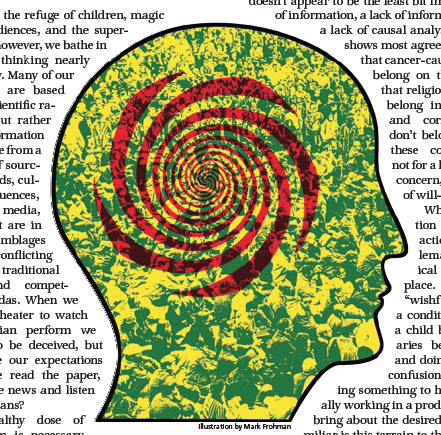
It would be easy to believe that magical thinking is merely the refuge of children, magic show audiences, and the superstitious; however, we bathe in magical thinking nearly every day. Many of our decisions are based not on scientific rationale but rather on information we receive from a variety of sources – friends, cultural influences, mass media, etc. And many of these sources are in fact assemblages of conflicting truths, traditional bias, and competing agendas. When we enter a theater to watch a magician perform we expect to be deceived. But what are our expectations when we read the paper, watch the news, and listen to politicians?
This past Saturday afternoon Arthur Magazine presented an L.A. River Beautification Meeting featuring a performance by NO AGE–a community gathering action in celebration of public space and nature amongst the urban sprawl, powered by a single generator we rented for $58 from a supply store.
Unfortunately, the beautiful, peaceful, all-ages, free public gathering was interrupted by sadly misguided Mountains Recreation and Conservation Authority rangers who, working with a dubious understanding of the law, announced by megaphone 19 minutes into No Age’s performance that the band and audience were not allowed to be in or near the riverbed. (Apparently we were supposed to be shopping at the mall or watching sports on television rather than gathering together down by the river as people were doing long before “Los Angeles” existed.)
Still, the event was a wonderful, worthwhile endeavor. Joshua Pressman shot some pix and wrote an account (“What could have been a humdrum Saturday afternoon turned out to be the most memorable I’ve had this entire year”) at LAist.com.
Mark Frohman & Molly Frances of colornational.com shot and edited a film of the event in a single evening. Here it is:
Part one: gathering and music…
Part two: more music…
Part three: busted…
“Did you know you can rent a generator for $52 and set up and play ANYWHERE until the cops come? So do it, do it and send me the pictures. It was such a radical spectacle. You forget that you can do this kind of thing. They made it through 4 songs. And then the cops showed up. Asking everyone who was in charge of this, and nobody knowing. A funny flurry of activity, people packing up and getting out of there. One of the more memorable moments of the Fall. A rich afternoon.” Wonderful photos and account by Cali at teenageteardrops.abstractdynamics.org/archives/009882.html
“Do the Math” column originally published in Arthur No. 26
BLANK IN THE FILL by David Crosby Reeves
“For those who stubbornly seek freedom, there can be no more urgent task than to come to understand the mechanisms and practices of indoctrination.” —Chomsky
In the days of President Carter, a fluoride program went through the public schools called ‘Swish and Spit.’ First grade students were given permission slips and told to bring them back with a parent’s signature. I was a good kid then, eager to prove myself. I took my permission slip to my mother. She put it aside and didn’t sign it.
The day the ‘Swish and Spit’ program was implemented, Ms. Goldie brought out a bottle of red fluid and told everyone, ‘This is fluoride, and it tastes good.’ It looked like cherry Kool-Aid. I never got to taste it because I didn’t have my permission slip.
I was left alone while the other kids went to the sink and did the Kool-Aid. ‘Swish and Spit’ was just that. Everybody came back with red tongues like they had eaten a Slushy.
Ms. Goldie came to me, wanting to know where my slip was. I had a sense that this was one of the first tests of this new thing called School, and I was eager to be good. I wanted to drink the Kool-Aid to commune with the other kids, the kool kids, and become one with the institution.
So when I get home I told Ma, ‘I got to get this thing signed!’ ‘What is it for?’ she wanted to know. I explained that the ‘Swish and Spit’ was good for me, harmless, and probably cherry Kool-Aid.
‘What did I tell you about people coming to you with candy?’ my mom asked me. She went on about how the product was manufactured to look like candy so that I would want it, but we didn’t know what was in it.
My argument was, Sure we know what’s in it: fluoride. It makes strong teeth. But Ma wasn’t signing it because she said the government should not be giving you anything, nor should you trust them to give you anything. It sets a bad precedent. And why would a government that cares so little about your health that I can’t afford health care suddenly care so much about your teeth?
Old people cry, young lovers smile and cynical hipsters get confused when she’s onstage. What is Lavender Diamond’s love-and-ecology frontlady BECKY STARK up to?
By Jay Babcock, with photography by Mark Frohman & Molly Frances Originally published in Arthur No. 26/Sept 2007
Recently Becky Stark and her mother dropped in on Arthur’s Thursday social at a pub in Los Angeles. Talk about the fruit not falling far from the tree: Diane Stark, an ordained minister serving at the Unity Church of Practical Christianity in Grand Rapids, Michigan, effortlessly owned the place. At a table of Becky’s friends, she told stories about her own mother, a spiritualist who gave public lectures on metaphysics in the ‘40s and completed an unpublished book entitled “The Meaning of Love.” She talked about working as a stripper on Sunset Boulevard in the mid-1970s; about witnessing Martin Luther King, Jr. give his “I Have a Dream” speech; about her own life philosophy (“I like to act as if I’m inside a fable”); about how you should hold a loved one when she’s asleep; and, of course, about Becky being born (“She was happy to be here”). Then someone put on Link Wray and it was time for the Stark women to dance—or, as Diane put it, “have a conversation at the energetic level.”
If that doesn’t explain Becky Stark, here are some other true stories. One of the first books she read was a collection of Gandhi’s writings given to her by a friend of the family who was active in the nuclear freeze movement. She joined the League of Women Voters at age seven and in seventh grade, traveled through the Soviet Union with 13 other American kids as part of a cross-cultural exchange initiative called Peace Child. The three-week tour included a stay with 500 Soviet kids at a Young Constables youth camp on the Volka River and participation in a youth choir performance opening for American poodlerockers Skid Row at the Moscow Peace Festival in Red Square. (“Peace Child” was the title of a hit song in Russia, and Becky can still sing it on demand.) From eighth to tenth grade, Becky was the head writer, anchor and host of “Kids’ Point of View,” a weekly 20-minute television show sandwiched on UHF between the World Wrestling Federation show and Gorgeous Ladies of Wrestling. At 14, she started a local youth chapter of the National Organization of Women. As a teenager, she developed her range by studying modern and romantic opera (as well as Tin Pan Alley and other classic American pop music), but her opera singing career was ended when her body failed to develop the large lung capacity required to sing at a professional level. She studied Russian as a Comparative Lit undergrad at Brown, and dance at the Merce Cunningham Conservatory in New York City. In 2000, Time Magazine published a photograph of Stark wearing a bright yellow dress levitating in front of riot police during a protest march at the Democratic Convention. In 2003, she toured across the country with Xander Marro, performing “Birdsongs of the Bauhauroque,” an operatic fable/comedic poem involving puppetry, keyboards and costume drama. Returning to Los Angeles, Stark worked a series of comical dayjobs and started performing solo as Lavender Diamond and doing stand-up at the Improv and other comedy clubs
Over the next two years, Lavender Diamond evolved from a one-woman act into a four-piece symphonic folk-pop band featuring composer Steve Gregoropoulos on piano, Jeff Rosenberg on acoustic guitar and Stark’s boyfriend, the cartoonist Ron Rege, Jr., on drums. The band’s sadness-and-ecstasy four-song EP The Cavalry of Light was self-released in 2005. At ArthurFest that year, they played into the sun with such beauty that left many (including poet Charles Potts) teary-eyed. During the next year, as they were recording with Vetiver/Brightblack Morning Light/Devendra Banhart producer Thom Monahan, Lavender Diamond were signed by the legendary Geoff Travis to Rough Trade in Europe and then to Matador in North America.
Imagine Our Love, Lavender Diamond’s debut full-length, was released earlier this year to the kind of divided response the band has often received live. Stark’s Lavender Diamond persona is unique: think of a cosmic grade school teacher, or maybe Mary Poppins, returned to talk to you later in life, heartbroken at first to have to remind her former pupils about the importance of sharing and respect for Nature, but happy to encourage you to do better, using music, humor and imagination. When Stark sings “You broke my heart” over and over, pointing her finger directly at specific audience members, it’s a loaded—transgressive, even—move in a culture built on evading responsibility; you can see how it might not fly with every jaded urban hipster. But Lavender Diamond’s music is for the entire school, not just the kids too cool to be there. It’s pop music for peace, simple songs pitched somewhere between Linda Ronstadt, Jefferson Airplane and Yellow Submarine. Or, as Stark says, “It’s lovesongs to the world.”
Here’s part of our recent conversation.
Arthur: So many people think you’re being ironic. Does that bother you?
Becky Stark: I thought our music was simple enough for anyone to get, and so it’s kind of confounded me when people think we’re joking. Why on earth would we do that? Every time anyone asks if I’m serious about celebrating peace on earth I have to say, “Are you seriously asking me that question?” For real. I’m the weirdo? For talking about peace? In the midst of a horrific insane war? What? What have things come to that people think it’s a joke to play music that celebrates peace? I guess that in the performance of Lavender Diamond I am trying to create an antidote to the degradation of our times—it’s like we are trying to run an interference pattern. It’s pretty extreme, and maybe that’s why people think it couldn’t be sincere. I think it’s our responsibility to be understood. Maybe some people think we’re kidding because we look silly. Well, I’ll have to work on my delivery and fashions so that we are taken more seriously. Maybe I’ll have to start wearing all grey and black and frowning! Seriously…maybe we just have to be more elegant…? More sexy? We’ll keep working on it. I probably need to be more dignified and not as loopy. If we’re being misunderstood, it’s because we’re not being powerful enough or intelligent enough in our communication.
Talk about the source for the title “Imagine Our Love.”
Ron [Rege, Jr.] was reading Peace Is Every Step by Thich Nhat Hanh and came across the phrase “imagine our love” in a passage about covering the world with loving prayer. Thich Nhat Hanh is a peace activist from Vietnam who was brought to the U.S. by Martin Luther King, Jr. in an effort to end the Vietnam War. Peace Is Every Step teaches how to cultivate the strength and power of a loving heart, about love and communication. How to be a peaceful person—a warrior of peace. He talks about how the people he was with in Vietnam had to heal from the war. It is very beautiful and inspiring and heartbreaking. He’ll be at MacArthur Park in Los Angeles leading a peace walk in September. Peace is every step!
Is peace enough?
Yes. That’s the definition of peace, I think: understanding that we already have enough. Peace, by definition, is enough.
What do you think music is for?
Music is for celebration, for having a great time. Music is like touch, language and medicine: it’s for healing, for uplifting. Music is a source of strength for people in a time of trouble. Music gives people a way of expressing joy and sorrow. Music is for communicating poetry and new ways of living and being, for communicating ideas of how we can transform our world and guide it into liberation of the mind and spirit.
The whole world seems to be getting stupider a la Idiocracy‘s predictions. Have we entered a new Dark Age, and if so, how can smart people—the ones who aren’t sharks or demagogues—survive in a devolving situation?
We have to be smarter. We have to grow. We have to evolve ourselves consciously—by being part of the consciousness revolution. We have to build the understanding of the nature of consciousness until it is understood as a fact like the world being round. People have to understand the reality that all of us have power and responsibility and that everyone matters. Everyone is you. The paradox of your own individuation—how at once your life can be whole and part, like a grain of sand—is a source of great pleasure and mystery. What a glorious paradox! It is liberating to discover that your life has meaning, whether you like it or not.
It’s a good thing that our terracidal economies are coming to an end, because our ways are not sustainable. We have to build new models that work so that when the current idiotic models come crashing down, we can be ready with the new ones. An end is a beginning. We have to build the new beginning! We have to be mischievous and intelligent. We have to build templates and demonstrate how to live in a sustainable way. That way it’ll be all figured out and everyone can just copy. We have to make harmonious living delightful. And exciting. And awesome. We should make eco-amusment parks. We could have rides like “It’s a Small World After All”—but everything demonstrating harmony with nature and sustainability. The energy sources for the rides will be transparently built as attractions. We’ll have the artists and engineers create gorgeous, exciting attractions around the energy sources, so that the kids are mesmerized! We’ll have murals, laser light shows. People can come with their families and have a delightful, uplifting, exciting, healing experience that is all powered by the sun and the wind.
I think that if we put our minds to it we can figure out ways to heal our environment. Sometimes I think about public healing rituals for the earth, holistic remedies for planetary toxicity, like our toxic urban rivers. Maybe baking soda would work? The best way to treat completely toxic water is to run it through a system of plant filters. A lot of ferns. Another powerful way to filter water is to run it down a path in the shape of a figure 8—it oxygenates the water. In China, they build gigantic figure 8 sculptures in the parks. I’d love to start an eco-village community that’s built around urban river water usage. That way we can figure out how to clean our rivers and live with them again and teach everyone else to do it too.
And—also—I think the way to progress/survive is to practice radical compassion, to relate to the world in a completely non-adversarial way. It’s a waste of energy to be against anything or anyone. We have to stop wasting energy. Change our energy source. Change our relationship to nature. Change our relationship to each other. Redirect our energy source from fear to love. From limited to unlimited. Perceive no enemies and no limitations. I have a feeling that we can come up with all the solutions we need.
But aren’t some people more responsible for what’s going on than others? Like the rich and powerful, for example. They seem fundamentally different to most people.
I love the rich and the poor just the same—it’s the middle class that’s the problem! Just kidding. It is true that sometimes it is staggering to witness the way that the rich go on with lives involved in the accumulation of power. But the rich aren’t the only ones in the death grip of the paradigm of domination and control—everyone is! Well, not everyone—but a lot of people are. Time to give it up! Sure, debutante balls and Wall Street culture are weird and corrupt but your question smacks of bigotry. Everyone needs healing and needs to grow. We have to stop dividing the world! Stop it! The only way to solve the world’s problems is for everyone to work together and love each other no matter what class you come from. I have friends who are homeless and friends who are billionaires. I used to have a lot of class rage but I’ve given it up completely. I grew up in a poor family, on the wrong side of the tracks (literally—the train tracks were down the block), but I can’t stand all this bigotry. It’s a cult mentality, a false reality. So, stop it. The most beautiful and gentle soul I ever met, who taught me chess and tai chi, inherited billions of dollars when he was 21. He died of a drug overdose on the street a year later. He was so lost. I think if people would have embraced him in our community he wouldn’t have gone astray. Who knows what would’ve happened if he hadn’t died? Maybe he would’ve used his money for good. It hurts my heart, all this dividing everybody up. If you think the rich are different from everybody else, you are operating in the paradigm of domination and control just like all the other idiots! When the earth becomes so toxic nobody can live on it, the rich die too! No one escapes!
Sorry, but you made me mad with that question. Don’t pull that shit. [laughter] There’s no time to fight.
Speaking of dividing up: why aren’t Lavender Diamond playing all-ages shows? It seems like all you played on your last tour were over-21 bars and nightclubs.
We realize that our music resonates for people of all ages so we’re playing as much as possible at all-ages places. We’re organizing a tour to schools where we’ll play with the student bands and choirs. But I do like club shows, though, because you can be more wild and dark.
You once told an interviewer “dancing should be the number one priority of the nation.” But I’ve never seen people dancing at your shows!
Maybe Lavender Diamond is part of the problem! [laughter] People do dance at our shows, but not enough. These days I always wish before the shows that we were making a dance party, but it’s true that we are definitely not making a dance party. That’s why our next record is definitely a dance party record. But yes, Lavender Diamond is part of the problem until we start to make better dancing music. Maybe we need help from the DFA, or M.I.A. Or I could help them, Donna Summer style…?
Who are your favorite dancers? What are your favorite dances?
In terms of historical dancers and choreographers, I love Alvin Ailey, Martha Graham, Merce Cunningham, George Balanchine, Maria Tallchief, so many great dancers from the 20th century. Busby Berkeley! I would love to make a musical film with David Parsons’ choreography. I love Ryan Heffington. I want to do some Gene Kelly-style duets. I really love the Singing in the Rain dance, the dance from the end of Lili, and the dances from West Side Story. I love the dead doll pas-de-deux from the ballet coppelia. I love the Balanchine Firebird dance—it’s psychedelic! Twentieth century ballet is so extreme. I like folk dancing too: the polka, the waltz, the do-si-do, square dancing, all the hip-hop dance grooves. I like West African dances—they organize their dances according to ritual purpose, so there’s a marriage dance and a crop dance and death dance and so on. And in Mali they don’t differentiate between the word for language, medicine, and dance. Everyone dances, it’s like yoga—healing codes and positions for your body. It’s like the opposite of ballet. West African dance is all down and ecstatic; ballet is lifting up and is really masochistic. I like ballet but I like the folk kind, not the masochistic high art style. Although I do really love to watch the great ballerinas, with them it doesn’t seems to be about suffering but is about ecstasy. And I want to dance with Patrick Swayze! The dance from Dirty Dancing. That reminds me that tango is the best dance ever. I also like meditative dance like tai chi.
And—I love Mecca Andrews. She is my favorite dancer, she dances in our video. I can’t wait to make more dances with her. Also I love the way Miranda July dances, she’s a great dancer. I love the way my sister dances and my mom dances. I love the way Ron Rege, Jr. dances, he’s a great dancer! I love the way Maximilla [Lukacs] dances!
I guess I really love the way that everyone dances. Everybody is a great dancer!
CONSPIRACIES OF DUNCES
by Douglas Rushkoff
(from Arthur No. 26)
I have to admit that I do this with some trepidation. I can already feel the assault on my inbox. But after a good long think about potential time and energy being lost by our entire community to senseless and ultimately inconsequential musings, I have to come out and say it: the alternative theories about 9-11 are wrong. Worse, the endless theorizing and speculation about trajectories, explosives, military tests, fake airplane parts and remote control navigation actually distracts some of our best potential activists from addressing the more substantive matters at hand.
Yes, I believe that 9-11 theorizing debilitates the counterculture. It robs us of some potentially creative thinkers. It replaces truly important questions with trivial ones. It marginalizes more constructive investigation of American participation in the development of Al Qaeda as well as its subsequent aggravation. And perhaps worst of all, it is precisely the sort of activity that government disinformation specialists would want us to be involved with.
9-11 theorists are unwittingly performing as the unpaid minions of the administration’s propaganda wing. (At least most of them are unpaid; no doubt, some of the loudest are working as contractors for the same agencies whose activities they pretend to deconstruct.) That’s why, instead of nodding along with their long-winded, preposterous yarns under the false belief that any critique is better than no critique, we—the informed, intelligent, and reasonable members of the war resistance—must instead disassociate ourselves from this drivel. In other words, we must draw the line between the kind of analysis done by Greg Palast and that done by Pilots for Truth. If we don’t apply discipline to our thinking, we risk falling into the trap that even some of our best intellectuals have—like Harper’s editor Lewis Lapham, who on reading a bit too much 9-11 conspiracy, has concluded that it all has some merit.
I’m all for supposing. It’s how the best science fiction gets written, the best science gets speculated, the best innovations get developed, and the wildest thoughts get hatched. But forensics is a different beast. As any detective will tell you, the most straightforward solution is usually the right one. As one NYPD detective explained to me, “Nineteen hijackers took four planes and crashed them at different places: WTC 1, 2, the Pentagon and a field in PA. These accounts broadly correspond to all that was observed and heard that day, who was on the flight manifests, where they came from and what they claimed to want to do, and yet do not involve vast US government conspiracies and do not need the coordinated, perfect lying of tens of thousands of people about the mass murder of their fellow citizens and those they gave their oath to spend their careers protecting.”
True enough, these huge incidents have produced many unexpected details. The plane in Pennsylvania scattered its parts differently than we might have expected it to. Lamp posts near the Pentagon got knocked over when we wouldn’t have thought were vulnerable given the altitude of the approaching plane. Building number 7 fell hours later, even though it was never directly hit by a plane. Video photography of the collapses show the towers falling quite neatly, as if in a planned detonation.
But strange and unexpected details don’t necessarily point to the fallacy of the central premise—especially when the alternative involves the active coordination of thousands, if not tens of thousands of citizens in a conspiracy to attack the United States. We must look at what each intriguing detail or inconsistency actually says about how the crime took place. Again, in the words of my favorite member of the NYPD, “These explanations are principally based on the fatally flawed idea that any confusion or misinterpretation or differing accounts in times of crisis must be the product of purposeful lies. They neglect the idea that in crises, and when there is mass confusion, people do not have specific recollections, only general ones that are highly subjective, such as what direction a plane sounded like it was coming from. Their stories seek to poke holes in prevailing truth, yet offer no alternative that could be seen as remotely plausible.”
For example, the Pilots for 911 Truth website explains: “Why was Capt. Burlingame, a retired Military Officer with training in anti-terrorism, reported to have given up his airplane to 5 foot nothing. 100 and nothing Hani Hanjour holding a “boxcutter”. (Exaggeration added for size of Hani, he was tiny, lets just put it that way). We at pilotsfor911truth.org feel the same as his family in that Capt. Burlingame would not have given up his airplane unlike what is reported in this linked article from CNN.”
What, exactly, is this supposed to mean? Was Captain Burlingame murdered? Or was he the willing participant in the government’s effort to sell the invasion of Iraq to America—so much so that he chose to enter into a suicidal pact? Or was the hijacker bigger than his passport suggests? Or is it implausible that a small dark man from an undeveloped country was able to overpower a big, trained, white man from a Superpower?
And that’s where I suspect all this theorizing really takes us: to the heart of a racist jingoism worse even than the triumphalism justifying our foreign policy to begin with. They can’t bring themselves to accept that our big bad government can really be so swiftly outfoxed by a dozen relatively untrained Arab guys. And rather than go there, they’d prefer to maintain the myth of American hegemony. On a certain level, it feels better to believe that we are only vulnerable by our leaders’ sick choice—not by our adversarsies’ increasing strength and prowess.
But maintaining this comforting illusion comes at a price. It paralyzes our ability to do the real work necessary to parse what is going on. I mean, on a certain level, what does it matter whether Osama Bin Laden, a CIA-trained former ally is currently acting on his own or as an operative of some covert semi-governmental organization or corporation? We can’t even begin to ask these questions when the people who might be most qualified to look into them are instead crippled by their own ethnocentrism.
The cultivation of a critically aware public is too important right now for us to entertain this silliness any longer. When a full 40 percent of the American public believes that Saddam Hussein was responsible for 9-11, we can’t afford the luxury of this delusional behavior. We are the alternative to the FoxNews version of events, and we must strive to present a more responsible alternative to Karl Rove’s disinformation.
The war profiteers are absolutely delighted that so many of us are still distracted by this phantom menace. And they delight in our belief that the central government is really powerful enough to pull something like this off. I’ve been interacting with intelligence people for the past three years, going to conferences and writing articles promoting an open-source approach to national security. After these encounters, I can assure you—anyone who knows anything about our government knows that a conspiracy on this order is well beyond their capabilities. Hell, the administration couldn’t even “find” weapons of mass destruction in Iraq. They can’t even reveal a Valerie Plame or fire the few remaining honest US attorneys without a complete backfire. Conspiracy is not what these folks are good at.
Our government excels at doing its really bad stuff out in the open. They break laws in order to spy on citizens, and refuse to acknowledge objections from lawmakers or justice. They take taxpayers money and give it to the companies they run. They acknowledge the many billions of dollars that go missing, and offer not even a shrug. They put the people who formerly lobbied on behalf of industries in positions running the agencies that are supposed to be regulating them.
By looking under the rug for what isn’t even there, we neglect the horror show that is in plain view. In the process, we make it even easier for the criminals running our government to perpetuate their illegal, unethical and un-American activities.
In fact, the most logical conclusion I can draw from the existing evidence is that 9-11 theorists are themselves covert government operatives, dedicated to confusing the public, distracting activists from their tasks, equating all dissent with the lunatic fringe, and provoking the counterculture’s misplaced belief in the competency of its foes.
That’s the real conspiracy.
Exploring the Voids of All Known Undergrounds Since 2002
by Byron Coley and Thurston Moore
Trans Industrial Toy Orchestra’s Alzheimer Underground LP (Ti Prod) [www.transindustriell.de] is a pip. They are a German troupe where the decidedly fluxus membership play and record by reading words without “e” with nuts cracked in a nut cracker and reading backwards while tearing a sheet. They also utilize record players in aurally illegitimate ways. Sounds dada, bizarre, unlistenable? Actually yes and no: it is indeed a fucked up thing but quite alluring in its tribute to brain blankness.
Very nice slab here from Liverpool’s Solar Fire Trio (Invada) [www.invada.co.uk]. Formed in ’05 by Spiritualized saxophonist, Ray Dickaty, alto player Dave Jackson and drummer, Steve Belger, their eponymous debut LP is classic squee-pileage in the post-ESP tradition. Unlike some Euro players, these three base their sound on loose sonic collisions and and interwoven blather in ripely extended fire-form, all revolving around theories of meat and its ability to burn. Solid, savage blurt.
Debut release by Weak Sisters is a cassette called Subterfuge (Basement Tapes) [myspace.com/boilerroomemissions]. Awesome cut up screams and dead-time pronouncements make this release unbearably savage. The fact that it’s not just wank but pretty taut and focused nihilist sense-slicing makes for killer listening. Weak Sisters is basically a solo spurt of Will van Goern of Other People’s Children and word on the streets of Fort Collins, Colorado is that this tape don’t come close to his live actions. Hopefully, we shall see.
The great Marcia Bassett is rightfully hailed around the globe for her work with Double Leopards, Hotogitsu, GHQ and plenty more. She’s been responsible for some beautiful visual projects as well, but we are here this time to praise her new solo LP, recorded under the monniker Zaimph. Mirage of the Other (Gipsy Sphinx) [myspace.com/gipsysphinx]. This album seems much more flowing and less harsh than the last Zaimph CD (not that flowing necessarily trumps harsh, it’s just different). The combination of voice and guitar here has lots of raspy edge, but there’s a deep gorgeousity to it making the record seem like it’s glowing when it spins. Long lunar notes have rarely sounded so fresh. Gipsy Sphinx also has a fine album by Bear Bones Lay Low [hets.tk] called Djid Hums. This is another solo album, cut by an 18-year-old Venezualan ex-pat living in Belgium. Guitar drones and tape loops pile up higher than kites and there are blasts of fuzz that will tweak every psychedelic bones in yr body. Beware!
Cover photograph by Jose Villarrubia. Art direction by W.T. Nelson.
Magic Is Afoot
Celebrated comics author ALAN MOORE gives Jay Babcock a historical-theoretical-autobiographical earful about the connection between the Arts and the Occult
Gen’rals gathered in their masses/Just like witches at black masses/Evil minds that plot destruction/Sorcerer of death’s construction/In the fields the bodies burning/As the war machine keeps turning/Death and hatred to mankind/Poisoning their brainwashed minds” — Black Sabbath, “War Pigs” (1970)
As author Daniel Pinchbeck pointed out in Arthur’s debut issue last fall, magic is afoot in the world. It doesn’t matter whether you think of magic a potent metaphor, as a notion of reality to be taken literally, or a willed self-delusion by goggly losers and New Age housewives. It doesn’t matter. Magic is here, right now, as a cultural force (Harry Potter, Buffy, Sabrina, Lord of the Rings, the Jedi, and of course, Black Sabbath) , as a part of our daily rhetoric, and perhaps, if you’re so inclined, as something truly perceivable, in the same way that love and suffering are real yet unquantifiable–experienced by all yet unaccounted for by the dogma of strict materialism that most of us First Worlders say we “believe“ in. Magic is here.
It’s the season of the witch. And arguably the highest-profile, openly practicing witch–or magus, or magician, or shaman–in the Western world is English comics author Alan Moore. You may know Moore for the mid-’80s comic book Watchmen, a supremely dark, exquisitely structured mystery story he crafted with artist Dave Gibbons that examined, amongst other things, superheroes, Nixon-Reagan America, the “ends justify the means” argument and the nature of time and space. Watchmen was a commercial and critical success, won numerous awards, and made the tall, Rasputin-like Moore a semi-pop star for a couple of years. Watchmen re-introduced the smiley face into the visual lexicon, the clock arrow-shaped blood spatter on its face studiously washed off by the late-’80s/early ‘90s rave scene. Rolling Stone lovingly profiled Moore; he guested on British TV talkshows; he was mobbed at comics conventions; and he got an infamous mention in a Pop Will Eat Itself song.
Recoiling in horror from the celebrity status being foisted on him, Moore withdrew from public appearances. He also withdrew from the mainstream comics industry, bent on pursuing creative projects that had little to do with fantasy-horror and science fiction and adult men with capes. Some of these projects, like the ambitious Big Numbers, fell apart; others were long-aborning sleeper successes that took years to produce, like From Hell (Moore and artist Eddie Campbell’s epic Ripperology), Voice of the Fire (Moore’s stunning first novel) and The League of Extraordinary Gentlemen (a clever Victorian pulp hero romp in comics form, drawn by Kevin O’Neill); and still others were good-faith genre comics efforts to pay the rent and restore certain storytelling standards to a genre (superhero comics) in decline.
In recent years, Moore’s public profile has been rising again, partly due to the embrace of Hollywood. This summer will see the release of the second high-profile film based on an Alan Moore comic series in three years: a $100-million film version of League of Extraordinary Gentlemen, starring Sean Connery. But like the Hughes Brothers’ 2001 radically simplified, arthouse/Hammer adaptation of From Hell starring Johnny Depp and Heather Graham, League will only have some surface similarity to the comics work that inspired it. That’s down as much to typical Hollywood machinations as much as the sheer unadaptability of Moore’s comics–these are works meant to function as comics. Even Terry Gilliam couldn’t see a way to make a film out of Watchmen. Moore’s comics are as tied to the peculiar, wonderful attributes of the comics form as possible.
Comics is itself where the magic comes in. The comics medium is one of the few mainstream entertainment industries open to folks who are openly into what is considered to be very weird, spooky and possibly dangerous stuff. Alejandro Jodorowsky, best known for the heavily occultist films El Topo and Holy Mountain, has been happily doing comics in France for decades. The English-speaking comics industry, meanwhile, has always been open to these sorts of people; indeed, Steve Moore (no relation) and Grant Morrison had been doing magic long before Alan Moore’s late-1993 foray into magical practice. Comics, it seems, attracts–or breeds–magicians, and magical thinking. Perhaps it’s that the form–representational lines on a surface–is directly tied to the first (permanent) visual art: the paintings on cave walls in what were probably shamanistic, or ritualistic settings. In other words: magical settings. Understood this way, comics writers and artists’ interest in magic/shamanism seems almost logical.
For Alan Moore, as the conversation printed below makes clear, this stuff isn’t just the stuff of theory or history or detached anthropological interest. It’s his reality. It informs his daily life. And it informs his artistic output, which in recent years, has been a prodigious outpouring of comics (his ongoing Promethea series, ingeniously drawn by J.H. Williams III, is by far the best), prose essays, “beat seance” spoken-word recordings and collaborative magical performances–one of which, a stunning multimedia tribute to William Blake, I was lucky enough to witness in London at the Queen Elizabeth Hall in February 2000. I did not get to meet Alan Moore at that performance, but I was able to interview him later that year by telephone. We talked for two and a half hours. Rather, Alan talked and I made occasional interjections or proddings. What I found is that Alan doesn’t speak in whole sentences. He doesn’t speak in whole paragraphs. He speaks in whole, fully-formed essays: compelling essays with logical structure, internal payoffs, joking asides, short digressions and strong conclusions. Reducing and condensing these enormously entertaining and enlightening lectures proved not only structurally impossible, but ultimately undesirable. So here are thousands upon thousands of words from Mr. Moore, with few interruptions, assembled from that first marathon in June 2000 and a second in November 2001. Don’t worry–these conversations are not out-of-date. They were ahead of their time. Their time is now.
Because Black Sabbath told us only half the story. There are other, largely forgotten purposes for magic…
Arthur: How did your interest in becoming a magician develop? How has being a magician affected how you approach your work?
Alan Moore: Brian Eno has remarked that a lot of artists, writers, musicians have a kind of almost superstitious fear of understanding how what they do for a living works. It’s like if you were a motorist and you were terrified to look under the bonnet for fear it will go away. I think a lot of people want to have a talent for songwriting or whatever and they think Well I better not examine this too closely or it might be like riding a bicycle–if you stop and think about what you’re doing, you fall off.
Now, I don’t really hold with that at all. I think that yes, the creative process is wonderful and mysterious, but the fact that it’s mysterious doesn’t make it unknowable. All of our existences are fairly precarious, but mine has been made considerably less precarious by actually understanding in some form how the processes that I depend on actually work. Now, alright, my understanding, or the understanding that I’ve gleaned from magic, might be correctly wrongheaded for all I know. But as long as the results are good, as long as the work that I’m turning out either maintains my previous levels of quality or, as I think is the case with a couple of those magical performances, actually exceeds those limits, then I’m not really complaining.
Arthur: You work mostly in comics, which is interesting, as so many magicians–maguses? magi?–have been involved in the visual arts in the last century. Austin Osman Spare, Harry Kenneth Anger, Maya Deren. Aleister Crowley did paintings and drawings.
Crowley lamented that he wasn’t a better visual artist. I went to an exhibition of his and well, some of the pictures work just because they’ve got such a strange color sense, but…it has to be said that the main item of interest was that they were by Crowley. But yes, there’s that whole kind of crowd really: Kenneth Anger, Maya Deren, Stan Brakhage, Harry Smith. And if you start looking beyond the confines of self-declared magicians, then it becomes increasingly difficult to find an artist who wasn’t in some way inspired either by an occult organization or an occult school of thought or by some personal vision.
Most of the Surrealists were very much into the occult. Marcel Duchamp was deeply involved in alchemy. “The Bride Stripped Bare by Her Bachelors”: that relates to alchemical formulae. He was self-confessedly, he referred to it as an alchemical work. Dali was a great many things, including a quasi-fascist and an obvious scatological nutcase, but he also was involved deeply in the occult. He did a Tarot deck. A lot of the Surrealists were taking inspiration from alchemical imagery, or from Tarot imagery, because occult imagery is perhaps a natural precursor of a lot of the things that the Surrealists were involving themselves with.
But you don’t have to look as far as the Surrealists, really. With all of those neat rectangular boxes, you’d think Mondrian would be rational and mathematical and as far away from the Occult as you could get. But Mondrian was a Theosophist. He [borrowed] the teachings of Madame Blavatsky–all of those boxes and those colors were meant to represent theosophical relationships. Annie Besant, the Theosophist around the turn of the last century, published a book where she had come up with the idea, novel at the time, that you could represent some of these abstract energies that Theosophy referred to by means of abstract shapes and colors. There were a lot of people in the art community who were keeping up upon ideas from the occult and theosophy, they immediately read this and thought, Gosh you could, couldn’t you? And thus modern abstract art was born.
One of the prime occult ideas from the beginning of the last century, which is also interesting because it was a scientific idea, and this was the sudden notion of the fourth dimension. This became very big in science around the end of the 19th century, beginning of the 20th, because of people like these eccentric Victorian mathematicians like Edwin Abbot Abbot–so good they named him twice–who did the book Flatland, and there was also C. Howard Hinton, who was the son of the close friend of William Gull, he gets a kind of walk-on in From Hell, who published his book, What is the Fourth Dimension?
And so ‘the fourth dimension’ was quite a buzzword around the turn of the last century and you got this strange meeting of scientists and spiritualists because the scientists and the spiritualists both realized that a lot of the key phenomena in spiritualism could be completely explained if you were to simply invoke the fourth dimension. Two woods of different materials, two rings of wood, different sorts of wood, but at seances could become interlocked. Presumably. This was some sort of so-called stage magic. The idea of the fourth dimension could explain that — how could you see inside a locked box? Or a sealed envelope? Well in terms of fourth dimension, you could. Just as sort of three-dimensional creatures can see the inside of a two-dimension square. They’re looking down on it through the top, from a dimension that two-dimensional individuals would not have.
So you got this surreal meeting of science and spiritualism back then, and also an incredible effect upon art. Picasso spent his youth pretty well immersed in hashish and occultism. Picasso’s imagery where you’ve got people with both eyes on one side of their face is actually an attempt to, it’s almost like trying to create, to approximate, a fourth dimensional view of a person. If you were looking at somebody from a fourth dimensional perspective, you’d be able to see the side and the front view at once. The same goes with Duchamp’s “Nude Descending A Staircase” where you’ve got this sort of multiple image as if the form was being projected through time, as it descends the staircase.
The further back you go, the more steeped in the occult the artists become. I’ll admit to you, this is looked at from an increasingly mad perspective on my part, but sometimes it looks to me like there’s not a lot that didn’t come from magic. Look at all of the musicians. Gustav Holst, who did The Planets? He was working according to kabbalistic principles, and was quite obsessed with Kabbalah. Alexander Scriabin: another one obsessed with Kabbalah. Edward Elgar: He had his own personal vision guiding him, much like Blake had got. Beethoven, Mozart, these were both alleged, particularly Mozart, were alleged to belong to Masonic occult organizations. Opera was entirely an invention of alchemy. The alchemists decided that they wanted to design a new art form that would be the ultimate artform. It would include all the other artforms: it would include song, music, costume, art, acting, dance. It would be the ultimate artform, and it would be used to express alchemical ideas. Monteverdi was an alchemist. You’ve only got to look at the early operas, and see just how many of them are about alchemical themes. The Ring. The Magic Flute. All of this stuff, there’s often overt or covert alchemical things running through it all.
And there’s Dr. Dee, himself. One of the first things he did, he used to do special effects for performances. He got a reputation for being a diabolist just through doing…I suppose it was a kind of 14th-century Industrial Light and Magic, really. He came up with some classical play, which required a giant flying beetle. He actually came up with a giant flying beetle! [laughs] I think that did more to get him branded as a diabolist than any of his later experiments in angels. No one could understand all this stuff that he was doing with the Enochian tables–they weren’t really bothered by that. But he’d made a man shoot up into the air! [laughter] So he must be the devil or something…
Given the sheer number of people from all fields that would seem to have a magical agenda, it’s even more strange that magic is generally held in such contempt by any serious thinkers. I think that most people that would think of themselves as serious thinkers would tend to assume that anybody in Magic must be some kind of wooly headed New Age mystical type that believes every horoscope that they read in the newspaper. That would be completely dismissive of giving the idea of Magic any intellectual credibility. It’s strange–it seems like you’ve got a world where most of our culture is very heavily informed by Magic but where we almost have to keep up the pretext that there isn’t any such thing as magic, and that you’d have to be mad to be involved in it. It’s something for children or Californians or other New Age lunatics. That seems to be the perception and yet once you only scratch the surface in a few areas, you find that magic is everywhere.
I first heard about Druid Heights a few years ago, when I began doing research for a book about the history of alternative spirituality in my home state of California. A musician, Colin Farish, described a gorgeously constructed round wooden building hidden in the woods of Marin County that once served as a library for Alan Watts. Farish told me that the building was condemned, and that he was working hard to save it, perhaps by transporting it elsewhere. It turned out that Farish had lived on the property where the library stood, a hidden bohemian community that went by the intriguing name of Druid Heights.
Sure, a lot of it has to do with that obsequiously pandering Time magazine cover—the one with the little mirror on it telling us all that each of us is the “person of the year.” That is, each of us connected to the Internet and throwing our photos and personal consumer histories up on the web for everyone to see. We’re supposedly undergoing a revolution because now, instead of paying for movie tickets, we can pay for computers, hard drives and access time—often to the very same media conglomerate we think we’re ripping off.
And some of my misgivings have to do with a recent mistake I made myself, posting to my weblog the fact that I had gotten mugged, and how that had caused me to reflect on my own participation in the gentrification of my part of Brooklyn. Diehard Brooklynites (no doubt harboring mixed feelings about whoever they may have displaced in order to live here and make it “cool” instead) went on something of a rampage against me, posting all sorts of nonsense on bulletin boards about how Rushkoff was leaving Park Slope because he’d got mugged. A few real-world newspapers even quoted fake postings in the comments section of my blog, mistakenly attributing those posts to me.
Adding insult to injury, some Zionist extremists (or their paid online shills) who don’t like me took the opportunity to create a “sock mob” effect —a term I coined to describe how one or two people can post dozens or even hundreds of comments online under different pseudonyms to make it look like there’s a mob of people agreeing to hate a particular person or idea. (Think Swift Boat Veterans, on a much smaller scale.)
So the Internet—the place where I actually grew up as a thinker and writer—was no longer a safe place for me to engage with others about the ideas that are most personally important to me. Even the “discussion” in the unmoderated comments section of my blog could at a moment’s notice turn as mean, vitriolic and ultimately fake as any conversation taking place anywhere online. The Internet didn’t elevate our discourse—it left us in the same pit we were in to begin with. In fact, the ability to conceal one’s identity, combined with the ability to attack others without ever looking them in the eye, has made discourse on the Internet even more prone to cruelty than in real life.
Meanwhile, on a daily basis, my inbox fills with messages from people I know and people I don’t. Everyone expects an answer from me the same way they expect an answer from the customer service department of the Gap. At least from me they get one. But am I making the most considered response I can? Of course not— for the most part, I’m simply trying to get through the stack of email and respond as sufficiently as necessary. But that’s not the way I want to interact with anyone—even if they’re treating me like the complaints desk. And it undermines the quality of the remaining exchanges with people whose queries really do merit consideration and response.
And all this keyboard activity has become quite draining. Back in the ’90s, I would log off the Well or a Usenet board feeling exhilarated by what I had learned and who I had “met.” Today I can’t get off the Internet fast enough. It’s as if my very chi is being absorbed by this pulsing datastructure—an avatar of the combined will of both humanity and the marketplace on each one of us.
We can’t help but want to respond when people reach out to us by email or on a discussion board—after all, there’s a real person on the other end of each transmission. But for me, anyway, it feels as if the transmissions themselves have been stripped of all prana—of all the nutrients otherwise associated with organic exchange. Think of the difference between teaching a person in a real bar how to play pool, and describing to someone in an email “how to play pool.” Almost the same information can be exchanged, but without any contact. Now, it’s not the lechery of live pool instruction I miss. Not exactly. What I miss is what one gets back during an exchange in person. The joy, the contact, the full range of subtle communication, is gone.
I’d argue that the data we’re exchanging —from pool lessons to political theories—are themselves just media for our social interactions. Yes, it’s great to have a cause to rally around, but for the most part these causes are excuses to rally. In our highly rational, highly time-pressured schedules, we need excuses to be with each other, from the woman taking a French class in the hopes of finding a husband to the guy taking yoga to check out girls in tight sweats. Somehow, the Internet convinces us that the content we’re exchanging is the end in itself—when it’s actually just a means to an end. And that end will never be found online.
I’ve been saying since the late ’80s—before the Internet really existed—that our networks are not a thing in themselves. They are a trial run, a social experiment: a way of practicing collective social engagement so that we might see whether or not such a thing is possible in real life. The Internet of the early to mid-’90s really was such a collaborative space, and a few of the projects that remain from those days, from Wikipedia to Craig’s List, still bear some resemblance to that earliest ethos of provisional collectivism.
But Wikipedia has now fallen victim, to some extent, to politicians and others with agendas, who change entries about their opposition to make them look bad. And Craig’s List has become increasingly difficult to patrol for scams and ruthless profiteers. Each organization has to spend more time and resources preventing abuse than it does doing the thing it originally set out to do. And that’s pretty much the definition of the “point of diminishing returns.”
I’m not signing off the Internet just yet. I need it for all the same reasons all of us do. But I no longer assume as much about the experiences I’m going to have online as I used to. I don’t take for granted the existence of a community on the other side the screen. I don’t read my email before my morning coffee—I wait until I’ve got my best psychological defense mechanisms in place. I don’t socialize online; I make appointments to socialize (as time allows these days) offline in some real place. Or even on the phone, which feels intimate compared to the asynchronous communication via computer screen.
I still refuse to believe the experiment in developing a virtual culture has failed. Even if the Internet doesn’t foster the gentle, compassionate, and open-minded society we might like to see in the real world, its descent into heated polarities, exhibitionism and profiteering should serve as an example of how even our best intentions can be undone. It makes us aware of how easily manipulated we are, how prone we are to excitation of the basest kind and how desperately we want attention from others. That is, each of the things we may dislike about the Internet—from its extreme forms of marketing to the cruelty and humiliation that pass as entertainment—are merely exaggerations of our tendencies in real life. But the Internet allows those tendencies to be rebroadcast and absorbed by us as if they were real—and they go on to influence the actions of individuals, organizations, corporations and governments in the real world.
People see an erroneous, venomous post somewhere, and can’t help but take in some part of that sentiment as justified or factual. Hell, I’m still getting emails from friends asking why I’m moving to Long Island, or why I denied the Holocaust—both completely fictitious constructions of anonymous Internet users that nevertheless trickle back out from the virtual world into the real one. A music reviewer I know became the recipient of death threats by phone and email after a band whose album she panned invited its fans—via their website—to go on the rampage. And we writers are a hell of a lot less victimized by these sorts of fabrications than the artists, scholars and activists who really stick their necks out, from Paul Krugman and Noam Chomsky to Tony Kushner and Al Gore.
The more monstrous thought-forms constructed online needn’t be allowed to feed back into the real world any more than the monsters of our nightmares need to invade our waking lives. They only lead to equally artificial extremes of thought and behavior — dangerously divorced from local, organic and social moderation. They grow into false polarities like the red-state/blue-state divide; they foment antagonism over religion and race; and they give license to the most ruthless marketers and profiteers.
Rather, we must remember that the expressions thriving in the online universe have been divorced of their connection to the flesh, the heart, and the neo-cortex.
Consumed in their raw form, many of them are toxic.
(intended for publication in the cancelled Arthur Vol. 1, No. 26 [March 2007])
Bull Tongue 26
The Top 80 of 2006
1. GOTHENBURG BLOOD CULT – New tape label out of Sweden bartering in ultra hell noise. Check out the compilation Fuck Money, Fuck Life w/ grinding hardcore spew from Maniac Cop , Ochu , and Treriksroset . Sweden’s such a beatific place, it’s hard to figure the gore mania the noise scene there is so preoccupied with.
2. SAME BAND – Boxed Set 10 CD box (Disques Dual) Amazing documentation of a Portland, ME combo who existed in an oddball universe akin to some of the best just-pre-punk weirdos. They came along later than bands like MX-80 Sound, but manifest a similar vibe, which makes sense because their roots are in combos first formed in 1968 or. Part free form, part Zappa, part punk, this is rural-experimental fuckeroo of the highest order. Includes some DVD video footage, interviews, a great booklet of fliers and pics, and is contained inside a most lovely wooden box. During their lifetime they cut only one LP and one 45, but this set (recorded between ’77 & ’80) captures a brilliant, beautiful strangeness.
3. SIC ALPS – Pleasures and Treasures LP (Animal Disguise) It’s time for Sic Alps to fully bust out. An incredible raw psychedelia is being played here and after a couple of down low tapes on Folding and Animal Disguise we’re steamy mouthed listening to their first LP (which is basically an early version of the band w/ the awesome Bianca Sparta of Erase Errata .)
4. DESPERATE MAN BLUES DVD – director: Edward Gillan (Dust to Digital) Nice to have a DVD of this great documentary on Joe Bussard , plus another featurette, King of the Record Collectors , and other bonus stuff. Bussard is a stone gas, grooving around his basement amidst one of the finest collections of pre-war 78s ever assembled. A few nice archival shots of Fahey , too. And the stories are hilarious.





 appeared in
  Arthur Magazine