Comets on Fire live at the White Horse – 26 November 2013

Comets on Fire live at the White Horse – 26 November 2013
Maybe give them this bk for xmas…


The Acid Diaries
by Christopher Gray
CHRISTOPHER GRAY (1942-2009) was well known for his involvement in the 1960s with Situationist International, for his various radical writings, and as Swami Prem Paritosh, disciple of the guru Osho.
Toward the end of his fifties, Gray took, for the first time in years, a 100-microgram acid trip. So extraordinary, and to his surprise so enjoyable, were the effects that he began to take the same dose in the same way–quietly and on his own–once every two to three weeks.
In The Acid Diaries
Publisher’s website (excerpt, purchase info, etc): Inner Traditions
Buy: Amazon
How did we miss THIS all-timer? Came out in April! This isn’t out of nowhere… Sly’s always been a Lord Buckley freak — but what a pleasure to hear…

Via georgeclinton.com –
The single “The Naz” features Sly Stone on vocals telling the story of Jesus Christ of Nazareth as told by beat poet Lord Buckley in his famous poem “The Nazz”. Sly uses his trademark radio rap that he used to kick as a DJ on San Francisco’s radio station KSOL-AM. “He just laid it down and we built the entire song around it,” says Clinton.
The second song on this single is “Nuclear Dog”, an instrumental rock reworking of Clinton’s 1983 chart topping hit “Atomic Dog.” In classic Funkadelic tradition, “Nuclear Dog” features blazing solo after solo from long time P-Funk guitarist DeWayne “Blackbyrd” McKnight. Jazz fans should know Blackbyrd from his start with the great Sonny Rollins and subsequent legendary work as a member of Herbie Hancock & The Headhunters before he joined P-Funk.
Available on itunes
From the very active and highly illuminating George Clinton and Parliement Funkadelic Facebook stream:
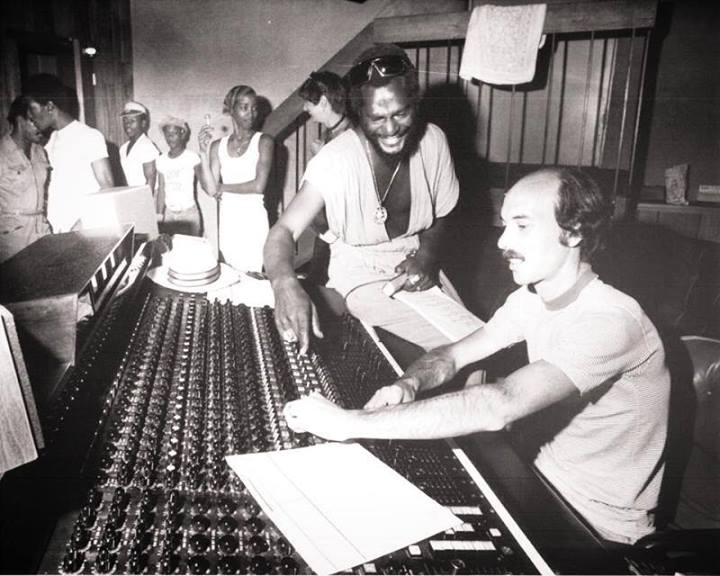
Starting from far left: maybe Ron Ford, Glen Goins, Garry Shider, Cordell Boogie Mosson, Debbie Wright, Me -George Clinton and Jim Vitti at the board at United Sounds in Studio A. Mixing one of the songs from Funkentelechy Vs. The Placebo Syndrome in 1977.

“Freeman House is a former commercial salmon fisher who has been involved with a community-based watershed restoration effort in northern California for more than 25 years. He is a co-founder of the Mattole Salmon Group and the Mattole Restoration Council. His book, Totem Salmon: Life Lessons from Another Species received the best nonfiction award from the San Francisco Bay Area Book Reviewers Association and the American Academy of Arts and Letters’ Harold D. Vursell Memorial Award for quality of prose. He lives with his family in northern California.”
That’s the biographical note for Freeman House on the Lannan Foundation website. We would add that earlier in his life, Freeman edited Innerspace, a mid-1960s independent press magazine for the nascent psychedelic community; presided over the marriage of Abbie and Anita Hoffman at Central Park on June 10, 1967; and was a member of both New York City’s Group Image and the San Francisco Diggers.
This is the second lecture in this series. This series ran previously on this site in 2010-11, and is being rerun now because it’s the right thing to do. Last week’s lecture is available here — “Wild Humanity: People and the Places That Make Them People”.
RESTORING RELATIONS: The Vernacular Approach to Ecological Restoration
by Freeman House
This piece is based on a keynote talk presented to the 3rd annual meeting of the Society for Ecological Restoration, California chapter, in Nevada City CA, May 1994. It was published in Restoration and Management Notes, Summer 1996.
A couple of years ago, I read a very well-written book that tried to convince me that wherever humans touched nature, nature became un-natural, its beauty and wildness spoiled .The book took notice, correctly I think, that human influence on the landscape had become universal. The writer, Bill McKibben, drew the conclusion that because of this, the end of nature was near. The name of the book is, in fact, The End of Nature (McKibben 1989). Like many environmentalists, McKibben is a passionate man, a man who grieves for injuries to nature. But during the time of writing, he seemed also to be a man who had swallowed most of industry’s argument for the inevitability and (indeed!) naturalness of its destructive behavior in regard to natural systems and human communities. If you accept these arguments—some of which are that economies must grow; that the efficiency of mass production legitimizes its brutalization of human life and and the destruction of natural systems; that mere appetite is the ruling element in human behavior—then McKibben’s conclusions must be correct. If humans are such a sport of nature, if their behavior can only be anti-nature, and if humans are everywhere, then nature must surely be on its way out. It is as if we lived somewhere else altogether than in the ecosystems which provide us with all our needs.
But in fact, humans have always been immersed in ecosystems. And for most of the time we’ve been on the planet, with the exception of the the last few hundred years, humans have behaved as if they were immersed in ecosystems. [1] The paleolithic hunter fails to find his game and returns to counsel with his people. How has their behavior strayed from the path of ample provision? The pre-industrial neolithic planter burns brush, saves seed, collects dung. Alongside deep frugality in the home exist the exuberant public indulgence in great monuments that were observatories of planetary movement, and the devotion of large amounts of time and energy to ceremonial observances of non-human processes and presences in the landscape surrounding. Throughout the industrial age, ecosystem behavior has endured even though its practitioners have been pushed back to the most marginal of land bases.
It is important to understand that behavior which rises out of ecosystems—life lived by immersion—has never been passive but diligently active: symbiotic, reciprocal, deliberately manipulative, and creative. Dennis Martinez, the pre-historian of the restoration movement, has shown us that the indigenous peoples of North America—and by extension elsewhere—have always been an interactive element of the landscape, effecting their own long-term survival with management practices so extensive that ecosystem function was affected (Martinez 1993). This is another view altogether of human relationships to nature. Rather than objectifying nature as a resource base functioning only to provide human wealth and comfort, such cultures express themselves as interactive parts of the natural systems around them. In such cultures, individuals are able to perceive themselves as having no greater (or lesser) a function in ecosystem process than algae, or deer.
Most of us have forgotten how to act this way. Over the recent few hundred years we have been encouraged to forget. There is, in fact, a whole educational industry structured for the purpose of convincing us that our primary identity is as consumers. The question is not how to mourn nature, or how to isolate and protect its tattered fragments, but how to re-engage it and thus rediscover our native wit and adaptive genius. And we will find, I believe, that this rediscovery is possible, but only ever in one place at a time. If we are to re-immerse ourselves in our larger lives, if we are to regain our extended identity, it will be through the portals of individual ecosystems and particular places. Continue reading
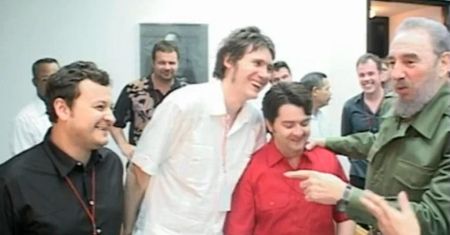

“Freeman House is a former commercial salmon fisher who has been involved with a community-based watershed restoration effort in northern California for more than 25 years. He is a co-founder of the Mattole Salmon Group and the Mattole Restoration Council. His book, Totem Salmon: Life Lessons from Another Species received the best nonfiction award from the San Francisco Bay Area Book Reviewers Association and the American Academy of Arts and Letters’ Harold D. Vursell Memorial Award for quality of prose. He lives with his family in northern California.”
That’s the biographical note for Freeman House on the Lannan Foundation website. We would add that earlier in his life, Freeman edited Innerspace, a mid-1960s independent press magazine for the nascent psychedelic community; presided over the marriage of Abbie and Anita Hoffman at Central Park on June 10, 1967; and was a member of both New York City’s Group Image and the San Francisco Diggers.
This is the first lecture in this series.
WILD HUMANITY: People and the Places That Make Them People
by Freeman House
Revised in November 2001 from a University of Montana Wilderness Lecture delivered in April 2001
1.
Richard Manning writes in Inside Passage: A Journey Beyond Borders, “…people should cease drawing borders around nature and instead start placing boundaries on human behavior…we should begin behaving as if all places matter to us as much as wilderness. Because they do.” We have not only set wilderness apart from our everyday lives; we have also made a distinction between human life and the very concept of wildness. The effect of this questionable distinction is to put a most dangerous limitation on our potential for adaptive human behavior. As Manning continues, both our parks and our culture set “a line between utility and beauty, sacred and profane. This line is destroying us, as it is destroying the planet.”
A few months ago I heard Florence Krall summarize her late husband Paul Shepard’s life work in a single sentence: There is an indigenous person waiting to be released in each of us. Our genome is “the sum of an individual’s genetic material, a product of millions of years of evolution” (Shepard 1998). The human genome is as wild as the ecological systems out of which it evolved. Basic comfort as a human being requires a conscious interaction with the more-than-human aspects of the textures of life surrounding, just as an infant needs the touch of other humans to thrive. Wild animals can survive for a while in a zoo. Contemporary humans are trained for survival in the zoo of an abstracted, objectified, and commodified world.
The genome demands, writes Shepard, that our cultures constitute a full and rewarding mediation between ourselves and the ecosystems within which we live. By this tenet, our genome, the structure within which our rational processes are embedded, is requiring of us that we recover our niches in particular ecosystems. Strong and mysterious language: the genome demands. It suggests that we are impelled to engage the health of our watersheds and ecosystems as a first step in our search for sanity—for ourselves, for our communities, and for our species.
The title of this series is the poetics of wilderness, but I’d rather be talking about the poetics of the wild. Because it’s among my assumptions that “wilderness” is a social and political construct, while the word “wild” is best used to describe the essential organizational structure of Creation; that Creation is a wild unfolding; and that we humans (as well as all our co-evolved life forms) are both expressions and agents of that unfolding.
Given these premises, it is quite possible that the self-satisfied technological advances of the last 500 to 5000 years of so-called civilization may not represent the pinnacle of evolution we encourage ourselves to believe they are. Continue reading
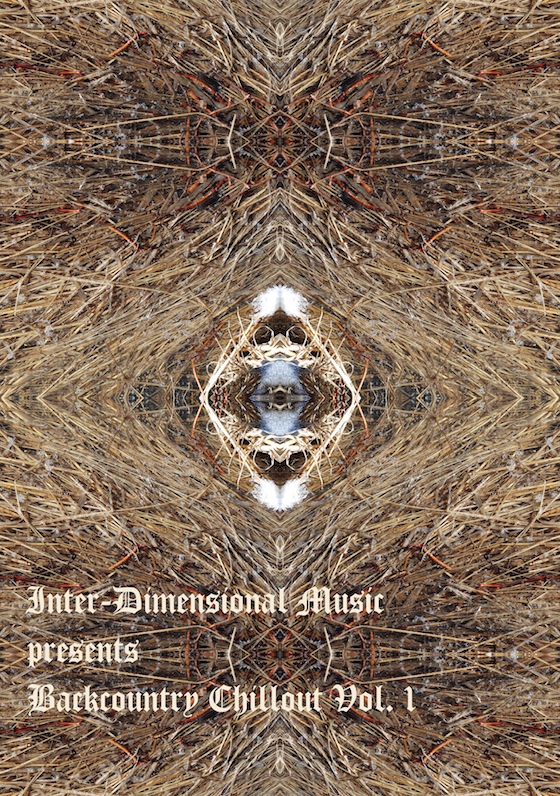
Inter-Dimensional Music presents BACKCOUNTRY CHILLOUT VOL. 1
A $3.00 Arthur mixtape compiled by Daniel Chamberlin
Buy Now Buy Now Buy Now Buy Now Buy Now
Daniel Chamberlin writes:
There’s a good reason that Inter-Dimensional Music is the number one New Age radio broadcast in the Big Bend region of Far West Texas: Since we first started transmitting on Marfa Public Radio back in the spring of 2010, each song we’ve played has been selected with the goal of offering all the souls passing through the Chihuahuan Desert a soundtrack worthy of our luminescent high country vistas.
So whether you’re waiting in line at the Sierra Blanca Border Patrol checkpoint; watching the lights of Boquillas from the South Rim of the Chisos; channeling the spirit of curandera Jewel Babb deep in the Quitman Mountains; decoding starlight vibrations at the McDonald Observatory; vibing on the sky island rhythms of the Davis Mountains Preserve; documenting rock art sites off Casa Piedra Road; or if you’re just another lonely backpacker waiting for your man down by the Rio Grande, we’re here to score your time under the radiant heavens of the Trans-Pecos with a soundtrack of expansive ambience and transcendent psychedelic drone.
Thus, in collaboration with our old friends at Arthur Magazine, ID Music presents this first edition of Backcountry Chillout, a collection of contemporary New Age music hand-picked for arid wilderness viewing stations. So light that special incense you’ve been saving, reposition your moonlight gemstones however the plant mind directs you, point the speakers toward the screen door and adjourn to the porch. Leave us on repeat until everything’s back to tranquilo again.
And be sure to join me, Daniel Chamberlin, the first Sunday of every month from 9-11p (CST) on KRTS. That’s 93.5FM if you’re fortunate enough to dwell out here in the Big Bend. We’re also streaming live worldwide at marfapublicradio.org and archived at interdimensionalmusic.com
Vaya con Gaia,
* * *
Music featured on “Backcountry Chillout Vol. 1”:
1. Matthewdavid – “Sneaky Marfa” (previously unreleased)
2. Sean McCann – “Aerial Sapphire Show” (from The Capital)
3. $3.33 – ” ) ) )-)-)-)-)-)-)-)-)-)-)-) ) ) )-)-)-)-)” (from – – – – — — — – – – –)
4. Ashan – “Forest Hair” (from Ancient Forever)
5. Sun Araw Band IX – “Canopy” (from Two From The Desert: Yucca Valley 2012)
6. Stag Hare – “Song for Justine” (previously unreleased)
7. Thoughts On Air – “A Psoft Psun Reflective” (from
Black Eagle Child/Thoughts On Air)
8. Matthewdavid – “Sneaky Marfa Slow” (previously unreleased)
Liner notes and cover artwork by DANIEL CHAMBERLIN.
Engineered by BOBBY TAMKIN at The Sound Ranch.
This new mixtape is now available direct from Arthur to your internet connection as a $3.00 digital download. As an added bonus, each download comes with liner notes by Daniel Chamberlin, along with a large-size image file of his cover artwork.
Click the following linkage to purchase using a debit card, credit card or Paypal account.
Buy Now Buy Now Buy Now Buy Now Buy Now
A link to download the “Backcountry Chillout Vol. 1” zip file (142mb — includes digital music file [320kpbs mp3], artwork, liner notes) will be emailed to you upon payment.
All proceeds help Arthur Magazine to embrace new possibilities.
Thank you kindly, hope you enjoy.
The Arthur Gang
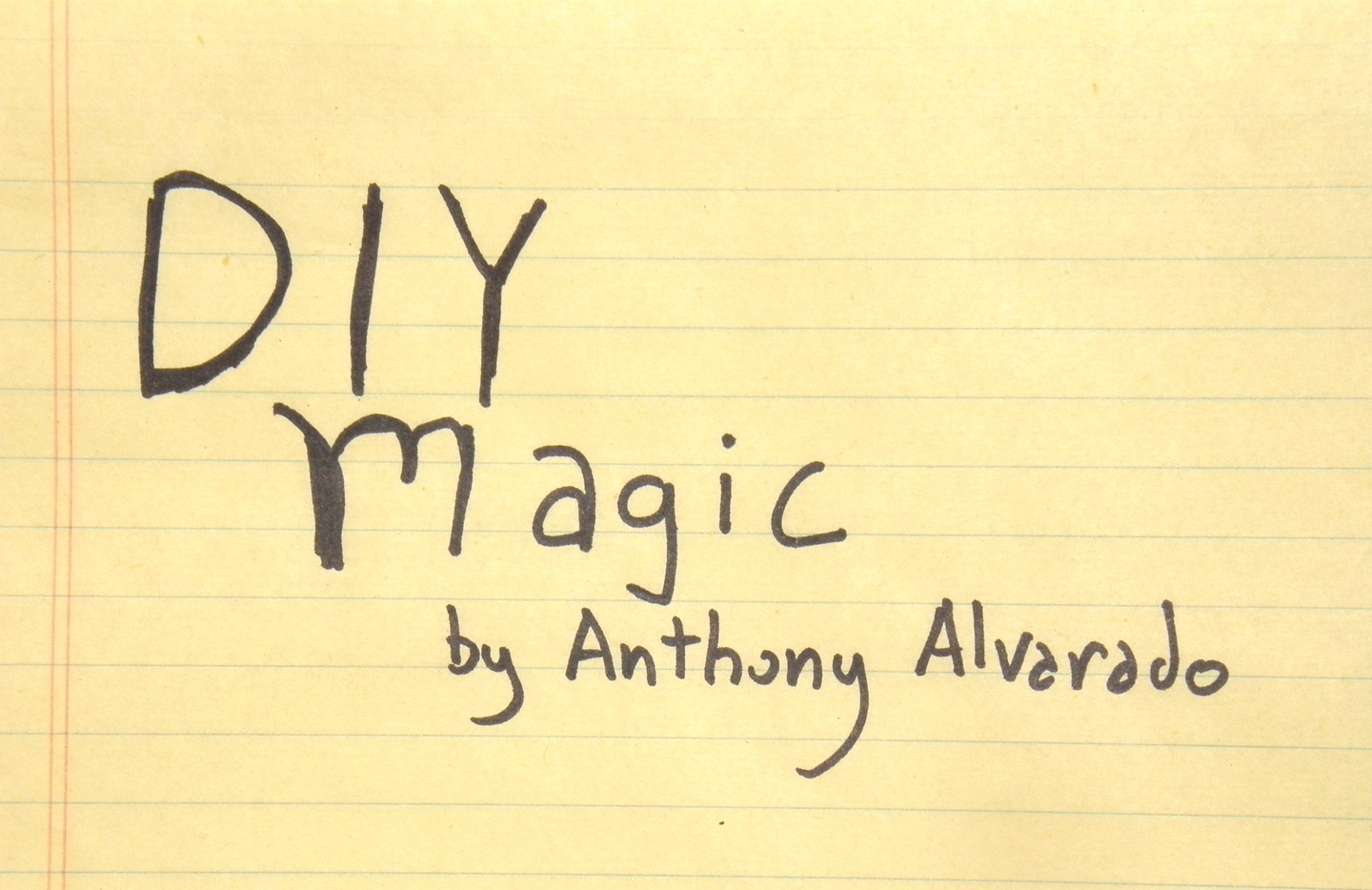
Anthony Alvarado‘s “D.I.Y. Magic” ran as a column for this website in 2010-11. In 2011, it was collected and expanded into book form through Floating World Comics, with 40 illustrations (curated by FWC’s Jason Leivian) and a cover designed by Lord Whimsy…
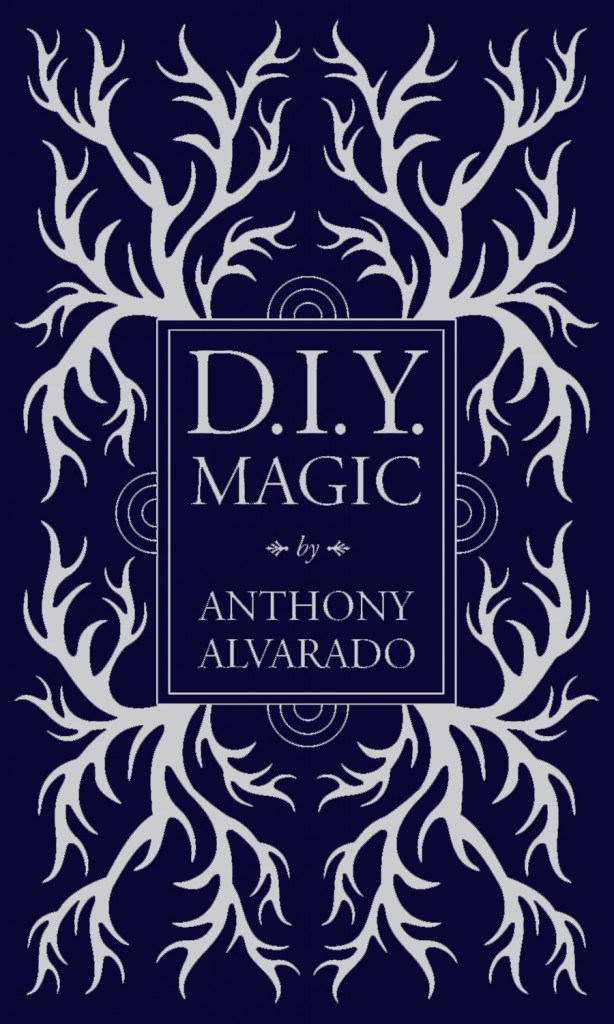
With that initial edition of 1,000 copies now sold out, Anthony has signed a deal with Perigee Books, an imprint of Penguin, to bring a revised, second edition of D.I.Y. Magic to the public in Spring 2015. This new edition will have about 50 pages of new material, with accompanying artwork again curated by Jason Leivian.
Congratulations, Mr. Alvarado!
D.I.Y. Magic is the third book to see publication in recent years after debuting in some form in Arthur. The others are 25,000 Years of Erotic Freedom (Abrams, 2009), a social history/polemic by Alan Moore based on his article “Bog Venus vs. Nazi Cock-Ring: Some Thoughts Concerning Pornography” from Arthur No. 25 (Dec. 2006); and the novel Zazen by Vanessa Veselka (Red Lemonade, 2011), which was serialized on this website in 2009-10. Zazen won Veselka the 2012 PEN/Robert W. Bingham prize.
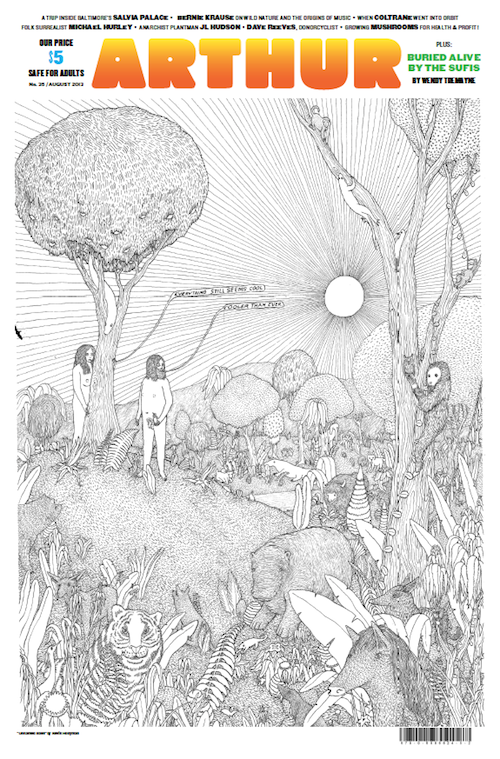
Cover by Kevin Hooyman
ARTHUR NO. 35 is still available for $5 from stores and direct from us. Or, read selected articles online, for free…
Contents:
ON THE TRAIL OF THE LONESOME SNOCK
Wily folkplayer MICHAEL HURLEY (aka Elwood Snock) has charmed hip audiences for over fifty years now with his timeless surrealist tunes and sweetly weird comics, all the while maintaining a certain ornery, outsider mystique. Longtime Snockhead/Arthur Senior Writer BYRON COLEY investigates this Wild American treasure in an enormous 11,000-word, 8-PAGE feature replete with rare photos, artwork, comics… and a giant color portrait by Liz Devine. Snock attack!
CHEW THE LEAVES, GET IN THE TANK
Inside Baltimore’s T HILL, new kinds of experiments with salvia divinorum are going on. Journalist/photographer Rjyan Kidwell visits Twig Harper, Carly Ptak…and the Wild Shepherdess.
BURIED ALIVE BY THE SUFIS
Swap-O-Rama Rama founder and author WENDY TREMAYNE (The Good Life Lab: Radical Experiments in Hands-On Living) wanted to understand what motivated her life-long anti-consumerism. She found the answer underground. Illustration by Kira Mardikes
GASH, CRASH, ASH
Nobody rides for free. DAVE REEVES on the price motorcyclists pay for being better than you. Illustration by Lale Westvind.
THE BIOPHONIC MAN
Guitarist, composer and analog synthesizer pioneer BERNIE KRAUSE left the recording studio to find that really wild sound. What he discovered was far more profound. Interview by Jay Babcock. Illustrations by Kevin Hooyman.
GIANT STEPS FOR MANKIND
Stewart Voegtlin on JOHN COLTRANE’s startling 1960s ascension from space bebop to universe symphonies. Dual astral/material plane illustration by Beaver.
FLOWERS, LEAVES, ANARCHISM
Matthew Erickson on the J.L. Hudson Ethnobotanical Catalog of Seeds
Plus…
* Arthur’s new regular column “Come On In My Garden” debuts. This issue, Camilla Padgitt-Coles visits Enumclaw’s Norm Fetter at his family’s Pennsylvania mushroom farm. They’re medicinal!
* The Center for Tactical Magic on demons and drones…
* New full-page full-color comics: “Forgiveness” by Julia Gfrörer and Part 2 of Will Sweeney’s “Inspector Homunculus” serial.
* And, of course, the “Bull Tongue” exhaustive survey of underground cultural output by your intrepid guides Byron Coley and Thurston Moore…
 Arthur Magazine